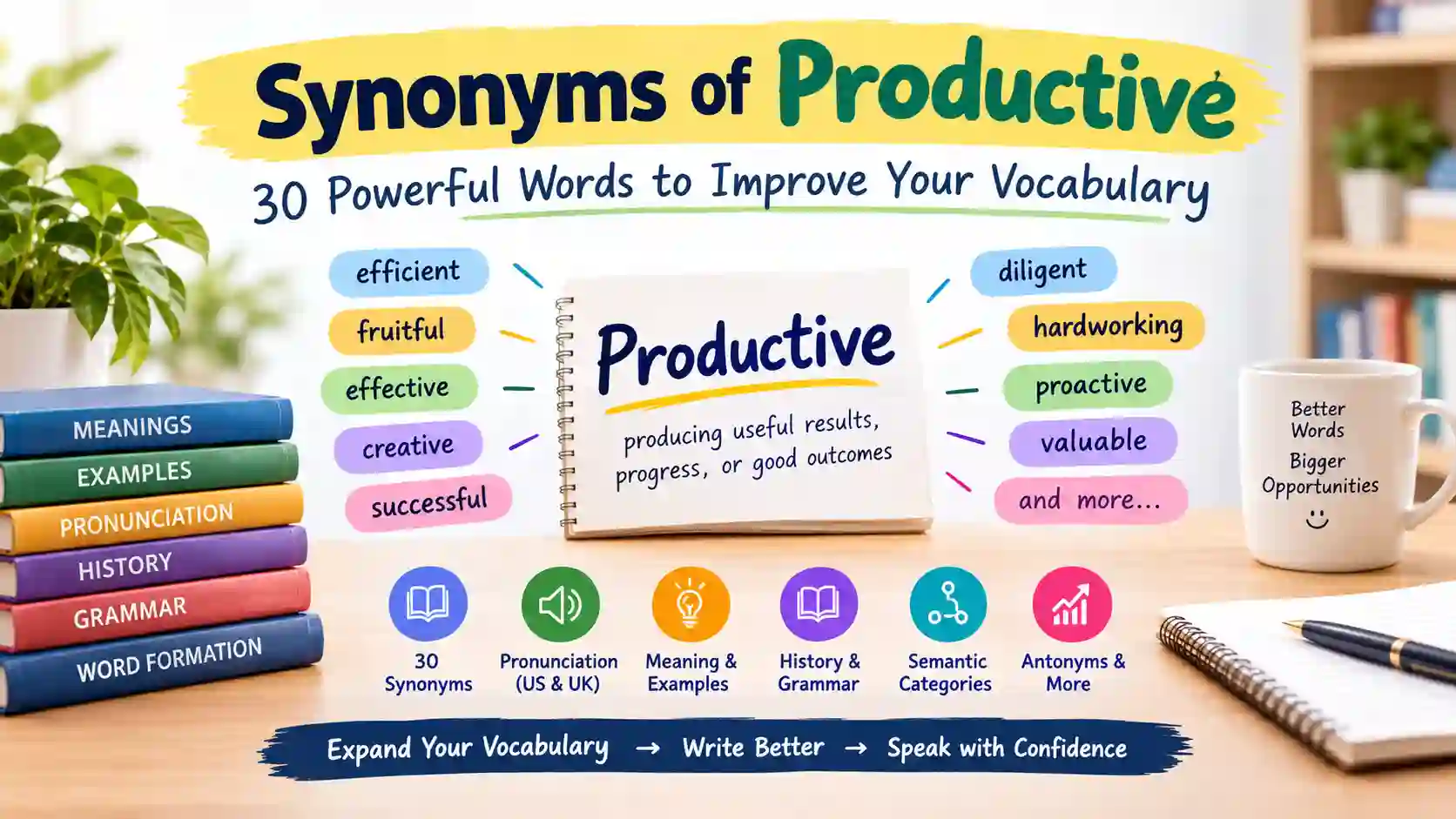
Imagine a student who plans to study for two hours and finishes three useful chapters. We can call that student productive because the time was used to achieve a useful result. The word productive is common in English because we often talk about productive people, workers, meetings, habits, days, and activities.
In this article, we will explore the meaning, examples, pronunciation, history, word formation, and semantic categories of productive. We will also examine 30 useful synonyms with simple examples so you can use them correctly in everyday English and writing.
Meaning of Productive
Definition
Productive (adjective): producing useful results, goods, ideas, or progress.
Examples
- She had a very productive day at work.
- The meeting was productive and solved several problems.
Connotative Meaning
- Positive tone: suggests useful work, progress, success, or good results.
- Negative tone: usually has no negative meaning by itself, but it can sound critical when someone is described as unproductive.
- Neutral tone: can simply describe something that produces a result.
Connotation (the feeling, idea, or association that a word suggests beyond its basic meaning).
Etymology
- Source language: Latin, through French and later English.
- It comes from Latin prōductīvus, meaning “producing or bringing forth.”
- It is related to the Latin verb prōdūcere, meaning “to bring forth, lead forward, or produce.”
Short History of the Keyword
- Old English (450–1100): The modern word productive was not commonly used in Old English. English used native words and expressions for ideas such as producing, making, and bringing forth.
- Middle English (1100–1500): French and Latin vocabulary became increasingly influential after the Norman Conquest. Words related to produce entered English through French and Latin.
- Modern English (1500–Present): Productive developed into its modern senses, including producing goods, creating useful results, generating ideas, and achieving useful work.
Pronunciation (US & UK – IPA)
US: /prəˈdʌktɪv/
UK: /prəˈdʌktɪv/
Syllables
pro-duc-tive
Affixation Pattern of Productive
Root: duct — from Latin dūcere, meaning “to lead” or “bring.”
Prefix: pro- — meaning “forward” or “forth.”
Suffix: -ive — forms an adjective meaning “having the nature of” or “tending to.”
Word Formation of Productive
- Product — noun/verb: something produced; to make or create something.
- Produce — verb: to make, create, or grow something.
- Production — noun: the process of making or producing something.
- Producer — noun: a person or organization that produces something.
- Productive — adjective: producing useful results.
- Productively — adverb: in a productive way.
- Productivity — noun: the ability or rate of producing useful results.
- Unproductive — adjective: not producing useful results.
- Unproductively — adverb: in an unproductive way.
Synonyms of Productive
1. Efficient (Adjective)
US IPA: /ɪˈfɪʃənt/ | UK IPA: /ɪˈfɪʃənt/
Meaning: Able to produce good results without wasting time, effort, or resources.
Examples:
- She is an efficient worker.
- We found a more efficient way to complete the task.
2. Fruitful (Adjective)
US IPA: /ˈfruːtfəl/ | UK IPA: /ˈfruːtfəl/
Meaning: Producing useful or successful results.
Examples:
- The discussion was very fruitful.
- Their research led to fruitful results.
3. Effective (Adjective)
US IPA: /ɪˈfektɪv/ | UK IPA: /ɪˈfektɪv/
Meaning: Producing the intended or desired result.
Examples:
- This is an effective teaching method.
- The new plan was highly effective.
4. Profitable (Adjective)
US IPA: /ˈprɑːfɪtəbəl/ | UK IPA: /ˈprɒfɪtəbəl/
Meaning: Producing financial gain or profit.
Examples:
- The business became profitable after two years.
- Farming can be profitable in this region.
5. Lucrative (Adjective)
US IPA: /ˈluːkrətɪv/ | UK IPA: /ˈluːkrətɪv/
Meaning: Producing a large amount of money.
Examples:
- Software development can be a lucrative career.
- They accepted a lucrative business offer.
6. Generative (Adjective)
US IPA: /ˈdʒenərətɪv/ | UK IPA: /ˈdʒenərətɪv/
Meaning: Able to create or produce something new.
Examples:
- The workshop encouraged generative thinking.
- The team used a generative approach to develop new ideas.
7. Creative (Adjective)
US IPA: /kriˈeɪtɪv/ | UK IPA: /kriˈeɪtɪv/
Meaning: Able to produce new and original ideas or things.
Examples:
- She is a highly creative writer.
- The students found a creative solution.
8. Constructive (Adjective)
US IPA: /kənˈstrʌktɪv/ | UK IPA: /kənˈstrʌktɪv/
Meaning: Helping to improve a situation or produce a useful result.
Examples:
- He gave me constructive feedback.
- Their discussion was honest but constructive.
9. Useful (Adjective)
US IPA: /ˈjuːsfəl/ | UK IPA: /ˈjuːsfəl/
Meaning: Providing help or serving a useful purpose.
Examples:
- She gave me some useful advice.
- The meeting produced several useful ideas.
10. Valuable (Adjective)
US IPA: /ˈvæljuəbəl/ | UK IPA: /ˈvæljuəbəl/
Meaning: Very useful or important because it provides benefit.
Examples:
- His experience was valuable to the team.
- We received valuable information.
11. Successful (Adjective)
US IPA: /səkˈsesfəl/ | UK IPA: /səkˈsesfəl/
Meaning: Achieving the result or goal that was wanted.
Examples:
- The project was successful.
- They had a successful meeting.
12. Accomplished (Adjective)
US IPA: /əˈkɑːmplɪʃt/ | UK IPA: /əˈkʌmplɪʃt/
Meaning: Highly skilled or successful in a particular area.
Examples:
- She is an accomplished writer.
- He became an accomplished musician.
13. Industrious (Adjective)
US IPA: /ɪnˈdʌstriəs/ | UK IPA: /ɪnˈdʌstriəs/
Meaning: Working hard and regularly.
Examples:
- The industrious student completed all her work.
- He is known as an industrious employee.
14. Diligent (Adjective)
US IPA: /ˈdɪlɪdʒənt/ | UK IPA: /ˈdɪlɪdʒənt/
Meaning: Showing careful and steady effort in work.
Examples:
- She is a diligent student.
- His diligent work earned him praise.
15. Hardworking (Adjective)
US IPA: /ˌhɑːrdˈwɜːrkɪŋ/ | UK IPA: /ˌhɑːdˈwɜːkɪŋ/
Meaning: Putting a lot of effort into work.
Examples:
- He is a hardworking employee.
- The company values hardworking people.
16. Active (Adjective)
US IPA: /ˈæktɪv/ | UK IPA: /ˈæktɪv/
Meaning: Taking part in activities or doing things rather than remaining inactive.
Examples:
- She is an active member of the team.
- He takes an active role in the project.
17. Energetic (Adjective)
US IPA: /ˌenərˈdʒetɪk/ | UK IPA: /ˌenəˈdʒetɪk/
Meaning: Having or showing a lot of energy.
Examples:
- The teacher was energetic throughout the lesson.
- She is an energetic team leader.
18. Dynamic (Adjective)
US IPA: /daɪˈnæmɪk/ | UK IPA: /daɪˈnæmɪk/
Meaning: Active, energetic, and able to create change or progress.
Examples:
- She is a dynamic business leader.
- The company has a dynamic team.
19. Busy (Adjective)
US IPA: /ˈbɪzi/ | UK IPA: /ˈbɪzi/
Meaning: Having a lot of work or activity to do.
Examples:
- I had a busy morning.
- The office was busy all day.
20. Prolific (Adjective)
US IPA: /prəˈlɪfɪk/ | UK IPA: /prəˈlɪfɪk/
Meaning: Producing a large amount of work, writing, or creative output.
Examples:
- She is a prolific author.
- The artist was prolific during this period.
21. Industrious (Adjective)
US IPA: /ɪnˈdʌstriəs/ | UK IPA: /ɪnˈdʌstriəs/
Meaning: Hardworking and active in producing work.
Examples:
- The industrious worker finished early.
- She was an industrious researcher.
22. Resourceful (Adjective)
US IPA: /rɪˈsɔːrsfəl/ | UK IPA: /rɪˈsɔːsfəl/
Meaning: Good at finding practical ways to solve problems.
Examples:
- She is a resourceful manager.
- He found a resourceful solution to the problem.
23. Enterprising (Adjective)
US IPA: /ˈentərpraɪzɪŋ/ | UK IPA: /ˈentəpraɪzɪŋ/
Meaning: Showing initiative and a willingness to start useful activities or businesses.
Examples:
- She is an enterprising young entrepreneur.
- His enterprising ideas helped the company grow.
24. Purposeful (Adjective)
US IPA: /ˈpɜːrpəsfəl/ | UK IPA: /ˈpɜːpəsfəl/
Meaning: Having a clear purpose or goal.
Examples:
- She took purposeful steps toward her goal.
- His work was focused and purposeful.
25. Practical (Adjective)
US IPA: /ˈpræktɪkəl/ | UK IPA: /ˈpræktɪkəl/
Meaning: Focused on real situations and useful results.
Examples:
- The course gives students practical skills.
- We need a practical solution.
26. Gainful (Adjective)
US IPA: /ˈɡeɪnfəl/ | UK IPA: /ˈɡeɪnfəl/
Meaning: Providing useful work or financial benefit.
Examples:
- He is looking for gainful employment.
- The program helps people find gainful work.
27. Fecund (Adjective)
US IPA: /ˈfiːkənd/ | UK IPA: /ˈfiːkənd/
Meaning: Producing many ideas, works, or results.
Examples:
- The writer had a fecund imagination.
- The discussion became a fecund source of new ideas.
28. Proactive (Adjective)
US IPA: /proʊˈæktɪv/ | UK IPA: /prəʊˈæktɪv/
Meaning: Taking action before a problem or need appears.
Examples:
- She takes a proactive approach to her work.
- A proactive employee looks for solutions early.
29. Resultful (Adjective)
US IPA: /rɪˈzʌltfəl/ | UK IPA: /rɪˈzʌltfəl/
Meaning: Producing a useful or successful result.
Examples:
- The meeting was short but resultful.
- Their efforts proved resultful.
30. Workmanlike (Adjective)
US IPA: /ˈwɜːrkmənlaɪk/ | UK IPA: /ˈwɜːrkmənlaɪk/
Meaning: Practical, steady, and competent in doing work.
Examples:
- The team gave a workmanlike performance.
- She has a workmanlike approach to difficult tasks.
Prototype Meaning
The most typical meaning of productive is producing useful results through work, effort, or activity. When people hear this word, they often imagine a person completing important tasks, a team making progress, a meeting solving problems, or a period of time used effectively.
Prototype Categorization
- Results and success: effective, successful, fruitful, valuable, useful
- Efficiency and smart work: efficient, practical, resourceful
- Hard work and effort: diligent, hardworking, industrious, energetic
- Creativity and ideas: creative, generative, prolific, fecund
- Business and financial results: profitable, lucrative, gainful
- Initiative and progress: proactive, purposeful, enterprising, dynamic
- General activity: active, busy
- Professional competence: accomplished, workmanlike
Categorization helps writers choose the word that matches the exact situation. For example, use efficient when you want to stress saving time or resources, prolific when you mean producing a large amount of creative work, and profitable when money is the main result.
Antonyms of Productive
- Unproductive (adjective): not producing useful results.
- Inefficient (adjective): wasting time, effort, or resources.
- Fruitless (adjective): producing no useful result.
- Useless (adjective): having no practical value or benefit.
- Ineffective (adjective): failing to produce the desired result.
- Idle (adjective): not active or engaged in useful work.
- Inactive (adjective): not taking action or participating in activity.
- Wasteful (adjective): using resources, time, or effort without good results.
- Unsuccessful (adjective): failing to achieve the desired result.
Short Questions and Answers
- What does productive mean?
Productive means producing useful results, progress, goods, ideas, or work. - When should productive be used?
Use productive when you want to describe work, time, activities, people, meetings, or efforts that produce useful results. - Is productive positive or negative?
Productive usually has a positive meaning because it suggests useful progress or results. Its exact tone depends on context. - How is productive different from similar words?
Productive focuses on producing results. Efficient focuses on using resources well. Effective focuses on achieving a desired result. Prolific focuses on producing a large amount of work.
Conclusion
Learning productive and its synonyms can make your English clearer, stronger, and more flexible. The word productive describes useful results, but its synonyms highlight different ideas. Efficient stresses good use of time and resources. Fruitful highlights successful results. Diligent describes careful effort, while prolific describes producing a large amount of work. Understanding these differences helps you select the right word instead of using the same word again and again. This can improve both writing and speaking. It can also build confidence when you communicate in English. Try learning two or three new synonyms each day and use them in your own sentences. Regular practice will help these words become a natural part of your vocabulary.

I am a linguist with 7 years of experience in English language teaching, including postgraduate-level instruction. My expertise includes English grammar, and I contribute as a content and blog writer, producing scholarly and educational language resources.