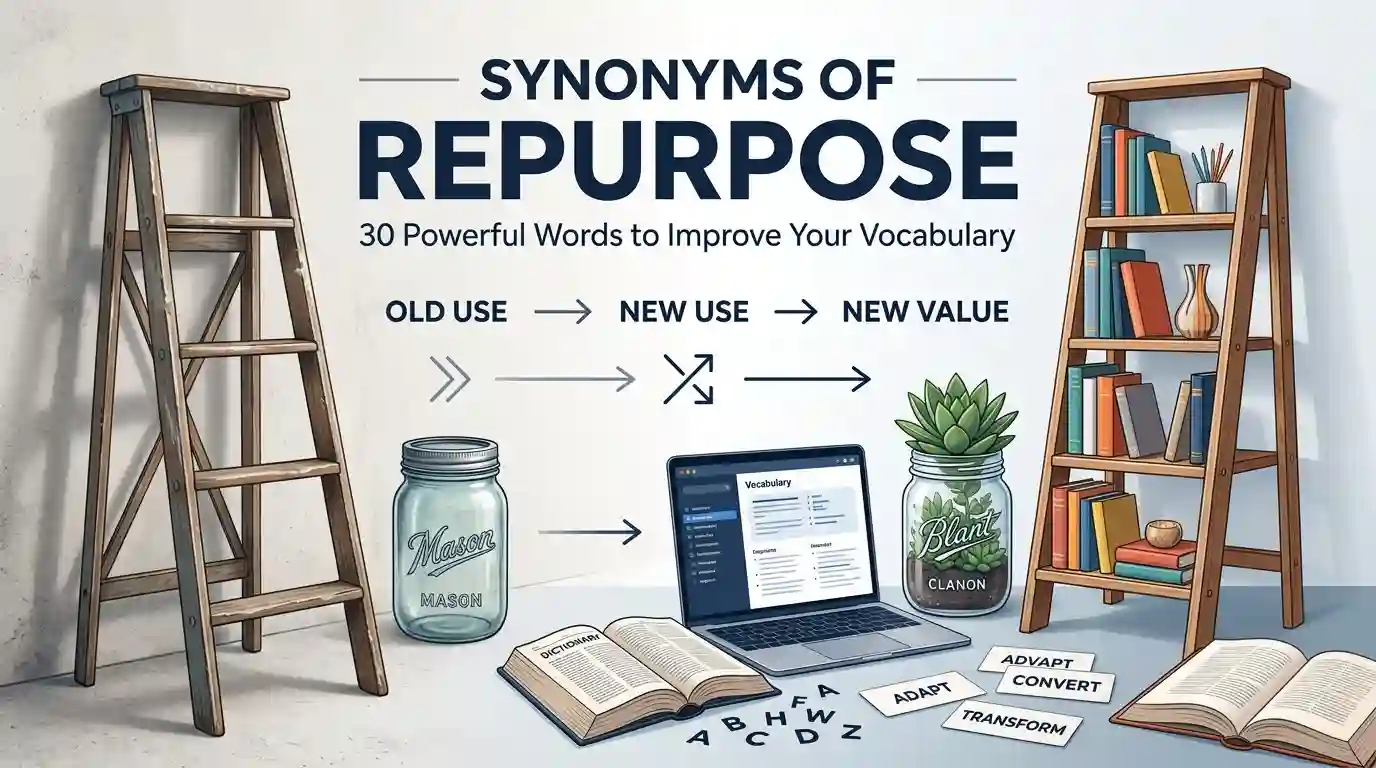
Repurpose means to use something again for a new or different purpose. Imagine you have an old wooden ladder that is no longer safe to climb. Instead of throwing it away, you turn it into a bookshelf. You have repurposed the ladder.
The word is common in everyday English, business, education, marketing, technology, and content writing. Content creators often repurpose one article into a video, social media post, email, or infographic.
In this article, we will explore the meaning, examples, connotation, history, pronunciation, word formation, and 30 useful synonyms of repurpose, along with their semantic categories and antonyms.
Meaning of Repurpose
Definition
Repurpose (verb): to use something for a new or different purpose from the one for which it was originally intended.
Examples
- The company decided to repurpose its old office as a training center.
- She repurposed her blog post into a short video.
Connotative Meaning
- Positive tone: Often suggests creativity, efficiency, sustainability, and practical thinking.
- Negative tone: In some contexts, it may suggest changing something without fully replacing or improving it.
- Neutral tone: Simply means giving something an additional or different purpose.
Connotation (the feeling or idea that a word suggests beyond its basic dictionary meaning).
Etymology
- Repurpose is formed from re-, meaning “again” or “anew,” and purpose, meaning an intended use or goal.
- The verb repurpose is recorded from around 1889, with its modern popularity developing much later, especially from the 1980s.
- The prefix re- comes through Old French and directly from Latin and has long been used in English to express ideas such as “again,” “back,” or “anew.”
- The word purpose has roots in Anglo-French and Old French forms related to intending, proposing, or designing.
Short History of Repurpose
- Old English (450–1100): The modern word repurpose did not exist in Old English. However, English already had words for ideas such as use, making, doing, and intention.
- Middle English (1100–1500): English developed many words and word-building patterns involving French and Latin elements. The prefix re- was increasingly used with verbs to express repetition or renewed action.
- Modern English (1500–Present): Repurpose became established as a verb meaning to give something a new use. Its modern popularity grew strongly in the late 20th century.
Pronunciation (US & UK – IPA)
US: /ˌriːˈpɝːpəs/
UK: /ˌriːˈpɜːpəs/
Syllables
re-pur-pose
Affixation Pattern of Repurpose
Root: purpose
Prefix: re-
Suffix: none
Word Formation of Repurpose
- repurpose — verb
- repurposed — past tense / past participle
- repurposes — third-person singular present verb
- repurposing — present participle / gerund
- repurposable — adjective, meaning capable of being repurposed
- repurposing — noun, referring to the act or process of giving something a new use
The basic pattern is re- + purpose, where re- adds the idea of doing something again or in a new way.
30 Synonyms of Repurpose
1. Reuse (Verb)
US: /ˌriːˈjuːz/ | UK: /ˌriːˈjuːz/
Meaning: To use something again, often for the same or a similar purpose.
Examples:
- We can reuse these boxes for storage.
- The designer decided to reuse the old fabric.
2. Recycle (Verb)
US: /ˌriːˈsaɪkəl/ | UK: /ˌriːˈsaɪkəl/
Meaning: To process or use something again instead of treating it as waste.
Examples:
- The company recycles old paper into new products.
- We can recycle the material instead of throwing it away.
3. Adapt (Verb)
US: /əˈdæpt/ | UK: /əˈdæpt/
Meaning: To change something so that it works for a new purpose or situation.
Examples:
- She adapted the lesson for younger students.
- The team adapted the software for mobile devices.
4. Modify (Verb)
US: /ˈmɑːdəfaɪ/ | UK: /ˈmɒdɪfaɪ/
Meaning: To make changes to something so that it suits a different need.
Examples:
- We modified the design for the new market.
- The teacher modified the activity for beginners.
5. Convert (Verb)
US: /kənˈvɝːt/ | UK: /kənˈvɜːt/
Meaning: To change something from one form, use, or function to another.
Examples:
- They converted the warehouse into apartments.
- I converted the article into a presentation.
6. Transform (Verb)
US: /trænsˈfɔːrm/ | UK: /trænsˈfɔːm/
Meaning: To change something greatly into a different form or use.
Examples:
- The artist transformed old wood into furniture.
- The team transformed the report into an online guide.
7. Rework (Verb)
US: /ˌriːˈwɝːk/ | UK: /ˌriːˈwɜːk/
Meaning: To work on something again to improve or change it.
Examples:
- The writer reworked the original article.
- We need to rework this design for mobile users.
8. Revise (Verb)
US: /rɪˈvaɪz/ | UK: /rɪˈvaɪz/
Meaning: To change or improve something after reviewing it.
Examples:
- She revised the old lesson for a new class.
- The editor revised the article before publication.
9. Redesign (Verb)
US: /ˌriːdɪˈzaɪn/ | UK: /ˌriːdɪˈzaɪn/
Meaning: To design something again for a new or improved purpose.
Examples:
- The company redesigned its website.
- We redesigned the brochure for younger readers.
10. Reconfigure (Verb)
US: /ˌriːkənˈfɪɡjər/ | UK: /ˌriːkənˈfɪɡə/
Meaning: To arrange the parts of something in a new way.
Examples:
- The engineers reconfigured the system.
- We reconfigured the room as a classroom.
11. Rework (Verb)
US: /ˌriːˈwɝːk/ | UK: /ˌriːˈwɜːk/
Meaning: To change existing work so that it can serve a new need.
Examples:
- The author reworked the story for children.
- They reworked the campaign for social media.
12. Recast (Verb)
US: /ˌriːˈkæst/ | UK: /ˌriːˈkɑːst/
Meaning: To present or shape something in a different form or way.
Examples:
- The teacher recast the complex idea in simple language.
- The company recast its message for a new audience.
13. Adaptate (Verb)
Meaning: Adapt is the standard English word for changing something to fit a new purpose; adaptate is not normally used as a standard synonym of repurpose.
Examples:
- The team adapted the old material for a new course.
- She adapted the design for a different audience.
Note: “Adaptate” is included here only to clarify that it should not normally replace “repurpose” in standard English.
14. Reappropriate (Verb)
US: /ˌriːəˈproʊpriˌeɪt/ | UK: /ˌriːəˈprəʊpriˌeɪt/
Meaning: To take or use something again for a different purpose or meaning.
Examples:
- The artist reappropriated an old visual idea.
- The campaign reappropriated an earlier slogan.
15. Reclaim (Verb)
US: /rɪˈkleɪm/ | UK: /rɪˈkleɪm/
Meaning: To recover something and put it back into useful service.
Examples:
- The builders reclaimed old bricks for the new wall.
- The community reclaimed the abandoned building.
16. Renew (Verb)
US: /rɪˈnuː/ | UK: /rɪˈnjuː/
Meaning: To give something new life, energy, or usefulness.
Examples:
- The project renewed interest in the old building.
- They renewed the product with a modern design.
17. Revitalize (Verb)
US: /ˌriːˈvaɪtəlaɪz/ | UK: /ˌriːˈvaɪtəlaɪz/
Meaning: To make something active, useful, or successful again.
Examples:
- The city revitalized the old market.
- The new campaign revitalized the brand.
18. Refashion (Verb)
US: /ˌriːˈfæʃən/ | UK: /ˌriːˈfæʃən/
Meaning: To make something again in a different form or style.
Examples:
- She refashioned the old dress into a skirt.
- The designer refashioned the traditional logo.
19. Refurbish (Verb)
US: /ˌriːˈfɝːbɪʃ/ | UK: /ˌriːˈfɜːbɪʃ/
Meaning: To repair or improve something so that it can be used again.
Examples:
- They refurbished the old school building.
- The company refurbished several used computers.
20. Reuse creatively (Verb Phrase)
US: /ˌriːˈjuːz kriˈeɪtɪvli/ | UK: /ˌriːˈjuːz kriˈeɪtɪvli/
Meaning: To use an existing thing again in a creative new way.
Examples:
- Bloggers reuse creatively by turning articles into videos.
- She reused creatively the old jars as plant holders.
21. Recycle creatively (Verb Phrase)
US: /ˌriːˈsaɪkəl kriˈeɪtɪvli/ | UK: /ˌriːˈsaɪkəl kriˈeɪtɪvli/
Meaning: To find a new creative use for an existing material.
Examples:
- The students recycled creatively by making art from waste.
- The designer recycled creatively old materials into furniture.
22. Recast (Verb)
US: /ˌriːˈkæst/ | UK: /ˌriːˈkɑːst/
Meaning: To express, organize, or present something in a new form.
Examples:
- The writer recast the story as a comedy.
- The teacher recast the explanation in simpler words.
23. Reengineer (Verb)
US: /ˌriːendʒəˈnɪr/ | UK: /ˌriːendʒɪˈnɪə/
Meaning: To redesign a system or process so that it works differently or better.
Examples:
- Engineers reengineered the production process.
- The company reengineered its website structure.
24. Retool (Verb)
US: /ˌriːˈtuːl/ | UK: /ˌriːˈtuːl/
Meaning: To change or equip something so that it can perform a new task.
Examples:
- The factory was retooled to produce electric vehicles.
- The company retooled its training program.
The word retool has long been used for changing tools or equipment and later developed broader meanings related to supplying or changing an operation.
25. Reorient (Verb)
US: /ˌriːˈɔːrient/ | UK: /ˌriːˈɔːrient/
Meaning: To change the direction, focus, or purpose of something.
Examples:
- The company reoriented its strategy toward digital services.
- The school reoriented the program toward practical skills.
26. Recast for (Verb Phrase)
US: /ˌriːˈkæst fɔːr/ | UK: /ˌriːˈkɑːst fə/
Meaning: To change something so that it suits a particular new audience or purpose.
Examples:
- The article was recast for young readers.
- The lesson was recast for online learning.
27. Adapt for (Verb Phrase)
US: /əˈdæpt fɔːr/ | UK: /əˈdæpt fə/
Meaning: To change something so that it works well for a specific new use.
Examples:
- The story was adapted for television.
- We adapted the lesson for beginners.
28. Convert for (Verb Phrase)
US: /kənˈvɝːt fɔːr/ | UK: /kənˈvɜːt fə/
Meaning: To change something so that it can be used for a particular new purpose.
Examples:
- They converted the garage for office use.
- We converted the report for online publication.
29. Reassign (Verb)
US: /ˌriːəˈsaɪn/ | UK: /ˌriːəˈsaɪn/
Meaning: To give a new role, task, or function to something or someone.
Examples:
- The manager reassigned the room for meetings.
- The team reassigned the old equipment to another department.
30. Put to a new use (Verb Phrase)
US: /pʊt tə ə nuː juːs/ | UK: /pʊt tə ə njuː juːs/
Meaning: To use an existing thing for a purpose different from its original one.
Examples:
- We put the old building to a new use.
- She put the unused material to a new use.
Prototype Meaning
The most typical meaning of repurpose is using something that already exists for a new purpose. People often imagine an old object, piece of content, building, tool, or resource being changed or used in a new way instead of being discarded. The key idea is not simply using something again; it is giving existing material a different function or role.
Prototype Categorization
- Direct reuse: reuse, recycle — best when something is used again with little change.
- Adaptation: adapt, modify, revise — useful when an existing item is changed to suit a new need.
- Major transformation: convert, transform, redesign — useful when the form or function changes substantially.
- Creative renewal: reclaim, refashion, revitalize — useful when something old gains fresh value.
- Business and technology: reconfigure, reengineer, retool, reorient — useful for systems, processes, organizations, and technology.
- Content writing: rework, recast, adapt for, put to a new use — useful when articles, lessons, reports, and other content are turned into new formats.
This categorization helps writers select a more precise word. For example, reuse suggests another use, while transform suggests a much bigger change. Reconfigure is more suitable for systems, while rework often fits writing and creative material.
Antonyms of Repurpose
- Discard (verb): To throw something away because it is no longer wanted or useful.
- Waste (verb): To use something carelessly or without gaining useful value.
- Abandon (verb): To stop using or supporting something.
- Destroy (verb): To damage or ruin something so that it cannot be used.
- Dispose of (verb phrase): To get rid of something.
- Preserve (verb): To keep something in its existing state or condition.
- Maintain (verb): To keep something in its current working condition.
- Decommission (verb): To formally remove something from active service.
Short Questions and Answers
- What does repurpose mean?
- Repurpose means to use something for a new or different purpose.
- When should repurpose be used?
- Use repurpose when an existing object, resource, building, idea, or piece of content is given a different function.
- Is repurpose positive or negative?
- It is usually neutral, but it can have a positive feeling when it suggests creativity, saving resources, or finding new value.
- How is repurpose different from reuse?
- Reuse usually means using something again. Repurpose specifically emphasizes using it for a different purpose.
- How is repurpose different from recycle?
- Recycle often involves processing material so it can become something useful again. Repurpose usually keeps the existing item or content and gives it another function.
- How is repurpose different from transform?
- Transform suggests a significant change in form or appearance. Repurpose focuses more on changing the function or intended use.
Conclusion
Learning repurpose and its synonyms gives English learners more ways to describe change, reuse, adaptation, and creative problem-solving. Words such as reuse, adapt, modify, convert, transform, rework, redesign, reclaim, and reorient are useful in different situations, so understanding their small differences is important. For writers, these alternatives can reduce repetition and make ideas more precise. For English learners, they provide useful vocabulary for speaking, academic writing, business communication, and everyday conversation. Understanding the history and pronunciation of a word also helps build deeper vocabulary knowledge. Try using one new synonym each day in a sentence, paragraph, or conversation. Regular practice can strengthen your writing and speaking skills, improve confidence, and help you choose the right word naturally.

I am a linguist with 7 years of experience in English language teaching, including postgraduate-level instruction. My expertise includes English grammar, and I contribute as a content and blog writer, producing scholarly and educational language resources.