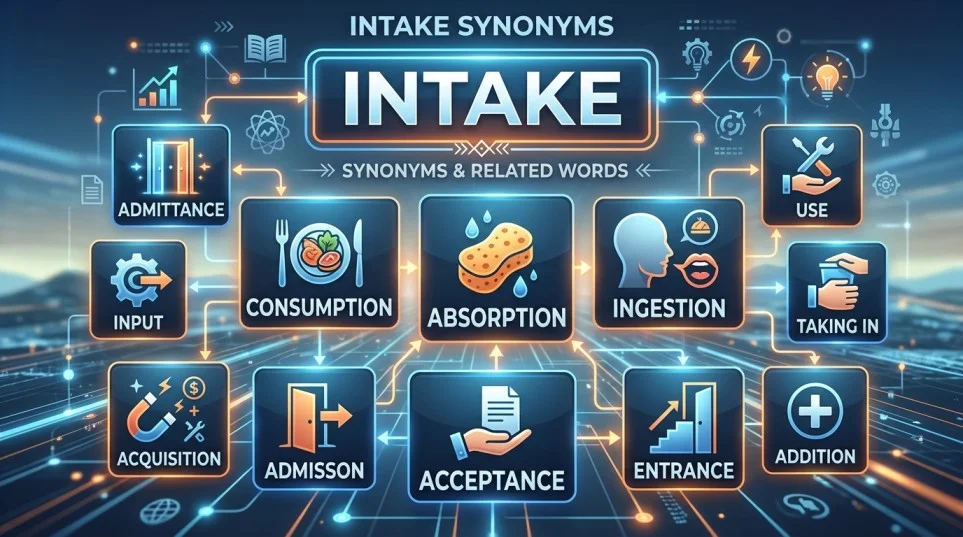
Intake means the amount of something a person takes in, or the act of taking it in, like food, air, or new members joining a group. Picture a doctor asking a patient about her daily water intake before giving advice on her diet. This word shows up often in health talk, school forms, and daily reports, because it describes a simple action in a clear way.
Since it appears so much, learning synonyms of intake helps English learners and content writers avoid saying the same word again and again. Knowing many synonyms of intake also helps a writer match the right tone, whether talking about food, breathing, or new students joining a class.
This article looks closely at the meaning of intake, along with its grammar, history, pronunciation, and word family. Then it shares 30 synonyms of intake, each with clear meanings and simple examples, so every reader can use them with confidence.
Meaning of Intake
Definition
Intake (noun): Intake means the amount of something taken in, or the act of receiving or accepting something.
Examples
- The nurse checked his daily food intake before the surgery.
- The school’s new intake of students arrived on Monday.
Connotative Meaning
Connotation is the feeling a word carries beyond its plain meaning (the emotional shade attached to a word, beyond its dictionary definition).
- Positive tone: used in health advice, showing care for the body, like tracking water intake.
- Negative tone: used when intake is too high or harmful, like excess sugar intake.
- Neutral tone: used in reports and forms, simply stating a number or fact.
Etymology
- The word comes from the phrasal verb “take in,” joining “in” with “take.”
- “Take” traces back to Old Norse “taka,” meaning to grasp or seize.
- The original sense described water flowing into a channel or opening.
Short History
- Old English (450–1100): The word “intake” did not yet exist. English used “niman” for “take,” and “in” was a separate word.
- Middle English (1100–1500): The phrase “take in” grew common, and “intake” formed as a compound noun around the late Middle English period, first used for water channels.
- Modern English (1500–Present): The meaning grew wider, now covering food intake, air intake in machines, and the intake of new students or workers.
Pronunciation (US & UK – IPA)
US: /ˈɪn.teɪk/ UK: /ˈɪn.teɪk/
Syllables
in-take
Affixation Pattern of Intake
- Root: take (from Old Norse “taka,” meaning to grasp or seize)
- Prefix: in-
- Suffix: none
Word formation from “intake”:
- intake (noun) — the amount or act of taking something in
- take in (phrasal verb) — to absorb, accept, or receive
- taken in (adjective) — describing something absorbed or, informally, someone fooled
- uptake (noun) — a related compound describing the rate of absorption
A List of Best Synonyms of Intake
Below are 30 synonyms of intake. Each one comes with pronunciation, a simple meaning, and two examples.
1. Consumption (noun)
US: /kənˈsʌmp.ʃən/ | UK: /kənˈsʌmp.ʃən/
Meaning: The act of eating, drinking, or using something up.
Examples:
- His daily sugar consumption dropped after the doctor’s warning.
- The report tracked water consumption across the city.
2. Ingestion (noun)
US: /ɪnˈdʒɛs.tʃən/ | UK: /ɪnˈdʒes.tʃən/
Meaning: The act of taking food or drink into the body.
Examples:
- Ingestion of the medicine should happen with food.
- Quick ingestion of cold water gave him a headache.
3. Absorption (noun)
US: /əbˈzɔːrp.ʃən/ | UK: /əbˈzɔːp.ʃən/
Meaning: The process of taking something in gradually, often into the body or a material.
Examples:
- The absorption of nutrients happens mainly in the small intestine.
- Sunlight absorption warms the dark stone quickly.
4. Uptake (noun)
US: /ˈʌp.teɪk/ | UK: /ˈʌp.teɪk/
Meaning: The rate or amount at which something is taken in or accepted.
Examples:
- The plant’s water uptake slows down in winter.
- Oxygen uptake improves with regular exercise.
5. Inhalation (noun)
US: /ˌɪn.həˈleɪ.ʃən/ | UK: /ˌɪn.həˈleɪ.ʃən/
Meaning: The act of breathing air or another substance into the lungs.
Examples:
- Deep inhalation before the race helped calm his nerves.
- Inhalation of smoke can harm the lungs over time.
6. Admission (noun)
US: /ədˈmɪʃ.ən/ | UK: /ədˈmɪʃ.ən/
Meaning: The act of allowing someone or something to enter or join.
Examples:
- Her admission to the university came as good news.
- Hospital admission numbers rose during the cold season.
7. Ingress (noun)
US: /ˈɪn.ɡrɛs/ | UK: /ˈɪn.ɡres/
Meaning: The act of entering, or a place through which something enters.
Examples:
- The ingress of cold air made the room chilly.
- Engineers checked the ingress point for water flow.
8. Entry (noun)
US: /ˈɛn.tri/ | UK: /ˈen.tri/
Meaning: The act of coming in, or a point where something comes in.
Examples:
- His entry into the market changed the whole business.
- The entry of new data updated the report.
9. Reception (noun)
US: /rɪˈsɛp.ʃən/ | UK: /rɪˈsep.ʃən/
Meaning: The act of receiving or accepting something offered.
Examples:
- The reception of new members happens every spring.
- Signal reception improved after moving the antenna.
10. Acceptance (noun)
US: /əkˈsɛp.təns/ | UK: /əkˈsep.təns/
Meaning: The act of agreeing to receive or take something.
Examples:
- Her acceptance into the program made her family proud.
- Acceptance of the terms was needed before starting.
11. Dose (noun)
US: /doʊs/ | UK: /dəʊs/
Meaning: A measured amount of something taken at one time, often medicine.
Examples:
- The doctor increased his dose of vitamin D.
- A small dose of caffeine helped him focus.
12. Ration (noun)
US: /ˈræʃ.ən/ | UK: /ˈræʃ.ən/
Meaning: A fixed amount of something allowed or given, especially food.
Examples:
- Each soldier received a daily food ration.
- The family kept a strict water ration during the drought.
13. Allowance (noun)
US: /əˈlaʊ.əns/ | UK: /əˈlaʊ.əns/
Meaning: A set amount permitted or given regularly.
Examples:
- His weekly food allowance covered simple meals.
- The trainer set a daily calorie allowance for the athlete.
14. Portion (noun)
US: /ˈpɔːr.ʃən/ | UK: /ˈpɔː.ʃən/
Meaning: A part or amount of something given for one person or use.
Examples:
- She served a smaller portion at dinner.
- His portion of vegetables grew with every meal.
15. Serving (noun)
US: /ˈsɜːr.vɪŋ/ | UK: /ˈsɜː.vɪŋ/
Meaning: An amount of food or drink given at one time.
Examples:
- One serving of rice was enough for lunch.
- The label showed the calories per serving.
16. Helping (noun)
US: /ˈhɛl.pɪŋ/ | UK: /ˈhel.pɪŋ/
Meaning: An amount of food given to one person at a meal.
Examples:
- He asked for a second helping of soup.
- Her helping of salad looked fresh and colorful.
17. Nourishment (noun)
US: /ˈnɜːr.ɪʃ.mənt/ | UK: /ˈnʌr.ɪʃ.mənt/
Meaning: Food or substances that keep a body healthy and growing.
Examples:
- The plant needed more nourishment to grow strong.
- Proper nourishment helped the baby gain weight.
18. Nutrition (noun)
US: /nuˈtrɪʃ.ən/ | UK: /njuːˈtrɪʃ.ən/
Meaning: The process of taking in food needed for health and growth.
Examples:
- Good nutrition kept the team energized all season.
- Her nutrition plan focused on whole foods.
19. Feeding (noun)
US: /ˈfiː.dɪŋ/ | UK: /ˈfiː.dɪŋ/
Meaning: The act of giving or taking in food.
Examples:
- The baby’s feeding schedule changed after three months.
- Feeding times at the zoo drew large crowds.
20. Gulp (noun)
US: /ɡʌlp/ | UK: /ɡʌlp/
Meaning: A large, quick swallow of food or drink.
Examples:
- He finished the juice in one big gulp.
- A quick gulp of water helped him catch his breath.
21. Swallow (noun)
US: /ˈswɒl.oʊ/ | UK: /ˈswɒl.əʊ/
Meaning: An act of moving food or drink down the throat.
Examples:
- One swallow of the hot soup burned his tongue.
- She took a slow swallow of tea to relax.
22. Sip (noun)
US: /sɪp/ | UK: /sɪp/
Meaning: A small amount of drink taken in at one time.
Examples:
- She took a sip of coffee before the meeting.
- A sip of water calmed his dry throat.
23. Draught (noun)
US: /dræft/ | UK: /drɑːft/
Meaning: A single act of drinking, often a full or deep one.
Examples:
- He took a long draught of cold cider.
- The traveler drank a deep draught of well water.
24. Enrollment (noun)
US: /ɪnˈroʊl.mənt/ | UK: /ɪnˈrəʊl.mənt/
Meaning: The act of officially joining a school, course, or program.
Examples:
- Enrollment for the new class opens next week.
- Her enrollment in the course started her new career.
25. Recruitment (noun)
US: /rɪˈkruːt.mənt/ | UK: /rɪˈkruːt.mənt/
Meaning: The process of bringing new people into a group or organization.
Examples:
- The company began recruitment for three new roles.
- Recruitment season brought many young players to the club.
26. Induction (noun)
US: /ɪnˈdʌk.ʃən/ | UK: /ɪnˈdʌk.ʃən/
Meaning: The process of formally bringing someone into a group or role.
Examples:
- His induction into the team came with a small ceremony.
- The induction program helped new staff learn the rules.
27. Acquisition (noun)
US: /ˌæk.wɪˈzɪʃ.ən/ | UK: /ˌæk.wɪˈzɪʃ.ən/
Meaning: The act of gaining or receiving something new.
Examples:
- The library’s newest acquisition was a rare old map.
- Language acquisition happens fastest in early childhood.
28. Input (noun)
US: /ˈɪn.pʊt/ | UK: /ˈɪn.pʊt/
Meaning: Something put into a system, process, or discussion.
Examples:
- The machine needed steady input to keep running.
- Her input during the meeting changed the final plan.
29. Assimilation (noun)
US: /əˌsɪm.əˈleɪ.ʃən/ | UK: /əˌsɪm.əˈleɪ.ʃən/
Meaning: The process of fully taking in and using something, such as food or information.
Examples:
- Assimilation of the new vocabulary took a few weeks.
- The body’s assimilation of iron improves with vitamin C.
30. Provision (noun)
US: /prəˈvɪʒ.ən/ | UK: /prəˈvɪʒ.ən/
Meaning: Something supplied or made available for use or consumption.
Examples:
- The camp kept a steady provision of clean water.
- Food provision for the trip lasted the full week.
Prototype Meaning
When most people hear the word intake, they picture a number or amount, like how much food, water, or air a person takes in each day. This is the prototype meaning. It often brings to mind a health form, a doctor’s chart, or a nutrition label. This clear, measurable picture is why the word feels so common in health and science writing, even though it also applies to new students or workers joining a group.
Prototype Categorization
Grouping synonyms of intake into categories helps writers choose the best word for each situation.
- Eating and drinking: consumption, ingestion, nourishment, nutrition, feeding, gulp, swallow, sip, draught
- Absorbing into the body: absorption, uptake, assimilation
- Breathing: inhalation
- Entering or joining: admission, ingress, entry, reception, acceptance, enrollment, recruitment, induction, acquisition, input, provision
- Fixed amounts: dose, ration, allowance, portion, serving, helping
Sorting synonyms of intake this way helps a writer match the exact context, whether the topic is health, science, or a new group of students.
Antonyms of Intake
- Output (noun): something produced or sent out, the opposite of what is taken in.
- Outflow (noun): the movement of something out of a place or system.
- Expulsion (noun): the act of forcing something out completely.
- Exhalation (noun): the act of breathing out, the opposite of inhalation.
- Discharge (noun): the release or sending out of something held or contained.
Short Questions and Answers
- What does intake mean? It means the amount of something taken in, or the act of receiving or accepting it.
- When should intake be used? Use it when talking about food, drink, air, or the entry of new people into a group.
- Is intake positive or negative? It depends on context. It feels positive in careful health tracking, and negative when the amount is too high or harmful.
- How is it different from similar words? Words like “consumption” focus on using something up, while “admission” or “entry” focus on people joining a place. Intake covers both, showing what enters a body, system, or group.
Conclusion
Learning intake and its many synonyms helps build a stronger, clearer vocabulary. Knowing synonyms of intake lets writers and speakers avoid repeating the same word in health reports, school forms, or daily writing. It also helps express exact meaning, whether talking about food, air, or new members joining a group. Studying synonyms of intake strengthens both writing and speaking skills, since each word fits a slightly different situation. This kind of practice builds real confidence in English, helping learners pick better words in schoolwork, health talk, and everyday conversation. Keep exploring synonyms of intake and similar words each day, even for a few minutes. Small, steady vocabulary practice adds up over time, and these new words will soon feel natural to use.

I am a linguist with 7 years of experience in English language teaching, including postgraduate-level instruction. My expertise includes English grammar, and I contribute as a content and blog writer, producing scholarly and educational language resources.