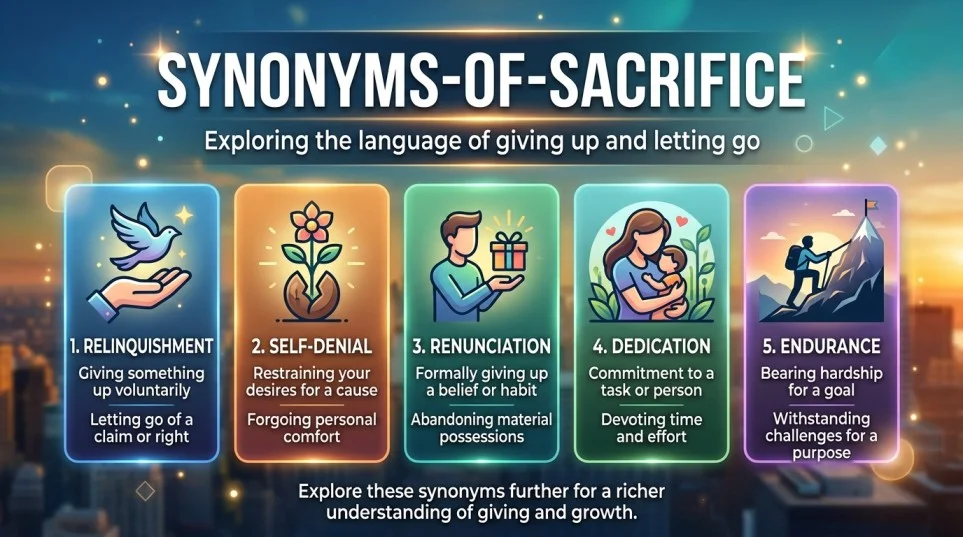
Sacrifice means giving up something important for a bigger goal or for another person. Picture a mother who skips her own dinner so her children can eat more. That small act is a sacrifice. People use this word often, in daily talk, in news, and in stories about hard choices. Because writers and speakers use it so much, it can start to feel repeated.
This is why learning synonyms of sacrifice helps English learners and content writers grow their vocabulary and sound more natural. Knowing many synonyms of sacrifice also helps you pick the right word for the right feeling. This article explores the meaning of sacrifice, its history, pronunciation, grammar, and word family.
Then it shares 30 synonyms of sacrifice with clear meanings and examples, so you can use each one with confidence.
Meaning of Sacrifice
Definition
Sacrifice (noun / verb): Sacrifice means giving up something valuable, often for a person, a belief, or a goal that matters more.
Examples
- She made a big sacrifice by moving away from her family for a new job.
- He decided to sacrifice his free time to help his neighbor.
Connotative Meaning
Connotation is the feeling or emotion a word carries beyond its plain meaning.
- Positive tone: shows love, care, or strong values, such as a parent’s sacrifice for a child.
- Negative tone: shows loss, pain, or unfair pressure, such as being forced to sacrifice one’s health.
- Neutral tone: simply states that something was given up, with no strong emotion attached.
Etymology
- The word comes from Old French “sacrifise.”
- It traces back to Latin “sacrificium,” built from “sacer” (holy) and “facere” (to make or do).
- The original meaning was “to make something holy” through a religious offering.
Short History
- Old English (450–1100): English did not yet borrow this Latin-based word. People used native terms for religious offerings instead.
- Middle English (1100–1500): The word entered English through Old French around the 13th century, mainly for religious offerings to gods.
- Modern English (1500–Present): The meaning grew wider. Today it covers any giving up of something valuable, not only religious acts.
Pronunciation (US & UK – IPA)
US: /ˈsæk.rɪ.faɪs/ UK: /ˈsæk.rɪ.faɪs/
Syllables
sac-ri-fice
Affixation Pattern of Sacrifice
- Root: sacr- (from Latin “sacer,” meaning holy)
- Prefix: none
- Suffix: -ice (forms a noun)
Word formation from “sacrifice”:
- sacrifice (noun) — the act of giving something up
- sacrifice (verb) — to give something up
- sacrificial (adjective) — describing something offered or given up
- sacrificially (adverb) — done in a sacrificial way
- sacrificer (noun) — a person who sacrifices something
A List of Wonderful Synonyms of Sacrifice
Below are 30 synonyms of sacrifice. Each one comes with pronunciation, a simple meaning, and two examples.
1. Offering (noun)
US: /ˈɒf.ər.ɪŋ/ | UK: /ˈɒf.ər.ɪŋ/
Meaning: Something given, often as a gift or act of devotion.
Examples:
- The farmer left an offering of fresh grain at the shrine.
- Her volunteer work was an offering of time and care.
2. Surrender (verb)
US: /səˈrɛn.dər/ | UK: /səˈren.də/
Meaning: To give up control or possession of something, often under pressure.
Examples:
- The team had to surrender the lead in the final minutes.
- He chose to surrender his comfort for a chance to grow.
3. Forfeiture (noun)
US: /ˈfɔːr.fɪ.tʃər/ | UK: /ˈfɔː.fɪ.tʃə/
Meaning: The loss of something as a penalty or result of a choice.
Examples:
- Missing the deadline led to the forfeiture of his prize.
- The forfeiture of his savings was hard, but necessary.
4. Renunciation (noun)
US: /rɪˌnʌn.siˈeɪ.ʃən/ | UK: /rɪˌnʌn.siˈeɪ.ʃən/
Meaning: The formal act of giving up a right, title, or claim.
Examples:
- Her renunciation of the throne shocked the nation.
- The renunciation of old habits took real courage.
5. Relinquishment (noun)
US: /rɪˈlɪŋ.kwɪʃ.mənt/ | UK: /rɪˈlɪŋ.kwɪʃ.mənt/
Meaning: The act of letting go of something, often reluctantly.
Examples:
- The relinquishment of his role was a tough decision.
- Their relinquishment of the land ended the dispute.
6. Self-denial (noun)
US: /ˌsɛlf dɪˈnaɪ.əl/ | UK: /ˌself dɪˈnaɪ.əl/
Meaning: Holding back from one’s own wants or comforts.
Examples:
- Years of self-denial helped her save enough for college.
- His self-denial during training made him stronger.
7. Immolation (noun)
US: /ˌɪm.əˈleɪ.ʃən/ | UK: /ˌɪm.əˈleɪ.ʃən/
Meaning: The act of giving something up completely, often through destruction.
Examples:
- The story described the immolation of the old temple offerings.
- His career felt like a slow immolation for the company’s sake.
8. Oblation (noun)
US: /əˈbleɪ.ʃən/ | UK: /əˈbleɪ.ʃən/
Meaning: A gift or offering made as part of worship.
Examples:
- The priest accepted the oblation with quiet respect.
- Their oblation of bread and wine marked the ceremony.
9. Tribute (noun)
US: /ˈtrɪb.juːt/ | UK: /ˈtrɪb.juːt/
Meaning: Something given to show respect or to honor a duty.
Examples:
- The soldiers paid tribute with their own safety.
- She gave a tribute of years of unpaid work to the cause.
10. Concession (noun)
US: /kənˈsɛʃ.ən/ | UK: /kənˈseʃ.ən/
Meaning: Something given up to reach an agreement.
Examples:
- Both sides made concessions to end the strike.
- Lowering the price was a small concession for the seller.
11. Forgoing (noun)
US: /fɔːrˈɡoʊ.ɪŋ/ | UK: /fɔːˈɡəʊ.ɪŋ/
Meaning: Choosing to go without something desired.
Examples:
- Forgoing dessert helped him reach his health goal.
- Her forgoing of a vacation paid for new equipment.
12. Abandonment (noun)
US: /əˈbæn.dən.mənt/ | UK: /əˈbæn.dən.mənt/
Meaning: The act of leaving or giving up something completely.
Examples:
- The abandonment of the old plan opened new doors.
- His abandonment of comfort led to a bold new start.
13. Waiver (noun)
US: /ˈweɪ.vər/ | UK: /ˈweɪ.və/
Meaning: A formal choice to give up a right or claim.
Examples:
- She signed a waiver of her bonus to help the team.
- The waiver of the fee saved them a lot of money.
14. Loss (noun)
US: /lɒs/ | UK: /lɒs/
Meaning: Something taken away or given up, often causing hardship.
Examples:
- The loss of free time was worth the new skills he gained.
- Their loss of profit helped keep every worker employed.
15. Submission (noun)
US: /səbˈmɪʃ.ən/ | UK: /səbˈmɪʃ.ən/
Meaning: The act of yielding to another’s control or wishes.
Examples:
- His submission to the team’s plan showed real humility.
- Submission of personal pride is often needed in teamwork.
16. Devotion (noun)
US: /dɪˈvoʊ.ʃən/ | UK: /dɪˈvəʊ.ʃən/
Meaning: Strong love or loyalty shown through effort or giving.
Examples:
- Her devotion to her students meant countless unpaid hours.
- His devotion to the farm cost him many quiet weekends.
17. Martyrdom (noun)
US: /ˈmɑːr.tər.dəm/ | UK: /ˈmɑː.tə.dəm/
Meaning: Great suffering or loss endured for a strong belief or cause.
Examples:
- The story of her martyrdom inspired the whole village.
- He spoke of his martyrdom for the cause with quiet pride.
18. Resignation (noun)
US: /ˌrɛz.ɪɡˈneɪ.ʃən/ | UK: /ˌrez.ɪɡˈneɪ.ʃən/
Meaning: The formal act of giving up a job or position.
Examples:
- His resignation surprised the entire office.
- Her resignation from the board freed her for new work.
19. Capitulation (noun)
US: /kəˌpɪtʃ.əˈleɪ.ʃən/ | UK: /kəˌpɪtʃ.əˈleɪ.ʃən/
Meaning: Giving up resistance and accepting terms set by another.
Examples:
- The capitulation of the old rules changed the whole system.
- His capitulation to the new schedule reduced the conflict.
20. Abnegation (noun)
US: /ˌæb.nɪˈɡeɪ.ʃən/ | UK: /ˌæb.nɪˈɡeɪ.ʃən/
Meaning: The denial of one’s own needs or desires for others.
Examples:
- Her quiet abnegation kept the family fed during hard years.
- His abnegation of comfort was a mark of true kindness.
21. Yielding (noun)
US: /ˈjiːl.dɪŋ/ | UK: /ˈjiːl.dɪŋ/
Meaning: Giving way or giving up ground to another.
Examples:
- Yielding the front seat to her was a small kind act.
- His yielding on the price closed the deal quickly.
22. Deprivation (noun)
US: /ˌdɛp.rɪˈveɪ.ʃən/ | UK: /ˌdep.rɪˈveɪ.ʃən/
Meaning: The state of being without something usually needed or wanted.
Examples:
- Sleep deprivation was the price of finishing the project.
- Their deprivation during the move taught them patience.
23. Denial (noun)
US: /dɪˈnaɪ.əl/ | UK: /dɪˈnaɪ.əl/
Meaning: Refusing oneself something wanted, often for discipline.
Examples:
- His denial of sweets helped him stay healthy.
- Years of denial let her build a strong business.
24. Forsaking (noun)
US: /fɔːrˈseɪ.kɪŋ/ | UK: /fɔːˈseɪ.kɪŋ/
Meaning: Giving up or leaving behind something once valued.
Examples:
- Forsaking the city life, they moved to a quiet farm.
- His forsaking of old friendships hurt him deeply.
25. Abstention (noun)
US: /æbˈstɛn.ʃən/ | UK: /əbˈsten.ʃən/
Meaning: The act of choosing not to do or have something.
Examples:
- Her abstention from meat lasted the whole year.
- His abstention from the vote showed his doubt.
26. Cost (noun)
US: /kɒst/ | UK: /kɒst/
Meaning: What must be given up to gain something else.
Examples:
- Success came at the cost of many late nights.
- The cost of the trip was worth every memory.
27. Toll (noun)
US: /toʊl/ | UK: /təʊl/
Meaning: A heavy loss or price paid for something over time.
Examples:
- The long hours took a toll on his health.
- Winning the case took a toll on the whole team.
28. Concede (verb)
US: /kənˈsiːd/ | UK: /kənˈsiːd/
Meaning: To admit defeat or give something up to another.
Examples:
- She had to concede the match after a long fight.
- He conceded his share of the profit to keep peace.
29. Give Up (phrasal verb)
US: /ɡɪv ʌp/ | UK: /ɡɪv ʌp/
Meaning: To stop having or doing something by choice.
Examples:
- He gave up his seat for the older people.
- She gave up sugar to feel healthier.
30. Dedication (noun)
US: /ˌdɛd.ɪˈkeɪ.ʃən/ | UK: /ˌded.ɪˈkeɪ.ʃən/
Meaning: Strong effort and loyalty given to a task or person.
Examples:
- Her dedication to the project meant many weekends at work.
- His dedication to his family shaped every choice he made.
Prototype Meaning
When most people hear the word sacrifice, they picture someone giving up comfort, money, or time so another person can benefit. This is the prototype meaning. It often brings to mind a parent, a soldier, or a helper who puts someone else’s needs first. This picture is strong and emotional, even though the word can also describe smaller, everyday choices.
Prototype Categorization
Grouping synonyms of sacrifice into categories helps writers pick the exact word for each situation.
- Religious or ceremonial: offering, oblation, immolation
- Formal or legal giving up: renunciation, relinquishment, waiver, forfeiture
- Personal restraint: self-denial, abstention, denial, forgoing
- Loss or cost: loss, cost, toll, deprivation
- Yielding to others: surrender, submission, concession, capitulation, yielding, concede
- Loyalty or effort: devotion, dedication, martyrdom, abnegation
- Leaving behind: abandonment, forsaking, resignation, give up
- Symbolic honor: tribute
Sorting synonyms of sacrifice this way helps a writer match tone, formality, and context, instead of picking a word at random.
Antonyms of Sacrifice
- Gain (noun): something received or won, the opposite of giving something up.
- Keep (verb): to hold onto something instead of giving it away.
- Reward (noun): something earned or given in return for effort, not lost.
- Retention (noun): the act of holding onto something rather than releasing it.
- Acquisition (noun): the act of gaining or getting something new.
Short Questions and Answers
- What does sacrifice mean? It means giving up something valuable for a person, belief, or goal.
- When should sacrifice be used? Use it when someone gives up comfort, money, time, or a chance for a bigger purpose.
- Is sacrifice positive or negative? It can be both. It feels positive when done out of love, and negative when forced or unfair.
- How is it different from similar words? Words like “loss” or “cost” describe what is given up, while “devotion” or “tribute” focus more on love or respect behind the act. Sacrifice sits between the two, showing both the loss and the reason behind it.
Conclusion
Learning sacrifice and its many synonyms helps build a stronger, richer vocabulary. Knowing synonyms of sacrifice lets writers and speakers avoid repeating the same word again and again. It also helps express feeling more clearly, whether the tone is warm, formal, or neutral. Studying synonyms of sacrifice improves both writing and speaking skills, since each word carries its own shade of meaning. This kind of practice builds real confidence in English, helping learners choose better words in daily conversations, essays, and articles. Keep exploring synonyms of sacrifice and other words like it every day, even for just a few minutes. Small, steady vocabulary practice adds up to big improvement over time, and soon these new words will come to you naturally.

I am a linguist with 7 years of experience in English language teaching, including postgraduate-level instruction. My expertise includes English grammar, and I contribute as a content and blog writer, producing scholarly and educational language resources.