Maria saw a flyer at her local library asking for help at the food bank. She had no money to give, but she had time. So she signed up. That simple act — giving her time and effort without pay — is what we call volunteering. Volunteering means offering to do work freely, without being forced and without expecting money in return.
This word shows up everywhere: in schools, news reports, job applications, and community groups. People use it because helping others is a normal part of life, and English needs a clear word for it.
But using the same word again and again makes writing and speaking sound flat. This is why English learners and content writers need synonyms. Learning synonyms of synonyms of volunteering helps you sound natural, avoid repetition, and express small differences in meaning.
This article covers the meaning of “volunteering,” its synonyms, grammar, history, pronunciation, and semantic categories — with simple examples for every word.
Meaning of Volunteering
Definition
Volunteering (noun/gerund): The act of offering to do a task or job freely, without pay and without being forced to do it.
Examples
- She spends her weekends volunteering at the animal shelter.
- Volunteering taught him how to work well with strangers.
Connotative Meaning
- Positive tone: Kind, generous, selfless, community-minded
- Negative tone: Rarely negative, but can sound naive if the effort seems wasted or unappreciated
- Neutral tone: Simply describing unpaid work, with no judgment attached
(Connotation: the feeling or emotion a word carries beyond its basic dictionary meaning.)
Etymology
- The word comes from the Latin voluntarius, meaning “willing” or “of one’s free will.”
- It passed through French voluntaire before entering English.
- The root idea has always been about choice, not duty.
Short History
- Old English (450–1100): The word did not exist yet; the idea was expressed with words like willan (to wish or want).
- Middle English (1100–1500): “Voluntary” appeared, borrowed from French and Latin, meaning done by free choice.
- Modern English (1500–Present): “Volunteer” became a noun and verb in the 1600s (first used for soldiers who joined armies freely). By the 1800s, it broadened to mean any unpaid helper. “Volunteering” as a gerund became common in the 20th century.
Pronunciation (US & UK – IPA)
- US: /ˌvɑː.lənˈtɪr.ɪŋ/
- UK: /ˌvɒl.ənˈtɪər.ɪŋ/
Syllables
vol-un-teer-ing
Affixation Pattern of Volunteering
- Root: volunt- (from Latin voluntas, meaning “will” or “choice”)
- Prefix: none
- Suffix: -eer (forms a person who does something) + -ing (forms the gerund/verb form)
Word formation from this root (grammatical category in brackets):
- Volunteer (noun) — a person who helps freely
- Volunteer (verb) — to offer to help freely
- Volunteering (gerund/noun) — the act of helping freely
- Voluntary (adjective) — done by choice, not forced
- Voluntarily (adverb) — in a way that is done by free choice
- Involuntary (adjective) — done without choice
A List of Wonderful Synonyms of Volunteering
1. Helping (verb/gerund)
US /ˈhɛl.pɪŋ/ | UK /ˈhel.pɪŋ/ Meaning: Giving aid or support to someone.
- She enjoys helping new students settle in.
- Helping others made him feel useful.
2. Assisting (verb/gerund)
US /əˈsɪs.tɪŋ/ | UK /əˈsɪs.tɪŋ/ Meaning: Giving support to make a task easier for someone.
- He spent the afternoon assisting the nurses.
- Assisting the coach is part of her weekly routine.
3. Aiding (verb/gerund)
US /ˈeɪ.dɪŋ/ | UK /ˈeɪ.dɪŋ/ Meaning: Giving help, often in a difficult situation.
- The team focused on aiding flood victims.
- Aiding the older neighbor became a daily habit.
4. Serving (verb/gerund)
US /ˈsɝː.vɪŋ/ | UK /ˈsɜː.vɪŋ/ Meaning: Carrying out duties for the benefit of others.
- He is proud of serving his community.
- Serving on the local council takes patience.
5. Contributing (verb/gerund)
US /kənˈtrɪb.jə.tɪŋ/ | UK /kənˈtrɪb.jʊ.tɪŋ/ Meaning: Giving time, effort, or resources toward a shared goal.
- She keeps contributing to the school’s garden project.
- Contributing even a few hours a week makes a difference.
6. Donating (verb/gerund)
US /ˈdoʊ.neɪ.tɪŋ/ | UK /dəʊˈneɪ.tɪŋ/ Meaning: Giving something, such as time or money, without payment.
- He is donating his weekends to the youth center.
- Donating blood is a small act with a big impact.
7. Participating (verb/gerund)
US /pɑːrˈtɪs.ə.peɪ.tɪŋ/ | UK /pɑːˈtɪs.ɪ.peɪ.tɪŋ/ Meaning: Taking part in an activity or event.
- Students enjoy participating in the beach cleanup.
- Participating in local events builds friendships.
8. Supporting (verb/gerund)
US /səˈpɔːr.tɪŋ/ | UK /səˈpɔː.tɪŋ/ Meaning: Backing a cause or person with time and effort.
- The club is supporting the fundraiser this year.
- Supporting refugees became her life’s mission.
9. Offering (verb/gerund)
US /ˈɔː.fɚ.ɪŋ/ | UK /ˈɒf.ər.ɪŋ/ Meaning: Presenting oneself or something willingly for a purpose.
- He kept offering his skills to the nonprofit.
- Offering free tutoring helped many children.
10. Giving (verb/gerund)
US /ˈɡɪv.ɪŋ/ | UK /ˈɡɪv.ɪŋ/ Meaning: Providing time, effort, or goods to someone in need.
- Giving her time every Sunday became a habit.
- Giving without expecting anything back is true kindness.
11. Pitching In (phrasal verb)
US /ˈpɪtʃ.ɪŋ ɪn/ | UK /ˈpɪtʃ.ɪŋ ɪn/ Meaning: Joining others to help with a task.
- Everyone started pitching in after the storm.
- Pitching in made the cleanup finish faster.
12. Lending a Hand (idiom)
US /ˈlɛn.dɪŋ ə hænd/ | UK /ˈlen.dɪŋ ə hænd/ Meaning: Offering help with a task.
- She’s always lending a hand at the shelter.
- Lending a hand costs nothing but means a lot.
13. Chipping In (phrasal verb)
US /ˈtʃɪp.ɪŋ ɪn/ | UK /ˈtʃɪp.ɪŋ ɪn/ Meaning: Contributing a small share of effort or money.
- The neighbors kept chipping in to fix the park.
- Chipping in with a few hours helps the whole team.
14. Community Service (noun phrase)
US /kəˈmjuː.nə.ti ˈsɝː.vɪs/ | UK /kəˈmjuː.nə.ti ˈsɜː.vɪs/ Meaning: Unpaid work done to help people in a local area.
- The students completed community service at the shelter.
- Community service taught him responsibility.
15. Charity Work (noun phrase)
US /ˈtʃær.ə.ti wɝːk/ | UK /ˈtʃær.ɪ.ti wɜːk/ Meaning: Unpaid effort given to help people through a charitable cause.
- She balances her job with charity work on weekends.
- Charity work connected him to new friends.
16. Pro Bono Work (noun phrase)
US /ˌproʊ ˈboʊ.noʊ wɝːk/ | UK /ˌprəʊ ˈbəʊ.nəʊ wɜːk/ Meaning: Professional work done for free, for the public good.
- The lawyer took the case as pro bono work.
- Pro bono work lets skilled people give back.
17. Philanthropy (noun)
US /fɪˈlæn.θrə.pi/ | UK /fɪˈlæn.θrə.pi/ Meaning: Generous effort to promote the welfare of others.
- His philanthropy funded three new schools.
- Philanthropy often starts with small local actions.
18. Benevolence (noun)
US /bəˈnɛv.ə.ləns/ | UK /bɪˈnev.əl.əns/ Meaning: Kindness and a wish to do good for others.
- Her benevolence was clear in every project she led.
- Benevolence drives many people to volunteer.
19. Altruism (noun)
US /ˈæl.tru.ɪ.zəm/ | UK /ˈæl.tru.ɪ.zəm/ Meaning: Selfless concern for the well-being of others.
- His altruism showed in how he treated strangers.
- Altruism is at the heart of most volunteer work.
20. Civic Duty (noun phrase)
US /ˈsɪv.ɪk ˈduː.ti/ | UK /ˈsɪv.ɪk ˈdʒuː.ti/ Meaning: A responsibility citizens feel toward their community.
- Voting and helping neighbors are both forms of civic duty.
- He saw volunteering as a civic duty, not a chore.
21. Social Work (noun phrase)
US /ˈsoʊ.ʃəl wɝːk/ | UK /ˈsəʊ.ʃəl wɜːk/ Meaning: Organized effort to support people’s welfare, often through formal programs.
- She studied social work before joining the nonprofit.
- Social work often relies on volunteer support.
22. Outreach (noun)
US /ˈaʊt.riːtʃ/ | UK /ˈaʊt.riːtʃ/ Meaning: Activity that brings help or services to people in need.
- The church runs outreach programs every month.
- Outreach connects volunteers with families who need help.
23. Selflessness (noun)
US /ˈsɛlf.ləs.nəs/ | UK /ˈself.ləs.nəs/ Meaning: Caring more about others’ needs than your own.
- Her selflessness inspired the whole team.
- Selflessness is common among long-term volunteers.
24. Generosity (noun)
US /ˌdʒɛn.əˈrɑː.sə.ti/ | UK /ˌdʒen.əˈrɒs.ə.ti/ Meaning: Willingness to give time, money, or effort freely.
- His generosity kept the food pantry running.
- Generosity doesn’t always mean giving money.
25. Humanitarianism (noun)
US /hjuːˌmæn.əˈtɛr.i.ə.nɪ.zəm/ | UK /hjuːˌmæn.ɪˈteə.ri.ə.nɪ.zəm/ Meaning: Concern for improving human welfare, especially during crises.
- Their humanitarianism led them to disaster relief work.
- Humanitarianism grew stronger after the earthquake.
26. Public Service (noun phrase)
US /ˈpʌb.lɪk ˈsɝː.vɪs/ | UK /ˈpʌb.lɪk ˈsɜː.vɪs/ Meaning: Work done to benefit the general public, often unpaid or low-paid.
- He dedicated his career to public service.
- Public service can take many forms, from teaching to cleanup drives.
27. Teamwork (noun)
US /ˈtiːm.wɝːk/ | UK /ˈtiːm.wɜːk/ Meaning: Working together with others toward a shared goal.
- The event succeeded because of great teamwork.
- Teamwork made the volunteer project easier.
28. Assistance (noun)
US /əˈsɪs.təns/ | UK /əˈsɪs.təns/ Meaning: Help given to someone who needs it.
- The shelter welcomed his assistance gladly.
- Assistance from volunteers kept the center open.
29. Good Deeds (noun phrase)
US /ɡʊd diːdz/ | UK /ɡʊd diːdz/ Meaning: Kind actions done to help others.
- Small good deeds add up over time.
- She tries to do one good deed every day.
30. Unpaid Work (noun phrase)
US /ʌnˈpeɪd wɝːk/ | UK /ʌnˈpeɪd wɜːk/ Meaning: Work done without receiving any wages.
- Unpaid work at the shelter taught her real-world skills.
- Many charities depend on unpaid work from locals.
Prototype Meaning
When most people hear “volunteering,” they picture someone giving up free time to help others without pay — like serving food at a shelter, cleaning a park, or reading to children at a library. This is the prototype: a clear, hands-on act of kindness done by choice, not for money or reward.
Prototype Categorization
Grouping the synonyms of volunteering helps writers pick the right word for the right moment.
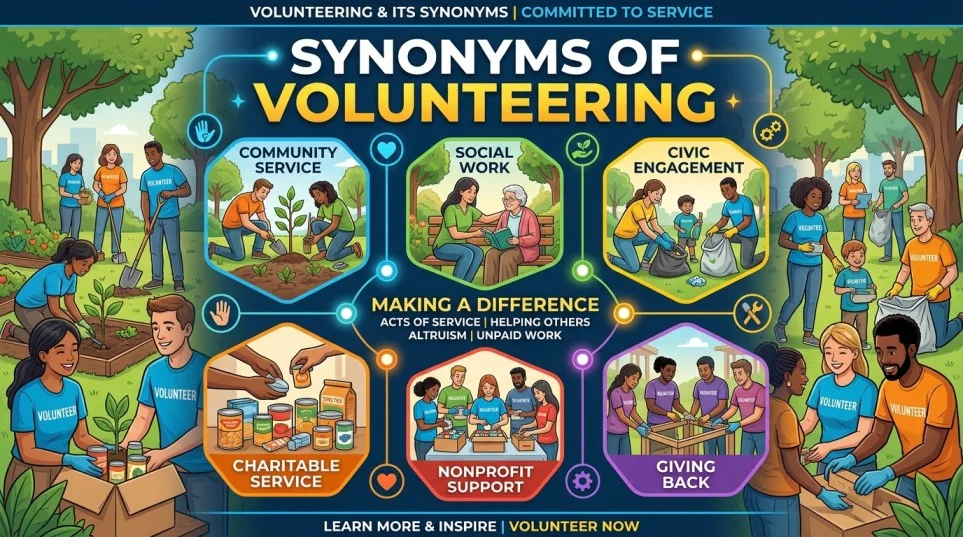
- General help: Helping, Assisting, Aiding, Supporting, Assistance
- Community and civic action: Community Service, Civic Duty, Public Service, Outreach
- Charity and cause-driven work: Charity Work, Pro Bono Work, Philanthropy, Social Work
- Personal qualities behind volunteering: Benevolence, Altruism, Selflessness, Generosity, Humanitarianism
- Everyday phrases and idioms: Pitching In, Lending a Hand, Chipping In, Good Deeds
- Formal or descriptive terms: Contributing, Donating, Participating, Offering, Giving, Serving, Unpaid Work, Teamwork
These categories help writers understand small differences in tone and setting. For example, “pro bono work” fits a professional context, while “lending a hand” fits a casual, friendly tone. Knowing these groups makes it easier to write naturally without repeating the same word.
Antonyms of Volunteering
- Coercion (noun): Forcing someone to do something against their will
- Paid Work (noun phrase): Work done in exchange for money
- Idleness (noun): Doing nothing; avoiding effort or activity
- Neglect (noun): Failing to give needed care or attention
- Selfishness (noun): Caring only about one’s own needs, not others’
Short Questions and Answers
- What does volunteering mean? It means offering your time or effort to help others without being paid or forced to do it.
- When should volunteering be used? Use it when describing unpaid help given freely, such as community work, charity events, or civic projects.
- Is volunteering positive or negative? It is almost always positive, since it describes kindness and free choice. It rarely carries a negative tone.
- How is it different from similar words? Words like “helping” or “assisting” are general and can apply to paid work too. “Volunteering” specifically means the help is unpaid and freely chosen.
Conclusion
Learning the synonyms of volunteering does more than expand your word list. It improves your vocabulary, strengthens your writing and speaking, and helps you avoid repeating the same word again and again. Whether you write “lending a hand,” “community service,” or “philanthropy,” each word adds color and precision to your sentences.
Studying synonyms of volunteering also builds real confidence in English. You start to notice small differences in tone, and you choose words that fit your meaning exactly. This skill helps students, writers, and everyday learners sound more natural and clear.
Keep practicing a little every day. Read new words, use them in sentences, and try to replace common words with fresh synonyms. Over time, this habit of daily vocabulary practice — including learning the synonyms of volunteering — will make your English stronger, richer, and more confident.

I am a linguist with 7 years of experience in English language teaching, including postgraduate-level instruction. My expertise includes English grammar, and I contribute as a content and blog writer, producing scholarly and educational language resources.