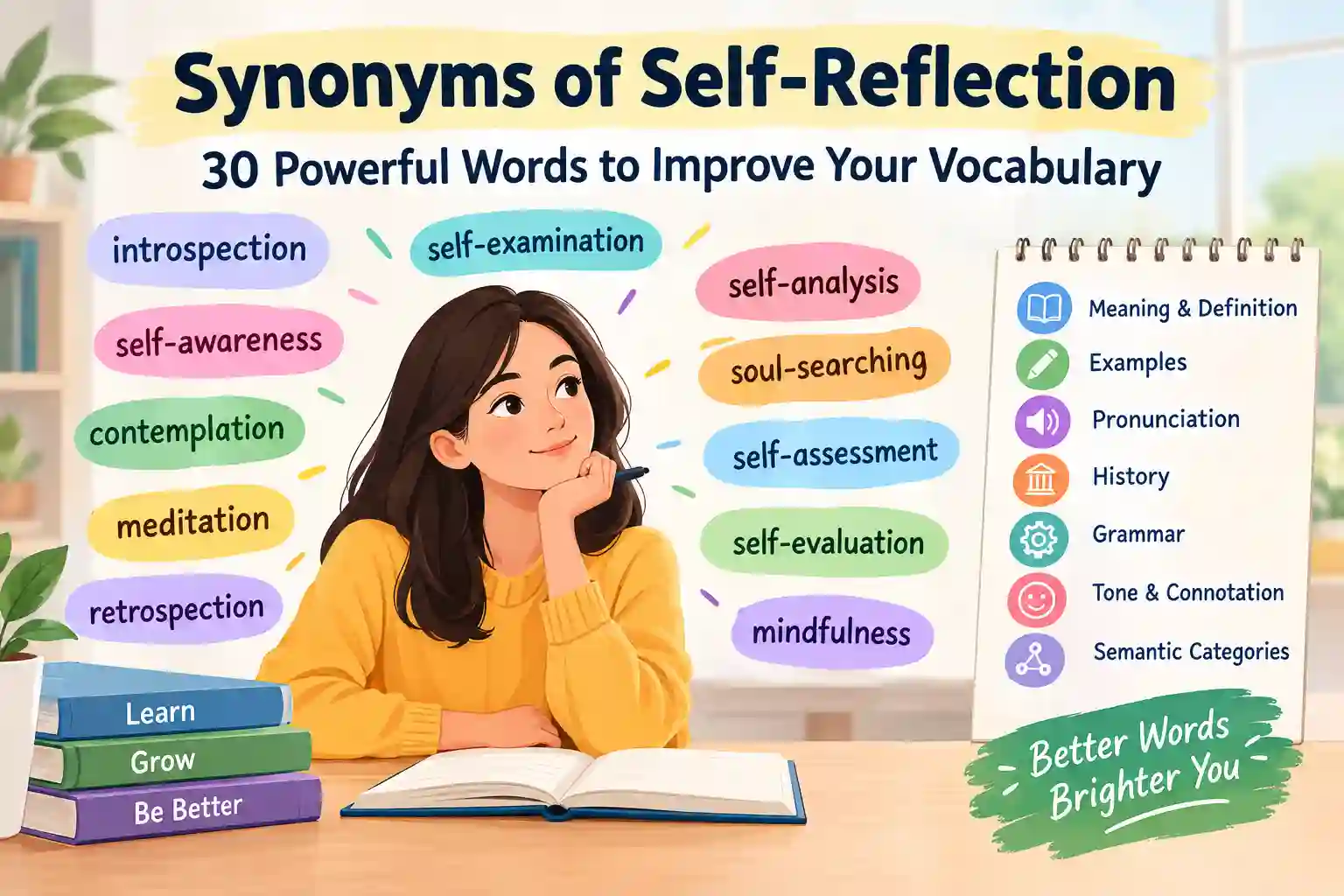
Self-reflection means thinking carefully about your own thoughts, feelings, actions, and experiences to understand yourself better. Common synonyms of self-reflection include introspection, self-examination, self-analysis, soul-searching, self-awareness, contemplation, meditation, self-assessment, retrospection, and reflection.
These words have similar meanings, but each fits a different situation. For example, introspection focuses on your inner thoughts, while self-assessment means judging your own skills or progress.
10 Synonyms of Self-Reflection at a Glance
| No. | Synonym | Simple meaning |
| 1 | Introspection | Looking into your own thoughts |
| 2 | Self-examination | Examining your own actions and beliefs |
| 3 | Self-analysis | Studying your own behavior and feelings |
| 4 | Soul-searching | Thinking deeply about your values |
| 5 | Self-awareness | Knowing your own feelings and habits |
| 6 | Self-assessment | Judging your own skills or progress |
| 7 | Contemplation | Thinking deeply about something |
| 8 | Meditation | Focusing the mind for calm or insight |
| 9 | Retrospection | Thinking about past events |
| 10 | Self-evaluation | Judging your own performance |
This article explores the meaning, grammar, pronunciation, history, and connotations of self-reflection. It also explains 30 related words with simple examples so learners can choose the right word for speaking, writing, study, and personal growth.
Meaning of Self-Reflection
Definition
Self-reflection (noun): The act of thinking carefully about your own thoughts, feelings, actions, and experiences to learn more about yourself.
Self-reflection helps people understand what they do well, where they make mistakes, and how they can improve.
Examples
- I use self-reflection to learn from my mistakes.
- Self-reflection helped Sara understand why she felt upset.
Connotative Meaning
(Connotation means the feelings or ideas that a word brings to mind beyond its basic meaning.)
- Positive tone: Growth, wisdom, honesty, learning, and personal improvement.
- Negative tone: Overthinking, regret, self-doubt, or excessive criticism when reflection becomes unhealthy.
- Neutral tone: A careful review of one’s thoughts, choices, or past actions.
Etymology
- Self: From Old English self, meaning one’s own person or identity.
- Reflection: From Latin reflectere, meaning “to bend back,” through Latin reflexio and later French and English forms associated with turning back or considering something.
- Self-reflection: A compound formed from self and reflection. Its modern meaning describes turning one’s attention inward to examine one’s own mind, behavior, or experiences.
Short History of Self-Reflection
- Old English (450–1100): The word self was already used to refer to one’s own person. The modern compound self-reflection was not established in its current sense.
- Middle English (1100–1500): Words related to reflection entered English through French and Latin influences. Reflection was linked to the idea of something turning or bending back.
- Modern English (1500–present): Reflection developed a stronger figurative sense of careful thought. Self-reflection became a useful term in discussions of philosophy, education, psychology, and personal development.
Pronunciation (US and UK – IPA)
- US: /ˌsɛlf rɪˈflɛkʃən/
- UK: /ˌself rɪˈflekʃən/
Syllables
self-re-flec-tion — 4 syllables.
Affixation Pattern of Self-Reflection
- Root 1: self — one’s own person.
- Root 2: reflect — to think carefully or consider.
- Prefix: None in the complete compound.
- Suffix: -ion — forms a noun from reflect through reflection.
- Word formation: self + reflection = self-reflection.
Words Formed from the Same Word Family
- Reflect (verb): To think carefully or show an image.
- Reflection (noun): Careful thought or an image shown by a surface.
- Reflective (adjective): Thoughtful or related to reflection.
- Reflectively (adverb): In a thoughtful way.
- Reflectiveness (noun): The quality of being thoughtful.
- Self-reflect (verb): To think about your own thoughts and actions.
- Self-reflective (adjective): Able to examine one’s own thoughts and actions.
- Self-reflection (noun): Careful thought about oneself.
The exact number of related words depends on whether we include uncommon forms and compounds.
30 Synonyms of Self-Reflection
The following words are closely related to self-reflection, but they are not all exact replacements. Some describe looking inward, while others focus on reviewing past events, judging performance, or thinking deeply.
1. Introspection (Noun)
US IPA: /ˌɪntrəˈspɛkʃən/ | UK IPA: /ˌɪntrəˈspekʃən/
Meaning: The act of examining your own thoughts and feelings.
Examples:
- Introspection helped me understand my fear.
- Through introspection, Ali learned why he felt angry.
2. Self-Examination (Noun)
US IPA: /ˌsɛlf ɪɡˌzæməˈneɪʃən/ | UK IPA: /ˌself ɪɡˌzæmɪˈneɪʃən/
Meaning: The act of carefully examining your own actions, beliefs, or behavior.
Examples:
- Self-examination helped him see his mistakes.
- Regular self-examination can improve our choices.
3. Self-Analysis (Noun)
US IPA: /ˌsɛlf əˈnæləsɪs/ | UK IPA: /ˌself əˈnæləsɪs/
Meaning: The process of studying your own thoughts, feelings, or behavior.
Examples:
- Self-analysis helped Sara find the cause of her stress.
- He used self-analysis to understand his habits.
4. Soul-Searching (Noun)
US IPA: /ˈsoʊl ˌsɝːtʃɪŋ/ | UK IPA: /ˈsəʊl ˌsɜːtʃɪŋ/
Meaning: Deep thought about your values, choices, and purpose in life.
Examples:
- After losing his job, he began soul-searching.
- Soul-searching helped her decide what mattered most.
5. Self-Awareness (Noun)
US IPA: /ˌsɛlf əˈwɛrnəs/ | UK IPA: /ˌself əˈweənəs/
Meaning: The ability to understand your own feelings, strengths, and weaknesses.
Examples:
- Self-awareness helps us manage our feelings.
- Her self-awareness improved the way she spoke to others.
6. Self-Assessment (Noun)
US IPA: /ˌsɛlf əˈsɛsmənt/ | UK IPA: /ˌself əˈsesmənt/
Meaning: The process of judging your own skills, progress, or performance.
Examples:
- The student completed a self-assessment after the test.
- Self-assessment helped me find areas for improvement.
7. Contemplation (Noun)
US IPA: /ˌkɑːntəmˈpleɪʃən/ | UK IPA: /ˌkɒntəmˈpleɪʃən/
Meaning: The act of thinking deeply about something.
Examples:
- Quiet contemplation helped him make a choice.
- She sat in contemplation before answering.
8. Meditation (Noun)
US IPA: /ˌmɛdəˈteɪʃən/ | UK IPA: /ˌmedɪˈteɪʃən/
Meaning: The practice of focusing the mind to develop calm, attention, or insight.
Examples:
- Meditation gave her time to notice her feelings.
- He used meditation to become calmer and more focused.
9. Retrospection (Noun)
US IPA: /ˌrɛtrəˈspɛkʃən/ | UK IPA: /ˌretrəˈspekʃən/
Meaning: The act of looking back on past events or experiences.
Examples:
- In retrospection, I understood why I had failed.
- Retrospection helped her learn from past choices.
10. Self-Evaluation (Noun)
US IPA: /ˌsɛlf ɪˌvæljuˈeɪʃən/ | UK IPA: /ˌself ɪˌvæljuˈeɪʃən/
Meaning: The act of judging your own work, actions, or progress.
Examples:
- Self-evaluation helped me improve my writing.
- The teacher asked us to complete a self-evaluation.
11. Introspection (Noun)
US IPA: /ˌɪntrəˈspɛkʃən/ | UK IPA: /ˌɪntrəˈspekʃən/
Meaning: Deep examination of one’s inner thoughts and feelings.
Examples:
- Introspection helped him understand his worries.
- She used introspection to explore her feelings.
12. Self-Review (Noun)
US IPA: /ˌsɛlf rɪˈvjuː/ | UK IPA: /ˌself rɪˈvjuː/
Meaning: A personal review of your own work, actions, or progress.
Examples:
- I did a self-review before sending my report.
- Her self-review showed that she needed more practice.
13. Self-Criticism (Noun)
US IPA: /ˌsɛlf ˈkrɪtɪˌsɪzəm/ | UK IPA: /ˌself ˈkrɪtɪˌsɪzəm/
Meaning: The act of judging your own faults or mistakes.
Examples:
- Too much self-criticism made him lose confidence.
- Healthy self-criticism helped her correct her errors.
14. Self-Reflection (Noun)
US IPA: /ˌsɛlf rɪˈflɛkʃən/ | UK IPA: /ˌself rɪˈflekʃən/
Meaning: Careful thought about your own behavior, thoughts, and experiences.
Examples:
- Self-reflection helped me understand my choices.
- Daily self-reflection can support personal growth.
15. Self-Observation (Noun)
US IPA: /ˌsɛlf ˌɑːbzərˈveɪʃən/ | UK IPA: /ˌself ˌɒbzəˈveɪʃən/
Meaning: The act of noticing your own thoughts, feelings, or actions.
Examples:
- Self-observation helped her notice her nervous habits.
- Through self-observation, he saw how stress affected him.
16. Mindfulness (Noun)
US IPA: /ˈmaɪndfəlnəs/ | UK IPA: /ˈmaɪndfəlnəs/
Meaning: Paying attention to the present moment without judging it too quickly.
Examples:
- Mindfulness helped me notice my feelings.
- She practiced mindfulness during her morning walk.
17. Deliberation (Noun)
US IPA: /dɪˌlɪbəˈreɪʃən/ | UK IPA: /dɪˌlɪbəˈreɪʃən/
Meaning: Careful thought before making a choice.
Examples:
- After much deliberation, he changed his plan.
- Deliberation helped her choose the right course.
18. Pondering (Noun)
US IPA: /ˈpɑːndərɪŋ/ | UK IPA: /ˈpɒndərɪŋ/
Meaning: The act of thinking carefully about something.
Examples:
- Pondering his actions helped him see the problem.
- She spent the evening pondering her future.
19. Consideration (Noun)
US IPA: /kənˌsɪdəˈreɪʃən/ | UK IPA: /kənˌsɪdəˈreɪʃən/
Meaning: Careful thought about an idea, choice, or situation.
Examples:
- Careful consideration helped me change my decision.
- He gave his behavior serious consideration.
20. Personal Inventory (Noun Phrase)
US IPA: /ˈpɝːsənəl ˈɪnvənˌtɔːri/ | UK IPA: /ˈpɜːsənəl ˈɪnvəntri/
Meaning: A review of your own strengths, weaknesses, values, and habits.
Examples:
- I took a personal inventory of my skills.
- Her personal inventory showed where she could improve.
21. Self-Inquiry (Noun)
US IPA: /ˌsɛlf ɪnˈkwaɪəri/ | UK IPA: /ˌself ɪnˈkwaɪəri/
Meaning: The act of asking yourself questions to understand your thoughts or beliefs.
Examples:
- Self-inquiry helped him question his assumptions.
- Through self-inquiry, she explored what she truly wanted.
22. Self-Understanding (Noun)
US IPA: /ˌsɛlf ˌʌndərˈstændɪŋ/ | UK IPA: /ˌself ˌʌndəˈstændɪŋ/
Meaning: Knowledge of your own feelings, needs, and behavior.
Examples:
- Reading and writing improved her self-understanding.
- Self-understanding helped him explain his needs.
23. Self-Knowledge (Noun)
US IPA: /ˌsɛlf ˈnɑːlɪdʒ/ | UK IPA: /ˌself ˈnɒlɪdʒ/
Meaning: Knowledge of your own character, abilities, and feelings.
Examples:
- Self-knowledge helped her set clear goals.
- Experience gave him greater self-knowledge.
24. Self-Discovery (Noun)
US IPA: /ˌsɛlf dɪˈskʌvəri/ | UK IPA: /ˌself dɪˈskʌvəri/
Meaning: The process of learning new things about yourself.
Examples:
- Traveling became a journey of self-discovery.
- Journaling helped him begin his self-discovery.
25. Retrospection (Noun)
US IPA: /ˌrɛtrəˈspɛkʃən/ | UK IPA: /ˌretrəˈspekʃən/
Meaning: Thought about the past to understand earlier events.
Examples:
- Retrospection helped her see how much she had grown.
- Through retrospection, he learned from an old mistake.
26. Intimate Reflection (Noun Phrase)
US IPA: /ˈɪntəmɪt rɪˈflɛkʃən/ | UK IPA: /ˈɪntɪmət rɪˈflekʃən/
Meaning: Deep and personal thought about your own experiences or feelings.
Examples:
- Intimate reflection helped her face a difficult memory.
- He used intimate reflection to understand his fears.
27. Self-Questioning (Noun)
US IPA: /ˌsɛlf ˈkwɛstʃənɪŋ/ | UK IPA: /ˌself ˈkwestʃənɪŋ/
Meaning: The act of asking yourself questions about your choices or beliefs.
Examples:
- Self-questioning made him rethink his decision.
- Her self-questioning led to a clearer goal.
28. Self-Contemplation (Noun)
US IPA: /ˌsɛlf ˌkɑːntəmˈpleɪʃən/ | UK IPA: /ˌself ˌkɒntəmˈpleɪʃən/
Meaning: Deep thought about your own life, feelings, or behavior.
Examples:
- Self-contemplation helped him understand his priorities.
- She made time for self-contemplation each evening.
29. Self-Study (Noun)
US IPA: /ˌsɛlf ˈstʌdi/ | UK IPA: /ˌself ˈstʌdi/
Meaning: Learning about a subject or yourself through independent study.
Examples:
- Self-study helped me understand my learning habits.
- She used self-study to improve her skills.
30. Self-Appraisal (Noun)
US IPA: /ˌsɛlf əˈpreɪzəl/ | UK IPA: /ˌself əˈpreɪzəl/
Meaning: The act of judging your own qualities, work, or performance.
Examples:
- Self-appraisal helped him recognize his strengths.
- The employee completed a self-appraisal at the end of the year.
Prototype Meaning of Self-Reflection
The most typical meaning of self-reflection is taking time to think about your own actions, feelings, choices, and experiences. Imagine a student who receives a low mark on a test. Instead of blaming others, the student asks, “Did I study enough? What can I do better next time?” This is self-reflection. It helps people understand themselves, learn from mistakes, and make better choices. It can happen through quiet thought, writing in a journal, or talking with someone they trust.
Prototype Categorization of Self-Reflection Synonyms
Different synonyms focus on different parts of the reflective process.
- Looking inward: Introspection, self-examination, self-analysis, and self-inquiry focus on thoughts, feelings, and beliefs.
- Knowing yourself: Self-awareness, self-knowledge, self-understanding, and self-discovery focus on learning about your identity and behavior.
- Reviewing performance: Self-assessment, self-evaluation, self-review, and self-appraisal focus on skills, work, and progress.
- Thinking deeply: Contemplation, meditation, pondering, and deliberation focus on careful thought.
- Looking at the past: Retrospection and personal reflection focus on earlier events and experiences.
- Examining faults: Self-criticism and self-questioning focus on mistakes, doubts, or beliefs.
- Paying attention to the present: Mindfulness and self-observation focus on current thoughts, feelings, and behavior.
Categorization helps writers choose words that fit their message. For example, use self-assessment when discussing school results, introspection when discussing inner feelings, and retrospection when looking back on past events.
Antonyms of Self-Reflection
Self-reflection has no single exact opposite in every context. However, these words describe actions or attitudes that contrast with thoughtful self-examination.
- Carelessness (noun): A lack of care or attention when acting.
- Thoughtlessness (noun): Acting without thinking carefully about the effects.
- Inattention (noun): Failure to pay attention to something.
- Impulsiveness (noun): Acting suddenly without considering the results.
- Ignorance (noun): Lack of knowledge or awareness about something.
- Unawareness (noun): A lack of knowledge about one’s feelings, actions, or surroundings.
- Neglect (noun): Failure to give something the attention it needs.
- Mindlessness (noun): Acting without much thought or awareness.
Short Questions and Answers
– What does self-reflection mean? Self-reflection means thinking carefully about your own thoughts, feelings, actions, and experiences.
– When should self-reflection be used? Use it when discussing personal growth, learning from mistakes, understanding feelings, or reviewing decisions.
– Is self-reflection positive or negative? It is usually positive because it can help people learn and grow. However, excessive reflection may lead to worry or self-criticism.
– How is self-reflection different from introspection? Self-reflection can include reviewing actions and experiences, while introspection focuses more directly on inner thoughts and feelings.
– How is self-reflection different from self-assessment? Self-reflection explores experiences and behavior, while self-assessment judges performance, skills, or progress.
– Can self-reflection improve writing? Yes. It helps writers explain experiences clearly, explore ideas, and avoid repeating the same words.
– What is the difference between reflection and retrospection? Reflection can concern the present or past, while retrospection specifically looks back at earlier events.
– How can I practice self-reflection daily? Spend five minutes asking yourself what went well, what you learned, and what you could do differently tomorrow.
Conclusion
Self-reflection is an important skill that helps us understand our thoughts, feelings, actions, and experiences. Learning its synonyms, such as introspection, self-awareness, self-examination, and self-assessment, helps us express our ideas more clearly. Each word has a slightly different meaning, so choosing the right one makes our writing and speaking more precise. These words also help us describe personal growth, past experiences, and the lessons we learn from mistakes. To improve your vocabulary, choose one new word each day, learn its meaning, practice its pronunciation, and use it in two original sentences. Regular practice will strengthen your English, reduce repetition, and build confidence in everyday communication.

I am a linguist with 7 years of experience in English language teaching, including postgraduate-level instruction. My expertise includes English grammar, and I contribute as a content and blog writer, producing scholarly and educational language resources.