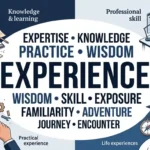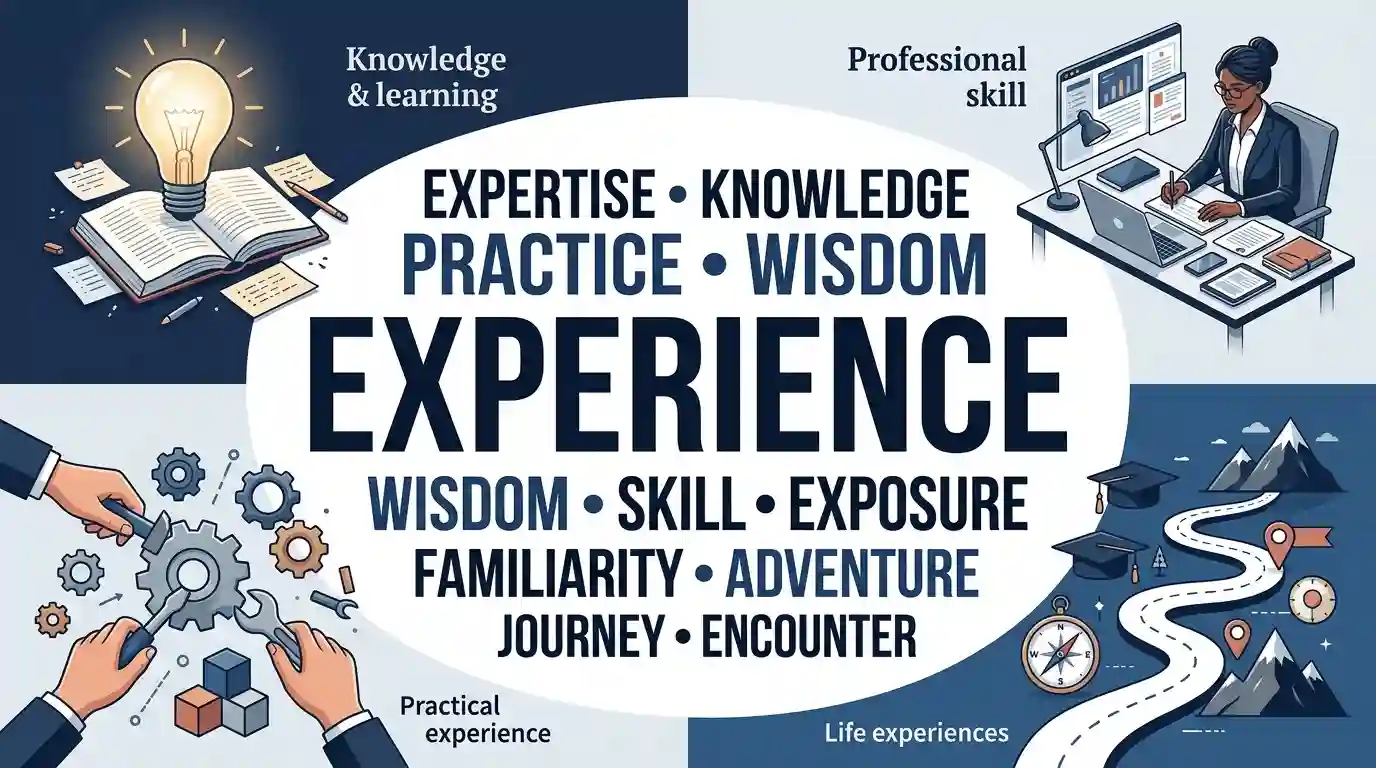
Experience means knowledge or skill gained by doing, seeing, or feeling things, or an event that affects you. Common synonyms include knowledge, expertise, familiarity, practice, exposure, understanding, learning, wisdom, skill, competence, encounter, event, episode, adventure, journey, ordeal, involvement, participation, and firsthand knowledge.
The best synonym of experience depends on the meaning and context. For example, expertise is best for advanced professional skill, while encounter usually describes a particular event or meeting.
This article explains the meaning of experience and its synonyms through simple examples, grammar, pronunciation, connotation, word history, word formation, and semantic categories.
Meaning of Experience
Definition
Experience (noun/verb):
As a noun, experience means knowledge or skill gained by doing, seeing, or feeling things, or something that happens to you and affects you. As a verb, experience means to have something happen to you or to feel or undergo something.
Examples
- She has five years of experience in teaching.
- Traveling abroad was a wonderful experience.
- We experienced many problems during the journey.
- He gained valuable experience from the project.
Connotative Meaning
Connotation (the feeling or idea that a word suggests beyond its basic meaning):
- Positive tone: Experience can suggest wisdom, maturity, confidence, skill, and personal growth.
- Negative tone: It can suggest a painful event, difficult situation, failure, loss, or hardship.
- Neutral tone: It can simply describe knowledge gained through life or something that happened to someone.
Etymology
- Experience entered English in the late 14th century from Old French esperience.
- Old French esperience came from Latin experientia, meaning a trial, proof, experiment, or knowledge gained through repeated trials.
- Latin experientia is related to experiri, meaning “to try” or “to test.”
- The idea of becoming skilled by doing something appeared in English by the late 15th century.
Short History of Experience
- Old English (450–1100): The modern word experience was not yet part of English. Ideas of learning through doing were expressed with native Germanic vocabulary.
- Middle English (1100–1500): Experience entered English through Old French and developed meanings connected with observation, testing, knowledge, and events that affect a person.
- Modern English (1500–Present): The word developed both noun and verb uses. The verb began to mean “to test” or “learn through practical trial” in the 1530s and later developed the meaning “to feel or undergo.”
Pronunciation (US & UK – IPA)
US: /ɪkˈspɪr.i.əns/
UK: /ɪkˈspɪə.ri.əns/
Syllables
ex-per-i-ence
Affixation Pattern of Experience
Root: The word ultimately comes from Latin experiri, “to try” or “to test.”
Prefix: ex-, historically connected with the idea of “out of” or “from.”
Suffix: -ence, part of the Latin-derived noun formation seen in experience.
The modern English word should not be treated as a simple productive combination of ex- + root + -ence. Its form developed through Latin and Old French before entering English.
Word Formation of Experience
Common grammatical forms and related words include:
- experience — noun/verb
- experiences — plural noun / third-person singular verb
- experienced — adjective / past participle
- experiencing — present participle / gerund
- experiential — adjective
- experientially — adverb
- inexperience — noun
- inexperienced — adjective
- re-experience — verb
- re-experienced — adjective/past participle
The forms experienced and experiential have documented histories going back to the 16th and 17th centuries respectively.
Synonyms of Experience
1. Knowledge (Noun)
US IPA: /ˈnɑː.lɪdʒ/ | UK IPA: /ˈnɒl.ɪdʒ/
Meaning: Information or understanding gained through learning or experience.
Examples:
- Her knowledge of computers is impressive.
- Experience gave him practical knowledge of the job.
2. Expertise (Noun)
US IPA: /ˌek.spɚˈtiːz/ | UK IPA: /ˌek.spɜːˈtiːz/
Meaning: High-level knowledge or skill in a particular field.
Examples:
- She has great expertise in digital marketing.
- His expertise comes from many years of practice.
3. Familiarity (Noun)
US IPA: /fəˌmɪlˈjærəti/ | UK IPA: /fəˌmɪlˈjærəti/
Meaning: Knowledge of something because you have seen or used it before.
Examples:
- His familiarity with the software helped the team.
- She has some familiarity with French culture.
4. Practice (Noun)
US IPA: /ˈpræk.tɪs/ | UK IPA: /ˈpræk.tɪs/
Meaning: Repeated activity that helps you develop skill or experience.
Examples:
- Teaching gives you plenty of practice in communication.
- With more practice, her writing improved.
5. Exposure (Noun)
US IPA: /ɪkˈspoʊʒɚ/ | UK IPA: /ɪkˈspəʊʒə/
Meaning: Contact with something that gives you knowledge or understanding.
Examples:
- The course gave students exposure to real business problems.
- Travel provides exposure to different cultures.
6. Understanding (Noun)
US IPA: /ˌʌndɚˈstændɪŋ/ | UK IPA: /ˌʌndəˈstændɪŋ/
Meaning: Knowledge of how something works or what it means.
Examples:
- Work experience improved her understanding of business.
- Practical tasks gave him a better understanding of the subject.
7. Learning (Noun)
US IPA: /ˈlɝːnɪŋ/ | UK IPA: /ˈlɜːnɪŋ/
Meaning: Knowledge gained through study, practice, or experience.
Examples:
- Every mistake can become a learning opportunity.
- Travel is a powerful form of learning.
8. Wisdom (Noun)
US IPA: /ˈwɪzdəm/ | UK IPA: /ˈwɪzdəm/
Meaning: Good judgment developed through knowledge and life experience.
Examples:
- Age often brings wisdom.
- Her life experience gave her great wisdom.
9. Skill (Noun)
US IPA: /skɪl/ | UK IPA: /skɪl/
Meaning: The ability to do something well.
Examples:
- Years of experience improved his writing skills.
- She has excellent communication skills.
10. Competence (Noun)
US IPA: /ˈkɑːmpɪtəns/ | UK IPA: /ˈkɒmpɪtəns/
Meaning: The ability and knowledge needed to do something successfully.
Examples:
- His work showed professional competence.
- Experience helped her develop competence in management.
11. Proficiency (Noun)
US IPA: /prəˈfɪʃənsi/ | UK IPA: /prəˈfɪʃənsi/
Meaning: A high level of ability in a particular skill.
Examples:
- She has strong proficiency in English.
- Practice increased his proficiency with the software.
12. Mastery (Noun)
US IPA: /ˈmæstəri/ | UK IPA: /ˈmɑːstəri/
Meaning: Very high skill or complete control of a subject or activity.
Examples:
- Years of practice led to mastery.
- His mastery of grammar is clear.
13. Acquaintance (Noun)
US IPA: /əˈkweɪntəns/ | UK IPA: /əˈkweɪntəns/
Meaning: Some knowledge or familiarity with a person, subject, or activity.
Examples:
- I have some acquaintance with web design.
- Her acquaintance with the topic is growing.
14. Know-how (Noun)
US IPA: /ˈnoʊˌhaʊ/ | UK IPA: /ˈnəʊˌhaʊ/
Meaning: Practical knowledge of how to do something.
Examples:
- He has the technical know-how to fix the machine.
- Practical experience gave her the know-how needed for the job.
15. Background (Noun)
US IPA: /ˈbækɡraʊnd/ | UK IPA: /ˈbækɡraʊnd/
Meaning: A person’s previous education, work, training, or experience.
Examples:
- She has a strong background in education.
- His professional background helped him get the position.
16. Training (Noun)
US IPA: /ˈtreɪnɪŋ/ | UK IPA: /ˈtreɪnɪŋ/
Meaning: Teaching and practice that prepare someone for a task or job.
Examples:
- The job requires special training.
- Her experience and training made her confident.
17. Encounter (Noun)
US IPA: /ɪnˈkaʊntɚ/ | UK IPA: /ɪnˈkaʊntə/
Meaning: An event in which you meet or come into contact with someone or something.
Examples:
- The meeting was an interesting encounter.
- His first encounter with the city was exciting.
18. Event (Noun)
US IPA: /ɪˈvent/ | UK IPA: /ɪˈvent/
Meaning: Something that happens, especially something important or memorable.
Examples:
- The trip was a memorable event.
- The accident became an important event in his life.
19. Episode (Noun)
US IPA: /ˈepəsoʊd/ | UK IPA: /ˈepɪsəʊd/
Meaning: A particular event or period in someone’s life.
Examples:
- The difficult episode taught her an important lesson.
- He described the episode in his autobiography.
20. Adventure (Noun)
US IPA: /ədˈventʃɚ/ | UK IPA: /ədˈventʃə/
Meaning: An exciting or unusual experience.
Examples:
- Our trip to the mountains was a great adventure.
- Studying abroad became an unforgettable adventure.
21. Journey (Noun)
US IPA: /ˈdʒɝːni/ | UK IPA: /ˈdʒɜːni/
Meaning: A period of development or a series of experiences over time.
Examples:
- Learning English is a long journey.
- Her teaching journey began many years ago.
22. Ordeal (Noun)
US IPA: /ɔːrˈdiːl/ | UK IPA: /ɔːˈdiːəl/
Meaning: A very difficult or painful experience.
Examples:
- The accident was a terrible ordeal.
- She remained strong during the difficult ordeal.
23. Incident (Noun)
US IPA: /ˈɪnsɪdənt/ | UK IPA: /ˈɪnsɪdənt/
Meaning: An event, especially one that is unusual or unpleasant.
Examples:
- The incident changed his view of safety.
- She remembered the strange incident clearly.
24. Involvement (Noun)
US IPA: /ɪnˈvɑːlvmənt/ | UK IPA: /ɪnˈvɒlvmənt/
Meaning: Participation in an activity or situation.
Examples:
- His involvement in the project gave him useful experience.
- Community involvement can teach valuable skills.
25. Participation (Noun)
US IPA: /pɑːrˌtɪsəˈpeɪʃən/ | UK IPA: /pɑːˌtɪsɪˈpeɪʃən/
Meaning: The act of taking part in something.
Examples:
- Active participation gives students practical experience.
- Her participation in the project improved her confidence.
26. Undergo (Verb)
US IPA: /ˌʌndɚˈɡoʊ/ | UK IPA: /ˌʌndəˈɡəʊ/
Meaning: To experience something, especially something difficult or important.
Examples:
- The building will undergo major repairs.
- She underwent a difficult period at work.
27. Encounter (Verb)
US IPA: /ɪnˈkaʊntɚ/ | UK IPA: /ɪnˈkaʊntə/
Meaning: To meet, face, or experience something unexpectedly.
Examples:
- We encountered several problems during the trip.
- Students often encounter new ideas at university.
28. Endure (Verb)
US IPA: /ɪnˈdʊr/ | UK IPA: /ɪnˈdjʊə/
Meaning: To experience something difficult and continue through it.
Examples:
- They endured many difficulties during the journey.
- She endured years of hard work before succeeding.
29. Live Through (Verb Phrase)
US IPA: /lɪv θruː/ | UK IPA: /lɪv θruː/
Meaning: To experience a difficult or important event and survive it.
Examples:
- He lived through a major economic crisis.
- Many families lived through difficult times.
30. Witness (Verb)
US IPA: /ˈwɪtnəs/ | UK IPA: /ˈwɪtnəs/
Meaning: To see or experience an event as it happens.
Examples:
- She witnessed a historic moment.
- We witnessed a beautiful sunset together.
Prototype Meaning
The most typical meaning of experience is knowledge or skill gained by actually doing something. When people hear the word in a job, education, or life context, they often imagine a person who has learned through real situations rather than only through books or theory. The word can also mean a particular event that someone has lived through.
Prototype Categorization
- Knowledge and learning: knowledge, understanding, learning, wisdom.
- Professional ability: expertise, proficiency, competence, skill, mastery.
- Practical contact: practice, exposure, familiarity, acquaintance, know-how.
- Personal history: background, training, journey.
- A particular event: encounter, event, episode, incident.
- Difficult experience: ordeal, undergo, endure, live through.
- Participation or observation: involvement, participation, witness.
Categorization helps writers choose a synonym based on the exact meaning they want. For example, expertise fits professional skill, ordeal fits a painful experience, and adventure fits an exciting experience. Replacing every use of experience with the same synonym can change the meaning or sound unnatural.
Antonyms of Experience
- Inexperience (noun): lack of knowledge or skill gained through experience.
- Inexpertise (noun): lack of expert knowledge or skill.
- Ignorance (noun): lack of knowledge or information.
- Unfamiliarity (noun): lack of knowledge or familiarity with something.
- Incompetence (noun): lack of ability or skill to perform a task properly.
- Inexperience (adjective-related form): lack of practical knowledge or previous involvement.
- Novice (noun): a person who has little experience in an activity.
- Beginner (noun): someone who is starting to learn something.
- Unskilled (adjective): lacking the skill developed through practice or training.
Short Questions and Answers
- What does experience mean?
Experience means knowledge or skill gained through doing, seeing, or feeling things. It can also mean something that happens to a person and affects them. - When should experience be used?
Use experience when talking about knowledge gained through practice, previous work, personal events, or something someone has lived through. - Is experience positive or negative?
Experience is neutral by itself. The context decides whether it is positive, negative, or neutral. A wonderful experience is positive, while a painful experience is negative. - How is experience different from similar words?
Experience is broad. Expertise means advanced knowledge or skill. Familiarity means knowing something because you have encountered it before. Practice emphasizes repeated activity. Encounter usually means a particular meeting or event. Ordeal suggests a very difficult experience.
Conclusion
Learning experience and its synonyms can make English more precise and interesting. The word experience covers several ideas, including knowledge gained through practice, personal events, professional background, and things that happen to us. Words such as expertise, familiarity, practice, exposure, wisdom, encounter, adventure, ordeal, and involvement let you express these ideas more clearly.
Using the right synonym of experience also helps you avoid repetition in essays, articles, conversations, and professional writing. A strong vocabulary can make both writing and speaking more confident and natural. Try to learn one new synonym each day and use it in a real sentence. Over time, this simple habit can improve your vocabulary, strengthen your communication, and help you express your ideas with greater accuracy.

I am a linguist with 7 years of experience in English language teaching, including postgraduate-level instruction. My expertise includes English grammar, and I contribute as a content and blog writer, producing scholarly and educational language resources.