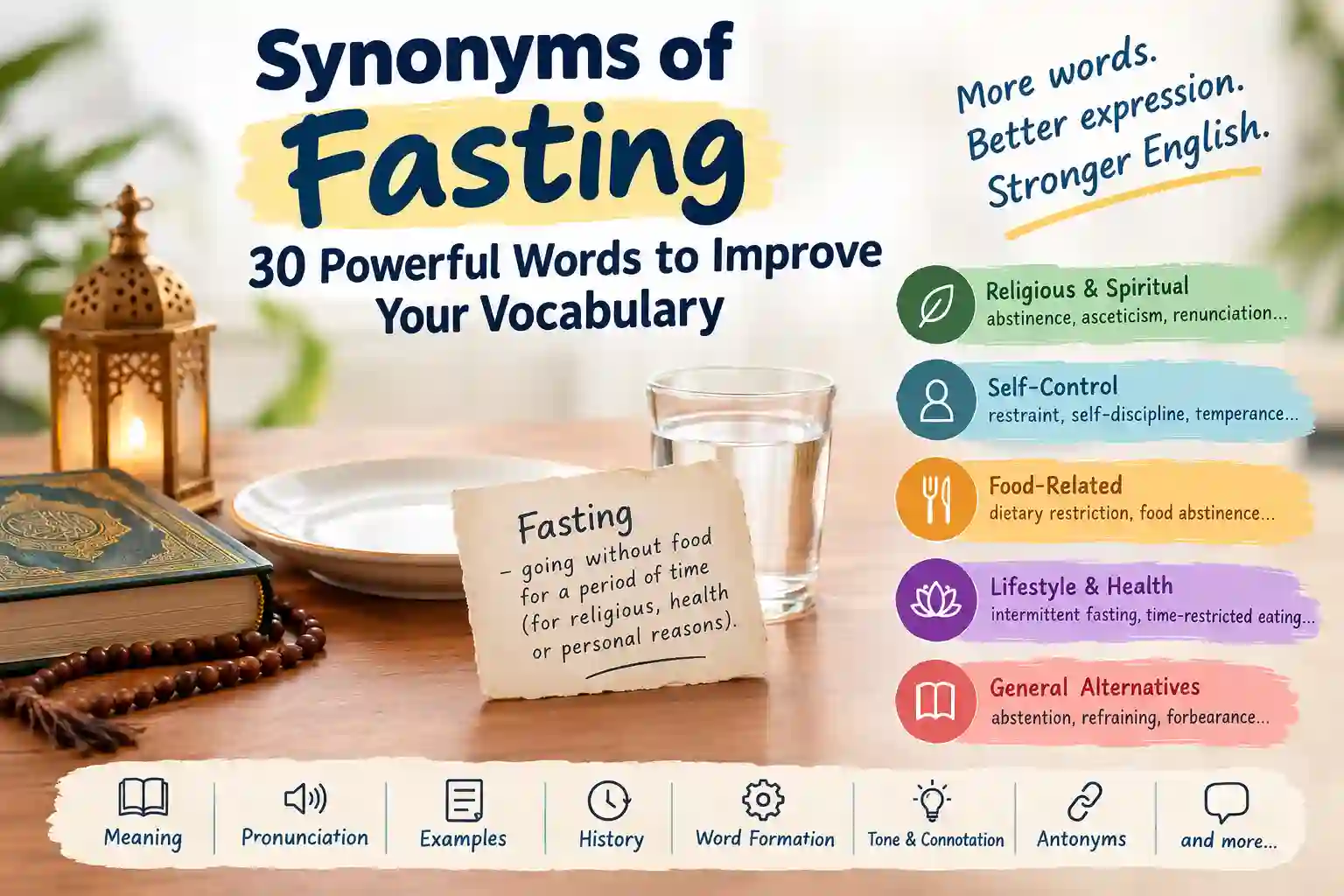
Fasting means going without food, or limiting food for a period of time. Imagine someone preparing for a religious day. From early morning, they do not eat or drink until evening. That period of going without food is called fasting.
The word is common in religious, cultural, health, and lifestyle discussions. It can describe a religious practice, a personal choice, or a planned eating pattern.
In this article, we will explore the meaning, examples, connotation, history, pronunciation, word formation, and 30 useful alternatives to fasting, with clear examples and semantic categories.
Meaning of Fasting
Definition
Fasting (noun): the practice or act of going without food, or limiting food, for a period of time, often for religious, health, or personal reasons.
Examples
- Fasting is an important practice during Ramadan.
- She began fasting before her medical test.
Connotative Meaning
(Connotation means the feeling or idea that a word suggests beyond its basic meaning.)
- Positive tone: Fasting can suggest discipline, devotion, self-control, reflection, or spiritual commitment.
- Negative tone: In some contexts, it can suggest deprivation, hunger, hardship, or self-denial.
- Neutral tone: It can simply describe a period when a person does not eat or limits food.
Etymology
- Source language: Old English.
- Old English form: fæstan, meaning “to fast” or observe abstinence.
- The word is related to Old High German fastēn, Gothic fastan, and Old Norse fasta.
- The older Germanic idea was connected with holding firmly or keeping an observance, which developed into the religious sense of abstaining from food.
Short History of Fasting
- Old English (450–1100): Fæstan was used for the practice of abstaining from food, especially as a religious duty.
- Middle English (1100–1500): Forms related to fasten and fast continued to describe abstaining from food and religious observance.
- Modern English (1500–Present): Fasting has remained common in religious language and has also expanded into health, diet, and lifestyle contexts.
Pronunciation (US & UK – IPA)
US: /ˈfæstɪŋ/
UK: /ˈfɑːstɪŋ/
Syllables
fast-ing
Affixation Pattern of Fasting
- Root: fast
- Prefix: none
- Suffix: -ing
Word formation of the keyword:
- fast — verb/noun/adjective
- fasted — verb, past tense and past participle
- fasting — noun/present participle
- faster — noun, a person who fasts
- fasts — verb, third-person singular, or plural noun
- fasting-related — compound adjective
The noun fasting is formed from fast + -ing. The ending -ing creates a present participle and can also create a gerund noun.
A List of 30 Synonyms for Fasting
The alternatives below are not all perfect one-for-one replacements. Some describe fasting directly, while others describe closely related ideas such as abstaining, self-denial, restraint, or going without food. Collins lists fasting, diet, and abstinence among related terms for the noun sense of fast, while its verb synonyms include abstain, go without food, deny yourself, and refrain from food or eating.
1. Abstinence (Noun)
US: /ˈæbstənəns/ | UK: /ˈæbstɪnəns/
Meaning: The voluntary practice of avoiding food, drink, or another pleasure.
Examples:
- Religious abstinence can be part of a spiritual practice.
- Her period of abstinence from food lasted until sunset.
2. Abstention (Noun)
US: /əbˈstenʃən/ | UK: /əbˈstenʃən/
Meaning: The act of deliberately choosing not to take or use something.
Examples:
- His abstention from food was part of the ceremony.
- The practice requires abstention from certain foods.
3. Abstemiousness (Noun)
US: /əbˈstiːmiəsnəs/ | UK: /əbˈstiːmiəsnəs/
Meaning: The habit of limiting food, drink, or other pleasures.
Examples:
- Her abstemiousness helped her follow the strict dietary plan.
- Abstemiousness can involve careful control of eating.
4. Self-Denial (Noun)
US: /ˌself dɪˈnaɪəl/ | UK: /ˌself dɪˈnaɪəl/
Meaning: The deliberate choice to give up something that you want.
Examples:
- Fasting can be an act of self-denial.
- His self-denial was part of his spiritual routine.
5. Self-Deprivation (Noun)
US: /ˌself ˌdɛprəˈveɪʃən/ | UK: /ˌself ˌdɛprɪˈveɪʃən/
Meaning: The act of deliberately going without something you normally enjoy or need.
Examples:
- She viewed fasting as temporary self-deprivation.
- Self-deprivation can be part of some forms of religious practice.
6. Restraint (Noun)
US: /rɪˈstreɪnt/ | UK: /rɪˈstreɪnt/
Meaning: The ability to control an action, desire, or appetite.
Examples:
- Fasting requires restraint for many people.
- He showed restraint by refusing food during the fasting period.
7. Self-Restraint (Noun)
US: /ˌself rɪˈstreɪnt/ | UK: /ˌself rɪˈstreɪnt/
Meaning: Control over your own desires or actions.
Examples:
- Fasting can teach self-restraint.
- She practiced self-restraint during the fasting hours.
8. Temperance (Noun)
US: /ˈtɛmpərəns/ | UK: /ˈtempərəns/
Meaning: Moderate behavior and control over physical desires.
Examples:
- The practice encouraged temperance in eating.
- Temperance is often linked with moderation and self-control.
9. Moderation (Noun)
US: /ˌmɑːdəˈreɪʃən/ | UK: /ˌmɒdəˈreɪʃən/
Meaning: The practice of avoiding excess.
Examples:
- Some people use fasting to support moderation in eating.
- Moderation can help people develop healthier eating habits.
10. Abstaining (Verb)
US: /əbˈsteɪnɪŋ/ | UK: /əbˈsteɪnɪŋ/
Meaning: Deliberately choosing not to eat, drink, or do something.
Examples:
- He is abstaining from food until sunset.
- She is abstaining from certain foods for religious reasons.
11. Refraining (Verb)
US: /rɪˈfreɪnɪŋ/ | UK: /rɪˈfreɪnɪŋ/
Meaning: Choosing not to do or take something.
Examples:
- He is refraining from eating during the fast.
- Refraining from food can have a religious purpose.
12. Going Without Food (Verb Phrase)
US: /ˈɡoʊɪŋ wɪˈðaʊt fuːd/ | UK: /ˈɡəʊɪŋ wɪˈðaʊt fuːd/
Meaning: Spending a period of time without eating.
Examples:
- Going without food until evening is part of the practice.
- She was comfortable with going without food for several hours.
13. Denying Yourself (Verb Phrase)
US: /dɪˈnaɪɪŋ jərˈself/ | UK: /dɪˈnaɪɪŋ jəˈself/
Meaning: Choosing not to allow yourself something you want.
Examples:
- He is denying himself food during the religious observance.
- Denying yourself certain foods can require discipline.
14. Forbearance (Noun)
US: /fɔːrˈberəns/ | UK: /fɔːˈbeərəns/
Meaning: The ability to patiently control an impulse or desire.
Examples:
- Fasting can require considerable forbearance.
- Her forbearance helped her continue the practice.
15. Forgoing (Verb)
US: /fɔːrˈɡoʊɪŋ/ | UK: /fɔːˈɡəʊɪŋ/
Meaning: Choosing to give up or do without something.
Examples:
- He is forgoing food until the evening meal.
- Forgoing certain foods is part of the tradition.
16. Renunciation (Noun)
US: /rɪˌnʌnsiˈeɪʃən/ | UK: /rɪˌnʌnsiˈeɪʃən/
Meaning: A formal or deliberate decision to give something up.
Examples:
- The fast represented a temporary renunciation of food.
- Religious renunciation may involve giving up certain pleasures.
17. Sacrifice (Noun)
US: /ˈsækrəfaɪs/ | UK: /ˈsækrɪfaɪs/
Meaning: Something willingly given up for a purpose or belief.
Examples:
- For her, fasting was a small sacrifice for a religious purpose.
- The practice was seen as a sacrifice made with sincere intention.
18. Austerity (Noun)
US: /ɔːˈsterəti/ | UK: /ɒˈsterəti/
Meaning: A strict way of living with few comforts or pleasures.
Examples:
- Fasting can be part of a life of religious austerity.
- The monk followed a simple life of austerity.
19. Asceticism (Noun)
US: /əˈsɛtɪˌsɪzəm/ | UK: /əˈsetɪˌsɪzəm/
Meaning: A way of life based on strict self-discipline and avoiding physical pleasures.
Examples:
- Fasting has a long history in religious asceticism.
- His lifestyle included prayer, fasting, and asceticism.
20. Mortification (Noun)
US: /ˌmɔːrtəfəˈkeɪʃən/ | UK: /ˌmɔːtɪfɪˈkeɪʃən/
Meaning: A religious practice of denying or disciplining the body.
Examples:
- In some historical traditions, fasting was linked with mortification.
- The practice was viewed as an act of religious mortification.
21. Self-Control (Noun)
US: /ˌself kənˈtroʊl/ | UK: /ˌself kənˈtrəʊl/
Meaning: The ability to control your feelings, actions, and desires.
Examples:
- Fasting can require strong self-control.
- She used self-control to follow her fasting schedule.
22. Self-Discipline (Noun)
US: /ˌself ˈdɪsəplɪn/ | UK: /ˌself ˈdɪsəplɪn/
Meaning: The ability to make yourself follow rules or plans.
Examples:
- Regular fasting can require self-discipline.
- His self-discipline helped him follow the schedule.
23. Restraint of Appetite (Noun Phrase)
US: /rɪˈstreɪnt əv ˈæpətaɪt/ | UK: /rɪˈstreɪnt əv ˈæpɪtaɪt/
Meaning: The deliberate control of the desire to eat.
Examples:
- Fasting involves restraint of appetite for a set period.
- Restraint of appetite can be difficult when food is available.
24. Dietary Abstention (Noun Phrase)
US: /ˈdaɪəˌteri əbˈstenʃən/ | UK: /ˈdaɪətri əbˈstenʃən/
Meaning: Deliberately avoiding food or certain foods.
Examples:
- Dietary abstention is part of some religious traditions.
- The doctor asked about periods of dietary abstention.
25. Food Abstinence (Noun Phrase)
US: /fuːd ˈæbstənəns/ | UK: /fuːd ˈæbstɪnəns/
Meaning: The deliberate practice of avoiding food.
Examples:
- Food abstinence may have religious or personal reasons.
- The tradition includes a period of food abstinence.
26. Dietary Restriction (Noun Phrase)
US: /ˈdaɪəˌteri rɪˈstrɪkʃən/ | UK: /ˈdaɪətri rɪˈstrɪkʃən/
Meaning: A rule or choice that limits what or how much a person eats.
Examples:
- Fasting is one form of temporary dietary restriction.
- Her dietary restriction ends at sunset.
27. Food Restriction (Noun Phrase)
US: /fuːd rɪˈstrɪkʃən/ | UK: /fuːd rɪˈstrɪkʃən/
Meaning: A limit placed on eating certain foods or eating at certain times.
Examples:
- The practice involves a temporary food restriction.
- Religious food restrictions can vary between traditions.
28. Intermittent Fasting (Noun Phrase)
US: /ˌɪntərˈmɪtənt ˈfæstɪŋ/ | UK: /ˌɪntəˈmɪtənt ˈfɑːstɪŋ/
Meaning: An eating pattern that alternates between periods of eating and fasting.
Examples:
- She follows an intermittent fasting schedule.
- Intermittent fasting has become a common health and diet term.
29. Time-Restricted Eating (Noun Phrase)
US: /ˈtaɪm rɪˈstrɪktɪd ˈiːtɪŋ/ | UK: /ˈtaɪm rɪˈstrɪktɪd ˈiːtɪŋ/
Meaning: An eating pattern in which food is consumed within a set daily time window.
Examples:
- Time-restricted eating gives a person a defined eating window.
- She uses time-restricted eating as part of her daily routine.
30. Going Hungry (Verb Phrase)
US: /ˈɡoʊɪŋ ˈhʌŋɡri/ | UK: /ˈɡəʊɪŋ ˈhʌŋɡri/
Meaning: Spending time without enough food or without eating.
Examples:
- The religious fast meant going hungry until evening.
- Going hungry is not always the same as voluntary fasting.
Usage note: The final alternatives are context-dependent rather than perfect dictionary synonyms. Abstinence, abstention, going without food, and refraining from food are closer substitutes, while terms such as asceticism, restraint, and dietary restriction describe related ideas. This distinction matters when choosing precise vocabulary.
Prototype Meaning
The most typical meaning of fasting is a deliberate period of not eating food. People commonly imagine a person avoiding food for a set time, often from morning until evening, because of a religious practice. The word can also describe modern eating patterns, but its central idea remains temporary abstention from food.
Prototype Categorization
- Direct food-related alternatives: abstinence, food abstinence, going without food, going hungry, dietary abstention.
- Self-control alternatives: restraint, self-restraint, self-control, self-discipline, temperance.
- Giving-up alternatives: self-denial, self-deprivation, forgoing, renunciation, sacrifice.
- Religious or spiritual terms: asceticism, austerity, mortification, religious abstinence.
- Diet and lifestyle terms: intermittent fasting, time-restricted eating, dietary restriction, food restriction.
- General abstention terms: abstention, abstaining, refraining, forbearance.
Categorization helps writers choose a word that matches the exact meaning. For example, abstinence works well in a formal or religious context, while intermittent fasting is more suitable for a modern eating pattern.
Antonyms of Fasting
- Feasting (noun): eating a large or special meal.
- Eating (noun): taking food into the body.
- Feeding (noun): giving or taking food.
- Indulgence (noun): allowing yourself something enjoyable, especially in excess.
- Consumption (noun): the act of eating or using something.
- Overeating (noun): eating more food than the body needs.
- Gluttony (noun): excessive or uncontrolled eating.
- Satisfaction (noun): a state in which hunger or desire has been fulfilled.
- Nourishment (noun): food or other substances needed for health and growth.
Short Questions and Answers
- What does fasting mean?
- Fasting means deliberately going without food or limiting food for a period of time, often for religious, health, or personal reasons.
- When should fasting be used?
- Use fasting when you are talking about a period or practice of avoiding food. It is common in religious, cultural, health, and lifestyle contexts.
- Is fasting positive or negative?
- The tone depends on context. It can suggest devotion, discipline, and self-control, or it can suggest hunger and deprivation.
- How is fasting different from similar words?
- Fasting specifically focuses on going without food or limiting food. Abstinence is broader and can involve avoiding food, drink, or other things. Restraint focuses on self-control, while dietary restriction focuses on limits placed on eating.
Conclusion
Learning the meaning and synonyms of fasting can make your English more precise and flexible. The word is simple, but its alternatives express different ideas. Abstinence emphasizes avoiding something, self-denial highlights giving something up, restraint focuses on control, and intermittent fasting describes a specific modern eating pattern. Understanding these differences helps you choose the right word for essays, articles, conversations, and everyday writing. It also reduces repetition and makes your vocabulary stronger. English learners can build confidence by learning one new synonym at a time and using it in a real sentence. Content writers can also use related terms naturally when the meaning truly fits. Practice these words regularly, but always choose accuracy over simply replacing one word with another.

I am a linguist with 7 years of experience in English language teaching, including postgraduate-level instruction. My expertise includes English grammar, and I contribute as a content and blog writer, producing scholarly and educational language resources.