Interested is a common English word that describes a person who wants to know more about something, take part in it, or give it attention. Imagine a student who hears about a new course at school. She asks questions, reads about the course, and wants to join it. We can say that she is interested in the course.
The word is common because people often talk about their hobbies, studies, work, plans, and feelings. However, using interested again and again can make speaking and writing sound repetitive.
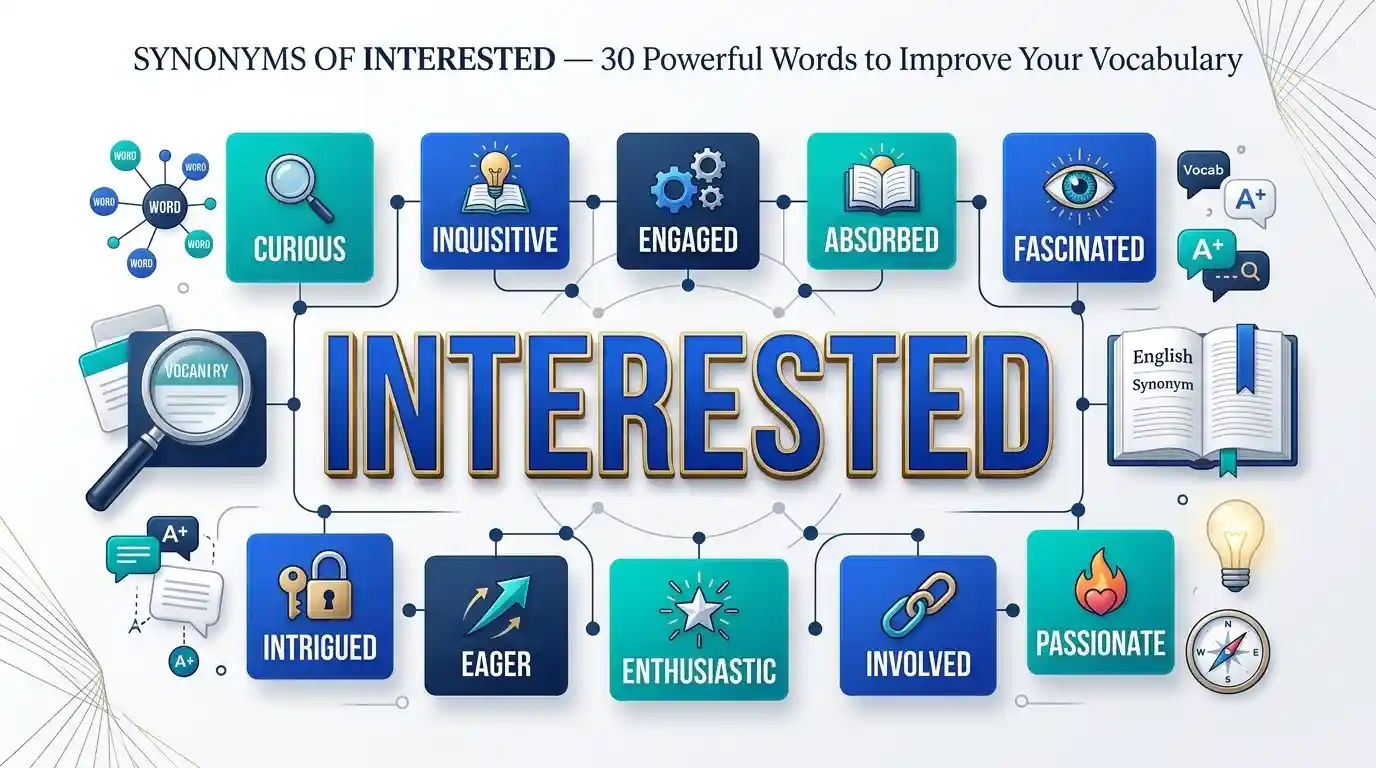
In this article, we explore the 30 synonyms of interested, its meaning, pronunciation, connotation, history, word formation, semantic categories, examples, and antonyms. The goal is to help learners choose the right word for each situation.
Meaning of Interested
Definition
Interested (adjective): wanting to know more about something, give it attention, or take part in it.
The usual pattern is interested in + noun/gerund:
- She is interested in history.
- They are interested in learning English.
- I am interested in your idea.
Interested can also describe someone who is involved in or affected by a situation, such as an interested party.
Examples
- Maria is interested in learning Spanish.
- He became interested in photography after buying a new camera.
Connotative Meaning
(Connotation means the feeling or idea that a word suggests beyond its basic dictionary meaning.)
- Positive tone: Interested can suggest curiosity, enthusiasm, attention, and a desire to learn.
- Negative tone: In some contexts, it can suggest personal gain, self-interest, or bias, as in “an interested witness.”
- Neutral tone: It can simply mean that someone wants to know more about something or is involved in it.
Collins notes that interested can describe both curiosity and personal involvement, so the context determines its tone.
Etymology
- Interested comes from the verb interest plus the suffix -ed.
- Interest entered English through Anglo-French and Medieval Latin sources.
- Latin interesse meant “to concern,” “to make a difference,” or literally “to be between.”
- The Latin form combines inter- (“between”) and esse (“to be”).
- The English adjective interested developed later from the past participle of interest. Etymonline dates the adjective to the 1660s.
Short History of Interested
Old English (450–1100):
The modern word interested did not exist in Old English. Its Latin root, however, contains esse, meaning “to be,” which is an ancient Indo-European element. The modern English word developed much later.
Middle English (1100–1500):
The related word interest/interesse entered Middle English through Anglo-French and Medieval Latin. Early meanings were connected with legal concern, a right, a claim, benefit, or involvement. Etymonline records interesse in Middle English from the late 14th century.
Modern English (1500–Present):
The noun interest developed several meanings, including curiosity, concern, advantage, financial interest, and participation. The adjective interested appeared in the 17th century. By later periods, it could describe curiosity as well as personal involvement or self-interest.
Pronunciation (US & UK – IPA)
US: /ˈɪntrəstɪd/ or /ˈɪntərɛstɪd/
UK: /ˈɪntrɪstɪd/ or /ˈɪntrəstɪd/
Collins gives several accepted American and British pronunciations, including forms with two or three syllables.
Syllables
in-ter-est-ed
Affixation Pattern of Interested
Root: interest
Prefix: none
Suffix: -ed
The basic formation is:
interest + -ed → interested
Word Formation of Interested
The root interest can participate in several related grammatical forms:
- interest — noun/verb
- interested — adjective
- interesting — adjective
- interestedly — adverb
- interestedness — noun
- interestingly — adverb
- disinterested — adjective
- uninterested — adjective
- self-interest — noun
- self-interested — adjective
- interest-free — adjective
These forms do not all have exactly the same meaning. In particular, disinterested traditionally means impartial or free from personal interest, while uninterested normally means lacking interest.
Synonyms of Interested
The following synonyms are grouped by meaning. They are not interchangeable in every sentence. Some express simple curiosity, while others show strong attention, enthusiasm, involvement, or concern.
1. Curious (Adjective)
US IPA: /ˈkjʊriəs/
UK IPA: /ˈkjʊəriəs/
Meaning: Wanting to know or learn more about something.
Examples:
- The children were curious about the strange sound.
- I am curious to know what happened.
Best use: Use curious when the main idea is a desire for information.
2. Inquisitive (Adjective)
US IPA: /ɪnˈkwɪzətɪv/
UK IPA: /ɪnˈkwɪzətɪv/
Meaning: Asking many questions because you want to understand something.
Examples:
- The inquisitive student asked several questions.
- Her inquisitive nature helped her learn quickly.
Best use: It is useful for people who actively ask questions.
3. Attentive (Adjective)
US IPA: /əˈtɛntɪv/
UK IPA: /əˈtɛntɪv/
Meaning: Giving careful attention to someone or something.
Examples:
- The students were attentive during the lesson.
- She was attentive to every detail.
Best use: Use attentive when the focus is on careful listening or observation.
4. Engaged (Adjective)
US IPA: /ɪnˈɡeɪdʒd/
UK IPA: /ɪnˈɡeɪdʒd/
Meaning: Actively involved and paying attention.
Examples:
- The audience remained engaged throughout the talk.
- Good teachers keep students engaged in learning.
Best use: Common in education, business, media, and communication.
5. Absorbed (Adjective)
US IPA: /əbˈzɔrbd/
UK IPA: /əbˈzɔːbd/
Meaning: Giving almost all your attention to something.
Examples:
- She was absorbed in her book.
- He became absorbed in the documentary.
Best use: Stronger than ordinary interested because it suggests deep attention.
6. Fascinated (Adjective)
US IPA: /ˈfæsəneɪtɪd/
UK IPA: /ˈfæsɪneɪtɪd/
Meaning: Extremely interested because something is unusual, exciting, or amazing.
Examples:
- The children were fascinated by the science experiment.
- I have always been fascinated by space.
Best use: Use it for very strong interest.
7. Intrigued (Adjective)
US IPA: /ɪnˈtriɡd/
UK IPA: /ɪnˈtriːɡd/
Meaning: Very interested because something seems mysterious or unusual.
Examples:
- I was intrigued by her unusual idea.
- The mysterious letter intrigued him.
Best use: Excellent for mysteries, unusual ideas, and unanswered questions.
8. Keen (Adjective)
US IPA: /kiːn/
UK IPA: /kiːn/
Meaning: Very eager or interested in doing something.
Examples:
- She is keen to learn new skills.
- He is keen on photography.
Best use: Especially common in British English.
9. Eager (Adjective)
US IPA: /ˈiːɡər/
UK IPA: /ˈiːɡə/
Meaning: Very excited and ready to do or learn something.
Examples:
- The students were eager to start the project.
- He was eager to hear the results.
Best use: Choose eager when interest includes strong desire or expectation.
10. Enthusiastic (Adjective)
US IPA: /ɪnˌθuːziˈæstɪk/
UK IPA: /ɪnˌθjuːziˈæstɪk/
Meaning: Showing strong excitement and positive interest.
Examples:
- She is enthusiastic about learning languages.
- The team gave an enthusiastic response.
Best use: Strong positive interest, especially for activities, ideas, and projects.
11. Fascinatedly (Adverb)
US IPA: /ˈfæsəneɪtɪdli/
UK IPA: /ˈfæsɪneɪtɪdli/
Meaning: In a way that shows strong fascination.
Examples:
- The child watched fascinatedly as the magician performed.
- They listened fascinatedly to the story.
Best use: This is less common than fascinated, but it can describe the manner of watching or listening.
12. Captivated (Adjective)
US IPA: /ˈkæptəveɪtɪd/
UK IPA: /ˈkæptɪveɪtɪd/
Meaning: Completely attracted by something and unable to stop paying attention.
Examples:
- The audience was captivated by the performance.
- She was captivated by the beautiful story.
Best use: Strong interest caused by something highly attractive or compelling.
13. Engrossed (Adjective)
US IPA: /ɪnˈɡroʊst/
UK IPA: /ɪnˈɡrəʊst/
Meaning: Giving complete attention to something.
Examples:
- He was engrossed in the novel.
- She became engrossed in the discussion.
Best use: Use it when someone is deeply focused.
14. Involved (Adjective)
US IPA: /ɪnˈvɑlvd/
UK IPA: /ɪnˈvɒlvd/
Meaning: Taking part in something or having a connection with it.
Examples:
- Many students are involved in the school project.
- She is involved in several community activities.
Best use: Better than interested when actual participation is important.
15. Concerned (Adjective)
US IPA: /kənˈsɜrnd/
UK IPA: /kənˈsɜːnd/
Meaning: Giving attention to or caring about a particular matter.
Examples:
- Parents are concerned about their children’s education.
- The report is concerned with climate change.
Best use: Useful when interested means connected with a matter or showing care.
16. Invested (Adjective)
US IPA: /ɪnˈvɛstɪd/
UK IPA: /ɪnˈvestɪd/
Meaning: Deeply involved or emotionally committed to an outcome.
Examples:
- The readers became invested in the story.
- She is emotionally invested in the project.
Best use: Often used for emotional, professional, or personal commitment.
17. Intent (Adjective)
US IPA: /ɪnˈtɛnt/
UK IPA: /ɪnˈtent/
Meaning: Giving serious and complete attention to something.
Examples:
- The students were intent on the speaker’s words.
- He sat quietly, intent on the task.
Best use: A formal word for strong concentration.
18. Receptive (Adjective)
US IPA: /rɪˈsɛptɪv/
UK IPA: /rɪˈseptɪv/
Meaning: Willing to listen to or accept new ideas.
Examples:
- The manager was receptive to new suggestions.
- The students were receptive to the new teaching method.
Best use: Useful in academic, professional, and formal writing.
19. Responsive (Adjective)
US IPA: /rɪˈspɑnsɪv/
UK IPA: /rɪˈspɒnsɪv/
Meaning: Reacting positively or actively to something.
Examples:
- The audience was responsive to the speaker.
- The company was responsive to customer needs.
Best use: Choose this when interest is shown through a reaction or response.
20. Mindful (Adjective)
US IPA: /ˈmaɪndfəl/
UK IPA: /ˈmaɪndfəl/
Meaning: Paying careful attention to something.
Examples:
- Be mindful of the needs of other people.
- She was mindful of every small detail.
Best use: It suggests awareness and careful attention rather than simple curiosity.
21. Observant (Adjective)
US IPA: /əbˈzɜrvənt/
UK IPA: /əbˈzɜːvənt/
Meaning: Good at noticing details.
Examples:
- The observant student noticed the small error.
- An observant reader will notice the hidden clue.
Best use: Use it when interest is shown through careful observation.
22. Attracted (Adjective)
US IPA: /əˈtræktɪd/
UK IPA: /əˈtræktɪd/
Meaning: Drawn toward something because it appeals to you.
Examples:
- She was attracted to the idea of studying abroad.
- Many visitors are attracted to the city’s historic buildings.
Best use: Useful when something creates interest or appeal.
23. Drawn (Adjective)
US IPA: /drɔːn/
UK IPA: /drɔːn/
Meaning: Naturally attracted or pulled toward something.
Examples:
- He was drawn to the quiet atmosphere.
- She felt drawn to creative writing.
Best use: Often suggests a natural or emotional attraction.
24. Into (Adjective/Informal Expression)
US IPA: /ˈɪntuː/
UK IPA: /ˈɪntuː/
Meaning: Very interested in or fond of something.
Examples:
- She is really into classical music.
- My brother is into video games.
Best use: Into is informal and common in everyday conversation. It should usually be avoided in highly formal writing.
25. Hooked (Adjective)
US IPA: /hʊkt/
UK IPA: /hʊkt/
Meaning: Extremely interested in something and wanting more.
Examples:
- I was hooked on the series after the first episode.
- The mystery novel had me hooked.
Best use: Informal and expressive. It suggests very strong interest.
26. Passionate (Adjective)
US IPA: /ˈpæʃənət/
UK IPA: /ˈpæʃənət/
Meaning: Having very strong feelings and enthusiasm about something.
Examples:
- She is passionate about teaching.
- He is passionate about protecting wildlife.
Best use: Stronger than interested and often connected with long-term commitment.
27. Motivated (Adjective)
US IPA: /ˈmoʊtəveɪtɪd/
UK IPA: /ˈməʊtɪveɪtɪd/
Meaning: Having a strong reason or desire to do something.
Examples:
- The students were motivated to improve their English.
- She is motivated to learn new skills.
Best use: Use it when interest leads to action or effort.
28. Stimulated (Adjective)
US IPA: /ˈstɪmjəleɪtɪd/
UK IPA: /ˈstɪmjəleɪtɪd/
Meaning: Made more interested, active, or mentally alert by something.
Examples:
- The discussion stimulated his interest in science.
- The students felt mentally stimulated by the lesson.
Best use: Common in educational, academic, and intellectual contexts.
29. Concerned (Adjective, Involved Sense)
US IPA: /kənˈsɜrnd/
UK IPA: /kənˈsɜːnd/
Meaning: Involved in or connected with a particular matter.
Examples:
- All concerned parties attended the meeting.
- The concerned organizations issued a joint statement.
Best use: This is a different sense of concerned from being worried. It is especially useful for formal writing.
30. Preoccupied (Adjective)
US IPA: /priˈɑkjəpaɪd/
UK IPA: /priːˈɒkjʊpaɪd/
Meaning: Giving most of your thoughts and attention to something.
Examples:
- He was preoccupied with the problem.
- She seemed preoccupied with her upcoming exam.
Best use: It can replace interested only when the idea is strong mental attention. It often suggests that other things receive less attention.
Prototype Meaning
The most typical meaning of interested is wanting to know more about something or wanting to spend time with it. When people hear the word, they usually imagine a person whose attention has been attracted by a subject, activity, person, or idea. For example, a student who asks questions about a new subject is interested in it. The word normally suggests curiosity or attention, but it can also describe involvement or a personal stake in something.
Prototype Categorization
Synonyms of interested can be grouped according to the kind of interest they express:
- Simple curiosity: curious, inquisitive
- Careful attention: attentive, mindful, observant
- Active participation: engaged, involved, responsive
- Deep concentration: absorbed, engrossed, intent, preoccupied
- Strong attraction: fascinated, intrigued, captivated, drawn, attracted
- Strong desire: eager, keen, motivated
- Positive enthusiasm: enthusiastic, passionate
- Openness to ideas: receptive
- Emotional commitment: invested
- Informal interest: into, hooked
- Concern or connection: concerned
- Mental stimulation: stimulated
Categorization helps writers choose a synonym that matches the exact meaning they want. For example, curious focuses on wanting information, while engaged focuses on active attention. Fascinated shows very strong attraction, while receptive shows openness to an idea. Choosing the right synonym makes writing clearer and more precise.
Antonyms of Interested
Uninterested (Adjective)
Meaning: Not interested in or not wanting to know more about something.
- He seemed uninterested in the discussion.
- She was uninterested in watching the movie.
Indifferent (Adjective)
Meaning: Not caring much about something.
- He was indifferent to the result.
- She seemed indifferent to the criticism.
Apathetic (Adjective)
Meaning: Showing little interest, emotion, or concern.
- The students appeared apathetic during the activity.
- He became apathetic about the project.
Bored (Adjective)
Meaning: Feeling that something is not interesting or exciting.
- The children were bored during the long lecture.
- I felt bored after watching the same program repeatedly.
Unconcerned (Adjective)
Meaning: Not worried or not concerned about something.
- He seemed unconcerned about the delay.
- She remained unconcerned about the problem.
Disengaged (Adjective)
Meaning: No longer actively involved or attentive.
- Several students became disengaged during the lesson.
- The audience appeared disengaged from the discussion.
Indifferent (Adjective)
Meaning: Having little or no preference, concern, or emotional response.
- She was indifferent to the offer.
- He remained indifferent to the outcome.
Short Questions and Answers
- What does interested mean?
Interested means wanting to know more about something, give it attention, or take part in it. - When should interested be used?
Use interested when you want to describe curiosity, attention, involvement, or concern. The common pattern is interested in + noun or -ing form. - Is interested positive or negative?
Usually, interested is neutral or positive. It can have a negative meaning when it suggests selfish personal benefit, as in an interested party or an interested witness. - How is interested different from similar words?
Curious focuses on wanting information. Fascinated shows very strong interest. Engaged suggests active attention or participation. Eager adds strong desire. Passionate suggests powerful and often lasting enthusiasm. - Is interested an adjective?
Yes. In common use, interested is an adjective, although it comes from the past participle of the verb interest. - What preposition is used with interested?
The most common preposition is in: “She is interested in art” and “They are interested in learning English.” - What is the difference between interested and interesting?
Interested normally describes how a person feels: “I am interested in history.” Interesting describes something that creates or holds interest: “History is interesting.”
Conclusion
Learning the meaning and synonyms of interested gives English learners more control over their language. The basic word is useful, but words such as curious, engaged, fascinated, intrigued, eager, enthusiastic, absorbed, involved, and passionate allow speakers and writers to express more exact ideas.
These words also help avoid repetition in essays, blog posts, conversations, and academic writing. A writer can use curious for a desire to know, engaged for active attention, fascinated for powerful attraction, and passionate for strong long-term enthusiasm. Understanding their tone and context is just as important as knowing their dictionary meanings.
Practice one or two new synonyms each day. Write your own sentences, notice these words in books and articles, and use them in conversation. Regular practice will improve vocabulary, strengthen writing and speaking, and build confidence in English.

I am a linguist with 7 years of experience in English language teaching, including postgraduate-level instruction. My expertise includes English grammar, and I contribute as a content and blog writer, producing scholarly and educational language resources.