A poem is a piece of writing that uses rhythm, sound, and imagery to share feelings or ideas. Picture a young girl reading a short poem out loud in class, her voice rising and falling with each line.
That simple moment shows why this word feels so warm and familiar to so many people. Writers, teachers, and students use it often, since it is one of the oldest forms of human expression. Because the word repeats so much in books, lessons, and reviews, learning synonyms of poems helps English learners and content writers keep their language fresh and clear. Knowing many synonyms of a poem also helps a writer name the exact type of writing, whether short and playful or long and serious.
This article explores the meaning of a poem, its history, pronunciation, grammar, and word family. Then it shares 30 synonyms of poem with clear meanings and examples, so every reader can use them naturally.
Meaning of Poem
Definition
Poem (noun): A poem is a piece of writing that uses rhythm, sound, and imagery to express feelings or ideas.
Examples
- She wrote a short poem about the rain outside her window.
- The teacher asked the class to read a poem aloud.
Connotative Meaning
Connotation is the feeling a word carries beyond its plain meaning (the emotional shade attached to a word, beyond its dictionary definition).
- Positive tone: brings feelings of beauty, art, and deep emotion.
- Negative tone: can feel distant or hard, when a poem seems too complex to understand.
- Neutral tone: simply names a form of writing, with no strong feeling attached.
Etymology
- The word comes from Old French “poeme.”
- It traces back to Latin “poema,” from Greek “poiēma,” meaning “a thing made” or “a composition.”
- The Greek root “poiein” meant “to make” or “to create.”
Short History
- Old English (450–1100): English used native words like “leoð” and “giedd” for song-like writing. The word “poem” had not yet entered the language.
- Middle English (1100–1500): The word arrived through Old French and Latin around the 14th century, naming a crafted piece of literary writing.
- Modern English (1500–Present): The meaning settled into its current sense, covering many forms, from sonnets and odes to free verse.
Pronunciation (US & UK – IPA)
US: /ˈpoʊ.əm/ UK: /ˈpəʊ.ɪm/
Syllables
po-em
Affixation Pattern of Poem
- Root: poem (from Greek “poiēma,” meaning “a thing made”)
- Prefix: none
- Suffix: none (borrowed as a whole word)
Word formation from “poem”:
- poem (noun) — a piece of poetic writing
- poet (noun) — a person who writes poems
- poetry (noun) — the art form made of poems
- poetic (adjective) — describing something with poem-like qualities
- poetically (adverb) — done in a poetic way
A List of Powerful Synonyms of Poem
1. Verse (noun)
US: /vɜːrs/ | UK: /vɜːs/
Meaning: A piece of writing arranged in rhythmic lines, often with rhyme.
Examples:
- He wrote a short verse for his sister’s birthday.
- The old book was full of verse about the sea.
2. Ode (noun)
US: /oʊd/ | UK: /əʊd/
Meaning: A poem that praises or celebrates a person, thing, or idea.
Examples:
- She wrote an ode to her grandmother’s garden.
- The poet read his ode to spring at the festival.
3. Sonnet (noun)
US: /ˈsɒn.ɪt/ | UK: /ˈsɒn.ɪt/
Meaning: A fourteen-line poem with a set rhyme pattern, often about love.
Examples:
- He wrote a sonnet for his wife’s anniversary gift.
- The class studied a famous sonnet from an old collection.
4. Ballad (noun)
US: /ˈbæl.əd/ | UK: /ˈbæl.əd/
Meaning: A poem that tells a story, often meant to be sung.
Examples:
- The singer performed a ballad about a lost sailor.
- Her ballad told the story of two brave friends.
5. Lyric (noun)
US: /ˈlɪr.ɪk/ | UK: /ˈlɪr.ɪk/
Meaning: A short poem that expresses personal feeling, often musical in style.
Examples:
- The songwriter turned the lyric into a full song.
- His lyric captured the quiet sadness of autumn.
6. Epic (noun)
US: /ˈɛp.ɪk/ | UK: /ˈep.ɪk/
Meaning: A long poem that tells the story of a hero’s great deeds.
Examples:
- The ancient epic described a king’s long journey home.
- Students read the epic to learn about old myths.
7. Elegy (noun)
US: /ˈɛl.ə.dʒi/ | UK: /ˈel.ə.dʒi/
Meaning: A sad poem written to honor someone who has died.
Examples:
- The poet wrote an elegy for his lost friend.
- Her elegy brought tears to the whole room.
8. Limerick (noun)
US: /ˈlɪm.ər.ɪk/ | UK: /ˈlɪm.ər.ɪk/
Meaning: A short, funny poem with five lines and a bouncy rhythm.
Examples:
- He made everyone laugh with his silly limerick.
- The children wrote a limerick about their pet dog.
9. Haiku (noun)
US: /haɪˈkuː/ | UK: /haɪˈkuː/
Meaning: A short Japanese-style poem with three lines about nature or a moment.
Examples:
- She wrote a haiku about falling leaves.
- His haiku captured the calm of a quiet lake.
10. Canto (noun)
US: /ˈkæn.toʊ/ | UK: /ˈkæn.təʊ/
Meaning: A main section or part of a long poem.
Examples:
- The first canto introduced the main character.
- Each canto of the poem told a new part of the tale.
11. Doggerel (noun)
US: /ˈdɒɡ.ər.əl/ | UK: /ˈdɒɡ.ər.əl/
Meaning: Simple, rough verse, often written for fun rather than skill.
Examples:
- He scribbled some doggerel for the office party.
- The old sign carried a bit of playful doggerel.
12. Jingle (noun)
US: /ˈdʒɪŋ.ɡəl/ | UK: /ˈdʒɪŋ.ɡəl/
Meaning: A short, catchy verse, often used in songs or ads.
Examples:
- The company’s jingle stuck in everyone’s head.
- She hummed the jingle from an old cereal ad.
13. Chant (noun)
US: /tʃænt/ | UK: /tʃɑːnt/
Meaning: Words repeated in a rhythmic, often musical pattern.
Examples:
- The crowd began a loud chant during the game.
- The monks sang a slow, quiet chant each morning.
14. Hymn (noun)
US: /hɪm/ | UK: /hɪm/
Meaning: A song or poem of praise, often sung in worship.
Examples:
- The choir sang a hymn at the start of the service.
- Her favorite hymn spoke of hope and peace.
15. Lay (noun)
US: /leɪ/ | UK: /leɪ/
Meaning: A short narrative poem, often meant to be sung, especially in old stories.
Examples:
- The bard performed a play about a brave knight.
- The old lady told of a hidden forest kingdom.
16. Madrigal (noun)
US: /ˈmæd.rɪ.ɡəl/ | UK: /ˈmæd.rɪ.ɡəl/
Meaning: A short poem or song, often about love, meant for several voices.
Examples:
- The group performed a madrigal at the spring concert.
- His madrigal praised the beauty of the countryside.
17. Poesy (noun)
US: /ˈpoʊ.ə.zi/ | UK: /ˈpəʊ.ɪ.zi/
Meaning: An older word for poetry or a poem, often used in classic writing.
Examples:
- The old book spoke fondly of poetry and song.
- Her love of poetry began in childhood.
18. Rhapsody (noun)
US: /ˈræp.sə.di/ | UK: /ˈræp.sə.di/
Meaning: An emotional, flowing poem or piece of writing, full of strong feeling.
Examples:
- He wrote a rhapsody about his first trip abroad.
- Her rhapsody captured the joy of a summer evening.
19. Epigram (noun)
US: /ˈɛp.ɪ.ɡræm/ | UK: /ˈep.ɪ.ɡræm/
Meaning: A short, clever poem or saying with a sharp or witty point.
Examples:
- His epigram made the whole room laugh.
- She shared a short epigram about honesty.
20. Idyll (noun)
US: /ˈaɪ.dəl/ | UK: /ˈɪd.ɪl/
Meaning: A poem describing a peaceful, simple scene, often in the countryside.
Examples:
- The idyll described a quiet farm in summer.
- His idyll painted a calm picture of village life.
21. Pastoral (noun)
US: /ˈpæs.tər.əl/ | UK: /ˈpɑː.stər.əl/
Meaning: A poem about peaceful country life, often featuring shepherds or nature.
Examples:
- The pastoral described fields full of grazing sheep.
- Her pastoral life captured the calm of rural mornings.
22. Dirge (noun)
US: /dɜːrdʒ/ | UK: /dɜːdʒ/
Meaning: A slow, sad poem or song sung for the dead.
Examples:
- The singer performed a dirge at the memorial.
- His dirge carried deep sorrow in every line.
23. Rondeau (noun)
US: /ˈrɒn.doʊ/ | UK: /ˈrɒn.dəʊ/
Meaning: A short poem with a repeated line or phrase throughout.
Examples:
- She practiced writing a rondeau for her poetry class.
- His rondeau repeated the same gentle line three times.
24. Villanelle (noun)
US: /ˌvɪl.əˈnɛl/ | UK: /ˌvɪl.əˈnel/
Meaning: A poem with nineteen lines and two repeating rhymes throughout.
Examples:
- The famous villanelle spoke about facing fear bravely.
- She studied the strict form of the villanelle in college.
25. Threnody (noun)
US: /ˈθrɛn.ə.di/ | UK: /ˈθren.ə.di/
Meaning: A poem or song of mourning, similar to a lament.
Examples:
- The composer wrote a threnody after the tragedy.
- Her threnody honored the memory of the fallen soldiers.
26. Canticle (noun)
US: /ˈkæn.tɪ.kəl/ | UK: /ˈkæn.tɪ.kəl/
Meaning: A hymn or poem, often based on religious text.
Examples:
- The choir sang a canticle during the ceremony.
- His canticle drew from an old sacred text.
27. Quatrain (noun)
US: /ˈkwɒt.reɪn/ | UK: /ˈkwɒt.reɪn/
Meaning: A short poem or stanza made of four lines.
Examples:
- She wrote a simple quatrain about the morning sky.
- The quatrain rhymes neatly at the end of each line.
28. Rhyme (noun)
US: /raɪm/ | UK: /raɪm/
Meaning: A short piece of writing with matching end sounds, often for children.
Examples:
- The teacher read a rhyme about counting stars.
- His rhyme made the whole class smile.
29. Song (noun)
US: /sɒŋ/ | UK: /sɒŋ/
Meaning: Words set to music, often poetic in style and feeling.
Examples:
- She wrote a song about her hometown.
- His song told a story much like an old poem.
30. Composition (noun)
US: /ˌkɒm.pəˈzɪʃ.ən/ | UK: /ˌkɒm.pəˈzɪʃ.ən/
Meaning: A piece of creative writing, including poetry, put together with care.
Examples:
- Her composition won first place in the school contest.
- He shared his composition with the writing group.
Prototype Meaning
When most people hear the word poem, they picture short lines of writing, often with rhythm or rhyme, expressing feelings or telling a small story. This is the prototype meaning. It often brings to mind school lessons, greeting cards, or quiet moments of reflection. This simple, emotional picture is why the word feels so familiar, even though poems can take many different shapes and lengths.
Prototype Categorization
Grouping synonyms of poem into categories helps writers choose the best word for each situation.
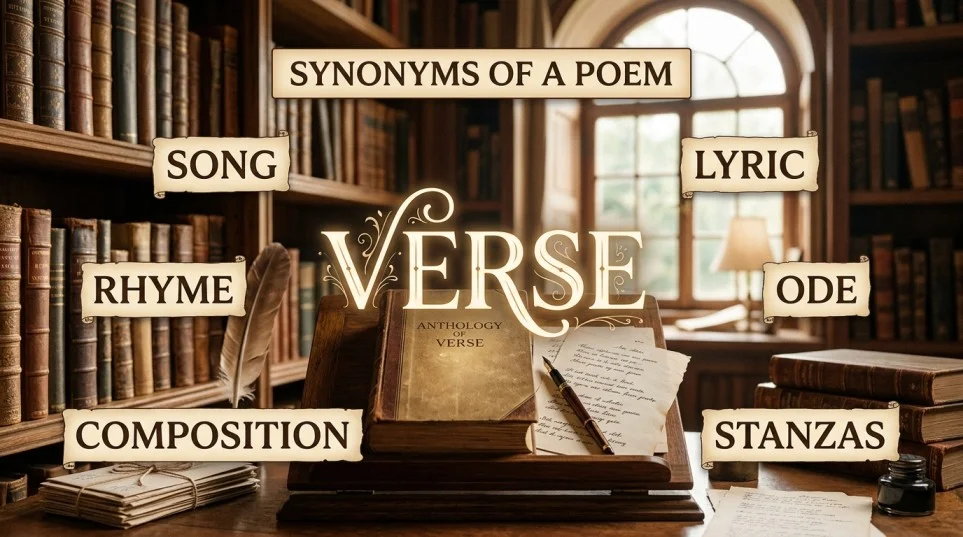
- Formal poetic forms: sonnet, ode, ballad, haiku, limerick, villanelle, rondeau, quatrain, canto
- Sad or mournful poems: elegy, dirge, threnody
- Musical or spoken poems: lyric, chant, hymn, madrigal, canticle, song
- Long story-telling poems: epic, lay, pastoral, idyll
- Playful or light poems: jingle, doggerel, epigram
- General or classic terms: verse, poesy, rhyme, rhapsody, composition
Sorting synonyms of poem this way helps a writer pick the exact word for tone, length, and purpose, instead of repeating the same general term.
Antonyms of Poem
- Prose (noun): ordinary writing without the rhythm or structure of poetry.
- Essay (noun): a piece of writing that explains ideas in plain, structured form.
- Report (noun): a factual account written in plain, straightforward language.
- Manual (noun): a practical guide written in clear instructional language.
- Article (noun): informative writing meant to explain facts rather than evoke feeling through rhythm.
Short Questions and Answers
- What does a poem mean? It means a piece of writing that uses rhythm, sound, and imagery to express feelings or ideas.
- When should a poem be used? Use it when talking about short or long creative writing that follows rhythm, rhyme, or strong imagery.
- Is the poem positive or negative? It usually feels positive, linked to beauty and emotion, though it can feel distant if the writing seems too complex.
- How is it different from similar words? Words like “prose” describe plain writing, while “poem” always carries rhythm or poetic structure. Compared to “song,” a poem does not always need music, though both can share similar feeling.
Conclusion
Learning poem and its many synonyms helps build a stronger, richer vocabulary. Knowing synonyms of poem lets writers and speakers avoid repeating the same word again and again in essays, reviews, or creative writing. It also helps express the exact type of writing, whether short and playful or long and serious. Studying synonyms of poem strengthens both writing and speaking skills, since each word carries its own shade of meaning and form. This kind of practice builds real confidence in English, helping learners describe creative writing with more color and precision. Keep exploring synonyms of poem and other literary words each day, even for a few minutes. Small, steady vocabulary practice adds up over time, and these words will soon feel natural to use.

I am a linguist with 7 years of experience in English language teaching, including postgraduate-level instruction. My expertise includes English grammar, and I contribute as a content and blog writer, producing scholarly and educational language resources.