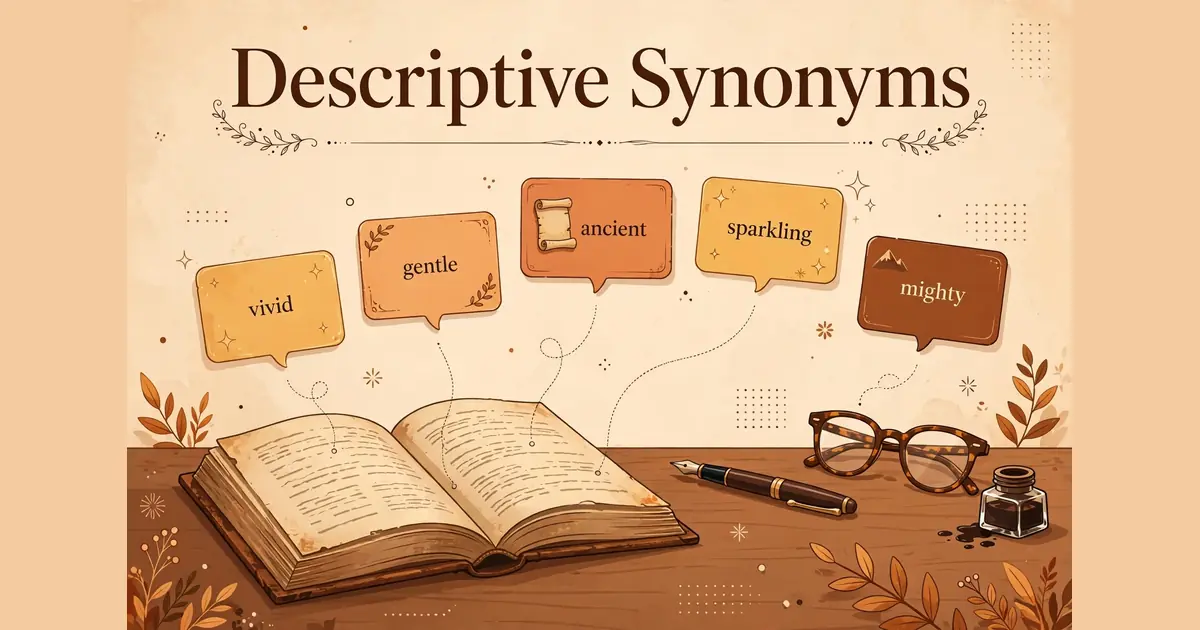
Descriptive synonyms are words that describe people, places, and things with exact detail — saying huge /hjud͡ʒ/ instead of big /bɪɡ/ , or tidy /ˈtaɪ.di/ instead of clean /kliːn/ . Common examples are huge, pristine, briskly, and vivid. These words show size, speed, manner, and condition with real precision.
A student stares at her essay. Every sentence says the food was “good” and the trip was “nice.” Her teacher circles the words in red and writes one comment in the margin: “Show me — don’t tell me.”
That is the moment descriptive words stop being decoration and start being the message itself.
Think of a weather report that only says “cold” on a morning that bites through your coat. “Biting” or “freezing” would have made you dress differently. One exact word changes what people picture — and what they do.
For students, precise descriptive words lift essay grades, because examiners reward exact vocabulary. For bloggers, they keep readers picturing the scene instead of skimming past it. Content writers use them to stop repeating “good” and “big” in every paragraph. For daily English users, they turn vague answers into clear ones at work, in messages, and in conversation. If you describe people often, our personality trait synonyms guide pairs naturally with this one.
“The difference between the almost right word and the right word is really a large matter — it is the difference between the lightning bug and the lightning.”
Words like big, good, and fast get used so often that they lose their punch. A reader glides over them and remembers nothing. A sharper synonym wakes the sentence up: enormous /ɪˈnoɹ.məs/ fixes a picture of real size in the mind, and a word like vivid fixes a picture of real color. That is why this list matters — every word below replaces a vague habit with an exact choice.
“Words are, of course, the most powerful drug used by mankind.”
Below, you will find 61 clear descriptive synonyms, each with a simple meaning and two easy examples.
Main Content: 61 Descriptive Synonyms
1. Adaptive /əˈdæp.tɪv/
- Meaning: able to adjust to new conditions (adjective).
- Examples: The adaptive app works on phones, tablets, and laptops. An adaptive leader changes the plan when the facts change. See synonyms of adaptive.
2. Aggressive /əˈɡɹɛs.ɪv/
- Meaning: forceful; pushing hard to win or succeed (adjective, often negative).
- Examples: They ran an aggressive sales campaign before the holidays. The company took an aggressive approach to expanding overseas.
3. Alike /əˈlaɪk/
- Meaning: similar; in the same way (adjective/adverb).
- Examples: The twins dress alike, but their personalities differ. The two villages look alike from the hilltop.
4. Arduous /ˈɑɹ.d͡ʒu.əs/
- Meaning: needing a lot of effort; very difficult (adjective, formal).
- Examples: Climbing the mountain was an arduous six-hour trek. Writing the report was an arduous task that took all week.
5. Astute /əsˈtjuːt/
- Meaning: clever at noticing and judging situations (adjective).
- Examples: Her astute questions showed she understood the contract fully. An astute investor spotted the trend before anyone else. Full list: synonyms of astute.
6. Briskly /ˈbɹɪskli/
- Meaning: quickly and with energy (adverb).
- Examples: She walked briskly to catch the morning train. He briskly swept the porch before the guests arrived. More at synonyms of briskly.
7. Blunt /blʌnt/
- Meaning: direct and plain-spoken; also, not sharp (adjective, informal).
- Examples: To be blunt, the first draft needs a lot of work. The knife was too blunt to cut the rope.
8. Crisp /kɹɪsp/
- Meaning: fresh and sharp; clear and brief (adjective, positive).
- Examples: The crisp morning air woke us up instantly. She gave a crisp summary of the whole meeting.
9. Dense /ˈdɛns/
- Meaning: thick; packed tightly together (adjective).
- Examples: The dense forest blocked most of the sunlight. A dense crowd filled the narrow street.
10. Drastic /ˈdɹæs.tɪk/
- Meaning: extreme and severe (adjective, strong).
- Examples: The company took drastic steps to cut costs. Prices rose by a drastic amount in a single year.
11. Challenging /ˈt͡ʃæl.ɪn.d͡ʒɪŋ/
- Meaning: difficult in a way that tests you (adjective).
- Examples: The puzzle was challenging, but we solved it together. It was a challenging exam, but a fair one.
12. Consistent /kənˈsɪs.tənt/
- Meaning: always behaving the same way; dependable (adjective).
- Examples: His consistent effort earned him a promotion. Her consistent kindness made her popular with everyone.
13. Continuous /kənˈtɪn.juː.əs/
- Meaning: continuing without a pause (adjective).
- Examples: We heard the continuous hum of the air conditioner. Continuous rain flooded the low fields.
14. Distinctive /dɪˈstɪŋktɪv/
- Meaning: clearly different; easy to recognize (adjective).
- Examples: Her distinctive laugh filled the whole room. The bird has a distinctive red crest.
15. Dysfunctional
- Meaning: not working normally (adjective).
- Examples: The dysfunctional printer jammed every second page. A dysfunctional team wastes everyone’s time.
16. Elegance /ˈɛl.ɪ.ɡəns/
- Meaning: graceful beauty in style or manner (noun, used descriptively).
- Examples: She handled the crisis with elegance and calm. The hall was decorated with simple elegance.
17. Elevated /ˈɛl.əˌveɪ.dɪd/
- Meaning: raised up; also, of high quality (adjective).
- Examples: The elevated walkway offers a great city view. His elevated mood lasted all day.
18. Federal /ˈfɛdəɹəl/
- Meaning: relating to a central government (adjective).
- Examples: Federal law requires seat belts in every car. The federal budget was announced on Monday.
19. Fragile /ˈfɹæd͡ʒaɪl/
- Meaning: easily broken; delicate (adjective).
- Examples: The fragile vase broke during the move. Handle the fragile eggs with care.
20. Gradual /ˈɡɹæd͡ʒuəl/
- Meaning: happening slowly, step by step (adjective).
- Examples: His gradual improvement impressed the coach. There was a gradual rise in temperature.
21. Half /ˈhæf/
- Meaning: partly; one of two equal parts (adjective/adverb).
- Examples: She was half asleep when the phone rang. He was only half convinced by the argument.
22. Hasty /ˈheɪsti/
- Meaning: done too quickly; rushed (adjective).
- Examples: Don’t make a hasty decision you will regret. She wrote a hasty note and left.
23. Huge /hjud͡ʒ/
- Meaning: extremely large (adjective).
- Examples: They live in a huge house near the lake. A huge crowd gathered outside the stadium.
24. Immediate /ɪˈmi.di.ɪt/
- Meaning: happening right now; without delay (adjective).
- Examples: We need an immediate answer before noon. The medicine had an immediate effect.
25. Inherent /ɪnˈhɪəɹənt/
- Meaning: a natural, built-in part of something (adjective).
- Examples: Risk is inherent in starting a business. There is an inherent risk in every investment.
26. Innate /ɪˈneɪt/
- Meaning: born with it; natural, not learned (adjective).
- Examples: Her innate musical talent showed at age four. Dogs have an innate sense of smell.
27. Keen /kin/
- Meaning: sharp; very eager or interested (adjective, common in British English).
- Examples: He has a keen eye for small details. She is keen to start her new job.
28. Maternal /məˈtɝnəl/
- Meaning: relating to a mother; caring like a mother (adjective).
- Examples: Her maternal instincts kicked in when the baby cried. The nurse showed maternal care toward the children.
29. Mild /ˈmaɪld/
- Meaning: gentle; not strong or harsh (adjective).
- Examples: We enjoyed the mild spring weather. He gave a mild reply instead of arguing.
30. Named /neɪmd/
- Meaning: given a particular name; appointed (adjective).
- Examples: The named suspect turned himself in yesterday. The named witness took the stand.
31. Nefarious /nɪˈfɛɹ.i.əs/
- Meaning: wicked; criminal (adjective, formal).
- Examples: The film’s villain had a nefarious plan. The nefarious scheme cheated hundreds of people.
32. Newfound /ˈn(j)u.faʊnd/
- Meaning: recently discovered or gained (adjective).
- Examples: She used her newfound freedom to travel. He tested his newfound skills at the workshop.
33. Occasionally /əˈkeɪʒənəli/
- Meaning: sometimes, but not often (adverb).
- Examples: We occasionally eat dinner at that Italian place. She occasionally works on weekends.
34. Once Again
- Meaning: one more time; again (adverb phrase).
- Examples: Once again, the train arrived ten minutes late. Once again, he forgot his keys at home.
35. Overzealous /ˌəʊvəˈzɛləs/
- Meaning: too eager; trying too hard (adjective, negative).
- Examples: The overzealous guard checked our bags twice. An overzealous fan shouted through the whole match.
36. Permanent /ˈpɝ.mə.nənt/
- Meaning: lasting forever; not temporary (adjective).
- Examples: They are looking for a permanent home, not a rental. The accident left a permanent mark.
37. Pristine /ˈprɪˌstin/
- Meaning: perfectly clean; untouched (adjective, formal tone).
- Examples: The pristine snow covered the whole valley. They keep their kitchen pristine.
38. Productive /pɹəˈdʌk.tɪv/
- Meaning: producing good results (adjective).
- Examples: It was a productive meeting with clear decisions. A productive morning cleared my whole inbox. See synonyms of productive.
39. Prompt /pɹɑm(p)t/
- Meaning: done without delay; quick (adjective).
- Examples: Thank you for your prompt reply to my email. Prompt action prevented a bigger problem.
40. Quantitative /ˈkwɒntətɪv/
- Meaning: measured in numbers (adjective).
- Examples: The study used quantitative data from 500 surveys. We need quantitative evidence, not opinions.
41. Relentless /ɹɪˈlɛntləs/
- Meaning: never stopping; harsh and constant (adjective, usually negative).
- Examples: The relentless rain flooded the streets. Her relentless practice made her a champion.
42. Remote /ɹəˈməʊt̞/
- Meaning: far away; isolated (adjective).
- Examples: They grew up in a remote mountain village. They hiked for two days to reach the remote lake.
43. Ruined /ˈɹuɪnd/
- Meaning: completely destroyed or spoiled (adjective).
- Examples: The ruined castle attracts thousands of tourists. The rain ruined our picnic plans.
44. Scarce /ˈskɛɚs/
- Meaning: hard to find; in short supply (adjective).
- Examples: Clean water is scarce in this region. Jobs were scarce that winter.
45. Sheer /ʃɪɚ/
- Meaning: complete; also, very thin or steep (adjective).
- Examples: It was sheer luck that we found the keys. She climbed the sheer cliff face.
46. Small /smɔl/
- Meaning: little in size or amount (adjective).
- Examples: They adopted a small dog from the shelter. He took a small sip of water.
47. Sturdy /ˈstɜrdi/
- Meaning: strong and solidly built (adjective, positive).
- Examples: The sturdy table held all the heavy boxes. Sturdy boots are essential for the hike.
48. Subtle /ˈsʌtəl/
- Meaning: not obvious; delicate and clever (adjective, often positive).
- Examples: There was a subtle change in her tone. The sauce has a subtle flavor of lemon.
49. Thirdly /ˈθɚdli/
- Meaning: as the third point (adverb).
- Examples: Thirdly, we must consider the budget limits. Thirdly, the plan saves money for everyone.
50. Thorough /ˈθʌɹoʊ/
- Meaning: complete; paying attention to every detail (adjective).
- Examples: She gave the report a thorough review. The doctor gave him a thorough checkup.
51. Tidy /ˈtaɪ.di/
- Meaning: neat, clean, and organized (adjective).
- Examples: He keeps a tidy desk with everything labeled. She keeps a tidy garden all year.
52. Unfamiliar /ˌʌnfəˈmɪli.ə(ɹ)/
- Meaning: not known; strange to you (adjective).
- Examples: The unfamiliar streets confused us at first. An unfamiliar name appeared on the list.
53. Unified /ˈjunəfaɪd/
- Meaning: joined into one; acting together (adjective).
- Examples: The team gave a unified response to the press. The players presented a unified front.
54. Unknown /ʌnˈnoʊn/
- Meaning: not known or identified (adjective).
- Examples: The author of the letter remains unknown. The cause of the fire is still unknown.
55. Unlimited /ʌnˈlɪm.ɪ.tɪd/
- Meaning: without any limit (adjective).
- Examples: The plan includes unlimited calls and texts. The gym offers unlimited classes.
56. Upscale /ˈʌpskeɪl/
- Meaning: high-class; expensive in style (adjective, marketing tone).
- Examples: They stayed at an upscale hotel downtown. An upscale boutique opened on the corner.
57. Used /juzd/
- Meaning: not new; already owned or employed (adjective).
- Examples: She bought a used car in good condition. He sold his used textbooks online.
58. Vague /væɡ/
- Meaning: unclear; not specific (adjective).
- Examples: His vague answer did not satisfy the teacher. She gave only a vague description of the man.
59. Variables
- Meaning: things that can change (noun, used descriptively).
- Examples: The scientists controlled all the variables. Weather variables affect the harvest.
60. Vivid /ˈvɪvɪd/
- Meaning: bright, strong, and very clear (adjective, positive).
- Examples: She gave a vivid description of the festival. He has vivid memories of the trip.
61. Zealous /ˈzɛləs/
- Meaning: full of eager energy for a cause (adjective, strong feeling).
- Examples: The zealous fans waited hours for tickets. She is zealous about protecting the park.
Descriptive Synonyms for Work Writing
Resumes, reports, and business emails need descriptive words that sound professional without sounding stiff. These six are safe, strong choices:
- Efficient /ɪˈfɪʃənt/ — working well without wasting time or effort. “An efficient filing system.”
- Proactive /pɹoʊˈæk.tɪv/ — acting early instead of reacting late. “A proactive approach to customer issues.”
- Meticulous /məˈtɪ.kjə.ləs/ — extremely careful about details. “Meticulous record-keeping.”
- Versatile /ˈvɜː.sə.təl/ — able to do many different things well. “A versatile team member.”
- Consistent /kənˈsɪs.tənt/ — delivering the same quality every time. “Consistent monthly growth.”
- Streamlined — made simpler and more effective. “A streamlined checkout process.”
Tip: in work writing, pair one descriptive word with one number whenever you can — “consistent 20% monthly growth” beats “good growth” every time.
Descriptive Synonyms for Formal Writing
Many descriptive synonyms come in pairs — one for formal writing, one for everyday talk. Picking the right one keeps your tone correct. In a report, write enormous /ɪˈnoɹ.məs/ ; in a chat with friends, huge /hjud͡ʒ/ sounds natural. News writing prefers rapid growth, while daily speech uses fast /fɑːst/ decisions. A fatigued /fəˈtiːɡd/ crew belongs in a news report; “I’m tired” belongs in a message to a friend.
The same pattern runs through the whole vocabulary. Formal irate customers appear in business writing, but people simply say angry /ˈæŋ.ɡɹi/ at home. A pristine /ˈprɪˌstin/ beach draws tourists in a travel brochure, while a spotless /spɑtlɪs/ kitchen is everyday praise. Stories use the diminutive /dəˈmən.jə.təv/ figure; children point at the tiny /ˈtaɪni/ puppy. An email says “We are pleased /pliːzd/ to announce”; a friend says “I’m happy /ˈhæpi/ to help.” And the weary /ˈwɪɹi/ travelers of a novel become simply beat /biːt/ after a run in real speech.
Descriptive Synonyms in Everyday Sentences
The fastest way to feel the value of these words is to watch one precise word transform a flat sentence:
- Before: “She gave a good /ɡʊd/ talk.”
After: “She gave a compelling /kəmˈpɛlɪŋ/ talk.” — compelling tells us the talk held everyone’s attention. - Before: “He walked fast /fɑːst/ to the station.”
After: “He walked briskly /ˈbɹɪskli/ to the station.” — briskly adds energy and purpose. - Before: “The room was clean /kliːn/ .”
After: “The room was pristine /ˈprɪˌstin/ .” — pristine suggests untouched perfection. - Before: “We had a big /bɪɡ/ problem.”
After: “We had a critical /ˈkɹɪt.ɪ.kəl/ problem.” — critical signals urgency, not just size. - Before: “His answer was not clear.”
After: “His answer was vague /væɡ/ .” — one word replaces three.
Practice this swap daily: take one vague word from something you wrote and replace it with a sharper one from the main list. Within weeks, precision becomes a habit.
Descriptive Synonyms People Mix Up
Even strong learners mix these pairs up. Check yourself against the five most common errors:
- Continuous vs. continual: continuous /kənˈtɪn.juː.əs/ means without any pause (a continuous noise); continual /kənˈtɪnjuəl/ means repeated with breaks (continual interruptions).
- Historic vs. historical: historic /hɪˈstoɹɪk/ means famous in history (a historic win); historical /hɪˈstɔɹɪkəl/ means relating to history (a historical novel).
- Very unique: unique /juːˈniːk/ means one of a kind — it cannot have degrees. Say truly unique or just unique, never very unique.
- Literally: literally /ˈlɪ.tə.ɹə.li/ means actually true. “I literally ran ten miles” is only correct if you really ran. For exaggeration, use practically /ˈpɹæk.tɪ.k(ə.)li/ or virtually /ˈvɚ.t͡ʃə.wə.li/ .
- Alternate vs. alternative: alternate /ɒlˈtɜː(ɹ).nət/ means every other one (alternate days); alternative /ɔlˈtɝ.nə.tɪv/ means a different choice (an alternative plan).
Descriptive Synonyms for Speaking and Writing
Descriptive words do two jobs. Adjectives describe nouns — people, places, and things: a sturdy table, a vague answer, a relentless storm. Adverbs describe verbs, adjectives, or other adverbs — how, when, or how often something happens: walked briskly, occasionally visits, thirdly, note that…
A quick clue: many adverbs end in -ly /li/ (briskly /ˈbɹɪskli/ , thirdly /ˈθɚdli/ ), but not all — occasionally /ɵˈkeɪʒənəli/ does, yet fast /fɑːst/ and half /ˈhæf/ work as adverbs without it. In speaking, favor shorter, warmer choices (huge /hjud͡ʒ/ , keen /kin/ , tidy /ˈtaɪ.di/ ); in writing, you can afford the precise, formal ones (quantitative /ˈkwɒntɪˌteɪtɪv/ , nefarious /nɪˈfeɪəɹi.əs/ ).
Strong Descriptive Synonyms
When a plain word feels too weak, reach for a strong one. Drastic /ˈdɹæstɪk/ , relentless /ɹɪˈlɛntləs/ , and zealous /ˈzɛləs/ carry force that big, constant, and eager cannot match.
Think in ladders of intensity. Anger climbs from annoyed to angry to irate /aɪˈɹeɪt/ to furious. Size climbs from small /smɔl/ to large to huge /hjud͡ʒ/ to enormous /ɪˈnɔɹməs/ . Happiness climbs from pleased /plizd/ to happy /ˈhæpi/ to thrilled. Tiredness climbs from tired /taɪɚd/ to weary /ˈwɪɹi/ to exhausted /ɪɡˈzɔstɪd/ . Choose the rung that matches the truth — too strong is as misleading as too weak.
Positive Descriptive Synonyms
For praise, encouragement, and warm description, keep these positive words ready:
- Vivid /ˈvɪvɪd/ — bright and full of life
- Crisp /kɹɪsp/ — fresh, clear, and pleasingly sharp
- Pristine /ˈprɪˌstin/ — perfectly clean and fresh
- Sturdy /ˈstɜrdi/ — strong and reliable
- Subtle /ˈsʌtəl/ — gentle and cleverly understated
Add astute /əˈstut/ , distinctive /dɪˈstɪŋktɪv/ , productive /pɹəˈdʌktɪv/ , thorough /ˈθʌɹoʊ/ , and tidy /ˈtaɪ.di/ from the main list, and you have a praise vocabulary for any report, review, or recommendation letter.
Synonyms and Antonyms for Descriptive Words
Every descriptive word sits between a synonym (a word with a similar meaning) and an antonym (its opposite). Huge /hjud͡ʒ/ pairs with enormous /ɪˈnɔɹməs/ and opposes tiny /ˈtaɪni/ . Scarce /ˈskɛɚs/ pairs with rare /ɹɛɚ/ and opposes plentiful /ˈplɛn.tɪ.fəl/ . Permanent /ˈpɝmənənt/ pairs with lasting /ˈlæstɪŋ/ and opposes temporary /ˈtɛmpəˌɹɛɹi/ .
Learning words in these triples — word, synonym, antonym — anchors each meaning from two directions and doubles the vocabulary you gain from every study session.
FAQ Section: People Also Ask
What is the difference between a synonym and a descriptive synonym?
A synonym is any word with a similar meaning to another word — begin /bəˈɡɪn/ and start /stɑɹt/ are synonyms. A descriptive synonym is narrower: the word must describe a quality of a person, place, thing, or action, the way vivid /ˈvɪvɪd/ or briskly /ˈbɹɪskli/ does.
So every descriptive synonym is a synonym, but not every synonym is descriptive. Most descriptive synonyms are adjectives, with adverbs close behind.
Can adverbs be descriptive synonyms?
Yes. Adverbs describe how, when, or how often an action happens, and that is description. Briskly /ˈbɹɪskli/ tells you how someone walked, and occasionally /ɵˈkeɪʒənəli/ tells you how often.
In this list, briskly /ˈbɹɪskli/ , occasionally /ɵˈkeɪʒənəli/ , and thirdly /ˈθɚdli/ are the adverb entries, sitting alongside the adjectives.
How many descriptive synonyms should I learn?
Start with 20 to 30 high-use words — enough to transform daily writing without overwhelming you. The 61 in this list are a complete working set; learn them in small groups over a few weeks.
Quality beats quantity: five words you actually use are worth more than fifty you only recognize. Add new ones only when the old ones feel automatic.
What is the fastest way to remember descriptive words?
Use each new word in a real sentence the same day you learn it — about your own life, not a textbook example. Personal sentences stick because they carry a picture and a feeling.
Then meet the word again within 48 hours: re-read your sentence, say it aloud, and look for a chance to use it in speech or a message. Two real uses beat ten flashcard rounds.
Conclusion
Descriptive synonyms turn flat sentences into clear pictures. The 61 words in this list — from adaptive /əˈdæptɪv/ to zealous /ˈzɛləs/ — cover size, speed, feeling, quality, and character for essays, work writing, and everyday talk.
“The limits of my language mean the limits of my world.”
Every precise word you add widens that world a little — one clearer sentence at a time.
“Words, like nature, half reveal and half conceal the soul within.”
Choose words that reveal more than they conceal, and your meaning will reach your reader intact.
Keep building your word power with action verb synonyms for stronger sentences and emotion synonyms for describing feelings with the same precision.
Keep this list close by. Come back whenever “big” or “good” feels too plain, and let these 61 words help your writing describe the world exactly as you see it.

Irshad Ullah is a linguist with an M.Phil. in Applied Linguistics and an M.Ed. He has 17 years of experience teaching English language to postgraduate classes and 10 years of experience in content writing.