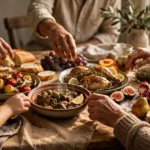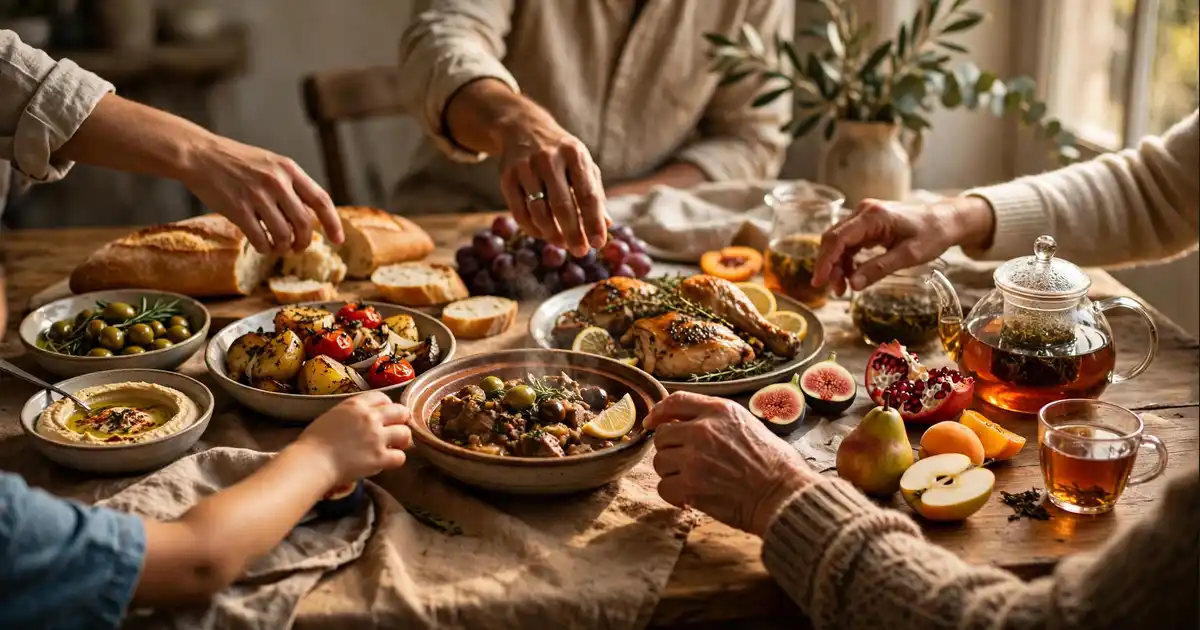
Synonyms of food are words that name the things we eat — from a quick snack to a wedding feast. Food /fuːd/ /fuːd/ is the general word for anything people or animals eat to live and grow. Common examples are meal, dish, cuisine, and nourishment. These words divide by size, style, and setting — some name a single plate, some a whole tradition, and some the life-giving value inside what we eat.
| Synonym | Meaning |
|---|---|
| Meal | food eaten at one sitting |
| Dish | food cooked in one particular way |
| Snack | small food between main meals |
| Cuisine | cooking style of a place |
| Fare | food served or offered somewhere |
| Nourishment | what food gives the body |
| Sustenance | basic food that keeps alive |
| Feast | large rich meal for celebration |
| Dinner | main meal of the day |
| Grub | informal word for plain food |
Below, you will find 30 clear synonyms for food, each with a simple meaning and two easy examples.
Main Content: 30 Synonyms for Food
1. Meal /ˈmiːl/
- Meaning: food eaten at one regular time of day — breakfast, lunch, or dinner. A meal is an occasion as much as a menu: the same soup is just soup at noon, but it becomes a meal when people sit down to it together.
- Examples: We sat down to a hot meal after the long drive. The hostel serves two meals a day to its guests.
2. Dish /dɪʃ/
- Meaning: food cooked and served in one particular way — a curry, a stew, a salad — and also the plate or bowl it arrives in. When a cook is famous for one dish, that single recipe carries their whole reputation.
- Examples: Her signature dish is a slow lamb curry. Each guest brought a dish to share at the party.
3. Snack /snæk/
- Meaning: a small amount of food eaten between the main meals, usually quick and informal. A snack fills a gap rather than a table — it is measured in handfuls, not courses.
- Examples: He packed nuts and fruit as a train snack. The children wanted a snack as soon as school ended.
4. Bite /baɪt/
- Meaning: a small piece of food, or a quick light meal in the phrase “a bite to eat”. Bite is the smallest unit on this list — one mouthful — which is why it doubles as the everyday word for grabbing something fast.
- Examples: She offered him a bite of her sandwich. Let’s grab a bite before the film starts.
5. Cooking /ˈkʊk.ɪŋ/
- Meaning: food that has been cooked, or the style in which it is prepared, as in “home cooking”. Cooking praises the hand behind the food — it is the word we reach for when the maker matters as much as the meal.
- Examples: Nothing beats my grandmother’s cooking on a cold day. The small hotel is famous for its plain, honest cooking.
6. Cuisine /kwɪˈziːn/
- Meaning: a style of cooking linked to a place, a culture, or a class of restaurant. Cuisine is a slightly formal, respectful word — a single cook makes a dish, but a whole people makes a cuisine.
- Examples: Thai cuisine balances sweet, sour, salt, and heat. The course introduced students to classic French cuisine.
7. Fare /fɛɹ/ /feə/
- Meaning: the food served or offered in a place — the inn’s fare, the festival’s fare. Fare sounds slightly formal or old-fashioned in speech, but it lives happily in fixed phrases like “traditional fare” and “hearty fare”.
- Examples: The old inn serves simple country fare. Festival fare included roasted corn and spiced tea.
8. Nourishment /ˈnɝ.ɪʃ.mənt/ /ˈnʌr.ɪʃ.mənt/
- Meaning: the substances in food that keep the body alive, healthy, and growing. Nourishment is the formal, health-focused member of the family — doctors and diet guides use it when the point is what food does inside you, not how it tastes.
- Examples: Babies need steady nourishment in the first year of life. The thin soup gave the sick man very little nourishment.
9. Sustenance /ˈsʌs.tə.nəns/
- Meaning: food that keeps you alive, especially the plain basics. Sustenance is more serious than nourishment — it belongs to survival stories, journeys, and hard times, where eating is about lasting one more day.
- Examples: The trapped miners survived on very little sustenance. For this village, rice is the main sustenance of life.
10. Diet /ˈdaɪ.ət/
- Meaning: the food that a person or animal normally eats, day after day. Diet also names a planned way of eating chosen to lose weight or protect health — but its older, wider sense is simply “what a creature lives on”.
- Examples: A balanced diet includes fruit, grains, and protein. His diet changed completely after the diagnosis.
11. Victuals /ˈvɪt.əlz/
- Meaning: food and drink supplies, in an old-fashioned, literary word. Mind the trap: it is spelled with a c but pronounced “vittles” — the spelling kept the Latin shape while the sound walked away centuries ago.
- Examples: The ship loaded victuals for a six-week voyage. Old letters home list the victuals sent to the fort.
12. Repast /rɪˈpæst/ /rɪˈpɑːst/
- Meaning: a meal, in a formal and literary word that modern speakers almost never use aloud. Repast survives in novels and old histories — choose it only when you want your writing to wear period dress.
- Examples: After the long ride, they enjoyed a cold repast. The novel ends with a joyful wedding repast.
13. Provisions /prəˈvɪʒ.ənz/
- Meaning: supplies of food and drink stored up for a journey, an army, or a household. Provisions are food with a plan behind it — bought before the need arrives, and counted with care.
- Examples: The expedition carried provisions for forty days. She stocked the pantry with provisions before the storm.
14. Rations /ˈræʃ.ənz/
- Meaning: a fixed share of food given out when supply is limited — to soldiers, prisoners, sailors, or a whole country in wartime. A ration is food measured by authority, not by appetite.
- Examples: The soldiers received daily rations of bread and dried meat. During the drought, food rations were cut across the region.
15. Refreshments /rɪˈfreʃ.mənts/
- Meaning: small amounts of food and drink served at a meeting, a party, a match, or an event. Refreshments are the polite, organised member of the family — nobody calls dinner “refreshments”, because the word promises light, quick, and served to guests.
- Examples: Refreshments will be served in the hall after the talk. The volunteers handed out refreshments to the runners.
16. Delicacy /ˈdel.ə.kə.si/ /ˈdel.ɪ.kə.si/
- Meaning: a rare, special, or expensive food that people treat as a luxury. What counts as a delicacy depends on the culture — one country’s everyday supper is another country’s prized delicacy, which makes the word a small lesson in taste itself.
- Examples: In some regions, roasted insects are eaten as a delicacy. The tiny fish eggs are sold abroad as a delicacy.
17. Feast /fiːst/
- Meaning: a large, rich meal for many people, usually held to celebrate something. A feast is food plus occasion plus crowd — weddings, harvests, and festivals all end at a feast, and the word stretches further in phrases like “a feast for the eyes”.
- Examples: The whole street shared the wedding feast. After the harvest, the farmers held a great feast.
18. Banquet /ˈbæŋ.kwɪt/
- Meaning: a formal dinner for many guests, often with speeches, awards, or honoured visitors. Banquet is the grandest word on this list — a feast can happen around a farmhouse table, but a banquet needs a hall, a seating plan, and a reason.
- Examples: The awards banquet seated four hundred guests. A banquet was held in honour of the visiting team.
19. Spread /spɹɛd/
- Meaning: a generous display of food laid out for guests to help themselves. Spread is warm and informal — it praises the giver’s generosity, and it pictures the table, not the cooking.
- Examples: Grandmother put on quite a spread for the holiday. The picnic spread covered three blankets end to end.
20. Treat /tɹiːt/
- Meaning: a special, enjoyable food eaten for pleasure rather than need — the cake, the ice cream, the festival sweet. A treat is defined by the smile, not the size: it can be one chocolate, as long as it feels like a reward.
- Examples: The children earned ice cream as a treat. She bought herself a small cake as a Friday treat.
21. Grub /ɡɹʌb/
- Meaning: an informal word for food, especially plain, everyday food with no ceremony about it. Grub is cheerful and slightly rough — perfect for camps, cafés, and hungry friends, wrong for a formal menu.
- Examples: Let’s get some grub before the game starts. The little café serves cheap, decent grub all day.
22. Eats /iːts/
- Meaning: a very informal word for food, mostly American, often pointing at what a place serves. Eats began as a verb wearing a noun’s clothes, and it still sounds like a road sign: short, hungry, and in a hurry.
- Examples: That little diner does the best eats in town. We stopped for eats at a village stall on the highway.
23. Chow /tʃaʊ/
- Meaning: slang for food or a meal, with strong military roots — soldiers still line up for chow. Chow sounds hearty rather than fine: nobody serves chow on porcelain, and that is exactly its charm.
- Examples: The soldiers lined up for chow at six sharp. He cooked up some chow for the whole work crew.
24. Fodder /ˈfɑ.dɚ/ /ˈfɒd.ə/
- Meaning: food for farm animals, especially dried hay, straw, and grain. Use fodder for people only as a joke or an insult — its second, figurative sense names anything used up without much thought, like stories feeding the tabloids.
- Examples: The barn stores fodder for the long winter. Cheap scandals became fodder for the evening papers.
25. Feed /fiːd/
- Meaning: food for animals, sold and stored by the bag — chicken feed, cattle feed. In some dialects feed also crosses over to people, naming a hearty meal: after hard work, a worker may sit down to “a good feed”.
- Examples: The farmer bought chicken feed by the sack. After the match, the whole team enjoyed a big feed.
26. Breakfast /ˈbɹɛk.fəst/
- Meaning: the first meal of the day, eaten in the morning. Breakfast names an occasion, not food in general — its very name tells the story, since it breaks the fast of the night.
- Examples: Breakfast at the hotel is served until ten. He never skips breakfast before a long ride.
27. Brunch /brʌntʃ/
- Meaning: a late-morning meal that joins breakfast and lunch in one sitting — the word itself is their blend. Brunch belongs to slow days and weekends, when nobody wants to choose between eggs and a full lunch.
- Examples: We met for brunch at eleven on Sunday. The café’s weekend brunch draws a long queue.
28. Lunch /lʌntʃ/
- Meaning: the meal eaten in the middle of the day. Lunch is the working day’s hinge — schools, offices, and building sites all stop for it, and in many homes it is bigger than the evening meal.
- Examples: Lunch is served in the hall at one o’clock. She packed a lunch for the children’s field trip.
29. Dinner /ˈdɪn.ɚ/ /ˈdɪn.ə/
- Meaning: the main meal of the day. For most speakers today dinner is the evening meal, but in some regions and older traditions it is eaten at midday — which is why school meals in Britain are still called “school dinners” at noon.
- Examples: Dinner at their house is always at seven. The whole family gathered for a roast dinner.
30. Supper /ˈsʌp.ɚ/ /ˈsʌp.ə/
- Meaning: a light evening meal, often the last food of the day. Where dinner is the main evening meal, supper shrinks to soup and bread before bed; in some homes the two words simply trade places, so listen to the household, not the dictionary.
- Examples: We had soup and warm bread for supper. Supper was late because the train was delayed.
Synonyms for Food in Formal Writing
Formal writing sends the plain word “food” to the back of the room and brings forward its dressed-up relatives. Nourishment /ˈnɝ.ɪʃ.mənt/ is the scientist’s and doctor’s choice — it names what food gives the body, which is why reports on child health speak of nourishment, never of grub. Sustenance /ˈsʌs.tə.nəns/ goes one step graver: it is food as survival, the word of famine reports and mountain rescues. Behind them stand two antiques — victuals /ˈvɪt.əlz/ for supplies in period writing, and repast /rɪˈpæst/ for a meal in a novel — both correct, both unmistakably old.
Between the clinic and the antique shop sits fare /fɛɹ/ , the food writer’s favourite for what a place serves: “simple fare”, “seasonal fare”, “hearty fare”. And when formal writing turns to the body’s side of eating — how much goes in, and when — it speaks of intake, the subject our guide to synonyms of intake takes apart. The rule of the formal register is simple: the further the word stands from the kitchen, the more respect it commands — and the less appetite it wakes.
Synonyms for Food at a Celebration
When food is the party, four words do the heavy lifting:
- Feast /fiːst/ Meaning: the big, joyful meal itself. Examples: The wedding feast lasted until midnight.
- Banquet /ˈbæŋ.kwɪt/ Meaning: the formal, seated, speech-making version. Examples: The club held its annual banquet in December.
- Spread /spɹɛd/ Meaning: everything laid out for guests to wander through. Examples: Neighbours added their own dishes to the spread.
- Delicacy /ˈdel.ə.kə.si/ Meaning: the one rare item everyone talks about. Examples: A single local delicacy anchored the whole table.
- Treat /tɹiːt/ Meaning: the sweet reward at the end of it all. Examples: Every child left the party with a treat.
Choose by dress code: a feast wears anything, a banquet wears a suit, and a spread wears an apron. And when the celebration turns sweet, our guide to synonyms of sweets covers the cakes, candies, and desserts that finish the table.
Another Word for Food in Everyday Speech
Everyday speech likes its food words short and a little hungry. Grub /ɡɹʌb/ is the all-rounder — plain food, honestly named, at home in any café or campsite on earth. Eats /iːts/ is its American cousin, the word on the hand-painted sign outside a roadside diner. Chow /tʃaʊ/ marched out of the army canteen into civilian life and still sounds like a meal eaten standing up, between jobs.
For smaller appetites, speech shrinks the word to match: a bite /baɪt/ when there is no time, a snack /snæk/ when there is no table. None of these words would survive five minutes on a formal menu — and that is precisely why they flourish everywhere else.
Synonyms for Food at Different Meals of the Day
Strictly speaking, the day’s meal names are synonyms of food only in context: each one names an occasion first and a menu second. Breakfast /ˈbɹɛk.fəst/ opens the day, brunch /brʌntʃ/ stretches the morning, and lunch /lʌntʃ/ holds the middle. The evening is shared between dinner /ˈdɪn.ɚ/ , the main meal whenever it falls, and supper /ˈsʌp.ɚ/ , the lighter, later one.
The same plate can change its name with the clock — eggs at eight are breakfast, at noon they are lunch, and at a midnight kitchen table they become a snack or a guilty supper. That is the quiet lesson of this group: English names meals by when they happen, and trusts you to know what is on the plate.
Strong Synonyms for Food
When food must carry real weight, three words outrank the rest. Nourishment /ˈnɝ.ɪʃ.mənt/ is the strongest word for what food does to a body — it is the term of doctors, nurses, and anyone feeding the weak back to strength. Sustenance /ˈsʌs.tə.nəns/ is the strongest word for food as survival, the word that appears when there is barely enough. And feast /fiːst/ is the strongest word for quantity and joy together — no other synonym promises so much food, for so many people, in such good spirits. Choose nourishment for health, sustenance for hardship, and feast for celebration — and keep plain “food” for everything in between.
Positive Synonyms for Food
Some words in the family sound delicious the moment you hear them. Start with these:
- Delicacy /ˈdel.ə.kə.si/ Meaning: the rare item everyone hopes to taste. Examples: Travellers crossed the province for one famous delicacy.
- Treat /tɹiːt/ Meaning: food as a small reward. Examples: A warm pastry is the perfect winter treat.
- Cuisine /kwɪˈziːn/ Meaning: a whole cooking tradition, praised in one word. Examples: She fell in love with the local cuisine in a week.
- Feast /fiːst/ Meaning: plenty, shared with pleasure. Examples: Sunday lunch at their farm is a feast.
- Refreshments /rɪˈfreʃ.mənts/ Meaning: the welcome tray at any gathering. Examples: Light refreshments waited at the garden gate.
Synonyms and Antonyms of Food
Food is the presence of the thing that keeps us alive. Meal, dish, cuisine, and nourishment cover most of its ground, from the daily plate to the whole art of cooking, while the words at the other end of the scale name its absence. At the mild end stands plain hunger /ˈhʌŋ.ɡɚ/ /ˈhʌŋ.ɡə/, the body’s ordinary request for a meal. Beyond it lies starvation /stɑɹˈveɪ.ʃən/ , suffering and death from long lack of food, and famine /ˈfæm.ɪn/ , the same disaster widened to a whole land. Between choice and disaster sits fasting — going without food on purpose, for faith or health; our guide to synonyms of fasting explores that deliberate empty plate. Every synonym in this article is, in the end, a direction away from those three dark words.
FAQ Section: People Also Ask
What are the best synonyms of food?
The best all-purpose synonyms are meal, dish, snack, and cuisine. Meal names food at one sitting, dish names one cooked item, snack names a small amount between meals, and cuisine names a whole style of cooking — between them, they cover most plates you will ever describe.
For special settings, reach further into the family. Feast and banquet lead at celebrations, nourishment and sustenance lead in formal and health writing, and grub leads almost everywhere friends are talking.
What is the most formal word for food?
The most formal everyday option is nourishment, the word of doctors and health reports, with sustenance close behind it in graver, survival-flavoured writing. Older still are victuals and repast, which now belong to novels and history books rather than to speech.
Formality rises as appetite falls, so choose by audience. A medical leaflet can carry nourishment without blinking; a café menu should leave all four in the drawer and say food, meals, or dishes instead.
How do you pronounce food?
In American English, say food /fuːd/ ; in British English, the sound is the same, /fuːd/ . It is one clean syllable that rhymes with “mood” — the double o holds a long “oo”, never the short sound of “foot”.
The real pronunciation trap in this family is not food but victuals: spelled with a c, it is spoken as “vittles”, /ˈvɪt.əlz/. English kept the learned spelling and the old sound side by side, and learners simply have to learn the pair together.
What is the difference between food and cuisine?
Food is the thing itself — anything eaten, by anyone, anywhere. Cuisine is food with an address: the dishes, methods, and tastes of one place or people, built up over generations. A single tomato is food; the whole Italian way with tomatoes is cuisine.
In practice, you eat food every day and meet cuisine when you travel, celebrate, or study a culture. Writers use food for the substance and cuisine for the tradition — which is why a town can have plenty of food and still, proudly or sadly, no cuisine of its own.
Conclusion
The synonyms of food all point at one daily miracle: turning simple things — grain, fruit, fire, and time — into the meals that hold a day, a family, and a culture together. Whether the plate is called a humble snack at a desk, fare at a country inn, or a banquet in a great hall, it is always built the same way: something grown, something cooked, and someone to share it with.
“One cannot think well, love well, sleep well, if one has not dined well.”
Use the word that fits your table, and notice what happens after the meal as well — our synonyms of digest guide collects the words for the body’s quiet work once the plates are cleared.
“Tell me what you eat, and I will tell you what you are.”
Every meal you name is quietly choosing between plain survival and real nourishment. Choose the richer word — and then cook the richer meal.

Irshad Ullah is a linguist with an M.Phil. in Applied Linguistics and an M.Ed. He has 17 years of experience teaching English language to postgraduate classes and 10 years of experience in content writing.