Imagine starting a new job in a busy store. On your first day, the computer system breaks down. Instead of stopping, you grab a notepad, track sales by hand, and keep customers happy. In this real-life situation, you showed an adaptive mindset. People use the word adaptive to describe anyone or anything that changes quickly to fit new conditions.
Learning synonyms for common words is essential for English learners and SEO content writers. Repeating the same word makes writing boring, while using clear synonyms expands your vocabulary, sharpens your message, and engages your readers.
This guide explores the exact meaning of adaptive along with its full linguistic breakdown. You will learn its dictionary definition, natural example sentences, emotional tones, word origin, IPA pronunciation, and syllabic structure. Furthermore, this article covers 30 powerful synonyms grouped into clear categories, key antonyms, prototype meanings, and answers to short questions to boost your English skills.
Meaning of Adaptive
Definition
Adaptive (Adjective): Able to change easily to fit new conditions or environments.
Examples
- The company created an adaptive software program that updates itself automatically.
- She succeeded in her new school because of her adaptive personality.
Connotative Meaning
Connotation means the emotional feeling or idea that a word carries beyond its literal definition.
- Positive tone: Shows intelligence, high resilience, survival skill, and fast learning.
- Negative tone: Can rarely mean a lack of stable principles if a person changes too quickly.
- Neutral tone: Describes a basic scientific or physical change in response to surroundings.
Etymology
- Source Language: Derived from Latin adaptāre, combining ad- (to or toward) and aptāre (to fit or join).
- Old English (450–1100): The word did not exist in Old English. Speakers used Germanic terms like gemæt (fit) or geferlic (suitable).
- Middle English (1100–1500): Borrowed into English through Old French as the verb adapten (“to fit something for a purpose”).
- Modern English (1500–Present): The adjective form adaptive appeared in the 18th century by joining adapt with the adjective suffix -ive.
Pronunciation
- US: /əˈdæp.tɪv/
- UK: /əˈdæp.tɪv/
Syllables
a-dap-tive
Affixation Pattern of Adaptive
- Root: Adapt
- Prefix: None
- Suffix: -ive (forming an adjective meaning “tending to” or “performing an action”)
- Word Formation:
- Adapt (Verb)
- Adaptation (Noun)
- Adaptability (Noun)
- Adaptively (Adverb)
- Adaptive (Adjective)
- Adaptiveness (Noun)
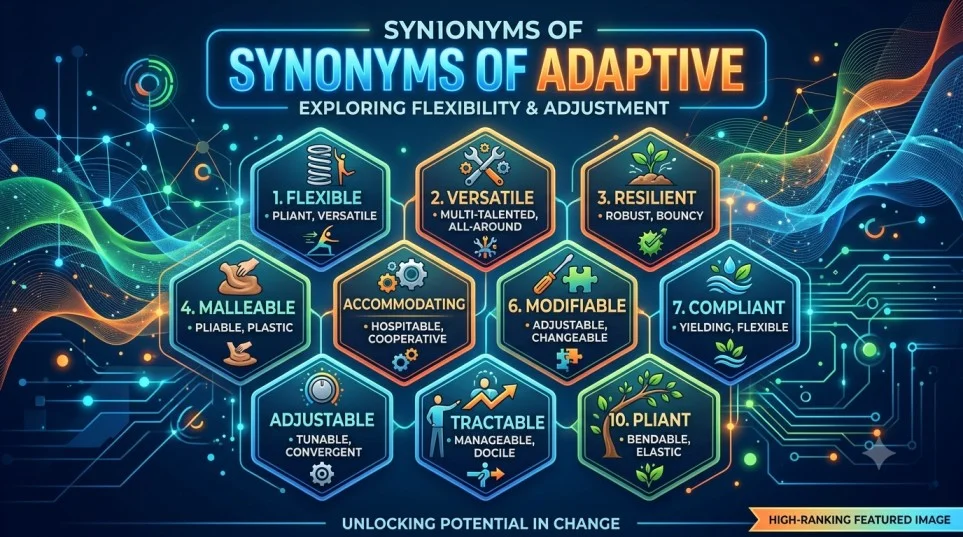
A List of wonderful Synonyms of Adaptive
1. Flexible (Adjective)
US IPA: /ˈflɛk.sə.bəl/ | UK IPA: /ˈflɛk.sə.bəl/
Meaning: Able to bend or change easily without breaking.
Examples:
- We need a flexible schedule for this project.
- She is very flexible about her working hours.
2. Adaptable (Adjective)
US IPA: /əˈdæp.tə.bəl/ | UK IPA: /əˈdæp.tə.bəl/
Meaning: Able to adjust well to new conditions.
Examples:
- Successful workers are usually very adaptable.
- Animals in the desert must be adaptable to extreme heat.
3. Adjustable (Adjective)
US IPA: /əˈdʒʌs.tə.bəl/ | UK IPA: /əˈdʒʌs.tə.bəl/
Meaning: Capable of being altered or moved to fit a position.
Examples:
- The office chair has an adjustable seat height.
- His plan is adjustable based on our budget.
4. Versatile (Adjective)
US IPA: /ˈvɝː.sə.t̬əl/ | UK IPA: /ˈvɜː.sə.taɪl/
Meaning: Able to perform many different functions or roles.
Examples:
- A pocket knife is a versatile tool for camping.
- He is a versatile actor who plays both funny and serious roles.
5. Pliable (Adjective)
US IPA: /ˈplaɪ.ə.bəl/ | UK IPA: /ˈplaɪ.ə.bəl/
Meaning: Easily shaped, bent, or influenced.
Examples:
- Damp clay is soft and pliable.
- Young minds are pliable and learn quickly.
6. Pliant (Adjective)
US IPA: /ˈplaɪ.ənt/ | UK IPA: /ˈplaɪ.ənt/
Meaning: Bending easily and yielding to force or influence.
Examples:
- Leather becomes more pliant as it gets older.
- The team was pliant and accepted the new rules.
7. Resilient (Adjective)
US IPA: /rɪˈzɪl.jənt/ | UK IPA: /rɪˈzɪl.i.ənt/
Meaning: Able to bounce back quickly from difficult conditions.
Examples:
- Children are often remarkably resilient during hard times.
- The local economy proved to be strong and resilient.
8. Accommodating (Adjective)
US IPA: /əˈkɑː.mə.deɪ.t̬ɪŋ/ | UK IPA: /əˈkɒm.ə.deɪ.tɪŋ/
Meaning: Eager to help and adjust to the needs of others.
Examples:
- The hotel staff was warm and accommodating.
- My boss was accommodating when I asked for leave.
9. Dynamic (Adjective)
US IPA: /daɪˈnæm.ɪk/ | UK IPA: /daɪˈnæm.ɪk/
Meaning: Constantly changing, active, and full of energy.
Examples:
- We work in a fast-paced and dynamic market.
- She is a dynamic leader with fresh ideas.
10. Elastic (Adjective)
US IPA: /iˈlæs.tɪk/ | UK IPA: /iˈlæs.tɪk/
Meaning: Able to stretch and return to its original shape or scale easily.
Examples:
- Demand for food is less elastic than demand for luxury items.
- Use an elastic band to hold the papers together.
11. Malleable (Adjective)
US IPA: /ˈmæl.i.ə.bəl/ | UK IPA: /ˈmæl.i.ə.bəl/
Meaning: Capable of being reshaped or altered easily.
Examples:
- Gold is a soft and malleable metal.
- Their plans are still malleable before the final vote.
12. Supple (Adjective)
US IPA: /ˈsʌp.əl/ | UK IPA: /ˈsʌp.əl/
Meaning: Bending easily and moving with smooth grace.
Examples:
- Regular stretching keeps your muscles supple.
- The gloves were made of fine, supple leather.
13. Compliant (Adjective)
US IPA: /kəmˈplaɪ.ənt/ | UK IPA: /kəmˈplaɪ.ənt/
Meaning: Willing to comply or change to obey rules and requests.
Examples:
- The factory must stay fully compliant with environmental laws.
- He had a compliant nature and never argued.
14. Agile (Adjective)
US IPA: /ˈædʒ.əl/ | UK IPA: /ˈædʒ.aɪl/
Meaning: Able to move or think quickly and easily.
Examples:
- The monkey is an agile climber.
- An agile mind helps you solve complex puzzles.
15. Fluid (Adjective)
US IPA: /ˈfluː.ɪd/ | UK IPA: /ˈfluː.ɪd/
Meaning: Smooth and changing smoothly without set borders or rigidity.
Examples:
- The travel plans remain fluid due to changing weather.
- The dancer showed fluid movements on stage.
16. Variable (Adjective)
US IPA: /ˈver.i.ə.bəl/ | UK IPA: /ˈveə.ri.ə.bəl/
Meaning: Able to change or be changed frequently.
Examples:
- The weather in spring is notoriously variable.
- The machine operates at variable speeds.
17. Reversible (Adjective)
US IPA: /rɪˈvɝː.sə.bəl/ | UK IPA: /rɪˈvɜː.sə.bəl/
Meaning: Able to turn around or be changed back to a previous state.
Examples:
- He bought a reversible jacket with two color sides.
- Most minor mistakes are easily reversible.
18. Open-ended (Adjective)
US IPA: /ˌoʊ.pənˈen.dɪd/ | UK IPA: /ˌəʊ.pənˈen.dɪd/
Meaning: Left open to change, growth, or free development.
Examples:
- The meeting turned into an open-ended discussion.
- The test consists of five open-ended questions.
19. Modifiable (Adjective)
US IPA: /ˈmɑː.də.faɪ.ə.bəl/ | UK IPA: /ˈmɒd.ɪ.faɪ.ə.bəl/
Meaning: Capable of being altered or customized.
Examples:
- The template provides a modifiable layout for your website.
- Diet is a modifiable factor for good health.
20. Mutable (Adjective)
US IPA: /ˈmjuː.t̬ə.bəl/ | UK IPA: /ˈmjuː.tə.bəl/
Meaning: Prone or liable to change over time.
Examples:
- Human emotions are mutable and complex.
- The borders of the empire remained mutable for decades.
21. Convertible (Adjective)
US IPA: /kənˈvɝː.t̬ə.bəl/ | UK IPA: /kənˈvɜː.tə.bəl/
Meaning: Able to be transformed from one form or use to another.
Examples:
- They bought a convertible sofa for the guest room.
- The currency is fully convertible into gold.
22. Responsive (Adjective)
US IPA: /rɪˈspɑːn.sɪv/ | UK IPA: /rɪˈspɒn.sɪv/
Meaning: Reacting quickly and positively to new inputs or conditions.
Examples:
- Modern websites must feature a responsive design for mobile phones.
- The engine is light and highly responsive.
23. Versatile-minded (Adjective)
US IPA: /ˈvɝː.sə.t̬əl ˈmaɪn.dɪd/ | UK IPA: /ˈvɜː.sə.taɪl ˈmaɪn.dɪd/
Meaning: Possessing a mind capable of turning easily to different subjects.
Examples:
- A versatile-minded person handles unexpected challenges well.
- The team needs a versatile-minded manager to lead the shift.
24. Yielding (Adjective)
US IPA: /ˈjiːl.dɪŋ/ | UK IPA: /ˈjiːl.dɪŋ/
Meaning: Soft, flexible, and willing to submit to physical or mental pressure.
Examples:
- The mattress had a soft, yielding surface.
- She showed a yielding attitude during negotiations.
25. Pragmatic (Adjective)
US IPA: /præɡˈmæt̬.ɪk/ | UK IPA: /præɡˈmæt.ɪk/
Meaning: Dealing with things sensibly and altering methods based on real conditions.
Examples:
- We need a pragmatic approach to solve this business problem.
- He made a pragmatic choice to accept the deal.
26. Resourceful (Adjective)
US IPA: /ˈriː.sɔːrs.fəl/ | UK IPA: /rɪˈzɔːs.fəl/
Meaning: Skilled at finding quick and clever ways to adjust to difficulties.
Examples:
- A resourceful survivalist can build a shelter anywhere.
- She proved to be resourceful when supplies ran low.
27. Versatile-use (Adjective)
US IPA: /ˈvɝː.sə.t̬əl juːs/ | UK IPA: /ˈvɜː.sə.taɪl juːs/
Meaning: Designed to adapt smoothly to multiple distinct functions.
Examples:
- Olive oil is a versatile-use kitchen item.
- This is a versatile-use jacket built for rain or snow.
28. Transformable (Adjective)
US IPA: /trænˈsfɔːr.mə.bəl/ | UK IPA: /trænsˈfɔː.mə.bəl/
Meaning: Capable of being changed in form, appearance, or character.
Examples:
- The room has transformable wall panels.
- Energy is transformable from heat to motion.
29. Receptive (Adjective)
US IPA: /rɪˈsep.tɪv/ | UK IPA: /rɪˈsep.tɪv/
Meaning: Willing to consider or accept new ideas, suggestions, and changes.
Examples:
- The audience was very receptive to the proposal.
- Good teachers remain receptive to student feedback.
30. Tractable (Adjective)
US IPA: /ˈtræk.tə.bəl/ | UK IPA: /ˈtræk.tə.bəl/
Meaning: Easy to control, shape, or influence.
Examples:
- The dog became more tractable after basic training.
- The problem was small and tractable.
Prototype Meaning
The most typical meaning of adaptive centers on the idea of smart modification for survival or success. When people hear the word adaptive, they usually imagine a living creature or a modern system altering its form, behavior, or structure to thrive in a new, challenging environment. It implies an active, intelligent response rather than a passive breakdown.
Prototype Categorization
Grouping synonyms into categories allows writers to select the most precise word for any sentence:
- Physical Flexibility: Flexible, Pliable, Pliant, Elastic, Supple, Malleable.
- Mental Speed & Skill: Agile, Versatile, Resourceful, Dynamic, Pragmatic.
- Behavior & Compliance: Accommodating, Compliant, Yielding, Receptive, Tractable.
- System & Physical Change: Adjustable, Modifiable, Convertible, Transformable, Responsive, Variable, Fluid, Mutable, Reversible, Open-ended, Adaptable, Versatile-minded, Versatile-use.
Understanding these groups helps content writers avoid awkward phrasing. For example, use supple for leather or muscles, agile for mental tasks, and adjustable for office furniture.
Antonyms of Adaptive
- Rigid (Adjective): Stiff and unable to bend or change under pressure.
- Inflexible (Adjective): Unwilling or unable to modify plans or behaviors.
- Uncompromising (Adjective): Unwilling to grant concessions or adjust views.
- Static (Adjective): Lacking movement, action, or ability to change.
- Immutable (Adjective): Unchangeable by nature over time.
- Obstinate (Adjective): Stubbornly refusing to change one’s opinions or actions.
Short Questions and Answers
What does adaptive mean?
- Answer: Adaptive means having the capacity to change quickly and effectively when faced with new situations or shifting environments.
When should adaptive be used?
- Answer: Use adaptive when describing biological traits, human personality strengths, smart technology, or business strategies that actively adjust to overcome new challenges.
Is adaptive positive or negative?
- Answer: Adaptive is almost always positive because it highlights intelligence, resilience, and survival ability. It can only turn negative if it implies a complete lack of consistent core values.
How is it different from similar words?
- Answer: While flexible means simply bending without breaking, adaptive specifically implies changing in order to fit or succeed in a brand-new situation.
Conclusion
Learning the word adaptive alongside its 30 synonyms expands your vocabulary and builds your English confidence. Choosing precise words helps you avoid boring repetition, sharpens your message, and strengthens both your spoken and written communication. Incorporating diverse terms into your daily practice allows you to express subtle thoughts clearly. Try using three new synonyms from this guide in your next conversation or writing assignment to master them completely.

I am a linguist with 7 years of experience in English language teaching, including postgraduate-level instruction. My expertise includes English grammar, and I contribute as a content and blog writer, producing scholarly and educational language resources.