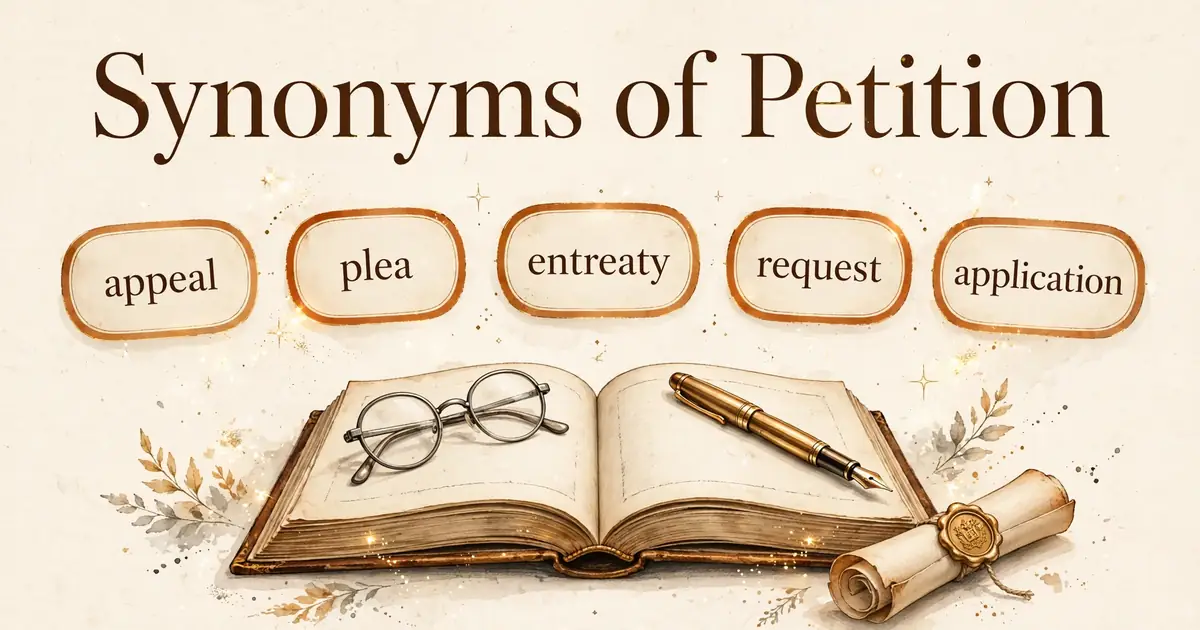
Synonyms of petition are words for a formal request made to someone in power — an official document, a routine application, or an earnest spoken plea. To petition /pəˈtɪʃ.ən/ is to ask formally, usually in writing. Common examples are appeal /əˈpiːl/ /əˈpiːl/ , plea /pliː/ , request, and application. Together they cover every strength of asking, from routine forms to desperate pleas.
| Synonym | Meaning |
|---|---|
| Appeal | an earnest, formal public request |
| Request | the everyday word for asking |
| Application | a formal written request form |
| Plea | an urgent, emotional request |
| Entreaty | an earnest, heartfelt request |
| Ask | the plain verb for requesting |
| Beg | to ask desperately and humbly |
| Implore | to beg with great emotion |
| Plead | to ask earnestly, argue in court |
| Supplication | a humble, prayer-like earnest request |
Below, you will find 29 clear synonyms for petition, each with a simple meaning and two easy examples.
Main Content: 29 Synonyms for Petition
1. Appeal /əˈpiːl/ /əˈpiːl/
- Meaning: (noun) a strong, earnest request, usually made publicly or to someone in authority; in law, a request for a higher court to change a decision. As a verb: to make such a request.
- Examples: The mayor made an appeal for calm after the storm. The prisoner lodged an appeal against his sentence.
2. Request /ɹɪˈkwɛst/
- Meaning: (noun and verb) the general, everyday word for something asked for politely; weaker and less formal than a petition, but the word all the official ones are built on.
- Examples: They sent a written request for more time. Passengers are requested to remain seated until the gate opens.
3. Application /ˌæp.lɪˈkeɪ.ʃən/
- Meaning: (noun) a formal written request, usually on an official form, for a job, a place, a permit, or permission; the routine, bureaucratic member of this family.
- Examples: Her application for a visa was approved within a week. You must submit your application before the end of the month.
4. Plea /pliː/
- Meaning: (noun) an urgent request made with strong feeling, because the need is serious; in court, also the answer a defendant gives — guilty or not guilty.
- Examples: The hospital issued a plea for blood donors. He entered a plea of not guilty.
5. Entreaty /ɪnˈtɹiːti/
- Meaning: (noun) an earnest, heartfelt request — the noun form of entreat; warmer and more emotional than a plain request, and often repeated.
- Examples: She turned away from his entreaties to stay a little longer. Their final letter was an entreaty for mercy.
6. Supplication /sʌplɪˈkeɪʃən/
- Meaning: (noun) a humble, earnest request made to God or to a great power; the asker presents themselves as low and the one asked as mighty.
- Examples: The villagers offered prayers of supplication during the drought. He bowed his head in supplication before the king.
7. Solicitation /səˌlɪsɪˈteɪʃən/
- Meaning: (noun) the formal act of asking for something — support, donations, business, or help; common in business and law, where it can also name asking for something illegal.
- Examples: The charity’s solicitation of donations raised thousands of dollars. A “no solicitation” sign keeps salespeople away from the door.
8. Representation /ˌɹɛp.ɹə.zɛnˈteɪ.ʃən/
- Meaning: (noun, usually plural: representations) a formal statement of facts, opinions, or complaints presented to an authority in order to influence its decision; the standard word in government and council paperwork.
- Examples: Residents made representations against the new road plan. The committee received representations from both sides before voting.
9. Memorial /məˈmɔːɹi.əl/
- Meaning: (noun) a statement of facts written in the form of a petition and presented to a person in authority, a court, or a government; formal and old-style — in everyday English, memorial more often means a monument honouring the dead.
- Examples: The merchants presented a memorial to the governor, listing their grievances one by one. In the old records, the village memorial asked for the river bridge to be repaired.
10. Round robin /ˌɹaʊnd ˈɹɒbɪn/
- Meaning: (noun) a petition or letter of complaint signed in a circle, so that no name stands first and no leader can be picked out; it began among sailors and is now used for any jointly signed letter.
- Examples: The crew sent a round robin asking for better food. Staff signed a round robin protesting the new night shifts.
11. Motion /ˈməʊ.ʃən/ /ˈmoʊ.ʃən/
- Meaning: (noun) a formal proposal or request put before a meeting, a council, or a court for a decision; a member “moves” a motion and the others vote on it.
- Examples: The council passed a motion to repair the library roof. Her lawyer filed a motion to dismiss the case.
12. Suit /sut/ /suːt/
- Meaning: (noun) an old, legal word for a petition or request — the dictionary gives it simply as “petition, request, entreaty”; today it mostly means a lawsuit, so use this sense knowingly, in formal or storybook settings.
- Examples: The young knight pressed his suit before the king. The farmers brought their suit to the lord of the manor.
13. Prayer /pɹɛɚ/
- Meaning: (noun) in law, the specific request written at the end of a court petition — lawyers call it the “prayer for relief,” meaning exactly what the filer asks the court to grant; outside law, it is the familiar word for words spoken to God.
- Examples: The petition ended with a prayer for compensation. The prayer of the document asked the court to stop the sale.
14. Invocation /ˌɪn.voʊˈkeɪ.ʃən/
- Meaning: (noun) a calling on God or a higher power for help or presence; the short prayer that opens a meeting, a ceremony, or a sitting of a legislature — asking, lifted into ritual.
- Examples: The council meeting opened with an invocation. The priest’s invocation asked for guidance and peace.
15. Requisition /ˌɹɛkwɪˈzɪʃən/
- Meaning: (noun) a formal, official written request or demand, especially for supplies, services, or property; the word of armies, hospitals, and store rooms — stronger than a request, close to an order.
- Examples: The hospital sent a requisition for fifty more beds. The army issued a requisition for trucks and fuel.
16. Demand /dɪˈmænd/ /dɪˈmɑːnd/
- Meaning: (noun) a firm request that expects “yes” for an answer; it stands at the strong edge of this family — a petition asks, but a demand insists.
- Examples: The workers presented a demand for safer conditions. Her letter was not a request but a demand for an apology.
17. Ask /æsk/ /ɑːsk/
- Meaning: (verb) the plain, everyday verb underneath this whole family — to say that you want something; neutral in tone, and the form you soften with “please” or “could I ask…”
- Examples: If you need more time, just ask. She asked the committee in writing, as the rules required.
18. Beg /ˈbɛɡ/
- Meaning: (verb) to ask desperately or humbly, because the need is great or all the power sits on the other side; also the everyday word in polite formulas such as “I beg your pardon.”
- Examples: He begged the officer to let him through. The children begged for one more story before bed.
19. Beseech /bɪˈsiːt͡ʃ/
- Meaning: (verb) to ask someone earnestly and emotionally to do or give something; a literary, older word — the voice of novels, plays, and prayers rather than of offices.
- Examples: “I beseech you,” she wrote, “do not forget us.” The villagers beseeched the council to spare the old house.
20. Implore /ɪmˈplɔː/
- Meaning: (verb) to beg with deep emotion, as if everything depends on the answer; one step below tears.
- Examples: She implored him not to leave. The doctor implored the crowd to stay calm.
21. Entreat /ɪnˈtɹiːt/ /ɪnˈtɹit/
- Meaning: (verb) to ask earnestly and with feeling, often again and again; slightly gentler than implore, and common in older or formal writing.
- Examples: He entreated his friends to stay a little longer. She wrote entreating the bank for more time to pay.
22. Supplicate /ˈsʌplɪkeɪt/
- Meaning: (verb) to ask humbly and earnestly, lowering yourself before God or a great power; the verb form of supplication, solemn and old-fashioned in flavour.
- Examples: They supplicated the king for mercy. The farmers supplicated heaven for rain.
23. Plead /pliːd/
- Meaning: (verb) to ask in an emotional, urgent way; also the legal verb — to plead in court is to present your case or to declare yourself guilty or not guilty.
- Examples: He pleaded with his manager for one more chance. She pleaded not guilty to the charge.
24. Solicit /səˈlɪsɪt/
- Meaning: (verb) to ask for something in an organised, persistent way — donations, support, business, or votes; formal, and in law it can mean asking someone to commit a crime, so let the context speak clearly.
- Examples: Volunteers solicited donations door to door. The group is soliciting support for the new shelter.
25. Apply /əˈplaɪ/ /əˈplaɪ/
- Meaning: (verb) to make a formal request, especially in writing — you apply to a person or body and apply for the thing you want; the everyday bureaucratic verb behind application.
- Examples: You can apply to the council for a parking permit. She applied for the course online.
26. Sue /suː/
- Meaning: (verb) in older and legal use, to seek by request — “to make application; to petition; to entreat”; today its main sense is to start a lawsuit, and the asking sense survives in the phrase “sue for peace.”
- Examples: After ten years of war, the two sides finally sued for peace. In the old chronicle, the town sued the king for a charter of rights.
27. Lobby /ˈlɒb.i/ /ˈlɑ.bi/
- Meaning: (verb) to try to persuade an authority or lawmaker to act, through organised, repeated asking — a petition that has grown into a campaign.
- Examples: Farmers lobbied the minister for lower taxes on fuel. Residents are lobbying for a safe crossing near the school.
28. Urge /ɝd͡ʒ/ /ɜːd͡ʒ/
- Meaning: (verb) to press someone strongly to act; not a request for yourself but a forceful recommendation — one step short of a demand.
- Examples: Doctors urged the council to clean up the river. She urged her brother to apply before the deadline.
29. Press /pɹɛs/ /pɹɛs/
- Meaning: (verb) to keep asking firmly and repeatedly, refusing to let the matter drop — a petition with pressure behind it, as in “press for change” or “press a claim.”
- Examples: The unions pressed the company for a pay rise. She pressed her case before the committee until they agreed to hear it.
Synonyms for Petition in Court and Law
The law has owned the petition for centuries. A suit /sut/ began life as a request laid before a ruler, long before it came to mean a court case. The written request at the heart of a modern filing still carries an old name: the prayer /pɹɛɚ/ , the closing part of the document that tells the court exactly what is being asked. And the working tool of every case is the motion /ˈmoʊ.ʃən/ — a formal request for a ruling or an order, made while the case is alive.
Around them stand plea and appeal. A plea answers a charge or begs the court with feeling; an appeal climbs one step up the ladder and asks a higher court to change what a lower one decided. It is the same root idea as the signature sheet on a clipboard — ask the power above you, in writing, with reasons.
Synonyms for Petition to Government and Rulers
Citizens keep their own shelf of words. A memorial /məˈmɔːɹi.əl/ sets out facts in petition form and lays them before a government or a court. Representations /ˌɹɛp.ɹə.zɛnˈteɪ.ʃən/ are the modern council-office version — formal statements sent in to influence a decision before it is made. And when the signers fear being singled out, history hands them the round robin /ˌɹaʊnd ˈɹɒbɪn/ , signatures arranged in a wheel so that no leader can be named.
A petition is a beginning, not the whole campaign: after the signatures come the meetings, and the asking turns into lobbying /ˈlɒb.i/ . Whichever form you choose, the facts must be exact and vivid — a memorial lives or dies by its details, and our descriptive synonyms guide will help you write them sharply.
Synonyms for Petition in Prayer and Worship
The oldest petitions were not sent to offices but spoken upward. A supplication /sʌplɪˈkeɪʃən/ is a humble, earnest request laid before God or a great power — the asker small, the One asked mighty. An invocation /ˌɪn.voʊˈkeɪ.ʃən/ calls for help or presence to come near, and it still opens council meetings and ceremonies today as a short formal prayer.
Between these stand entreaty and plea — the asking words with the most heart in them. It is no accident that the same words serve the courtroom and the chapel: asking with feeling is one of the oldest human acts, and the feeling words around it fill a whole shelf — see our emotion synonyms guide for the rest of that family.
Synonyms for Petition at Work and School
Most real-life petitions wear office clothes. These four words handle almost every formal ask you will ever make in a job or in study:
- Application /ˌæp.lɪˈkeɪ.ʃən/ — Meaning: the standard form-based request — jobs, leave, admissions, permits. Examples: Her leave application was approved on Friday.
- Request /ɹɪˈkwɛst/ — Meaning: the safe all-purpose word, polite in any email or form. Examples: He put in a request to change his shift.
- Appeal /əˈpiːl/ /əˈpiːl/ — Meaning: the word for asking a decision-maker to look again — exam marks, grades, warnings. Examples: Students may appeal their results within ten days.
- Representation /ˌɹɛp.ɹə.zɛnˈteɪ.ʃən/ — Meaning: a formal statement made to a body — the word staff unions and student councils use. Examples: The union submitted a representation about overtime pay.
Strong Synonyms of Petition
Three words ask with the most force behind them. Supplication /sʌplɪˈkeɪʃən/ bows the lowest and means it the most: nothing held back, everything staked on the answer. Entreaty /ɪnˈtɹiːti/ presses with feeling, again and again, until the heart on the other side moves. And demand /dɪˈmænd/ drops the bow altogether — it asks like an order and expects compliance.
Use them in that order of risk. Supplication wins mercy and entreaty wins sympathy, but a demand wins only when you already hold some power — so spend it rarely, and never by accident.
Positive Synonyms for Petition
Not every petition is a protest. These are the constructive members of the family — the words that build, apply, and improve rather than complain:
- Ask /æsk/ Meaning: the friendly root of all asking; clear, honest, and impossible to take offence at. Examples: Just ask the office for a fresh form.
- Request /ɹɪˈkwɛst/ Meaning: asking, polished for professional life — the default word of good emails. Examples: She requested a short meeting with her tutor.
- Application /ˌæp.lɪˈkeɪ.ʃən/ Meaning: asking as progress — for the job, the course, the place you want to reach. Examples: His application to the summer school succeeded.
- Appeal /əˈpiːl/ /əˈpiːl/ Meaning: asking the public, or a higher authority, with a good cause in hand. Examples: The school launched an appeal for library books.
Synonyms and Antonyms for Petition
The synonyms gather on one side — appeal, plea, entreaty, supplication, application — all naming formal asking at different temperatures. On the other side wait the answers a petitioner dreads: a flat refusal, a formal rejection, a denial of the request — and, from above, the command or order that needs no one’s permission at all.
Learn the two directions together and whole negotiations shrink into single sentences: “Their plea met a flat refusal.” A petition travels upward, from the one who needs to the one who can grant; its opposites travel downward. Contrast, as always, is the cheapest special effect in writing.
FAQ Section: People Also Ask
What is the difference between a petition and a request?
Weight and form. A request is any polite asking — spoken or written, to anyone, for anything. A petition is a request that has been dressed formally: written down, addressed to an authority, often signed by many people, and aimed at a decision or a change.
A quick test: if you can say it across a desk, it is a request. If it needs signatures, a subject line, and a body that can say no — it is a petition.
What is the difference between a petition and an appeal?
A petition usually asks for something new — a law, a repair, a change of policy. An appeal asks someone higher to look again at something already decided: a court verdict, an exam result, a punishment.
In law the line is sharp: you petition a court to grant something, and you appeal to a higher court to undo what a lower court has done. In everyday speech the two overlap, and a public “appeal” for donations is simply a petition with a megaphone.
What is a formal word for asking for something?
For the verb, English gives you a ladder: request for polite everyday formality, apply when a form or an office is involved, and solicit when the asking is organised and repeated, as with donations or support.
For the written thing itself, the formal nouns are application for routine matters and representation for statements sent to councils and governments. Choose by setting first and by strength second.
What do you call a person who signs a petition?
A person who signs is a signatory — each name on the page is a signatory to the request. The person who writes, organises, or presents the petition is the petitioner.
The split is worth remembering in formal writing: the petitioner speaks, the signatories stand behind the words, and the authority who receives it is the one being petitioned.
Conclusion
The synonyms of petition all describe asking in its most serious dress — written down, signed, and aimed at someone with the power to act. You now own the whole family: the office routine of application and request, the courtroom weight of suit, motion, and prayer, the humility of supplication, and the heat of plea and entreaty.
“Power concedes nothing without a demand. It never did and it never will.”
Try one this week: take a request you would normally drop into a chat message and write it as a proper one-paragraph petition, with the exact word it deserves at its head. The verbs inside it deserve the same care — our action verb synonyms guide sharpens them one by one.
“Freedom is never voluntarily given by the oppressor; it must be demanded by the oppressed.”
Ask clearly, ask in writing, and ask with the right word — that is the whole art of the petition, and most of its power.

Nighat Fatima is a linguist with an M.A. in Linguistics and an M.Ed. She has 7 years of experience teaching English language to postgraduate classes and 6 years of experience in content writing.