You drop your keys on the floor, pick them up, and then drop them a second later. You sigh and say, “I dropped my keys once again.” The key phrase once again means doing or experiencing something one more time. We use it all the time because daily life is full of repeated events. However, writing “once again” over and over makes your essays, emails, and stories sound boring.
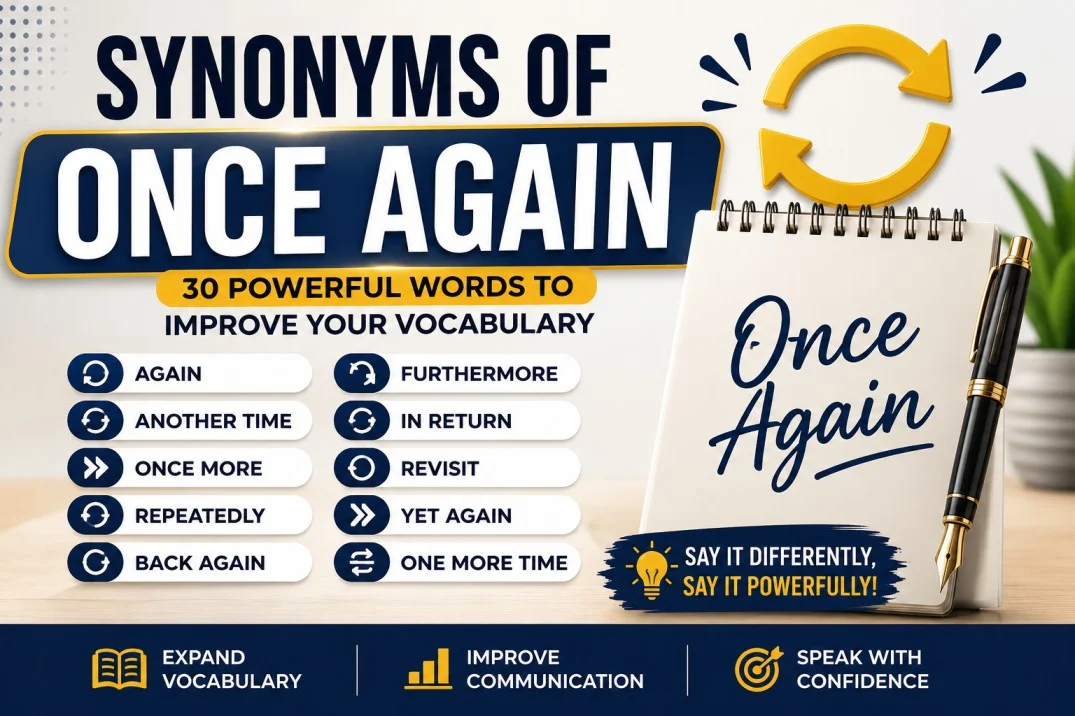
Learning synonyms for this expression helps English learners and content writers speak with variety, tone, and precision. This article explains the exact meaning of “once again” alongside its grammar, history, tone, and pronunciation. You will also discover 30 rich synonyms grouped by usage style to help you pick the exact right word every time.
Meaning of Once Again
Definition
Once again (Adverbial Phrase):
Doing something one more time, or repeating an action that happened in the past.
Examples
- She read the letter once again to make sure she understood the message.
- The train was delayed once again due to heavy winter snow.
Connotative Meaning
- Positive tone: Used to highlight a pleasant returning event, like “Once again, our team won the cup!”
- Negative tone: Used to show annoyance at repeated mistakes, like “Once again, he forgot his keys.”
- Neutral tone: Used to state a simple repeated fact, like “The sun rose once again at dawn.”
(Connotation means the emotional feeling or extra idea that a word gives alongside its plain definition.)
Etymology
- Originates from Old English ānes (once) combined with ongegn (again/opposite).
History of Once Again
- Old English (450–1100): The root words ānes (meaning “one time”) and ongegn (meaning “opposite” or “in return”) were used separately.
- Middle English (1100–1500): The words merged in form as ones agayn, used to describe a second occurrence of an event.
- Modern English (1500–Present): Fixed into the standardized spelling “once again,” becoming a primary phrase for repetition.
Pronunciation
US: /wʌns əˈɡɛn/
UK: /wʌns əˈɡɛn/
Syllables
once-a-gain
Affixation Pattern of Once Again
- Root: once, again
- Prefix: None
- Suffix: None
Word Formation
- Once (Adverb / Conjunction)
- Again (Adverb)
- Re-again (Non-standard / Dialectal variation)
A List of wonderful Synonyms of Once Again
1. Once More (Adverbial Phrase)
US: /wʌns mɔr/ | UK: /wʌns mɔː/
Meaning: One additional time beyond what has occurred.
Examples:
- Please play that beautiful song once more.
- He checked his pocket once more to ensure his wallet was safe.
2. Anew (Adverb)
US: /əˈnu/ | UK: /əˈnjuː/
Meaning: Starting over from the beginning in a fresh way.
Examples:
- After the storm passed, they began to build their home anew.
- The painter decided to erase the canvas and start anew.
3. Afresh (Adverb)
US: /əˈfrɛʃ/ | UK: /əˈfrɛʃ/
Meaning: Repeating an action with new energy or a clean start.
Examples:
- Let us look at this tricky problem afresh tomorrow morning.
- She washed her face to begin her work afresh.
4. Repeatedly (Adverb)
US: /rɪˈpiːtɪdli/ | UK: /rɪˈpiːtɪdli/
Meaning: Happening many times over and over.
Examples:
- He repeatedly knocked on the door until someone opened it.
- The teacher repeatedly reminded the class about the deadline.
5. Over Again (Adverbial Phrase)
US: /ˈoʊvər əˈɡɛn/ | UK: /ˈəʊvə r əˈɡɛn/
Meaning: Doing a task a second time from the start.
Examples:
- I made a big mistake, so I had to type the essay over again.
- She sang the chorus over again until it was perfect.
6. Yet Again (Adverbial Phrase)
US: /jɛt əˈɡɛn/ | UK: /jɛt əˈɡɛn/
Meaning: Happening one more time, often showing surprise or annoyance.
Examples:
- Yet again, the bus arrived twenty minutes late.
- The printer jammed yet again during my print job.
7. Repeatedly (Adverb)
US: /rɪˈpiːtɪdli/ | UK: /rɪˈpiːtɪdli/
Meaning: Happening multiple times in direct succession.
Examples:
- The machine beeped repeatedly to alert the operator.
- She called his office repeatedly throughout the afternoon.
8. Recurrently (Adverb)
US: /rɪˈkɜːrəntli/ | UK: /rɪˈkʌrəntli/
Meaning: Occurring periodically or time after time.
Examples:
- The theme of freedom appears recurrently in his novels.
- She recurrently visited the quiet library to study.
9. Time and Again (Adverbial Phrase)
US: /taɪm ænd əˈɡɛn/ | UK: /taɪm ænd əˈɡɛn/
Meaning: Happening frequently on many separate occasions.
Examples:
- Time and again, this small team proves its incredible skill.
- I have told you time and again to lock the front gate.
10. Time after Time (Adverbial Phrase)
US: /taɪm ˈæftər taɪm/ | UK: /taɪm ˈɑːftə taɪm/
Meaning: Occurring regularly with steady repetition.
Examples:
- She delivers excellent work time after time.
- Time after time, the old car refused to start on cold mornings.
11. Frequently (Adverb)
US: /ˈfriːkwəntli/ | UK: /ˈfriːkwəntli/
Meaning: Happening often or at short intervals.
Examples:
- It frequently rains in this coastal town during autumn.
- They check their email messages frequently during the workday.
12. Consistently (Adverb)
US: /kənˈsɪstəntli/ | UK: /kənˈsɪstəntli/
Meaning: Happening in the same reliable way every single time.
Examples:
- She consistently arrives at the office ten minutes early.
- The bakery consistently produces delicious fresh bread.
13. Habitually (Adverb)
US: /həˈbɪtʃuəli/ | UK: /həˈbɪtʃuəli/
Meaning: Done out of regular habit or custom.
Examples:
- He habitually drinks a hot cup of tea every evening.
- She habitually double-checks all of her financial math.
14. Continually (Adverb)
US: /kənˈtɪnjuəli/ | UK: /kənˈtɪnjuəli/
Meaning: Happening repeatedly over a long duration with brief pauses.
Examples:
- The phone rang continually throughout the busy morning.
- He continually updates his software to keep it safe.
15. Constantly (Adverb)
US: /ˈkɑːnstəntli/ | UK: /ˈkɒnstəntli/
Meaning: Occurring without stopping or changing.
Examples:
- The waterfall flows constantly down the steep cliff side.
- She is constantly looking for ways to improve her craft.
16. Over and Over (Adverbial Phrase)
US: /ˈoʊvər ænd ˈoʊvər/ | UK: /ˈəʊvə r ænd ˈəʊvə/
Meaning: Repeated many times continuously.
Examples:
- He practiced the piano scale over and over until his fingers hurt.
- The child sang the melody over and over during the trip.
17. Iteratively (Adverb)
US: /ˈɪtəreɪtɪvli/ | UK: /ˈɪtərətɪvli/
Meaning: Repeating a procedure step-by-step to make improvements.
Examples:
- The developers worked iteratively to fix every bug in the program.
- Design teams build products iteratively based on real user feedback.
18. Monotonously (Adverb)
US: /məˈnɑːtənəsli/ | UK: /məˈnɒtənəsli/
Meaning: Repeating in a dull, unvarying tone or way.
Examples:
- The rain fell monotonously against the glass window.
- The clock ticked monotonously in the empty room.
19. Rhythmically (Adverb)
US: /ˈrɪðmɪkli/ | UK: /ˈrɪðmɪkli/
Meaning: Repeating with a regular, musical beat or pattern.
Examples:
- Ocean waves crashed rhythmically against the sandy shore.
- The engine hummed rhythmically as they drove down the highway.
20. Regularly (Adverb)
US: /ˈrɛɡjələrli/ | UK: /ˈrɛɡjʊləli/
Meaning: Happening at fixed or equal time periods.
Examples:
- You should exercise regularly to stay healthy and strong.
- The clock strikes regularly at the top of every hour.
21. Perennially (Adverb)
US: /pəˈrɛniəli/ | UK: /pəˈrɛniəli/
Meaning: Lasting or repeating continuously over many years.
Examples:
- Tulips are perennially popular flowers in spring gardens.
- This classic story remains perennially inspiring to young readers.
22. Cyclically (Adverb)
US: /ˈsɪklɪkli/ | UK: /ˈsɪklɪkli/
Meaning: Moving or recurring in a repeating circle or cycle.
Examples:
- The seasons change cyclically every twelve months.
- Economic trends tend to rise and fall cyclically over time.
23. Periodically (Adverb)
US: /ˌpɪriˈɑːdɪkli/ | UK: /ˌpɪərɪˈɒdɪkli/
Meaning: Occurring from time to time at routine intervals.
Examples:
- Fire alarms are tested periodically to guarantee safety.
- We meet periodically to discuss our shared project goals.
24. Unceasingly (Adverb)
US: /ʌnˈsiːsɪŋli/ | UK: /ʌnˈsiːsɪŋli/
Meaning: Continuing without ever stopping or taking a break.
Examples:
- The rescue crew worked unceasingly to clear the roadway.
- Wind blew unceasingly across the open prairie lands.
25. Incessantly (Adverb)
US: /ɪnˈsɛsəntli/ | UK: /ɪnˈsɛsəntli/
Meaning: Continuing without pause, often in an annoying way.
Examples:
- My neighbor’s dog barked incessantly all night long.
- She talked incessantly about her vacation memories.
26. Endless (Adjective)
US: /ˈɛndləs/ | UK: /ˈɛndləs/
Meaning: Seeming to go on forever without stopping.
Examples:
- The desert stretched out in an endless line of sand dunes.
- They offered endless praise for her heroic actions.
27. Non-stop (Adverb)
US: /nɑːnˈstɑːp/ | UK: /nɒnˈstɒp/
Meaning: Happening without any pause or interruption.
Examples:
- It rained non-stop for three whole days during the storm.
- They worked non-stop to meet the tight project deadline.
28. Perpetual (Adjective)
US: /pərˈpɛtʃuəl/ | UK: /pəˈpɛtʃuəl/
Meaning: Continuing forever or occurring without interruption.
Examples:
- High mountains are covered in perpetual snow and icy glaciers.
- He lives in a perpetual state of worry about his exam results.
29. Intermittently (Adverb)
US: /ˌɪntərˈmɪtəntli/ | UK: /ˌɪntəˈmɪtəntli/
Meaning: Stopping and starting again at random intervals.
Examples:
- Showers fell intermittently throughout the long afternoon.
- The old light bulb flickered intermittently before burning out.
30. Re-repeatedly (Adverb)
US: /riː rɪˈpiːtɪdli/ | UK: /riː rɪˈpiːtɪdli/
Meaning: Repeated over again multiple times for strong emphasis.
Examples:
- The safety instructions were re-repeatedly stated before takeoff.
- The warning was re-repeatedly sent to all local residents.
Prototype Meaning
When people hear “once again,” they picture a familiar scene happening a second time. It creates a mental image of a person stepping back into an exact same event, like walking back into a room or retrying a failed test. The core idea is simple: a former event is taking place right now.
Prototype Categorization
- Simple One-Time Repetition: Once more, over again, yet again.
- Fresh or New Starts: Anew, afresh.
- High Frequency & Regularity: Repeatedly, time and again, time after time, frequently, regularly, periodically.
- Continuous or Unbroken Action: Constantly, continually, unceasingly, incessantly, non-stop.
- Structured & Technical Cycles: Iteratively, cyclically, recurrently.
Categorization helps writers choose the right term for their context. For instance, if you want to emphasize a clean slate, use anew. If you want to show frustration at an annoying habit, choose incessantly.
Antonyms of Once Again
- Never (Adverb): Not at any time; not ever.
- Once (Adverb): On one single occasion only.
- Singly (Adverb): One by one; individually without repetition.
- Finally (Adverb): At the end; after all other events are complete.
- Permanently (Adverb): In a way that lasts forever without repeating.
Short Questions and Answers
- What does once again mean?
- It means doing or experiencing something one more time after it already happened before.
- When should once again be used?
- Use it when you want to call attention to a repeated action, a returning habit, or an event that happens again.
- Is once again positive or negative?
- It is neutral on its own, but its tone changes depending on your sentence—it can express joyful celebration or mild annoyance.
- How is it different from similar words?
- Words like “anew” mean starting over completely freshly, whereas “once again” simply highlights that an event is happening one more time.
Conclusion
Learning synonyms for “once again” expands your English vocabulary quickly. Using words like anew, repeatedly, or time and again adds natural color to your writing and speaking. It prevents your language from sounding repetitive repetitive while helping you express exact feelings. Practicing these 30 terms every day builds your confidence in English, making you a clearer speaker and a far better writer.

I am a linguist with 7 years of experience in English language teaching, including postgraduate-level instruction. My expertise includes English grammar, and I contribute as a content and blog writer, producing scholarly and educational language resources.