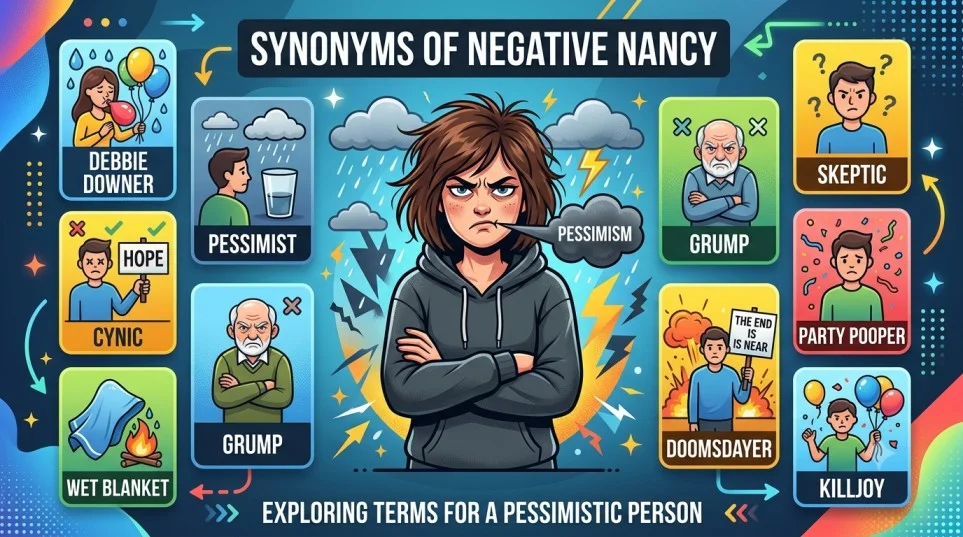
Imagine you are at a party. Everyone is having fun, but one person complains about the music, the food, and the weather. That person is a negative nancy. People use this phrase often because it quickly describes someone who always sees the bad side of things. If you are searching for a synonym of negative nancy, you are in the right place.
Learning synonyms helps English learners and writers speak clearly and avoid repeating the same words. When you know more words, your writing becomes rich and engaging. This article explores the meaning of this famous phrase alongside its history, grammar, pronunciation, and semantic groups.
We will also examine thirty useful synonyms with clear examples to help you master this vocabulary.
Meaning of Negative Nancy
Definition
Negative nancy (Noun): A person who is always negative, complains a lot, and ruins the mood of others.
Examples
- She did not want to be a negative nancy, but she hated the cold rain.
- Don’t be such a negative nancy; the movie was actually quite good!
Connotative Meaning
- Positive tone: None. This term is almost never used as a compliment.
- Negative tone: High. It highlights annoying pessimism, complaining, and a lack of enthusiasm.
- Neutral tone: Low. It can be used in casual banter among friends without deep malice.
- (Connotation is the emotional feeling or social association that a word carries beyond its direct dictionary definition.)
Etymology
- Origin: American English slang from the mid-20th century.
- Source details: It uses alliteration (matching starting letters) with the female name “Nancy” to create a catchy, memorable idiom.
- Old English (450–1100): Neither “negative” (from Latin) nor “Nancy” existed in this form.
- Middle English (1100–1500): “Nancy” developed as a pet name for Anne or Agnes.
- Modern English (1500–Present): The phrase emerged in popular culture as a casual, rhyming label for a habitual pessimist.
Pronunciation
- US: /ˈnɛɡ.ə.tɪv ˈnæn.si/
- UK: /ˈnɛɡ.ə.tɪv ˈnæn.si/
Syllables
neg-a-tive nan-cy
Affixation Pattern of Negative Nancy
- Root: Negate (verb) / Nancy (proper noun)
- Prefix: None
- Suffix: -ive (forms an adjective from a verb)
Word Formation & Related Forms:
- Negative (Adjective): Showing a lack of positivity.
- Negatively (Adverb): Done in an unhappy or critical manner.
- Negativity (Noun): The state or quality of being pessimistic.
A List of Powerful Synonyms of Negative Nancy
1. Pessimist (Noun)
US: /ˈpɛs.ə.mɪst/ | UK: /ˈpɛs.ɪ.mɪst/
Meaning: A person who always expects bad things to happen.
- Examples:
- Mark is a total pessimist who thinks it will rain on every picnic.
- Try not to be a pessimist when starting a new project.
2. Complainant (Noun)
US: /kəmˈpleɪ.nənt/ | UK: /kəmˈpleɪ.nənt/
Meaning: A person who formally or informally expresses dissatisfaction.
- Examples:
- The store manager listened carefully to the unhappy complainant.
- He acted as the primary complainant regarding the noisy neighbors.
3. Killjoy (Noun)
US: /ˈkɪl.dʒɔɪ/ | UK: /ˈkɪl.dʒɔɪ/
Meaning: Someone who stops other people from enjoying themselves.
- Examples:
- Nobody invited Paul because he is such a killjoy.
- Turning off the music made her look like a total killjoy.
4. Wet Blanket (Noun)
US: /wɛt ˈblæŋ.kət/ | UK: /wɛt ˈblæŋ.kɪt/
Meaning: A person who ruins fun by being gloomy or disapproving.
- Examples:
- Do not bring a wet blanket to the birthday party!
- His sad attitude acted like a wet blanket on our fun plans.
5. Party Pooper (Noun)
US: /ˈpɑːr.ti ˈpuː.pər/ | UK: /ˈpɑː.ti ˈpuː.pər/
Meaning: Someone who ruins a good time at a social gathering.
- Examples:
- She left at eight o’clock, earning the nickname party pooper.
- Don’t be a party pooper; stay and play one more game!
6. Grouch (Noun)
US: /ɡraʊtʃ/ | UK: /ɡraʊtʃ/
Meaning: An habitually grumpy or complaining person.
- Examples:
- He is a real grouch before he drinks his morning coffee.
- The old grouch yelled at the kids playing on the lawn.
7. Grump (Noun)
US: /ɡrʌmp/ | UK: /ɡrʌmp/
Meaning: A person who is easily annoyed or continually in a bad mood.
- Examples:
- My uncle can be a grump when he gets tired.
- Stop being a grump and smile for the family photo!
8. Cynic (Noun)
US: /ˈsɪn.ɪk/ | UK: /ˈsɪn.ɪk/
Meaning: Someone who believes people are motivated purely by self-interest.
- Examples:
- As a hardened cynic, she doubted the politician’s honest promises.
- A cynic rarely believes in selfless acts of kindness.
9. Downer (Noun)
US: /ˈdaʊ.nər/ | UK: /ˈdaʊ.nə/
Meaning: A depressing person, news item, or experience.
- Examples:
- Talking about exams all night was a complete downer.
- She avoided him because his endless stories were a downer.
10. Alarmist (Noun)
US: /əˈlɑːr.mɪst/ | UK: /əˈlɑː.mɪst/
Meaning: A person who causes needless fear or anxiety in others.
- Examples:
- The news reporter was accused of being a sensational alarmist.
- Don’t listen to that alarmist; the situation is stable.
11. Gloomy Gus (Noun)
US: /ˈɡluː.mi ɡʌs/ | UK: /ˈɡluː.mi ɡʌs/
Meaning: A habitually sad or miserable person.
- Examples:
- Cheer up, Gloomy Gus, things are not that bad!
- Ever since he lost his key, he has been a Gloomy Gus.
12. Debbie Downer (Noun)
US: /ˈdɛb.i ˈdaʊ.nər/ | UK: /ˈdɛb.i ˈdaʊ.nə/
Meaning: A slang name for someone who constantly spoils the mood with bad news.
- Examples:
- Sarah was a Debbie Downer when she kept bringing up the news.
- This fun slang serves as a great synonym of negative nancy in casual chats.
13. Crab (Noun)
US: /krab/ | UK: /kræb/
Meaning: An ill-tempered, complaining person.
- Examples:
- He acts like an old crab whenever he misses breakfast.
- Why are you being such a crab this afternoon?
14. Faultfinder (Noun)
US: /ˈfɑːltˌfaɪn.dər/ | UK: /ˈfɔːltˌfaɪn.də/
Meaning: A person who constantly criticizes or finds flaws in things.
- Examples:
- The strict boss was a known faultfinder who rarely gave compliments.
- An editor must be a careful faultfinder to catch minor errors.
15. Whiner (Noun)
US: /ˈwaɪ.nər/ | UK: /ˈwaɪ.nə/
Meaning: A person who frequently complains in an annoying tone.
- Examples:
- Nobody wants to travel with a whiner who hates long trips.
- She corrected her child so he would not grow up to be a whiner.
16. Moaner (Noun)
US: /ˈmoʊ.nər/ | UK: /ˈməʊ.nə/
Meaning: Someone who complains repeatedly about small problems.
- Examples:
- He is a chronic moaner about the daily commute.
- Ignore that moaner; the food is delicious.
17. Skeptic (Noun)
US: /ˈskɛp.tɪk/ | UK: /ˈskɛp.tɪk/
Meaning: A person inclined to question or doubt accepted opinions.
- Examples:
- The scientist remained a skeptic until she saw clear data.
- A healthy skeptic asks good questions before buying a product.
18. Misanthrope (Noun)
US: /ˈmɪs.ən.θroʊp/ | UK: /ˈmɪs.ən.θrəʊp/
Meaning: A person who dislikes humankind and avoids human society.
- Examples:
- The old man lived alone in the woods like a total misanthrope.
- Writing dark books made the author seem like a misanthrope.
19. Despondent (Adjective)
US: /dɪˈspɑːn.dənt/ | UK: /dɪˈspɒn.dənt/
Meaning: Feeling or showing extreme hopelessness and gloom.
- Examples:
- He grew despondent after failing the driving test twice.
- Her despondent mood vanished when she heard the good news.
20. Defeatist (Noun)
US: /dɪˈfiː.tɪst/ | UK: /dɪˈfiː.tɪst/
Meaning: A person who expects failure and accepts it easily.
- Examples:
- A defeatist mindset will stop you from trying new things.
- Don’t act like a defeatist before the game even begins!
21. Spoilsport (Noun)
US: /ˈspɔɪl.spɔːrt/ | UK: /ˈspɔɪl.spɔːt/
Meaning: Someone who spoils the pleasure of other people.
- Examples:
- The referee was called a spoilsport after ending the game early.
- Don’t be a spoilsport; join the game with us!
22. Sorehead (Noun)
US: /ˈsɔːr.hɛd/ | UK: /ˈsɔː.hɛd/
Meaning: An easily offended or habitually angry person.
- Examples:
- He became a sorehead after losing the board game.
- Ignore him today; he is just being a sorehead.
23. Complainer (Noun)
US: /kəmˈpleɪ.nər/ | UK: /kəmˈpleɪ.nə/
Meaning: A person who frequently voices dissatisfaction.
- Examples:
- Finding a synonym of negative nancy like “complainer” helps you write precise descriptions.
- The constant complainer demanded to see the store manager.
24. Naysayer (Noun)
US: /ˈneɪ.seɪ.ər/ | UK: /ˈneɪ.seɪ.ə/
Meaning: Someone who opposes, denies, or speaks against something.
- Examples:
- Prove every naysayer wrong by achieving your goals.
- The team ignored the naysayer and built the project anyway.
25. Malcontent (Noun)
US: /ˈmæl.kən.tɛnt/ | UK: /ˈmæl.kən.tent/
Meaning: A person who is dissatisfied and rebellious against a system.
- Examples:
- The manager tried to calm down the malcontent employee.
- A malcontent often spreads doubt among group members.
26. Sourpuss (Noun)
US: /ˈsaʊ.ər.pʊs/ | UK: /ˈsaʊ.ə.pʊs/
Meaning: A person who habitually wears a gloomy or unpleasant expression.
- Examples:
- Why does that cashier always look like a sourpuss?
- Cheer up and drop that sourpuss expression!
27. Curmudgeon (Noun)
US: /kərˈmʌdʒ.ən/ | UK: /kəˈmʌdʒ.ən/
Meaning: A bad-tempered, difficult person (often an older person).
- Examples:
- The famous writer was known as a brilliant curmudgeon.
- Beneath his exterior as a curmudgeon, he had a big heart.
28. Rainmaker of Gloom (Noun)
US: /reɪn.meɪ.kər ʌv ɡluːm/ | UK: /reɪn.meɪ.kə ɒv ɡluːm/
Meaning: An informal description for someone who brings sadness everywhere.
- Examples:
- He acted like a rainmaker of gloom at the summer barbecue.
- Using this phrase is an imaginative synonym of negative nancy in descriptive writing.
29. Bummer (Noun)
US: /ˈbʌm.ər/ | UK: /ˈbʌm.ə/
Meaning: An irritating, disappointing, or unpleasant person or event.
- Examples:
- It was a real bummer when the event was canceled.
- Sitting next to a total bummer ruined her flight.
30. Pessimistic Person (Noun Phrase)
US: /ˌpɛs.əˈmɪs.tɪk ˈpɜːr.sən/ | UK: /ˌpɛs.ɪˈmɪs.tɪk ˈpɜː.sən/
Meaning: A clear, formal term for an individual who expects bad outcomes.
- Examples:
- A pessimistic person rarely expects good results.
- You can use this clear term as a formal synonym of negative nancy in essays.
Prototype Meaning
The prototype meaning of this phrase centers on a person who drains the joy out of a room through constant complaining and gloom. When people hear this term, they usually picture someone standing in a corner with crossed arms, frowning, and finding fault with everything—from the weather to the food—while everyone else is trying to enjoy themselves.
Prototype Categorization
- Informal Slang: Debbie Downer, Sourpuss, Party Pooper, Gloomy Gus, Wet Blanket.
- Formal & Professional: Pessimist, Cynic, Skeptic, Faultfinder, Complainant.
- Extreme Personality Types: Misanthrope, Malcontent, Naysayer, Defeatist.
- Mood-Based Descriptions: Grouch, Grump, Crab, Curmudgeon, Sorehead.
Categorization helps writers choose the ideal term for their context. For instance, you would use “pessimist” in a formal essay, but “Debbie Downer” in a casual blog post. Knowing each category ensures your writing fits your audience perfectly.
Antonyms
- Optimist (Noun): A person who tends to be hopeful and confident about the future.
- Pollyanna (Noun): An excessively agreeable or cheerful person who sees good in everything.
- Idealist (Noun): A person who is guided by ideals rather than practical considerations.
- Cheerleader (Noun): A strong supporter or promoter of an idea, person, or group.
- Ray of Sunshine (Noun Phrase): A person who brings happiness and positivity to others.
Short Questions and Answers
- What does negative nancy mean?
- It refers to a person who is constantly pessimistic, complains frequently, and spoils the mood of others.
- When should it be used?
- Use it in casual, informal conversations or blog posts when describing someone with a bad attitude.
- Is it positive or negative?
- It is entirely negative because it highlights annoying pessimism and complaining.
- How is it different from similar words?
- Unlike formal words like “pessimist,” it is casual slang that carries a lighthearted, conversational tone.
CONCLUSION
Learning this key idiom and improving your vocabulary is easy. By replacing overused phrases with precise terms, you strengthen your speaking and writing skills. Expanding your word bank helps you avoid boring repetition, communicate complex emotions accurately, and build strong confidence in English conversation. Practice using these thirty words daily in your journals, emails, and conversations to master them completely.

I am a linguist with 7 years of experience in English language teaching, including postgraduate-level instruction. My expertise includes English grammar, and I contribute as a content and blog writer, producing scholarly and educational language resources.