Imagine sitting on a jury where the judge already decided the case before hearing any proof. That judge is biased. We hear this word in news reports, sports games, and daily chats. People use it often because unfair judgment happens every day.
Learning a synonym of biased is crucial for English learners and content writers. Repeating the same word makes writing weak and boring. Expanding your word bank helps you share exact feelings, improve your essays, and create better SEO content.
This guide explores the meaning of our target word and its synonyms. You will learn easy definitions, clear example sentences, basic grammar, word histories, precise pronunciations, and useful semantic groups. Everything in this guide is written in plain language to boost your vocabulary quickly.
Meaning of Biased
Definition
Biased (Adjective)
Biased means favoring one person, group, or idea over another in an unfair way.
Examples
- The referee made a biased call that helped the home team win.
- She avoided reading that news article because it felt biased.
Connotative Meaning
(Connotation means the emotional feeling or idea that a word creates beyond its main definition.)
- Positive tone: Rarely used positively, though it can sometimes show strong loyalty to family or friends.
- Negative tone: Usually implies unfairness, prejudice, partiality, or lack of justice.
- Neutral tone: Can describe a statistical sample or technical test that leans toward one specific outcome.
Etymology
- Source Language: Old French (biais) and Old Provençal.
- Original Meaning: Slanting, diagonal, or sideways slope.
Short History
- Old English (450–1100): The word did not exist in Old English.
- Middle English (1100–1500): Used in the game of lawn bowls to describe a ball weighted on one side to curve.
- Modern English (1500–Present): Shifted from a physical slant to mean a mental prejudice or unfair preference.
Pronunciation
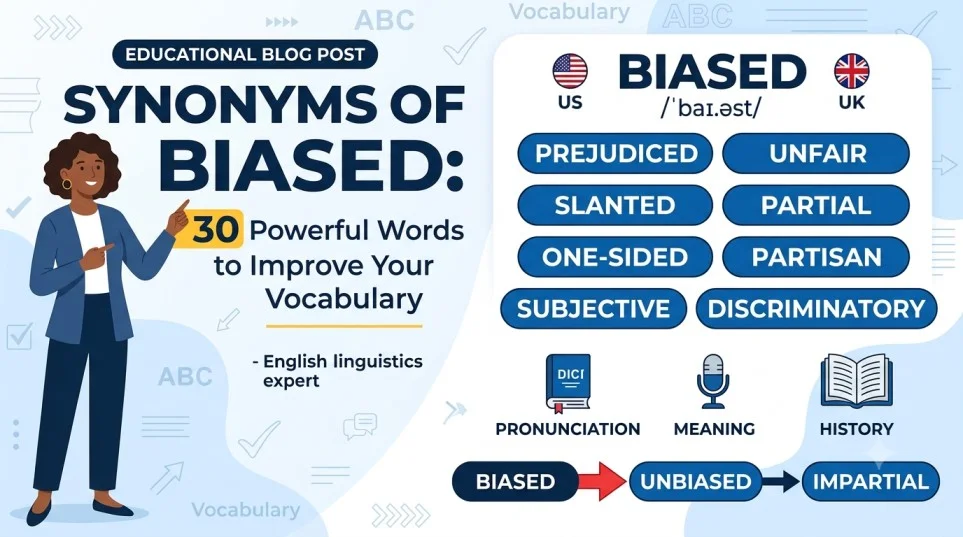
- US: /ˈbaɪ.əst/
- UK: /ˈbaɪ.əst/
Syllables
- bi-ased
Affixation Pattern of Biased
- Root: Bias
- Prefix: None
- Suffix: -ed (forms the adjective)
Word Formation
- Bias (Noun): An unfair preference or prejudice.
- Bias (Verb): To influence someone in an unfair way.
- Biased (Adjective): Holding an unfair opinion.
- Biasedly (Adverb): Acting in an unfair or slanted manner.
- Unbiased (Adjective): Fair, neutral, and open-minded.
A List of Foremost Synonyms of Biased
1. Partial (Adjective)
US: /ˈpɑːr.ʃəl/ | UK: /ˈpɑː.ʃəl/
Meaning: Favoring one side over another in a dispute or discussion.
- The judge was partial toward the defense attorney.
- A good manager cannot be partial when picking team leaders.
2. Prejudiced (Adjective)
US: /ˈprɛdʒ.ə.dɪst/ | UK: /ˈprɛdʒ.ʊ.dɪst/
Meaning: Having a strong dislike or unfair opinion formed without full knowledge.
- He held prejudiced views about modern art.
- The company replaced the prejudiced test system.
3. One-sided (Adjective)
US: /ˌwʌnˈsaɪ.dɪd/ | UK: /ˌwʌnˈsaɪ.dɪd/
Meaning: Presenting only one point of view in an argument or report.
- The documentary gave a one-sided view of the event.
- Their debate felt one-sided from the very start.
4. Partisan (Adjective)
US: /ˈpɑːr.tə.zən/ | UK: /ˌpɑː.tɪˈzæn/
Meaning: Strongly supporting one specific political party or cause without considering other views.
- The newspaper published a partisan attack on the mayor.
- Partisan politics can slow down helpful public laws.
5. Slanted (Adjective)
US: /ˈslæn.tɪd/ | UK: /ˈslɑːn.tɪd/
Meaning: Presented in a way that favors a particular opinion or outcome.
- The reporter wrote a slanted summary of the interview.
- I stopped reading that slanted blog post.
6. Colored (Adjective)
US: /ˈkʌl.ɚd/ | UK: /ˈkʌl.əd/
Meaning: Influenced or distorted by personal feelings or past experiences.
- Her view of the city was colored by a bad vacation.
- His memories were colored by anger.
7. Subjective (Adjective)
US: /səbˈdʒɛk.tɪv/ | UK: /səbˈdʒɛk.tɪv/
Meaning: Based on personal feelings and opinions rather than clear facts.
- Art reviews are usually very subjective.
- Taste in food is purely subjective.
8. Opinionated (Adjective)
US: /əˈpɪn.jə.neɪ.tɪd/ | UK: /əˈpɪn.jə.neɪ.tɪd/
Meaning: Holding strong beliefs and unwilling to change your mind.
- My uncle is opinionated about sports.
- She tried to avoid the opinionated caller.
9. Discriminatory (Adjective)
US: /dɪˈskrɪm.ə.nə.tɔːr.i/ | UK: /dɪˈskrɪm.ɪ.nə.tər.i/
Meaning: Treating a person or group unfairly based on race, gender, or religion.
- The court struck down the discriminatory law.
- They protested against discriminatory hiring habits.
10. Jaundiced (Adjective)
US: /ˈdʒɔːn.dɪst/ | UK: /ˈdʒɔːn.dɪst/
Meaning: Looking at things with suspicion, bitterness, or dislike.
- He took a jaundiced view of corporate promises.
- Her bad past gave her a jaundiced attitude toward business partners.
11. Predisposed (Adjective)
US: /ˌpriː.dɪˈspoʊzd/ | UK: /ˌpriː.dɪˈspoʊzd/
Meaning: Leaning naturally toward a specific opinion or action beforehand.
- She was predisposed to agree with her sister.
- The voters were predisposed to support the local candidate.
12. Unfair (Adjective)
US: /ʌnˈfɛr/ | UK: /ʌnˈfeə/
Meaning: Not treating people equally or according to rules.
- The teacher gave an unfair test to the class.
- It is unfair to blame one person for a group mistake.
13. Bigoted (Adjective)
US: /ˈbɪɡ.ət.əd/ | UK: /ˈbɪɡ.ət.ɪd/
Meaning: Unreasonably attached to a belief and hateful toward different people.
- He made bigoted remarks during the dinner.
- The community rejected her bigoted views.
14. Skewed (Adjective)
US: /skjuːd/ | UK: /skjuːd/
Meaning: Not accurate, balanced, or correct due to unfair influence.
- The survey results were skewed by bad questions.
- He has a skewed idea of how businesses operate.
15. Warped (Adjective)
US: /wɔːrpt/ | UK: /wɔːpt/
Meaning: Distorted or changed from a natural, normal state.
- The movie presented a warped picture of history.
- Greed gave him a warped view of right and wrong.
16. Preferential (Adjective)
US: /ˌprɛf.əˈrɛn.ʃəl/ | UK: /ˌprɛf.ərˈɛn.ʃəl/
Meaning: Giving special advantage or treatment to one person or group.
- The star pupil received preferential treatment.
- Members enjoy preferential rates at the hotel.
17. Influenced (Adjective)
US: /ˈɪn.flu.ənst/ | UK: /ˈɪn.flu.ənst/
Meaning: Affected or changed by outside ideas or power.
- The jury felt influenced by public rumors.
- His choice was influenced by his parents.
18. Preconceived (Adjective)
US: /ˌpriː.kənˈsiːvd/ | UK: /ˌpriː.kənˈsiːvd/
Meaning: Formed in the mind before having full facts or experience.
- Try to enter the test without preconceived ideas.
- Her preconceived notions about the town were wrong.
19. Blind (Adjective)
US: /blaɪnd/ | UK: /blaɪnd/
Meaning: Unable or unwilling to see facts or flaws.
- He had a blind faith in his business plan.
- She was blind to her friend’s mistakes.
20. Dogmatic (Adjective)
US: /dɔːɡˈmæt.ɪk/ | UK: /dɒɡˈmæt.ɪk/
Meaning: Stating personal opinions as if they were unquestionable facts.
- The speaker had a dogmatic style that bothered listeners.
- Avoid dogmatic statements when writing essay papers.
21. Sectarian (Adjective)
US: /sɛkˈtɛr.i.ən/ | UK: /sɛkˈteə.ri.ən/
Meaning: Rigidly following the interests of a small group or sect.
- The region suffered from sectarian fights.
- The paper avoided sectarian opinions.
22. Inequitable (Adjective)
US: /ɪnˈɛkw.ə.tə.bəl/ | UK: /ɪnˈɛkw.ɪ.tə.bəl/
Meaning: Not fair or equal; lacking justice.
- They protested the inequitable division of money.
- The system created an inequitable distribution of work.
23. Narrow-minded (Adjective)
US: /ˌnær.oʊˈmaɪn.dɪd/ | UK: /ˌnær.əʊˈmaɪn.dɪd/
Meaning: Unwilling to accept or consider different ideas and thoughts.
- His narrow-minded views alienated his neighbors.
- Moving to a big city can help narrow-minded people grow.
24. Myopic (Adjective)
US: /maɪˈɑː.pɪk/ | UK: /maɪˈɒp.ɪk/
Meaning: Short-sighted; lacking long-term vision or broad understanding.
- The board made a myopic choice to cut safety budgets.
- Focusing only on quick profits is a myopic strategy.
25. Intolerant (Adjective)
US: /ɪnˈtɑː.lɚ.ənt/ | UK: /ɪnˈtɒl.ər.ənt/
Meaning: Unwilling to accept views, beliefs, or behavior that differ from your own.
- An intolerant leader struggles to build strong teams.
- He became intolerant of opposing views.
26. Asymmetrical (Adjective)
US: /ˌeɪ.səˈmɛtr.ɪ.kəl/ | UK: /ˌeɪ.sɪˈmɛtr.ɪ.kəl/
Meaning: Lacking balance or equal proportions on both sides.
- The two companies had an asymmetrical power relationship.
- The debate suffered from asymmetrical rules.
27. Tendentious (Adjective)
US: /tɛnˈdɛn.ʃəs/ | UK: /tɛnˈdɛn.ʃəs/
Meaning: Expressing or intending to promote a strong, controversial point of view.
- The author wrote a tendentious account of the war.
- Critics disliked the tendentious tone of the editorial.
28. Favoring (Adjective)
US: /ˈfeɪ.vɚ.ɪŋ/ | UK: /ˈfeɪ.vər.ɪŋ/
Meaning: Showing preference toward one specific side or choice.
- Finding a synonym of biased helps when describing a referee who prefers one team.
- The company kept a favoring stance toward local suppliers.
29. Weighty (Adjective)
US: /ˈweɪ.ti/ | UK: /ˈweɪ.ti/
Meaning: Tending to lean heavily toward one side; carrying unbalanced influence.
- The panel gave a weighty advantage to legacy members.
- A synonym of biased like “weighty” shows how evidence can lean one way.
30. Slanted-mind (Adjective)
US: /ˈslæn.tɪd maɪnd/ | UK: /ˈslɑːn.tɪd maɪnd/
Meaning: Thinking in a skewed or pre-judged direction.
- Using a synonym of biased like slanted-mind clarifies a voter’s habit.
- The article exposed the slanted-mind view of the reviewer.
Prototype Meaning
The prototype meaning of our target word centers on a lack of fairness. When people hear this term, they usually picture a referee favoring one team, a news channel ignoring half of a story, or a judge making a decision before the trial starts. It describes a mind or system that leans away from straight truth toward personal interest.
Prototype Categorization
Grouped synonyms make it easier for writers to pick the right term:
- Political & Social Grouping: Partisan, Sectarian, Discriminatory, Bigoted.
- Thought & Perception Grouping: Subjective, Opinionated, Preconceived, Narrow-minded, Dogmatic, Intolerant, Myopic, Jaundiced.
- Data & Presentation Grouping: Slanted, Skewed, One-sided, Warped, Asymmetrical, Tendentious.
- General Unfairness Grouping: Partial, Unfair, Preferential, Inequitable, Predisposed, Colored, Influenced, Blind, Favoring, Weighty, Slanted-mind.
Categorizing these terms helps writers pick the most accurate synonym of biased for news reports, academic essays, or everyday conversations.
Antonyms
Antonyms of Biased
- Unbiased (Adjective): Free from all prejudice or partiality.
- Impartial (Adjective): Treating all rivals or disputants equally.
- Neutral (Adjective): Not supporting or helping either side in a conflict.
- Objective (Adjective): Based on real facts rather than personal feelings.
- Fair (Adjective): Treating people equally without favor or discrimination.
- Just (Adjective): Based on or behaving according to what is morally right and fair.
- Disinterested (Adjective): Not influenced by personal advantage; free from bias.
- Equitable (Adjective): Fair and impartial to everyone involved.
Short Questions and Answers
Short Questions and Answers
- What does biased mean?
- It means favoring one side, person, or idea over another in an unfair way.
- When should this word be used?
- Use it when describing unfair reports, unbalanced sports calls, personal prejudice, or skewed research data.
- Is the word positive or negative?
- It carries a negative tone in most situations because it implies unfairness and lack of justice.
- How is it different from similar words?
- Words like subjective mean based on feelings, while prejudiced implies unreasonable dislike. Choosing the right synonym of biased helps you capture these exact shades of meaning.
Conclusion
Mastering this key word and its synonyms is a great step toward language fluency. Learning these alternatives expands your vocabulary, sharpens your writing, and prevents repetitive phrasing in your essays. It also builds your overall confidence when speaking with native speakers. Try adding one new synonym to your daily reading and writing practice today!

I am a linguist with 7 years of experience in English language teaching, including postgraduate-level instruction. My expertise includes English grammar, and I contribute as a content and blog writer, producing scholarly and educational language resources.