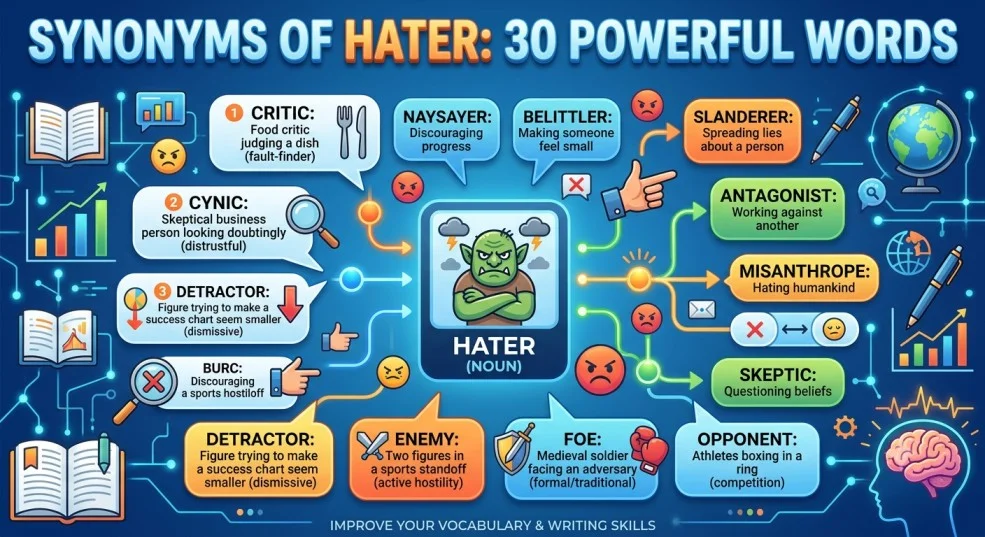
Imagine posting a picture of your new bicycle online. Most friends leave nice comments, but one person writes that your bicycle looks cheap and ugly. That person is a hater. People use this word all the time today because social media makes it very easy for people to criticize others.
For English learners and content writers, repeating the same word makes your writing dull. Learning synonyms helps you share exact feelings and makes your writing much more exciting. This article explains the meaning of the key word alongside its synonyms using clear examples, helpful grammar tips, and historical facts.
We will also explore correct pronunciation guides and semantic groups to help you choose the best words for your writing.
Meaning of Hater
Definition
Hater (noun): A person who dislikes, criticizes, or wishes failure upon another person or thing.
Examples
- The young singer ignored every hater who said she could not sing.
- Do not let a hater stop you from trying out for the school soccer team.
Connotative Meaning
(Connotation is the emotional feeling or idea that a word brings to your mind beside its literal meaning.)
- Positive tone: This word is almost never used in a positive way.
- Negative tone: It describes a mean, jealous, or cruel person who wants to see others fail.
- Neutral tone: It can be neutral when used in casual jokes between close friends.
Etymology
- Origin: The word comes from the Old English word hatian, which means to dislike intensely or pursue with hatred.
- Old English (450–1100): The root verb hatian was used to describe deep, intense anger or warfare between enemies.
- Middle English (1100–1500): It became haten, and people started using it for everyday dislikes.
- Modern English (1500–Present): The suffix “-er” was firmly added to create “hater,” meaning a person who hates. In the early 2000s, hip-hop culture changed the word to mean a jealous critic.
Pronunciation
- US: /ˈheɪ.tər/
- UK: /ˈheɪ.tə/
Syllables
ha-ter
Affixation Pattern of Hater
- Root: hate (verb)
- Prefix: None
- Suffix: -er (noun suffix meaning “one who does an action”)
- Word formation:
- Hate (verb) — To feel intense dislike.
- Hate (noun) — The feeling of intense dislike.
- Hateful (adjective) Full of malice or hate.
- Hatefully (adverb) — Doing something in a mean or angry way.
A List of wonderful Synonyms of Hater
1. Critic (noun)
US: /ˈkrɪt.ɪk/ | UK: /ˈkrɪt.ɪk/
Meaning: A person who judges and finds faults in something or someone.
Examples:
- The food critic wrote a bad review about the new restaurant.
- She is her own worst critic when she paints a picture.
2. Cynic (noun)
US: /ˈsɪn.ɪk/ | UK: /ˈsɪn.ɪk/
Meaning: A person who believes that people are motivated purely by selfishness.
Examples:
- The cynic smiled and said the politician was lying to get votes.
- Do not be such a cynic about the kindness of strangers.
3. Detractor (noun)
US: /dɪˈtræk.tər/ | UK: /dɪˈtræk.tə/
Meaning: A person who tries to make something seem less good or less important.
Examples:
- Despite what every detractor said, the movie became a massive hit.
- The chef proved his detractors wrong by winning the big award.
4. Enemy (noun)
US: /ˈen.ə.mi/ | UK: /ˈen.ə.mi/
Meaning: A person who actively hates or hurts another person.
Examples:
- The superhero fought hard to defeat his worst enemy.
- It is better to make a new friend than a bitter enemy.
5. Foe (noun)
US: /foʊ/ | UK: /fəʊ/
Meaning: A traditional or formal word for an enemy or opponent.
Examples:
- The two nations fought as foe against foe for many years.
- She faced her final foe on the tennis court during the match.
6. Opponent (noun)
US: /əˈpoʊ.nənt/ | UK: /əˈpəʊ.nənt/
Meaning: A person who disagrees with or competes against someone else.
Examples:
- His opponent in the chess game made a very smart move.
- The boxer shook hands with his opponent after the fight ended.
7. Adversary (noun)
US: /ˈæd.vər.ser.i/ | UK: /ˈæd.və.sər.i/
Meaning: A person, group, or force that contends with or opposes another.
Examples:
- He knew his adversary was fast, so he trained hard every day.
- The young lawyer proved to be a tough adversary in the courtroom.
8. Rival (noun)
US: /ˈraɪ.vəl/ | UK: /ˈraɪ.vəl/
Meaning: A person who competes with another for the same goal or success.
Examples:
- The two schools have been sports rivals for over fifty years.
- He beat his closest rival to win the gold medal.
9. Skeptic (noun)
US: /ˈskep.tɪk/ | UK: /ˈskep.tɪk/
Meaning: A person who doubts accepted ideas or truths.
Examples:
- The skeptic did not believe that the magician could actually fly.
- I am a bit of a skeptic when it comes to quick weight loss plans.
10. Naysayer (noun)
US: /ˈneɪˌseɪ.ər/ | UK: /ˈneɪˌseɪ.ə/
Meaning: A person who says something is not possible or will fail.
Examples:
- The team ignored the naysayers and won the final championship game.
- There will always be naysayers when you try something brand new.
11. Belittler (noun)
US: /bɪˈlɪt.lər/ | UK: /bɪˈlɪt.lə/
Meaning: A person who makes others feel small, unimportant, or weak.
Examples:
- She left her job because her boss was a constant belittler.
- Do not let a belittler make you feel bad about your goals.
12. Faultfinder (noun)
US: /ˈfɔːltˌfaɪn.dər/ | UK: /ˈfɔːltˌfaɪn.də/
Meaning: A person who constantly looks for mistakes or flaws in everything.
Examples:
- My uncle is a faultfinder who always complains about his dinner.
- It is hard to work with a faultfinder who never praises good work.
13. Backbiter (noun)
US: /ˈbækˌbaɪ.tər/ | UK: /ˈbækˌbaɪ.tə/
Meaning: A person who says mean things about someone who is not there.
Examples:
- A true friend talks to you directly instead of being a backbiter.
- The backbiter spread false rumors around the office floor.
14. Slanderer (noun)
US: /ˈslæn.dər.ər/ | UK: /ˈslɑːn.dər.ə/
Meaning: A person who tells harmful lies about someone to ruin their reputation.
Examples:
- The actor took the slanderer to court for destroying his career.
- She refused to listen to the slanderer speak about her sister.
15. Defamer (noun)
US: /dɪˈfeɪ.mər/ | UK: /dɪˈfeɪ.mə/
Meaning: A person who attacks the good name or reputation of another.
Examples:
- The politician spoke out against the defamer who wrote the fake article.
- The company protected its brand by suing the online defamer.
16. Caviler (noun)
US: /ˈkæv.əl.ər/ | UK: /ˈkæv.əl.ə/
Meaning: A person who raises petty, annoying, or trivial objections.
Examples:
- The caviler spent an hour arguing about the font size on the cover.
- Ignore the caviler and focus on the main parts of the project.
17. Carper (noun)
US: /ˈkɑːr.pər/ | UK: /ˈkɑː.pə/
Meaning: A person who complains or finds fault continually about small things.
Examples:
- The old carper next door always complains if our dog barks once.
- It is tiring to live with a carper who is never happy.
18. Vilifier (noun)
US: /ˈvɪl.ə.faɪ.ər/ | UK: /ˈvɪl.ə.faɪ.ə/
Meaning: A person who speaks or writes very harsh, abusive statements about someone.
Examples:
- The online vilifier typed angry comments on every single video.
- He remained calm even when his vilifier yelled at him in public.
19. Traducer (noun)
US: /trəˈduː.sər/ | UK: /trəˈdjuː.sə/
Meaning: A person who speaks badly of another to cause shame or disgrace.
Examples:
- The king banished the traducer for spreading lies about the queen.
- She did not let her traducer ruin her confidence before the speech.
20. Maligner (noun)
US: /məˈlaɪ.nər/ | UK: /məˈlaɪ.nə/
Meaning: A person who says misleading, malicious things about someone else.
Examples:
- The manager discovered that the maligner was trying to get him fired.
- She chose to ignore the maligner and kept doing her best work.
21. Complainer (noun)
US: /kəmˈpleɪ.nər/ | UK: /kəmˈpleɪ.nə/
Meaning: A person who expresses grief, pain, or discontent frequently.
Examples:
- The chronic complainer said the room was too hot and then too cold.
- No one wants to sit next to a complainer during a long trip.
22. Grumbler (noun)
US: /ˈɡrʌm.blər/ | UK: /ˈɡrʌm.blə/
Meaning: A person who complains in a quiet, low, and angry voice.
Examples:
- The grumbler muttered about the long line at the grocery store.
- He is a known grumbler who hates working early morning shifts.
23. Disparager (noun)
US: /dɪˈspær.ɪ.dʒər/ | UK: /dɪˈspær.ɪ.dʒə/
Meaning: A person who talks about something as if it has little value or importance.
Examples:
- The young inventor proved every disparager wrong with his new machine.
- Do not listen to a disparager who laughs at your creative dreams.
24. Reviler (noun)
US: /rɪˈvaɪ.lər/ | UK: /rɪˈvaɪ.lə/
Meaning: A person who uses abusive, angry, and insulting language toward others.
Examples:
- The crowd yelled back at the angry reviler on the street corner.
- The leader remained quiet while his reviler shouted insults.
25. Scolder (noun)
US: /ˈskoʊl.dər/ | UK: /ˈskəʊl.də/
Meaning: A person who loudly judges or finds fault with someone’s behavior.
Examples:
- The neighborhood scolder stood on her porch and yelled at the kids.
- I try to avoid that scolder because she makes everyone feel guilty.
26. Antisocial (noun)
US: /ˌæn.t̬iˈsoʊ.ʃəl/ | UK: /ˌæn.tiˈsəʊ.ʃəl/
Meaning: A person who opposes or dislikes social norms and human interaction.
Examples:
- The town antisocial lived alone in a cabin away from everyone.
- He acts like an antisocial because he never talks at parties.
27. Misanthrope (noun)
US: /ˈmɪs.ən.θroʊp/ | UK: /ˈmɪz.ən.θrəʊp/
Meaning: A person who dislikes humankind and avoids human society.
Examples:
- The old miser was a true misanthrope who locked his doors to everyone.
- Writing dark poems did not make him a bitter misanthrope.
28. Doubter (noun)
US: /ˈdaʊ.t̬ər/ | UK: /ˈdaʊ.tə/
Meaning: A person who lacks confidence or has doubts about something.
Examples:
- The young athlete showed the doubters that he could finish the marathon.
- Every doubter was quiet when the team scored the winning goal.
29. Antagonist (noun)
US: /ænˈtæɡ.ə.nɪst/ | UK: /ænˈtæɡ.ə.nɪst/
Meaning: A person who actively struggles against or competes with another.
Examples:
- The story became exciting when the antagonist revealed his evil plan.
- She had to face her main antagonist in the final round of debate.
30. Denigrator (noun)
US: /ˈden.ə.ɡreɪ.t̬ər/ | UK: /ˈden.ɪ.ɡreɪ.tə/
Meaning: A person who attacks the reputation of others or denies their value.
Examples:
- The artist ignored the denigrator who called his paintings trash.
- A constant denigrator will always look for ways to ruin your joy.
Prototype Meaning
The most typical meaning of a hater is a jealous person who leaves mean, negative comments online. When people hear this word, they immediately picture a user hiding behind a computer screen. This person types angry words on social media because they see someone else enjoying success, beauty, or happiness.
Prototype Categorization
- Direct Competitors: Opponent, rival, adversary, antagonist. (These people fight against you fairly in games or debates).
- Verbal Attackers: Slanderer, defamer, vilifier, traducer, maligner. (These people tell serious, harmful lies to destroy your name).
- Whiners and Flaw-Finders: Faultfinder, carper, caviler, grumbler, complainer. (These people focus on tiny, annoying mistakes).
- Doubtful Thinkers: Cynic, skeptic, naysayer, doubter. (These people simply do not believe in good intentions or big success).
Grouping these words helps writers pick the perfect synonym. If someone is competing in sports, choose “rival.” If someone is spreading dirty lies, choose “slanderer.”
Antonyms of Hater
- Supporter (noun): A person who encourages or approves of someone or something.
- Fan (noun): A person who has a strong interest in or admiration for a celebrity or team.
- Admirer (noun): A person who looks at someone or something with pleasure and approval.
- Friend (noun): A person whom one knows and has a bond of mutual affection with.
- Ally (noun): A person or group that cooperates with or helps another.
Short Questions and Answers
- What does hater mean?
- A hater is a person who dislikes, criticizes, or wishes failure upon another person.
- When should hater be used?
- Use it in casual conversations or informal articles to describe someone who is jealous of another person’s success.
- Is hater positive or negative?
- It is highly negative because it describes an unkind person, but it can be neutral when close friends use it as a joke.
- How is it different from similar words?
- A hater is driven by jealousy, while a critic judges the actual quality of work, and an opponent simply competes in a game.
Conclusion
Learning the word hater and its thirty synonyms is a fantastic way to improve your English vocabulary. Using different words strengthens your writing and speaking by making your sentences precise. It helps you avoid repeating the same terms over and over again, which keeps your audience interested. Best of all, knowing exactly which word to use builds your overall English confidence in school or at work. Try to practice using at least one new synonym from this list in your daily conversations or writing tasks!

I am a linguist with 7 years of experience in English language teaching, including postgraduate-level instruction. My expertise includes English grammar, and I contribute as a content and blog writer, producing scholarly and educational language resources.