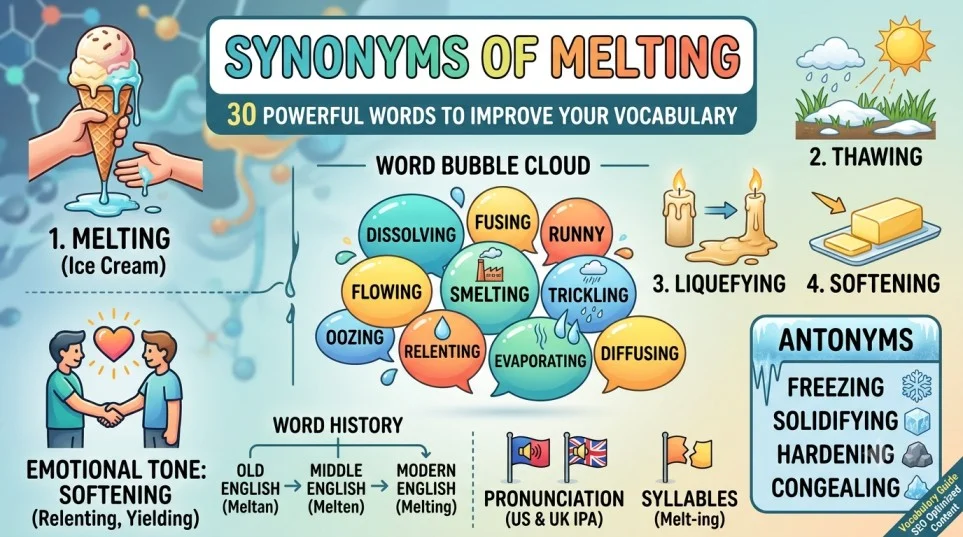
Imagine holding a soft ice cream cone on a bright summer afternoon. The cold cream turns into a liquid sticky drip down your warm hand. This common experience shows what the word melting means. People use this word often because heat changes solid things into liquid every single day.
Learning synonyms of melting is very important for English learners and writers. It helps you stop repeating the same simple words in your essays and stories. Using varied words makes your writing precise, lively, and fun to read.
This guide explores the meaning of our key word and its many synonyms. You will discover clear example sentences, basic grammar rules, simple history, correct pronunciation, and smart word categories to boost your English skills today.
Meaning of Melting
Definition
Melting (Verb / Adjective / Noun): Changing from a solid to a liquid state by heating, or showing strong emotion like love or sympathy.
Examples
- The hot sun is melting the thick ice on the road.
- Her sweet smile had a melting effect on his cold heart.
Connotative Meaning
(Connotation is the emotional feeling or idea that a word brings to mind beyond its literal definition.)
- Positive tone: Softening hearts, deep love, warm gentle feelings, or sweet tasty treats.
- Negative tone: Sad destruction, losing form, extreme uncomfortable heat, or total loss.
- Neutral tone: A normal physical change from solid to liquid caused by heat.
Etymology
- Source language: Proto-Germanic word melta, meaning to turn into liquid or dissolve.
- Old English (450–1100): Written as meltan, meaning to become liquid by heat or consume by fire.
- Middle English (1100–1500): Evolved into melten, used for both physical heat changes and soft human feelings.
- Modern English (1500–Present): Became the familiar word melting, widely used in science, cooking, and emotional language.
Pronunciation
- US: /ˈmɛl.tɪŋ/
- UK: /ˈmɛl.tɪŋ/
Syllables
melt-ing
Affixation Pattern of Melting
- Root: Melt (Verb)
- Prefix: None
- Suffix: -ing (Participle / Gerund suffix)
Word Formation:
- Melt (Verb): To turn solid into liquid.
- Melt (Noun): A melted state or a warm food dish.
- Melted (Adjective): Turned into liquid form.
- Meltingly (Adverb): In a soft, touching, or gentle manner.
- Melter (Noun): A tool or device that melts things.
30 Synonyms of Melting
1. Thawing (Verb)
US: /ˈθɑː.ɪŋ/ | UK: /ˈθɔː.ɪŋ/
Meaning: Becoming warm enough to change ice or frost back into water.
Examples:
- The morning sun is thawing the frozen grass in the garden.
- Spring weather brings gentle thawing to the mountain trails.
2. Dissolving (Verb)
US: /dɪˈzɑːlv.ɪŋ/ | UK: /dɪˈzɒlv.ɪŋ/
Meaning: Mixing completely with a liquid until it breaks down and disappears.
Examples:
- Sugar is dissolving quickly in the hot mug of tea.
- The salt started dissolving as soon as it hit the boiling water.
3. Liquefying (Verb)
US: /ˈlɪk.wə.faɪ.ɪŋ/ | UK: /ˈlɪk.wɪ.faɪ.ɪŋ/
Meaning: Turning a solid or gas into a smooth liquid state.
Examples:
- The extreme heat is liquefying the candle wax on the plate.
- Machines are liquefying the gas to store it safely in metal tanks.
4. Deliquescing (Verb)
US: /ˌdɛl.əˈkwɛs.ɪŋ/ | UK: /ˌdɛl.ɪˈkwɛs.ɪŋ/
Meaning: Absorbing moisture from the air until becoming a liquid.
Examples:
- The dry salt crystals are deliquescing in the humid room air.
- Certain mushrooms start deliquescing as they grow old.
5. Fusing (Verb)
US: /ˈfjuː.zɪŋ/ | UK: /ˈfjuː.zɪŋ/
Meaning: Joining materials together by using high heat to soften them.
Examples:
- The worker is fusing two metal pipes with a hot torch.
- Intense warmth is fusing the plastic pieces into one block.
6. Smelting (Verb)
US: /ˈsmɛlt.ɪŋ/ | UK: /ˈsmɛlt.ɪŋ/
Meaning: Heating raw ore to extract pure metal from rock.
Examples:
- The factory is smelting iron ore inside huge blast furnaces.
- Ancient people learned smelting to make strong copper tools.
7. Softening (Verb)
US: /ˈsɑː.fən.ɪŋ/ | UK: /ˈsɒf.ən.ɪŋ/
Meaning: Becoming less hard, stiff, or solid due to heat.
Examples:
- The butter is softening on the warm kitchen counter.
- Heat is softening the clay so the artist can shape it.
8. Runny (Adjective)
US: /ˈrʌn.i/ | UK: /ˈrʌn.i/
Meaning: Having a liquid consistency that flows easily.
Examples:
- The hot chocolate sauce became smooth and runny.
- She likes her eggs with warm runny yolks in the morning.
9. Flowing (Verb)
US: /ˈfloʊ.ɪŋ/ | UK: /ˈfləʊ.ɪŋ/
Meaning: Moving steadily and smoothly like a liquid stream.
Examples:
- Hot red lava is flowing down the side of the volcano.
- Warm syrup was flowing over the freshly cooked pancakes.
10. Dripping (Verb)
US: /ˈdrɪp.ɪŋ/ | UK: /ˈdrɪp.ɪŋ/
Meaning: Falling in small single drops as a solid turns soft.
Examples:
- Water was dripping slowly from the icicles on the roof.
- The soft ice cream was dripping onto his white shirt.
11. Relenting (Verb)
US: /rɪˈlɛnt.ɪŋ/ | UK: /rɪˈlɛnt.ɪŋ/
Meaning: Becoming softer, kinder, or less strict in feeling.
Examples:
- Her strict father was relenting after seeing her sad tears.
- The bitter cold weather is finally relenting this afternoon.
12. Softening (Adjective)
US: /ˈsɑː.fən.ɪŋ/ | UK: /ˈsɒf.ən.ɪŋ/
Meaning: Showing gentle emotions or becoming less harsh.
Examples:
- He spoke with a softening tone to comfort the crying child.
- She felt a softening touch in his gentle handshake.
13. Warming (Verb)
US: /ˈwɔːr.mɪŋ/ | UK: /ˈwɔː.mɪŋ/
Meaning: Increasing in temperature and losing coldness or ice.
Examples:
- The afternoon sunshine is warming the cold metal bench.
- Soup is warming on the small stove inside the tent.
14. Unfreezing (Verb)
US: /ʌnˈfriːz.ɪŋ/ | UK: /ʌnˈfriːz.ɪŋ/
Meaning: Changing back from a frozen solid state to liquid.
Examples:
- The lake is slowly unfreezing as warm spring days arrive.
- They are unfreezing the water pipes using warm wet towels.
15. Fluxing (Verb)
US: /ˈflʌks.ɪŋ/ | UK: /ˈflʌks.ɪŋ/
Meaning: Flowing or causing a substance to mix and melt easily.
Examples:
- The intense fire is fluxing the minerals inside the pot.
- Heat is fluxing the metals together during the repair work.
16. Vanishing (Verb)
US: /ˈvæn.ɪʃ.ɪŋ/ | UK: /ˈvæn.ɪʃ.ɪŋ/
Meaning: Disappearing completely from view as if going into air.
Examples:
- Morning mist is vanishing under the bright rising sun.
- The small ice cube was vanishing in the warm drink.
17. Dissipating (Verb)
US: /ˈdɪs.ə.peɪt.ɪŋ/ | UK: /ˈdɪs.ɪ.peɪt.ɪŋ/
Meaning: Slowly breaking up, scattering, or disappearing away.
Examples:
- The dark clouds are dissipating after the heavy rain stopped.
- Engine heat is dissipating quickly into the cool air.
18. Merging (Verb)
US: /ˈmɜːrdʒ.ɪŋ/ | UK: /ˈmɜːdʒ.ɪŋ/
Meaning: Combining two soft or liquid things into one single body.
Examples:
- Two tiny drops of water were merging on the glass window.
- The soft colors were merging together on the wet paper.
19. Blending (Verb)
US: /ˈblɛnd.ɪŋ/ | UK: /ˈblɛnd.ɪŋ/
Meaning: Mixing smoothly together until individual parts are lost.
Examples:
- Warm butter is blending easily into the hot wheat flour.
- The melted paints are blending into a pretty purple shade.
20. Evaporating (Verb)
US: /ɪˈvæp.ə.reɪt.ɪŋ/ | UK: /ɪˈvæp.ə.reɪt.ɪŋ/
Meaning: Changing from liquid into gas or vapor due to warmth.
Examples:
- Water on the sidewalk is evaporating in the summer heat.
- The puddle was evaporating fast under the direct sunlight.
21. Sublimating (Verb)
US: /ˈsʌb.lə.meɪt.ɪŋ/ | UK: /ˈsʌb.lɪ.meɪt.ɪŋ/
Meaning: Turning directly from solid to gas without becoming liquid.
Examples:
- The dry ice block is sublimating into white misty gas.
- Snow can start sublimating under bright dry mountain light.
22. Yielding (Verb)
US: /ˈjiːld.ɪŋ/ | UK: /ˈjiːld.ɪŋ/
Meaning: Giving way under pressure or heat by losing firmness.
Examples:
- The stiff plastic is yielding to the heat of the dryer.
- Her stern mood was yielding to his warm cheerful words.
23. Disintegrating (Verb)
US: /dɪsˈɪn.tə.ɡreɪt.ɪŋ/ | UK: /dɪsˈɪn.tɪ.ɡreɪt.ɪŋ/
Meaning: Breaking apart completely into tiny pieces or fluid.
Examples:
- The wet paper box was disintegrating in the warm rain.
- Soil was disintegrating as water rushed through the yard.
24. Slumping (Verb)
US: /ˈslʌmp.ɪŋ/ | UK: /ˈslʌmp.ɪŋ/
Meaning: Sinking down heavy and soft due to extreme heat or weight.
Examples:
- The tall wax statue was slumping inside the hot greenhouse.
- The soft chocolate cake was slumping on the warm tray.
25. Trickling (Verb)
US: /ˈtrɪk.lɪŋ/ | UK: /ˈtrɪk.lɪŋ/
Meaning: Flowing slowly in a thin, light, continuous stream.
Examples:
- Water was trickling down from the thawing ice block.
- Melted butter was trickling over the warm baked bread.
26. Oozing (Verb)
US: /ˈuːz.ɪŋ/ | UK: /ˈuːz.ɪŋ/
Meaning: Flowing out slowly through small openings like thick liquid.
Examples:
- Warm sweet cheese was oozing out of the hot toast.
- Tree sap was oozing from the trunk in the warm sun.
27. Subduing (Verb)
US: /səbˈduː.ɪŋ/ | UK: /səbˈdjuː.ɪŋ/
Meaning: Softening strong feelings, intensity, or harsh power.
Examples:
- The calm music was subduing his angry nervous feelings.
- Soft light was subduing the bright glare in the big room.
28. Warming-up (Verb)
US: /ˈwɔːr.mɪŋ.ʌp/ | UK: /ˈwɔː.mɪŋ.ʌp/
Meaning: Slowly raising temperature to lose coldness and hardness.
Examples:
- Frozen berry pie is warming-up slowly inside the oven.
- The room is warming-up after turning on the heater.
29. Consuming (Verb)
US: /kənˈsuːm.ɪŋ/ | UK: /kənˈsjuːm.ɪŋ/
Meaning: Destroying or changing completely through heat or fire.
Examples:
- Fire was consuming the dry wooden logs in the pit.
- Extreme heat was consuming the thin frost on windows.
30. Diffusing (Verb)
US: /dɪˈfjuːz.ɪŋ/ | UK: /dɪˈfjuːz.ɪŋ/
Meaning: Spreading out softly and widely in all directions.
Examples:
- The sweet smell of melting sugar was diffusing in the house.
- Warm color was diffusing across the soft cloudy sky.
Prototype Meaning
The prototype meaning of melting centers on ice turning into water when heated by the sun. When people hear this word, they usually picture a clear ice cube shrinking in a warm glass, a delicious ice cream cone dripping on a hot day, or snow disappearing from green grass in spring. It represents a smooth, natural change from a hard solid state to a liquid flow.
Prototype Categorization
Categorization helps writers choose the best synonyms of melting for physical, scientific, or emotional contexts:
- Physical heat changes: Thawing, liquefying, unfreezing, warming, softening. (Best for weather, ice, cooking, and daily solid-to-liquid changes.)
- Industrial & high heat: Smelting, fusing, fluxing. (Best for metals, factories, tools, and technical manufacturing processes.)
- Fluid movement: Dripping, flowing, trickling, oozing, runny. (Best for describing liquid motion, texture, and physical flow.)
- Emotional & figurative changes: Relenting, yielding, subduing, softening. (Best for describing changing hearts, feelings, moods, and warm human reactions.)
- Science & chemical dissolution: Dissolving, deliquescing, sublimating, evaporating. (Best for chemistry, lab work, gases, and natural water cycles.)
Learning popular synonyms of melting improves clarity across all types of writing.
Antonyms of Melting
- Freezing (Verb): Turning a liquid into a hard solid through extreme cold.
- Solidifying (Verb): Becoming hard, firm, or solid instead of liquid.
- Hardening (Verb): Becoming stiff, firm, and difficult to bend or break.
- Congealing (Verb): Changing from a fluid state to a thick or solid mass.
- Coagulating (Verb): Changing a liquid into a dense, thick, semi-solid gel.
Short Questions and Answers
- What does melting mean?
- It means changing from a solid state into a liquid using heat, or feeling warm emotion inside your heart.
- When should melting be used?
- Use it when describing ice changing to water, butter heating in a pan, or someone feeling deep love, pity, or affection.
- Is melting positive or negative?
- It can be positive (tasty food, kind hearts) or negative (ruined ice sculptures, extreme global heat), depending entirely on the context.
- How is it different from similar words?
- While thawing applies strictly to ice or frozen things warming up, melting works for any solid material turned liquid by heat.
Conclusion
Learning useful synonyms of melting is a wonderful way to boost your daily vocabulary skills. Exploring smart synonyms of melting gives you exact words like thawing, fusing, or relenting for different situations. Using rich vocabulary strengthens your writing and speaking while helping you avoid boring repetition in school or work essays. Choosing accurate words also builds your overall English confidence fast. Make it a habit to practice new words every day to express your ideas clearly and naturally.

I am a linguist with 7 years of experience in English language teaching, including postgraduate-level instruction. My expertise includes English grammar, and I contribute as a content and blog writer, producing scholarly and educational language resources.