Imagine you walk into a job interview room. Five other people sit outside, waiting for their turn, just like you. Each of you is a candidate — someone who hopes to get the job. This word shows up everywhere: in elections, job applications, school admissions, and even talent shows. People use it because it is short, clear, and formal enough for serious situations.
But using the same word again and again can make your writing feel flat. That is why learning the synonyms of candidates matters so much for English learners and content writers. A rich vocabulary helps you sound natural, avoid repetition, and express small shades of meaning — the difference between a hopeful applicant and a confident front-runner is real, and the right word shows it.
This article explains the meaning of “candidate,” its history, grammar, and pronunciation. It then walks through 30 useful synonyms with simple examples, so you can pick the perfect word every time.
Meaning of Candidate
Definition
Candidate (noun): a person who applies for a job, runs for a position, or is being considered for something, such as an award or an exam.
Examples
- She is a strong candidate for the manager position.
- Three candidates are running in the local election.
Connotative Meaning
- Positive tone: Often shows hope, ambition, and effort, as in “a promising candidate.”
- Negative tone: Can suggest doubt or competition stress, as in “a weak candidate.”
- Neutral tone: Most commonly used in a plain, factual way, such as in job postings or news reports.
(Connotation means the feeling or idea a word suggests beyond its plain dictionary meaning.)
Etymology
- The word comes from the Latin candidatus, meaning “clothed in white.”
- In ancient Rome, men seeking public office wore white togas to show honesty and purity.
- The word passed into French as candidate before entering English.
- It kept the idea of someone seeking trust or approval from others.
Short History
- Old English (450–1100): The word did not exist yet. Anglo-Saxon speakers used native words tied to seeking or asking rather than a borrowed Latin term.
- Middle English (1100–1500): Still not common in English texts. French and Latin influence was growing, setting the stage for later borrowing.
- Modern English (1500–Present): The word entered English around the early 1600s through Latin and French. Over time, its use grew beyond politics to include jobs, exams, and awards.
Pronunciation (US & UK – IPA)
- US: /ˈkæn.dɪ.deɪt/
- UK: /ˈkæn.dɪ.dət/
Syllables
can-di-date (3 syllables)
Affixation Pattern of Candidate
- Root: candid- (from Latin candidus, meaning “white” or “shining”)
- Prefix: none
- Suffix: -ate (forms nouns, often for people or states)
Word formation from the root (grammatical category):
- candidate (noun) — a person seeking a position
- candidacy (noun) — the state of being a candidate
- candidature (noun, mainly British) — same meaning as candidacy
- candid (adjective, related word family) — open and honest
A List of High Ranked Synonyms of Candidate
Below are 30 synonyms of candidates. Each one carries a slightly different shade of meaning, so you can choose the best word for your sentence.
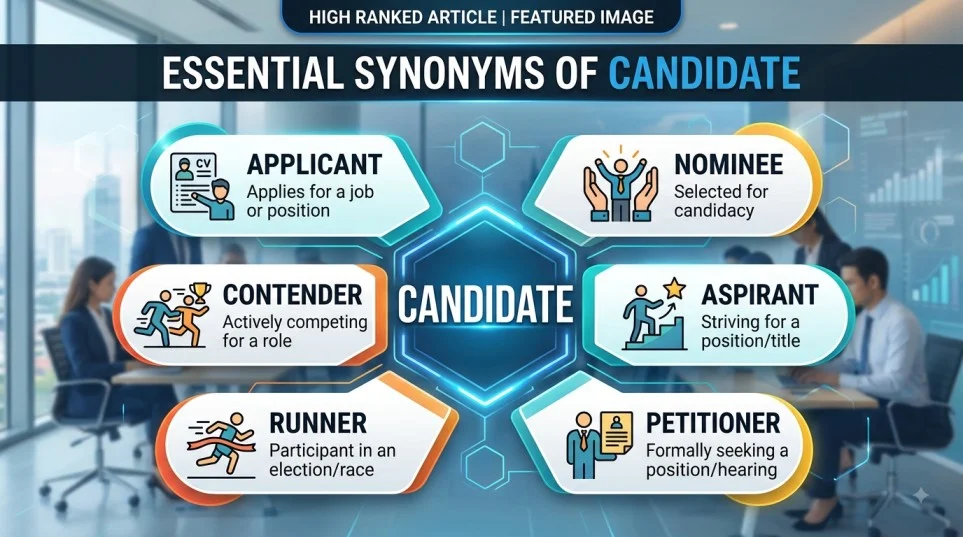
1. Applicant (noun)
US: /ˈæp.lɪ.kənt/ | UK: /ˈæp.lɪ.kənt/
Meaning: A person who formally asks for a job, place, or service.
- The job applicant sent her resume yesterday.
- Only two applicants met all the requirements.
2. Nominee (noun)
US: /ˌnɒm.ɪˈniː/ | UK: /ˌnɒm.ɪˈniː/
Meaning: A person chosen or suggested for a position or award.
- He is the party’s official nominee for mayor.
- The film received five award nominee spots.
3. Contender (noun)
US: /kənˈtɛn.dɚ/ | UK: /kənˈtɛn.də/
Meaning: Someone who competes seriously to win something.
- She is a top contender for the championship title.
- The debate showed which contender knew the issues best.
4. Aspirant (noun)
US: /ˈæs.pɚ.ənt/ | UK: /əˈspaɪə.rənt/
Meaning: A person with a strong hope of reaching a goal or position.
- Many young aspirants apply to the pilot training program.
- He remains a hopeful aspirant for the leadership role.
5. Contestant (noun)
US: /kənˈtɛs.tənt/ | UK: /kənˈtɛs.tənt/
Meaning: A person taking part in a competition.
- Each contestant performed a two-minute song.
- The show’s contestant answered every question correctly.
6. Entrant (noun)
US: /ˈɛn.trənt/ | UK: /ˈɛn.trənt/
Meaning: A person who enters a race, contest, or exam.
- New entrants must register before Friday.
- The marathon had over 500 entrants this year.
7. Competitor (noun)
US: /kəmˈpɛt.ɪ.tɚ/ | UK: /kəmˈpɛt.ɪ.tə/
Meaning: A person who tries to win against others.
- Each competitor trained for months before the race.
- She studied her closest competitor carefully.
8. Petitioner (noun)
US: /pəˈtɪʃ.ə.nɚ/ | UK: /pəˈtɪʃ.ə.nə/
Meaning: A person who formally requests something, often through an official process.
- The petitioner asked the court for a new hearing.
- Local petitioners gathered signatures for the new park.
9. Runner (noun)
US: /ˈrʌn.ɚ/ | UK: /ˈrʌn.ə/
Meaning: A person seeking a political position (informal, often “runner for office”).
- She announced herself as a runner for city council.
- The young runner for office gained quick support.
10. Hopeful (noun)
US: /ˈhoʊp.fəl/ | UK: /ˈhəʊp.fəl/
Meaning: A person who has a good chance or strong wish to succeed.
- The young hopeful auditioned for the lead role.
- Olympic hopefuls trained early every morning.
11. Prospect (noun)
US: /ˈprɑː.spɛkt/ | UK: /ˈprɒs.pɛkt/
Meaning: A person seen as likely to succeed or be chosen, often in sports or business.
- The coach called him a top prospect this season.
- Sales teams follow up with every new prospect.
12. Seeker (noun)
US: /ˈsiː.kɚ/ | UK: /ˈsiː.kə/
Meaning: A person who is looking for something, such as a job or asylum.
- The job seeker updated her online profile.
- Asylum seekers waited months for a decision.
13. Claimant (noun)
US: /ˈkleɪ.mənt/ | UK: /ˈkleɪ.mənt/
Meaning: A person who states they have a right to something, often a benefit or title.
- The claimant filed paperwork with the insurance office.
- A distant relative became a claimant to the estate.
14. Suitor (noun)
US: /ˈsuː.tɚ/ | UK: /ˈsjuː.tə/
Meaning: A person or company seeking to win a position, deal, or favor (often used for business takeovers).
- The company attracted several corporate suitors.
- Only one suitor offered a fair price.
15. Rival (noun)
US: /ˈraɪ.vəl/ | UK: /ˈraɪ.vəl/
Meaning: A person who competes with another for the same goal.
- The two rivals debated on live television.
- Her closest rival dropped out of the race.
16. Challenger (noun)
US: /ˈtʃæl.ɪn.dʒɚ/ | UK: /ˈtʃæl.ɪn.dʒə/
Meaning: A person who competes to take a position held by someone else.
- The challenger questioned the champion’s record.
- A new political challenger entered the race.
17. Standard-bearer (noun)
US: /ˈstæn.dɚd ˌbɛr.ɚ/ | UK: /ˈstæn.dəd ˌbeə.rə/
Meaning: A leading person chosen to represent a group’s main goals or values.
- He became the standard-bearer for the reform movement.
- Voters saw her as the party’s true standard-bearer.
18. Front-runner (noun)
US: /ˈfrʌnt ˌrʌn.ɚ/ | UK: /ˈfrʌnt ˌrʌn.ə/
Meaning: The person most likely to win, ahead of the others.
- Polls showed him as the clear front-runner.
- The front-runner kept a steady lead all season.
19. Dark horse (noun)
US: /ˈdɑːrk ˌhɔːrs/ | UK: /ˈdɑːk ˌhɔːs/
Meaning: A person who unexpectedly becomes a serious competitor.
- The dark horse surprised everyone by winning the vote.
- Analysts had ignored the dark horse until the final round.
20. Interviewee (noun)
US: /ˌɪn.tɚ.vjuːˈiː/ | UK: /ˌɪn.tə.vjuːˈiː/
Meaning: A person being asked questions, often for a job or news story.
- The interviewee arrived ten minutes early.
- Each interviewee answered five standard questions.
21. Recruit (noun)
US: /rɪˈkruːt/ | UK: /rɪˈkruːt/
Meaning: A person newly chosen to join an organization, team, or group.
- The army welcomed 200 new recruits.
- She was the star recruit for the college team.
22. Trainee (noun)
US: /treɪˈniː/ | UK: /treɪˈniː/
Meaning: A person being trained for a job or role, often as a step before full hiring.
- The trainee shadowed a senior manager all week.
- Each trainee completed a short skills test.
23. Examinee (noun)
US: /ɪɡˌzæm.əˈniː/ | UK: /ɪɡˌzæm.əˈniː/
Meaning: A person taking a test or exam.
- Every examinee had two hours to finish.
- The examinee double-checked her answers before submitting.
24. Postulant (noun)
US: /ˈpɑːs.tʃə.lənt/ | UK: /ˈpɒs.tjʊ.lənt/
Meaning: A person seeking to join a group or role, often formal or religious.
- The postulant studied for a year before joining fully.
- Few postulants complete the entire training path.
25. Probationer (noun)
US: /proʊˈbeɪ.ʃə.nɚ/ | UK: /prəˈbeɪ.ʃə.nə/
Meaning: A person in a trial period before full acceptance into a role.
- The new officer worked as a probationer for six months.
- Probationers are reviewed before receiving full status.
26. Pretender (noun)
US: /prɪˈtɛn.dɚ/ | UK: /prɪˈtɛn.də/
Meaning: A person who claims a right to a title or position, often a throne.
- The exiled prince remained a pretender to the crown.
- Historians studied the rival pretender’s claim.
27. Aspirer (noun)
US: /əˈspaɪ.rɚ/ | UK: /əˈspaɪə.rə/
Meaning: A person who strongly wishes to reach a goal or position.
- The young aspirer practiced daily for the audition.
- Each aspirer submitted a short essay.
28. Wannabe (noun, informal)
US: /ˈwɒn.ə.biː/ | UK: /ˈwɒn.ə.biː/
Meaning: A person who wants to be something, often used casually or with light humor.
- He was called a rock-star wannabe in school.
- The magazine mocked the celebrity wannabe.
29. Finalist (noun)
US: /ˈfaɪ.nə.lɪst/ | UK: /ˈfaɪ.nə.lɪst/
Meaning: A person who has reached the last round of a competition.
- Ten finalists competed for the scholarship.
- The finalist gave a confident closing speech.
30. Office-seeker (noun)
US: /ˈɒf.ɪs ˌsiː.kɚ/ | UK: /ˈɒf.ɪs ˌsiː.kə/
Meaning: A person seeking a public or political position.
- Local office-seekers met voters at the town hall.
- Every office-seeker promised lower taxes.
Prototype Meaning
When most people hear the word “candidate,” they picture someone standing before a decision-maker — a hiring manager, a group of voters, or an exam board — hoping to be chosen. This mental image usually includes effort, competition, and a clear goal. The synonyms of candidate share this same core idea, but each one adds its own small detail, such as formality, confidence, or the stage of the process.
Prototype Categorization
Grouping the synonyms of candidates helps writers pick the right word for the right moment.
- Job and career context: applicant, recruit, trainee, interviewee, prospect
- Election and politics context: nominee, runner, standard-bearer, front-runner, office-seeker
- Competition and sport context: contender, contestant, competitor, rival, challenger, finalist, dark horse
- Formal or legal context: petitioner, claimant, postulant, probationer, pretender
- General or informal context: seeker, hopeful, aspirant, aspirer, entrant, suitor, wannabe, examinee
This kind of grouping helps writers match tone and setting. A resume needs “applicant,” not “wannabe.” A political article fits “front-runner,” while a casual chat might use “hopeful.” Sorting synonyms by context saves time and keeps writing accurate.
Antonyms of Candidate
- Incumbent (noun): the person who currently holds a position, unlike someone still hoping to get it.
- Winner (noun): the person who has already succeeded, not someone still competing.
- Non-participant (noun): a person who takes no part in the process at all.
- Dropout (noun): a person who leaves a race or process before it ends.
Short Questions and Answers
- What does candidate mean? It means a person who applies for a job, runs for office, or is considered for a role, exam, or award.
- When should candidate be used? Use it in formal settings like job applications, elections, exams, and interviews, where someone is being evaluated for a position.
- Is candidate positive or negative? It is mostly neutral. It can sound positive when paired with words like “strong” or “promising,” and slightly negative with words like “weak” or “unlikely.”
- How is it different from similar words? “Applicant” fits job settings, “nominee” fits elections and awards, “contestant” fits competitions, and “recruit” fits new members of a group. “Candidate” is the general, formal word that covers all of these situations.
Conclusion
Learning the synonyms of candidate does more than add new words to your list. It improves your vocabulary, strengthens your writing and speaking, and helps you avoid repeating the same word again and again. With 30 clear alternatives, you can now choose words that fit job applications, elections, exams, or everyday conversation with confidence. Understanding meaning, tone, history, and pronunciation together builds real English confidence, not just memorized lists. Keep practicing a few new synonyms each day, use them in your own sentences, and watch your English grow stronger and more natural over time.

I am a linguist with 7 years of experience in English language teaching, including postgraduate-level instruction. My expertise includes English grammar, and I contribute as a content and blog writer, producing scholarly and educational language resources.