Maria moved to a new town last year. At first, her neighbors smiled at her. But after a small dispute over a shared fence, they stopped talking to her. They looked away when she walked by. They never invited her to block parties again. Maria felt shunned. This simple story shows what the word means: being avoided or rejected by other people, often on purpose.
The word “shunned” is common in daily talk, books, and news stories. People use it to describe social rejection, whether it happens between friends, families, or whole communities. Learning the meaning of this word, along with its many synonyms, helps English learners and content writers speak and write with more color and precision. Instead of repeating the same word again and again, you can choose a fresh word that fits the mood of your sentence.
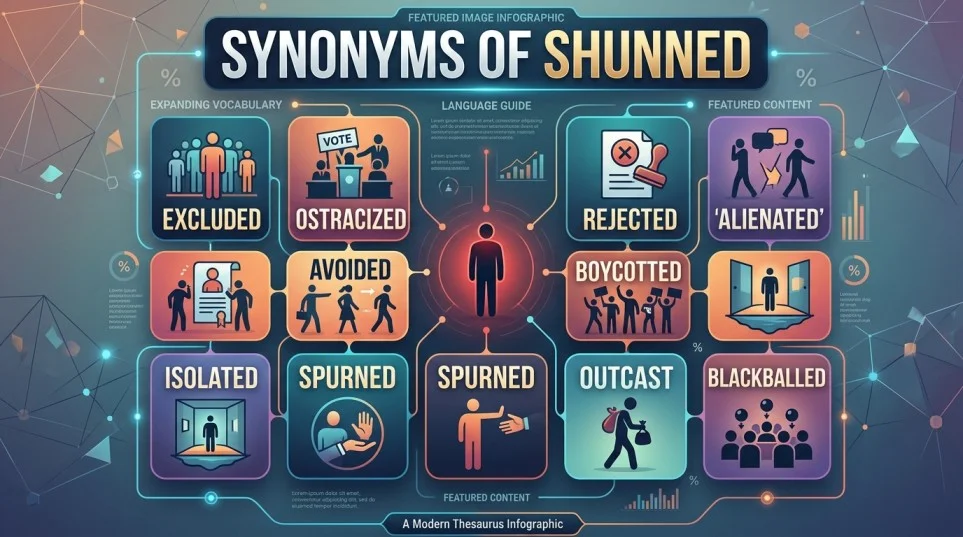
This article covers everything you need to know. We will look at the meaning of “shunned,” study its history, hear how it sounds in US and UK English, and explore its grammar. Then we will walk through 30 useful synonyms of shunned, each with clear meanings, pronunciation, and example sentences. By the end, you will understand this word and its synonyms deeply, and you will know exactly when to use each one.
Meaning of Shunned
Definition
Shunned (verb, past tense/past participle of “shun”): to deliberately avoid or stay away from a person, place, or thing, often because of dislike or disapproval.
Examples
- The villagers shunned the old house because they believed it was haunted.
- After the scandal, many of his old friends shunned him.
Connotative Meaning
- Positive tone: Rarely positive. It can sound neutral-positive only when people shun something harmful, like shunning bad habits.
- Negative tone: Most common tone. It suggests coldness, rejection, and social pain.
- Neutral tone: Used in factual or historical writing without strong emotion, such as in reports or research.
(Connotation means the feeling or emotion a word carries, beyond its plain dictionary meaning.)
Etymology
- The word comes from the Old English word “scunian,” which meant “to shun, avoid, or abhor.”
- It is related to old Germanic roots connected to fear and avoidance.
- Over time, the meaning narrowed from general fear to social avoidance and rejection.
Short History
- Old English (450–1100): The root “scunian” appeared, meaning to avoid or dread something.
- Middle English (1100–1500): The word shifted to “shonien” or “shunnen,” used for avoiding danger, sin, or unpleasant people.
- Modern English (1500–Present): “Shun” and “shunned” settled into their current meaning: deliberately avoiding or rejecting someone, often for social reasons.
Pronunciation (US & UK – IPA)
- US: /ʃʌnd/
- UK: /ʃʌnd/
Syllables
shunned (one syllable)
Affixation Pattern of Shunned
- Root: shun
- Prefix: none
- Suffix: -ned (past tense marker)
Word formation from “shun”:
- shun (verb, base form)
- shuns (verb, present tense, third person singular)
- shunning (verb, present participle / gerund)
- shunned (verb, past tense and past participle)
- shunner (noun, a person who shuns others)
A list of Best Synonyms of Shunned
Below are 30 powerful synonyms of shunned. Each one comes with pronunciation, a simple meaning, and two example sentences. Whenever you need a new way to talk about avoidance or rejection, this list of synonyms of shunned will help you pick the right word.
1. Avoided (verb)
US: /əˈvɔɪdɪd/ | UK: /əˈvɔɪdɪd/
Meaning: Stayed away from someone or something on purpose.
Examples:
- She avoided her noisy neighbor at the market.
- He avoided eye contact after the argument.
2. Rejected (verb)
US: /rɪˈdʒɛktɪd/ | UK: /rɪˈdʒɛktɪd/
Meaning: Refused to accept or welcome someone.
Examples:
- The team rejected his idea without discussion.
- She felt rejected when her calls went unanswered.
3. Ostracized (verb)
US: /ˈɑːstrəˌsaɪzd/ | UK: /ˈɒstrəˌsaɪzd/
Meaning: Excluded someone from a group on purpose.
Examples:
- The boy was ostracized by his classmates after the incident.
- She felt ostracized at family gatherings.
4. Excluded (verb)
US: /ɪkˈskluːdɪd/ | UK: /ɪkˈskluːdɪd/
Meaning: Left someone out of a group or activity.
Examples:
- He was excluded from the team photo.
- They excluded her from the group chat.
5. Snubbed (verb)
US: /snʌbd/ | UK: /snʌbd/
Meaning: Treated someone rudely by ignoring them.
Examples:
- She snubbed him at the party by walking away.
- The manager snubbed the new employee’s greeting.
6. Ignored (verb)
US: /ɪɡˈnɔːrd/ | UK: /ɪɡˈnɔːd/
Meaning: Paid no attention to someone on purpose.
Examples:
- He ignored her messages for a week.
- The committee ignored his complaint.
7. Spurned (verb)
US: /spɜːrnd/ | UK: /spɜːnd/
Meaning: Rejected someone or something with scorn.
Examples:
- She spurned his offer of help.
- The writer spurned fame and stayed private.
8. Disregarded (verb)
US: /ˌdɪsrɪˈɡɑːrdɪd/ | UK: /ˌdɪsrɪˈɡɑːdɪd/
Meaning: Paid no attention to someone’s presence or opinion.
Examples:
- They disregarded his warnings about the storm.
- Her advice was disregarded by the board.
9. Boycotted (verb)
US: /ˈbɔɪkɑːtɪd/ | UK: /ˈbɔɪkɒtɪd/
Meaning: Refused to deal with a person, group, or business as a form of protest.
Examples:
- Customers boycotted the store after the scandal.
- The workers boycotted the unfair meeting.
10. Repudiated (verb)
US: /rɪˈpjuːdiˌeɪtɪd/ | UK: /rɪˈpjuːdiˌeɪtɪd/
Meaning: Formally refused to accept or be linked with someone.
Examples:
- The family repudiated his claims of ownership.
- She repudiated her former friend’s behavior.
11. Rebuffed (verb)
US: /rɪˈbʌft/ | UK: /rɪˈbʌft/
Meaning: Rejected someone in a blunt or unfriendly way.
Examples:
- He rebuffed every attempt at friendship.
- Her offer was rebuffed by the committee.
12. Cold-shouldered (verb)
US: /ˈkoʊld ˈʃoʊldərd/ | UK: /ˈkəʊld ˈʃəʊldəd/
Meaning: Treated someone in an unfriendly, distant way.
Examples:
- The team cold-shouldered the new intern.
- She cold-shouldered him after the breakup.
13. Isolated (verb)
US: /ˈaɪsəˌleɪtɪd/ | UK: /ˈaɪsəˌleɪtɪd/
Meaning: Kept someone apart from others.
Examples:
- The illness isolated him from his friends.
- She felt isolated in the new city.
14. Alienated (verb)
US: /ˈeɪliəˌneɪtɪd/ | UK: /ˈeɪliəˌneɪtɪd/
Meaning: Made someone feel like an outsider.
Examples:
- His harsh words alienated his coworkers.
- The new rules alienated many members.
15. Banished (verb)
US: /ˈbænɪʃt/ | UK: /ˈbænɪʃt/
Meaning: Sent someone away or forced them out of a group or place.
Examples:
- The king banished the traitor from the land.
- He was banished from the club for cheating.
16. Exiled (verb)
US: /ˈɛɡzaɪld/ | UK: /ˈɛksaɪld/
Meaning: Forced someone to leave their home or country.
Examples:
- The writer was exiled for his political views.
- She lived exiled from her homeland for years.
17. Ousted (verb)
US: /ˈaʊstɪd/ | UK: /ˈaʊstɪd/
Meaning: Removed someone from a position or group.
Examples:
- The board ousted the CEO after the scandal.
- He was ousted from the leadership role.
18. Blocklist (verb)
US: /ˈblækˌlɪstɪd/ | UK: /ˈblækˌlɪstɪd/
Meaning: Placed someone on a list to be avoided or refused.
Examples:
- The actor was blocklist by the studio.
- The company blocklist the unreliable supplier.
19. Estranged (verb/adjective)
US: /ɪˈstreɪndʒd/ | UK: /ɪˈstreɪndʒd/
Meaning: No longer close or in contact with someone, often a family member.
Examples:
- He is estranged from his brother.
- The estranged couple rarely spoke.
20. Excommunicated (verb)
US: /ˌɛkskəˈmjuːnɪˌkeɪtɪd/ | UK: /ˌɛkskəˈmjuːnɪˌkeɪtɪd/
Meaning: Formally excluded someone from a religious community.
Examples:
- The priest was excommunicated by the church.
- She was excommunicated after the disagreement.
21. Marginalized (verb)
US: /ˈmɑːrdʒɪnəˌlaɪzd/ | UK: /ˈmɑːdʒɪnəˌlaɪzd/
Meaning: Treated someone as unimportant and pushed to the edge of a group.
Examples:
- The policy marginalized small farmers.
- She felt marginalized during meetings.
22. Sidelined (verb)
US: /ˈsaɪdˌlaɪnd/ | UK: /ˈsaɪdˌlaɪnd/
Meaning: Kept someone from taking part in an activity.
Examples:
- The injury sidelined him for the season.
- She was sidelined after voicing her opinion.
23. Dismissed (verb)
US: /dɪsˈmɪst/ | UK: /dɪsˈmɪst/
Meaning: Refused to consider someone or their idea seriously.
Examples:
- The judge dismissed his complaint.
- Her concerns were dismissed by the team.
24. Discarded (verb)
US: /dɪsˈkɑːrdɪd/ | UK: /dɪsˈkɑːdɪd/
Meaning: Got rid of someone or something as unwanted.
Examples:
- He felt discarded once he lost his job.
- The old plan was discarded quickly.
25. Cast out (verb phrase)
US: /kæst aʊt/ | UK: /kɑːst aʊt/
Meaning: Forced someone to leave a group or community.
Examples:
- The crew cast out the wrongdoer.
- She was cast out by her own family.
26. Turned away (verb phrase)
US: /tɜːrnd əˈweɪ/ | UK: /tɜːnd əˈweɪ/
Meaning: Refused to let someone in or help them.
Examples:
- The guard turned away latecomers.
- He was turned away at the door.
27. Kept at bay (verb phrase)
US: /kɛpt æt beɪ/ | UK: /kɛpt æt beɪ/
Meaning: Kept someone or something at a distance.
Examples:
- The fence kept the crowd at bay.
- She kept her critics at bay with silence.
28. Overlooked (verb)
US: /ˌoʊvərˈlʊkt/ | UK: /ˌəʊvəˈlʊkt/
Meaning: Failed to notice or consider someone on purpose or by accident.
Examples:
- He felt overlooked for the promotion.
- Her hard work was overlooked by the boss.
29. Passed over (verb phrase)
US: /pæst ˈoʊvər/ | UK: /pɑːst ˈəʊvə/
Meaning: Skipped someone when giving a chance or reward.
Examples:
- She was passed over for the award.
- He felt passed over for the lead role.
30. Distanced (from) (verb)
US: /ˈdɪstənst/ | UK: /ˈdɪstənst/
Meaning: Deliberately moved away from a person or association.
Examples:
- The politician distanced himself from the scandal.
- She distanced herself from her old friends.
Prototype Meaning
When most people hear the word “shunned,” they picture a person standing alone while others turn their backs or walk away. It brings to mind cold silence, closed doors, and quiet rejection rather than loud arguments. The typical image is social: a person, group, or community choosing to avoid someone on purpose, often over time, rather than a single sudden act.
Prototype Categorization
Grouping the synonyms of shunned helps writers pick the exact word for the exact situation:
- Social rejection: avoided, snubbed, ignored, cold-shouldered, rebuffed
- Group exclusion: excluded, ostracized, marginalized, sidelined, isolated
- Formal or official rejection: rejected, repudiated, dismissed, blocklist, excommunicated
- Forced removal: banished, exiled, ousted, cast out
- Emotional distance: alienated, estranged, distanced, disregarded
- Protest-based avoidance: boycotted, turned away, kept at bay
- Being passed by: overlooked, passed over, discarded, spurned
This kind of grouping helps writers match tone and context. A story about family conflict may need “estranged,” while a news report about a company might need “blocklist” or “boycotted.” Choosing from the right category keeps writing accurate and natural.
Antonyms of Shunned
- Welcomed (verb): greeted someone warmly and happily.
- Accepted (verb): allowed someone into a group willingly.
- Embraced (verb): accepted an idea or person with enthusiasm.
- Included (verb): added someone as part of a group.
- Invited (verb): asked someone to join or take part.
- Befriended (verb): became friendly with someone.
Short Questions and Answers
- What does shunned mean? It means to be deliberately avoided or rejected by others.
- When should shunned be used? Use it when describing social avoidance, especially when it feels intentional or hurtful.
- Is shunned positive or negative? It is mostly negative, since it points to rejection and social pain. In rare cases, like shunning bad habits, it can sound more neutral.
- How is it different from similar words? Unlike “ignored,” which can be accidental, “shunned” is always on purpose. Unlike “rejected,” which can be a single event, “shunned” often suggests ongoing avoidance over time.
Conclusion
Learning the word “shunned” and its many synonyms gives you real power in English. It improves your vocabulary and helps you describe social situations with more detail. It strengthens your writing and speaking, since you can choose the exact word that fits your tone, whether formal, emotional, or neutral. Studying the synonyms of shunned also helps you avoid repeating the same word again and again, which makes your writing feel fresh and professional. Most of all, it builds your confidence in English, since you can express complex feelings like rejection and exclusion with ease. Keep practicing a little every day. Read the synonyms of shunned out loud, use them in your own sentences, and soon these words will become a natural part of your https://dictionary.cambridge.org/dictionary/english/strengthen

I am a linguist with 7 years of experience in English language teaching, including postgraduate-level instruction. My expertise includes English grammar, and I contribute as a content and blog writer, producing scholarly and educational language resources.