The most useful synonyms of digest grow out of its two core meanings: to break down food in the body, or to think about new information until you understand it. Picture Maya after a long class. She read the chapter twice, but nothing stuck. So she closed her book, took a walk, and let the ideas settle.
That is how she learned to digest what she read. People use this word often because it works for both food and ideas. Still, repeating one word makes writing dull. English learners and content writers need synonyms to sound clear, fresh, and confident.
This article explains the meaning of digest and gives 30 synonyms with examples. It also covers grammar, word history, pronunciation, and semantic groups, all in simple sentences.
Meaning of Digest
Definition
Digest (verb): to break food down so the body can use it, or to understand new information by thinking about it carefully.
Digest (noun): a short summary of a longer text.
Examples
- It takes several hours to digest a heavy meal.
- I need time to digest the news before I reply.
Connotative Meaning
(Connotation is the feeling or extra meaning a word carries beyond its dictionary definition.)
- Positive tone: Careful and wise. “She digested the advice and made a smart plan.”
- Negative tone: Slow or heavy. “The bad news was hard to digest.”
- Neutral tone: Plain and factual. “The body digests food in the stomach.”
Etymology
- Source language: Latin, from digestus, the past participle of digerere.
- Original meaning: “to separate, divide, or arrange.” It joins dis- (apart) and gerere (to carry).
- Old English (450–1100): The word was not yet used. English speakers used other words for the idea.
- Middle English (1100–1500): It entered English around the late 1300s through French and Latin. It meant to break down food, and also to arrange or sort things.
- Modern English (1500–present): The meaning grew to include understanding ideas. The noun came to mean a short summary or collection of writing.
Pronunciation (US & UK – IPA)
- US: /daɪˈdʒɛst/ (verb), /ˈdaɪdʒɛst/ (noun)
- UK: /daɪˈdʒest/ (verb), /ˈdaɪdʒest/ (noun)
Syllables
di-gest
Affixation Pattern of Digest
- Root: gest (from Latin gerere, “to carry”)
- Prefix: di- (from dis-, “apart”)
- Suffix: none
Word formation from digest:
- digestion (noun)
- digester (noun)
- digestibility (noun)
- indigestion (noun)
- digestive (adjective; also a noun for a biscuit or aid)
- digestible (adjective)
- indigestible (adjective)
- undigested (adjective)
- digestively (adverb)
- predigest (verb)
- digesting, digested (verb forms)
A List of Powerful Synonyms of Digest
1. Absorb (verb)
US /əbˈzɔːrb/ | UK /əbˈzɔːb/
Meaning: To take in information or liquid and keep it.
Examples:
- Kids absorb new words very fast.
- The sponge absorbed all the water.
2. Assimilate (verb)
US /əˈsɪməleɪt/ | UK /əˈsɪməleɪt/
Meaning: To fully learn something so it becomes part of what you know.
Examples:
- It took him a week to assimilate the new rules.
- Plants assimilate nutrients from the soil.
3. Comprehend (verb)
US /ˌkɑːmprɪˈhɛnd/ | UK /ˌkɒmprɪˈhend/
Meaning: To understand something fully.
Examples:
- She could not comprehend the long contract.
- Young children comprehend simple stories.
4. Understand (verb)
US /ˌʌndərˈstænd/ | UK /ˌʌndəˈstænd/
Meaning: To know what something means.
Examples:
- I finally understand the rule.
- Do you understand the question?
5. Grasp (verb)
US /ɡræsp/ | UK /ɡrɑːsp/
Meaning: To get the meaning of an idea.
Examples:
- He quickly grasped the main point.
- Some students struggle to grasp grammar.
6. Process (verb)
US /ˈprɑːsɛs/ | UK /ˈprəʊses/
Meaning: To think through information or feelings step by step.
Examples:
- She needed time to process the bad news.
- The brain processes new facts during sleep.
7. Take in (phrasal verb)
US /teɪk ɪn/ | UK /teɪk ɪn/
Meaning: To notice and understand something new.
Examples:
- I could not take in all the details at once.
- He took in every word of the speech.
8. Internalize (verb)
US /ɪnˈtɜːrnəlaɪz/ | UK /ɪnˈtɜːnəlaɪz/
Meaning: To learn an idea so well that it becomes your own belief.
Examples:
- Good readers internalize what they read.
- She internalized her teacher’s advice.
9. Fathom (verb)
US /ˈfæðəm/ | UK /ˈfæðəm/
Meaning: To understand something deep or hard.
Examples:
- I cannot fathom why he left.
- It is hard to fathom such a huge number.
10. Master (verb)
US /ˈmæstər/ | UK /ˈmɑːstə/
Meaning: To learn something so well that you know it fully.
Examples:
- He mastered the lesson after daily practice.
- It takes years to master a new language.
11. Ponder (verb)
US /ˈpɑːndər/ | UK /ˈpɒndə/
Meaning: To think about something slowly and carefully.
Examples:
- She pondered the offer for a day.
- He sat and pondered his next step.
12. Consider (verb)
US /kənˈsɪdər/ | UK /kənˈsɪdə/
Meaning: To think about something before deciding.
Examples:
- Please consider all the facts first.
- We considered moving to a new city.
13. Contemplate (verb)
US /ˈkɑːntəmpleɪt/ | UK /ˈkɒntəmpleɪt/
Meaning: To think deeply about something for a long time.
Examples:
- He contemplated the meaning of the poem.
- She contemplated her future by the sea.
14. Mull over (phrasal verb)
US /mʌl ˈoʊvər/ | UK /mʌl ˈəʊvə/
Meaning: To think about something slowly, often before a choice.
Examples:
- I will mull over your idea tonight.
- He mulled over the question all morning.
15. Reflect (verb)
US /rɪˈflɛkt/ | UK /rɪˈflekt/
Meaning: To think quietly about something that happened.
Examples:
- Take a moment to reflect on what you learned.
- She reflected on her first year of work.
16. Study (verb)
US /ˈstʌdi/ | UK /ˈstʌdi/
Meaning: To look at something closely to learn it.
Examples:
- He studied the report line by line.
- We studied the map before the trip.
17. Summarize (verb)
US /ˈsʌməraɪz/ | UK /ˈsʌməraɪz/
Meaning: To tell the main points in a short way.
Examples:
- Can you summarize the chapter for me?
- She summarized the meeting in three lines.
18. Condense (verb)
US /kənˈdɛns/ | UK /kənˈdens/
Meaning: To make a text shorter without losing its main meaning.
Examples:
- The editor condensed the long article.
- He condensed ten pages into one.
19. Abridge (verb)
US /əˈbrɪdʒ/ | UK /əˈbrɪdʒ/
Meaning: To shorten a book or text by cutting parts.
Examples:
- The publisher abridged the old novel for children.
- An abridged version is easier to read.
20. Summary (noun)
US /ˈsʌməri/ | UK /ˈsʌməri/
Meaning: A short account of the main points.
Examples:
- Write a summary of the story.
- The summary fits on one page.
21. Synopsis (noun)
US /sɪˈnɑːpsɪs/ | UK /sɪˈnɒpsɪs/
Meaning: A short outline of a story, film, or plan.
Examples:
- The book’s synopsis is on the back cover.
- She sent a one-page synopsis to the editor.
22. Abstract (noun)
US /ˈæbstrækt/ | UK /ˈæbstrækt/
Meaning: A short summary of a research paper.
Examples:
- Read the abstract before the full paper.
- His abstract was only 150 words.
23. Précis (noun)
US /preɪˈsiː/ | UK /ˈpreɪsiː/
Meaning: A short, clear summary of a text.
Examples:
- The students wrote a précis of the speech.
- Her précis kept only the key ideas.
24. Compendium (noun)
US /kəmˈpɛndiəm/ | UK /kəmˈpendiəm/
Meaning: A short but full collection of facts on one subject.
Examples:
- The book is a compendium of travel tips.
- He keeps a compendium of cooking facts.
25. Outline (noun)
US /ˈaʊtlaɪn/ | UK /ˈaʊtlaɪn/
Meaning: A short plan that lists the main points.
Examples:
- Make an outline before you write.
- The outline helped her stay on topic.
26. Break down (phrasal verb)
US /breɪk daʊn/ | UK /breɪk daʊn/
Meaning: To split food or a hard idea into small parts.
Examples:
- Enzymes break down food in the stomach.
- The teacher broke down the problem into steps.
27. Metabolize (verb)
US /məˈtæbəlaɪz/ | UK /məˈtæbəlaɪz/
Meaning: To change food into energy inside the body.
Examples:
- The liver helps metabolize many foods.
- Some people metabolize sugar faster than others.
28. Stomach (verb)
US /ˈstʌmək/ | UK /ˈstʌmək/
Meaning: To handle or accept something hard to take.
Examples:
- I cannot stomach spicy food.
- She could not stomach the cruel joke.
29. Organize (verb)
US /ˈɔːrɡənaɪz/ | UK /ˈɔːɡənaɪz/
Meaning: To put facts or things in a clear order.
Examples:
- He organized his notes by topic.
- She organized the data into a short report.
30. Classify (verb)
US /ˈklæsɪfaɪ/ | UK /ˈklæsɪfaɪ/
Meaning: To sort things into groups by type.
Examples:
- Scientists classify animals by features.
- The librarian classified the books by subject.
Prototype Meaning
When people hear digest, most picture food moving through the body. The stomach breaks the meal into small parts, and the body takes what it needs. The same picture applies to ideas. A person reads or hears something, then slowly breaks it down until it makes sense.
Prototype Categorization
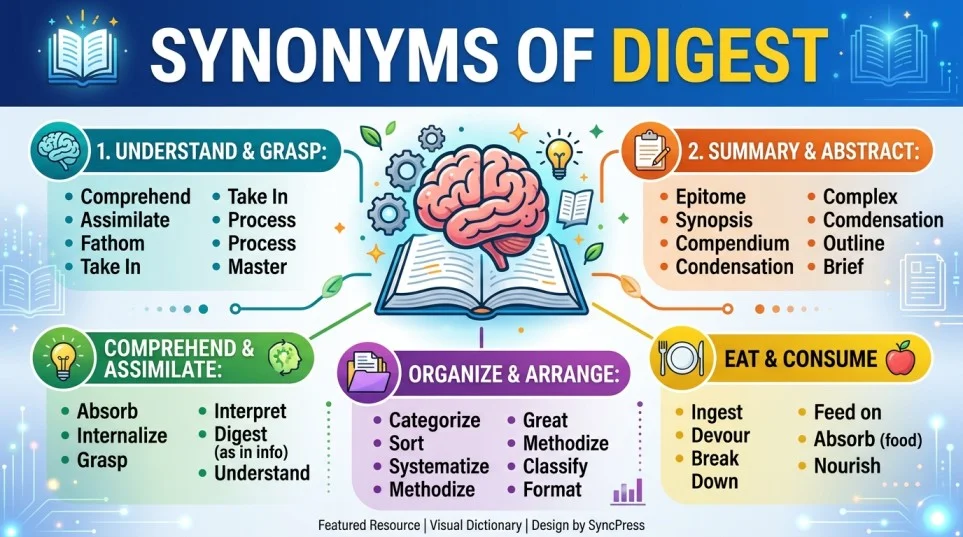
- Understanding words: absorb, assimilate, comprehend, understand, grasp, process, take in, internalize, fathom, master
- Deep thinking words: ponder, consider, contemplate, mull over, reflect, study
- Shortening verbs: summarize, condense, abridge
- Summary nouns: summary, synopsis, abstract, précis, compendium, outline
- Body and food words: break down, metabolize, stomach
- Organizing words: organize, classify
Categories help you pick the right word fast. If you write about food, choose metabolize or break down. You write about learning, choose grasp or assimilate. You write about a short text, choose synopsis or abstract. The right category keeps your meaning clear.
Antonyms of Digest
- Misunderstand (verb): to get the meaning wrong.
- Ignore (verb): to pay no attention to something.
- Reject (verb): to refuse to accept an idea or food.
- Expand (verb): to make a text longer with more detail.
- Scramble (verb): to mix things up so they lose order.
- Overlook (verb): to miss something by mistake.
Short Questions and Answers
- What does digest mean?
It means to break down food in the body, or to understand new information by thinking about it. As a noun, it means a short summary. - When should digest be used?
Use it for food, learning, and summaries. Say “digest the news” when someone needs time to understand it. - Is digest positive or negative?
It is mostly neutral. It feels positive in “digest the lesson well” and negative in “hard to digest.” - How is it different from similar words?
Understand is simple and direct. Digest adds the idea of slow, careful thinking. Summarize only means to shorten.
Conclusion
Learning the synonyms of digest helps you build a stronger vocabulary. You can swap one tired word for many precise ones. Your writing becomes clearer, and your speaking sounds more natural. You also avoid repeating the same word again and again. Each new word makes you more confident in English. Do not try to learn all 30 at once. Pick one or two words each day, say them aloud, and use them in your own sentences. Small daily practice adds up fast. Keep a notebook, review it often, and let each new word settle in. Soon you will digest English with ease.

Nighat Fatima is a linguist with an M.A. in Linguistics and an M.Ed. She has 7 years of experience teaching English language to postgraduate classes and 6 years of experience in content writing.