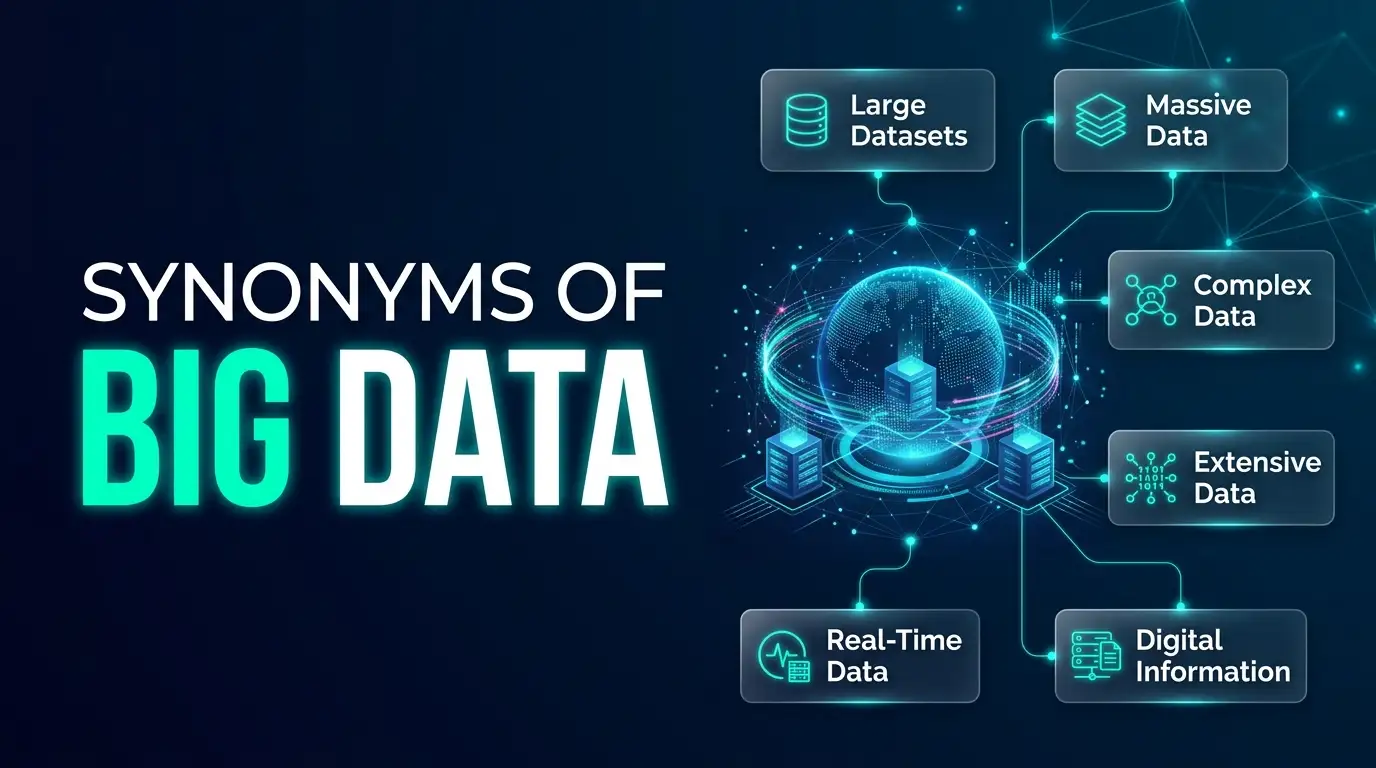
Featured snippet: Big data refers to very large and complex sets of information that people collect, store, and analyze to find patterns and make better decisions. Common alternatives include large datasets, massive data, extensive data, complex data, and data at scale. The best synonym depends on whether you mean the size of the data, its complexity, or the way people use it.
Synonyms of Big Data at a Glance
| Synonym | Meaning |
| 1. Large datasets | Very large collections of data |
| 2. Massive data | Data in very large amounts |
| 3. Extensive data | Data covering a wide range |
| 4. Complex data | Data with many connected parts |
| 5. Large-scale data | Data collected or handled on a large scale |
| 6. Big datasets | Very large sets of information |
| 7. High-volume data | Data produced or stored in large amounts |
| 8. Data at scale | Data handled across large systems or operations |
| 9. Massive datasets | Extremely large collections of data |
| 10. Complex datasets | Data collections with many variables or relationships |
Note: These expressions are related alternatives, not exact replacements in every context. In technical writing, big data is the standard term for data whose size, speed, or complexity calls for specialized methods and tools.
Understanding Big Data and Its Synonyms
This article explores the meaning of big data and 30 related terms. It explains their definitions, examples, pronunciation, word formation, history, and common uses. It also groups the alternatives by meaning so English learners, students, and writers can choose the right term for each situation.
Meaning of Big Data
Definition
Big data (noun): Extremely large or complex collections of information that require special tools and methods to store, process, and analyze effectively.
Examples
- Companies use big data to understand customer needs.
- Scientists analyze big data to study climate change.
Connotative Meaning
(Connotation is the feeling, idea, or association a word creates beyond its basic definition.)
- Positive tone: Big data can suggest innovation, discovery, efficiency, and better decisions.
- Negative tone: It may suggest privacy risks, data misuse, surveillance, or information overload.
- Neutral tone: It can simply refer to large and complex collections of information.
Etymology
- Big: An English word meaning large in size, amount, or importance.
- Data: From Latin datum, meaning “something given.” Data is the plural form of datum in traditional Latin-based usage, although modern English often treats it as a singular mass noun.
- Big data: A modern compound expression formed from the words big and data. It became widely used as digital information grew in volume and complexity.
Short History of Big Data
- Old English (450–1100): The word big was not the usual form in Old English; related ideas were expressed through words such as micel, meaning “great” or “large.” The modern term data was not yet part of English.
- Middle English (1100–1500): Big developed in English, while scholarly writing used Latin forms related to datum and data. The modern technical expression had not yet emerged.
- Modern English (1500–present): Data became common in scientific and technical writing. As computers, the internet, and digital records expanded, big data became an established term for information that traditional methods may struggle to handle.
Pronunciation (US & UK – IPA)
US: /ˌbɪɡ ˈdeɪtə/
UK: /ˌbɪɡ ˈdeɪtə/
Pronunciation note: The final vowel in data varies by speaker. Some pronounce it with a sound like “day-tuh,” while others use “daa-tuh.”
Syllables
big da-ta — 3 syllables in total.
Affixation Pattern of Big Data
- Root: big and data are the two main elements of the compound expression.
- Prefix: None.
- Suffix: None in the expression big data itself.
- Word formation: Big data is a compound noun made from an adjective (big) and a noun (data).
Related forms and expressions include:
- Data (noun): Information collected for reference or analysis.
- Dataset (noun): A collection of related data.
- Database (noun): An organized collection of data stored for access and management.
- Data-driven (adjective): Guided by data or evidence.
- Data-based (adjective): Built on information or data.
- Big-data analytics (noun phrase): The analysis of large and complex datasets.
These are related terms, not all direct synonyms. English does not have a fixed number of words formed from big data; new compounds and technical expressions can develop as the field changes.
Synonyms of Big Data
The following 30 alternatives describe large quantities of information, data collections, or the systems used to handle them. Some are close substitutes, while others are useful only in specific technical contexts.
1. Large Datasets (Noun Phrase)
US IPA: /lɑrdʒ ˈdeɪtəˌsɛts/ | UK IPA: /lɑːdʒ ˈdeɪtəˌsets/
Meaning: Very large collections of information gathered for storage or analysis.
Examples:
- Researchers study large datasets to find useful patterns.
- Large datasets help the team compare customer behavior.
2. Massive Data (Noun Phrase)
US IPA: /ˈmæsɪv ˈdeɪtə/ | UK IPA: /ˈmæsɪv ˈdeɪtə/
Meaning: An extremely large amount of information.
Examples:
- The system processes massive data from online stores.
- Massive data can help scientists track changes over time.
3. Extensive Data (Noun Phrase)
US IPA: /ɪkˈstɛnsɪv ˈdeɪtə/ | UK IPA: /ɪkˈstensɪv ˈdeɪtə/
Meaning: A broad or wide-ranging collection of information.
Examples:
- The report uses extensive data from many regions.
- Extensive data helped the team understand the problem.
4. Complex Data (Noun Phrase)
US IPA: /kəmˈplɛks ˈdeɪtə/ | UK IPA: /kəmˈpleks ˈdeɪtə/
Meaning: Information that is difficult to understand because it has many parts or relationships.
Examples:
- The software helps researchers analyze complex data.
- Complex data can come from videos, sensors, and text files.
5. Large-Scale Data (Noun Phrase)
US IPA: /ˌlɑrdʒ ˈskeɪl ˈdeɪtə/ | UK IPA: /ˌlɑːdʒ ˈskeɪl ˈdeɪtə/
Meaning: Information collected, stored, or processed on a very large scale.
Examples:
- The company uses large-scale data to improve its services.
- Large-scale data analysis can reveal important trends.
6. Big Datasets (Noun Phrase)
US IPA: /bɪɡ ˈdeɪtəˌsɛts/ | UK IPA: /bɪɡ ˈdeɪtəˌsets/
Meaning: Large collections of related facts, figures, or records.
Examples:
- Students learn to work with big datasets.
- Big datasets can contain millions of records.
7. High-Volume Data (Noun Phrase)
US IPA: /ˌhaɪ ˈvɑljum ˈdeɪtə/ | UK IPA: /ˌhaɪ ˈvɒljuːm ˈdeɪtə/
Meaning: Data produced, received, or stored in very large quantities.
Examples:
- Banks must manage high-volume data from daily transactions.
- High-volume data can place pressure on storage systems.
8. Data at Scale (Noun Phrase)
US IPA: /ˈdeɪtə ət skeɪl/ | UK IPA: /ˈdeɪtə ət skeɪl/
Meaning: Data handled across large operations or systems.
Examples:
- The platform analyzes data at scale.
- Data at scale requires reliable storage and processing tools.
9. Massive Datasets (Noun Phrase)
US IPA: /ˈmæsɪv ˈdeɪtəˌsɛts/ | UK IPA: /ˈmæsɪv ˈdeɪtəˌsets/
Meaning: Extremely large collections of data.
Examples:
- Scientists use massive datasets to study the weather.
- Massive datasets can reveal patterns that small samples miss.
10. Complex Datasets (Noun Phrase)
US IPA: /kəmˈplɛks ˈdeɪtəˌsɛts/ | UK IPA: /kəmˈpleks ˈdeɪtəˌsets/
Meaning: Data collections containing many types of information or relationships.
Examples:
- The analyst combines complex datasets from different sources.
- Complex datasets often need careful cleaning before analysis.
11. Vast Amounts of Data (Noun Phrase)
US IPA: /væst əˈmaʊnts əv ˈdeɪtə/ | UK IPA: /vɑːst əˈmaʊnts əv ˈdeɪtə/
Meaning: Extremely large quantities of information.
Examples:
- Social media platforms collect vast amounts of data.
- Vast amounts of data can support better research.
12. Enormous Datasets (Noun Phrase)
US IPA: /ɪˈnɔrməs ˈdeɪtəˌsɛts/ | UK IPA: /ɪˈnɔːməs ˈdeɪtəˌsets/
Meaning: Data collections that are exceptionally large.
Examples:
- The research team studies enormous datasets.
- Enormous datasets can take time to process.
13. Extensive Datasets (Noun Phrase)
US IPA: /ɪkˈstɛnsɪv ˈdeɪtəˌsɛts/ | UK IPA: /ɪkˈstensɪv ˈdeɪtəˌsets/
Meaning: Large or broad collections of information covering many subjects or areas.
Examples:
- The study draws on extensive datasets from hospitals.
- Extensive datasets give researchers a wider view of the issue.
14. High-Dimensional Data (Noun Phrase)
US IPA: /ˌhaɪ daɪˈmɛnʃənəl ˈdeɪtə/ | UK IPA: /ˌhaɪ daɪˈmenʃənəl ˈdeɪtə/
Meaning: Data that contains many features or variables for each item.
Examples:
- Machine learning can analyze high-dimensional data.
- High-dimensional data may include hundreds of measurements.
15. Multidimensional Data (Noun Phrase)
US IPA: /ˌmʌlti daɪˈmɛnʃənəl ˈdeɪtə/ | UK IPA: /ˌmʌlti daɪˈmenʃənəl ˈdeɪtə/
Meaning: Data that can be examined across several dimensions or factors.
Examples:
- The analyst studies multidimensional data about sales.
- Multidimensional data helps compare several factors at once.
16. High-Velocity Data (Noun Phrase)
US IPA: /ˌhaɪ vəˈlɑsəti ˈdeɪtə/ | UK IPA: /ˌhaɪ vəˈlɒsɪti ˈdeɪtə/
Meaning: Data that arrives or changes very quickly.
Examples:
- Fraud detection systems monitor high-velocity data.
- High-velocity data needs fast processing.
17. Real-Time Data (Noun Phrase)
US IPA: /ˌriəl ˈtaɪm ˈdeɪtə/ | UK IPA: /ˌrɪəl ˈtaɪm ˈdeɪtə/
Meaning: Information delivered or processed as events happen, or with very little delay.
Examples:
- Traffic apps use real-time data to show road conditions.
- Real-time data helps teams respond to sudden changes.
18. High-Variety Data (Noun Phrase)
US IPA: /ˌhaɪ vəˈraɪəti ˈdeɪtə/ | UK IPA: /ˌhaɪ vəˈraɪəti ˈdeɪtə/
Meaning: Data that comes in many different forms and formats.
Examples:
- The project combines high-variety data from text and images.
- High-variety data can be hard to organize.
19. Heterogeneous Data (Noun Phrase)
US IPA: /ˌhɛtərəˈdʒiniəs ˈdeɪtə/ | UK IPA: /ˌhetərəˈdʒiːniəs ˈdeɪtə/
Meaning: Information made up of different types, formats, or sources.
Examples:
- The software brings heterogeneous data into one system.
- Heterogeneous data may include text, numbers, and video.
20. Unstructured Data (Noun Phrase)
US IPA: /ʌnˈstrʌktʃərd ˈdeɪtə/ | UK IPA: /ʌnˈstrʌktʃəd ˈdeɪtə/
Meaning: Information that does not fit neatly into a fixed table or predefined format.
Examples:
- Emails and videos are common forms of unstructured data.
- AI tools can help analyze unstructured data.
21. Structured Data (Noun Phrase)
US IPA: /ˈstrʌktʃərd ˈdeɪtə/ | UK IPA: /ˈstrʌktʃəd ˈdeɪtə/
Meaning: Information organized in a clear format, such as rows and columns.
Examples:
- A spreadsheet often contains structured data.
- Structured data is easier to search with many database tools.
22. Digital Information (Noun Phrase)
US IPA: /ˈdɪdʒɪtəl ˌɪnfərˈmeɪʃən/ | UK IPA: /ˈdɪdʒɪtəl ˌɪnfəˈmeɪʃən/
Meaning: Information stored or shared in a digital form.
Examples:
- Businesses use digital information to track orders.
- Digital information can include text, images, and records.
23. Data Repositories (Noun Phrase)
US IPA: /ˈdeɪtə rɪˈpɑzəˌtɔriz/ | UK IPA: /ˈdeɪtə rɪˈpɒzɪtəriz/
Meaning: Organized places or systems where data is stored.
Examples:
- Researchers share their findings through data repositories.
- Data repositories help teams keep information in one place.
24. Data Collections (Noun Phrase)
US IPA: /ˈdeɪtə kəˈlɛkʃənz/ | UK IPA: /ˈdeɪtə kəˈlekʃənz/
Meaning: Groups of information gathered for a purpose.
Examples:
- The museum maintains data collections about its visitors.
- Data collections can support research and planning.
25. Information Pools (Noun Phrase)
US IPA: /ˌɪnfərˈmeɪʃən puːlz/ | UK IPA: /ˌɪnfəˈmeɪʃən puːlz/
Meaning: Combined stores of information available for use or analysis.
Examples:
- The team draws on information pools from several departments.
- Shared information pools can improve teamwork.
26. Data Streams (Noun Phrase)
US IPA: /ˈdeɪtə striːmz/ | UK IPA: /ˈdeɪtə striːmz/
Meaning: Continuous flows of data arriving from one or more sources.
Examples:
- Sensors send data streams to the control center.
- Data streams help monitor events as they happen.
27. Data Floods (Noun Phrase)
US IPA: /ˈdeɪtə flʌdz/ | UK IPA: /ˈdeɪtə flʌdz/
Meaning: Very large or overwhelming flows of incoming data.
Examples:
- The company faced data floods during its major sale.
- Better tools helped the team manage the data floods.
28. Information Overload (Noun Phrase)
US IPA: /ˌɪnfərˈmeɪʃən ˈoʊvərˌloʊd/ | UK IPA: /ˌɪnfəˈmeɪʃən ˈəʊvəˌləʊd/
Meaning: A situation in which the amount of information is too great to manage or understand easily.
Examples:
- Too many reports can cause information overload.
- Clear summaries help workers avoid information overload.
29. Data at Massive Scale (Noun Phrase)
US IPA: /ˈdeɪtə ət ˈmæsɪv skeɪl/ | UK IPA: /ˈdeɪtə ət ˈmæsɪv skeɪl/
Meaning: Information handled across extremely large systems or operations.
Examples:
- Global platforms process data at massive scale.
- Data at massive scale calls for efficient computing systems.
30. Large-Scale Information (Noun Phrase)
US IPA: /ˌlɑrdʒ ˈskeɪl ˌɪnfərˈmeɪʃən/ | UK IPA: /ˌlɑːdʒ ˈskeɪl ˌɪnfəˈmeɪʃən/
Meaning: A very large amount of information gathered or used across a broad operation.
Examples:
- The project analyzes large-scale information from public records.
- Large-scale information can help planners identify long-term trends.
Pronunciation note: IPA transcriptions are broad learner-oriented forms. Individual speakers may pronounce data and some unstressed vowels differently.
Prototype Meaning of Big Data
The most typical meaning of big data is a huge collection of information that is too large, fast-moving, or varied for ordinary methods to handle easily. People often imagine millions of customer records, online searches, social media posts, medical records, or sensor readings. The key idea is not size alone. Big data also involves the challenges of storing, managing, and analyzing information to find useful patterns.
Prototype Categorization
Synonyms can be grouped by the main idea they express. This helps writers select the most accurate term instead of repeating big data throughout an article.
- Size and quantity: Large datasets, massive data, massive datasets, enormous datasets, vast amounts of data, and high-volume data emphasize the amount of information.
- Range and coverage: Extensive data, extensive datasets, and large-scale information highlight broad coverage or scope.
- Complexity and dimensions: Complex data, complex datasets, high-dimensional data, multidimensional data, and heterogeneous data describe information with many features, formats, or relationships.
- Speed and flow: High-velocity data, real-time data, data streams, and data floods emphasize how quickly information arrives or moves.
- Format and structure: Structured data and unstructured data describe how information is organized.
- Storage and organization: Data repositories and data collections refer to places or groups where information is kept.
- Scale of operation: Data at scale, data at massive scale, and large-scale data emphasize the size of the operation used to handle information.
- Information and its effects: Digital information and information pools are broader alternatives, while information overload describes the problem of receiving more information than one can manage.
Categorization helps writers match the term to the intended meaning. For example, high-velocity data is suitable when speed matters, while massive datasets emphasizes size. Information overload is not a true synonym for big data because it describes a problem that information can cause.
Antonyms of Big Data
There is no single exact antonym for big data. The following terms describe smaller amounts of information or different ways of managing data.
- Small dataset (noun phrase): A collection containing relatively little information.
- Limited data (noun phrase): A small or restricted amount of available information.
- Minimal data (noun phrase): The smallest amount of information needed for a purpose.
- Sparse data (noun phrase): Data with relatively few observations or values.
- Small-scale data (noun phrase): Information collected or processed in a limited operation.
- Sample data (noun phrase): A subset of information selected from a larger population or dataset.
- Low-volume data (noun phrase): Data produced or stored in small quantities.
- Insufficient data (noun phrase): Information that is not enough to support a reliable conclusion.
Short Questions and Answers
– What does big data mean?
Big data means very large or complex collections of information that require suitable tools and methods for storage and analysis.
– When should big data be used?
Use the term when discussing large, fast-moving, or varied datasets that are difficult to manage with conventional methods.
– Is big data positive or negative?
It is neutral. Big data can support research and better decisions, but it can also raise privacy, security, and data-quality concerns.
– How is big data different from similar words?
Big data describes a broad technical concept. Large datasets focuses on size, real-time data focuses on timing, and complex data focuses on difficulty or structure.
– Is massive data the same as big data?
Not always. Massive data emphasizes quantity, while big data can also involve speed, variety, and processing challenges.
– Can digital information replace big data?
Sometimes, but digital information is much broader. It can refer to a single digital file as well as a huge collection of records.
– What is the best synonym for big data in academic writing?
Large datasets or extensive datasets may work well, depending on the context. Use big data when referring to the wider technical field.
– What are the main characteristics of big data?
Common characteristics include volume, velocity, and variety. Some frameworks also include veracity and value.
Conclusion
Learning the meaning and synonyms of big data can improve your English vocabulary and technical communication. Words such as large datasets, massive data, and extensive data help explain the amount of information being discussed. Other terms, such as high-velocity data and complex datasets, express more specific ideas.
Choosing the right alternative makes writing clearer, reduces repetition, and helps readers understand your message. These expressions are useful in technology, education, business, science, and research. For the best results, learn each term with its meaning, pronunciation, and example sentence. Practice using one or two new expressions each day in your own writing and speech. Regular practice will strengthen your vocabulary, improve your confidence, and help you communicate in English more naturally.

Nighat Fatima is a linguist with an M.A. in Linguistics and an M.Ed. She has 7 years of experience teaching English language to postgraduate classes and 6 years of experience in content writing.