Imagine a young chef who spends years in a kitchen. At first, she burns rice and drops eggs. After many months, she can cook a perfect meal with her eyes closed. People say she has come to master her craft. The word master means to gain full skill or control over something. Writers, coaches, and teachers use this word every day because it captures hard work and success in one simple term.
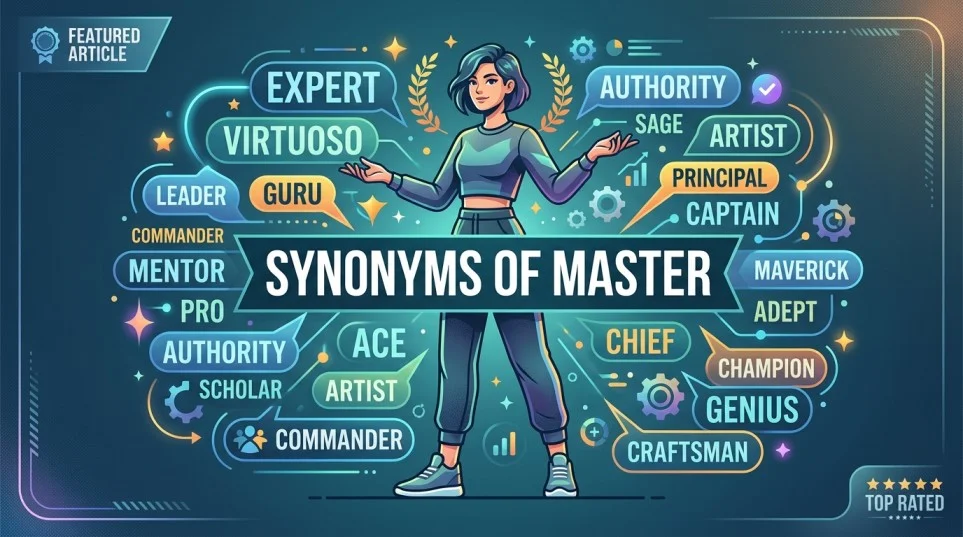
Learning the synonyms of master helps English learners and content writers avoid using the same word again and again. A rich vocabulary makes writing sound smooth, clear, and professional. When you know many synonyms of master, you can pick the exact word that fits your sentence and your tone.
This article explains the meaning of master, its history, pronunciation, and grammar. It also lists 30 useful synonyms of master with simple meanings and example sentences, so you can grow your vocabulary step by step.
Meaning of Master
Definition
Master (verb): to learn a skill or subject so well that you can do it with ease and confidence.
Examples
- She worked every day until she could master the piano.
- It takes years to master a new language.
Connotative Meaning
- Positive tone: shows hard work, success, and expert skill.
- Negative tone: can suggest control or power over someone else.
- Neutral tone: simply means to learn something completely.
(Connotation means the feeling or idea a word gives, beyond its plain dictionary meaning.)
Etymology
- The word comes from the Latin word magister, meaning “chief” or “teacher.”
- It passed through Old French maistre before entering English.
- The original sense carried the idea of someone in charge or highly skilled.
Short History
- Old English (450–1100): The word appeared as mægester, borrowed early from Latin, used for a person of authority.
- Middle English (1100–1500): It became maister, used for teachers, skilled workers, and leaders of guilds.
- Modern English (1500–Present): Master now means both a title of skill and a verb meaning to learn something fully.
Pronunciation (US & UK – IPA)
- US: /ˈmæs.tɚ/
- UK: /ˈmɑː.stə/
Syllables
mas-ter
Affixation Pattern of Master
- Root: master
- Prefix: none in the base word
- Suffix: -y (mastery), -ful (masterful), -ing (mastering), -ed (mastered)
Word Formation from Master
- Mastery (noun) — the state of having great skill.
- Masterful (adjective) — showing great skill.
- Masterpiece (noun) — a work of outstanding skill.
- Mastermind (noun) — a person who plans something clever.
- Mastering (verb, gerund) — the act of learning fully.
A List of Powerful Synonyms of Master
1. Learn (verb)
US: /lɝːn/ | UK: /lɜːn/
Meaning: To gain knowledge or a skill through study or practice.
- She wants to learn guitar this summer.
- He is trying to learn French quickly.
2. Grasp (verb)
US: /ɡræsp/ | UK: /ɡrɑːsp/
Meaning: To understand something fully and clearly.
- It took time for him to grasp the math rule.
- She quickly grasped the new software.
3. Understand (verb)
US: /ˌʌn.dɚˈstænd/ | UK: /ˌʌn.dəˈstænd/
Meaning: To know the meaning or working of something.
- I finally understand how engines work.
- She understands the topic better now.
4. Comprehend (verb)
US: /ˌkɑːm.prɪˈhend/ | UK: /ˌkɒm.prɪˈhend/
Meaning: To fully understand a complex idea.
- Students struggled to comprehend the lesson.
- He comprehends difficult science topics easily.
5. Conquer (verb)
US: /ˈkɑːŋ.kɚ/ | UK: /ˈkɒŋ.kə/
Meaning: To overcome a difficult challenge completely.
- She worked hard to conquer her fear of public speaking.
- He finally conquered the tricky dance routine.
6. Dominate (verb)
US: /ˈdɑː.mɪ.neɪt/ | UK: /ˈdɒm.ɪ.neɪt/
Meaning: To have strong control or power over something.
- The champion dominates every match she plays.
- His skill dominates the entire competition.
7. Control (verb)
US: /kənˈtroʊl/ | UK: /kənˈtrəʊl/
Meaning: To have the power to direct or manage something.
- A good driver can control the car in rain.
- She learned to control her nerves before the test.
8. Command (verb)
US: /kəˈmænd/ | UK: /kəˈmɑːnd/
Meaning: To have full skill or authority over something.
- He commands three languages fluently.
- Her writing commands the reader’s attention.
9. Excel (verb)
US: /ɪkˈsel/ | UK: /ɪkˈsel/
Meaning: To be very good at something.
- She excels in mathematics and science.
- He excels at solving hard puzzles.
10. Perfect (verb)
US: /pɚˈfekt/ | UK: /pəˈfekt/
Meaning: To make something completely correct or skillful.
- The chef spent years trying to perfect the recipe.
- She wants to perfect her painting technique.
11. Acquire (verb)
US: /əˈkwaɪɚ/ | UK: /əˈkwaɪə/
Meaning: To gain a skill or knowledge over time.
- He acquired strong coding skills at work.
- She acquired a deep knowledge of history.
12. Tame (verb)
US: /teɪm/ | UK: /teɪm/
Meaning: To bring something wild or difficult under control.
- The trainer worked to tame the young horse.
- She learned to tame her temper over time.
13. Subdue (verb)
US: /səbˈdjuː/ | UK: /səbˈdjuː/
Meaning: To bring something under control by force or effort.
- He managed to subdue his anger during the argument.
- The team worked hard to subdue the rival players.
14. Overcome (verb)
US: /ˌoʊ.vɚˈkʌm/ | UK: /ˌəʊ.vəˈkʌm/
Meaning: To successfully deal with a problem or challenge.
- She worked hard to overcome her shyness.
- He overcame many obstacles to finish the course.
15. Handle (verb)
US: /ˈhæn.dəl/ | UK: /ˈhæn.dəl/
Meaning: To deal with or manage something skillfully.
- She knows how to handle difficult customers.
- He can handle any coding problem quickly.
16. Manage (verb)
US: /ˈmæn.ɪdʒ/ | UK: /ˈmæn.ɪdʒ/
Meaning: To control or run something successfully.
- She manages her time very well.
- He manages a large team at work.
17. Govern (verb)
US: /ˈɡʌv.ɚn/ | UK: /ˈɡʌv.ən/
Meaning: To have control or authority over something.
- Rules govern how the game is played.
- She governs her own schedule with care.
18. Rule (verb)
US: /ruːl/ | UK: /ruːl/
Meaning: To have complete control over something or someone.
- The champion rules the tennis court.
- Her calm mind rules every match she plays.
19. Direct (verb)
US: /dəˈrekt/ | UK: /daɪˈrekt/
Meaning: To guide or control the course of something with skill.
- She directs the entire project with confidence.
- He directs his team toward clear goals.
20. Lead (verb)
US: /liːd/ | UK: /liːd/
Meaning: To guide others using strong skill and knowledge.
- She leads the design team with great skill.
- He leads every project to success.
21. Guide (verb)
US: /ɡaɪd/ | UK: /ɡaɪd/
Meaning: To skillfully show the way or help someone learn.
- The coach guides young players through each drill.
- She guides new students through the course.
22. Train (verb)
US: /treɪn/ | UK: /treɪn/
Meaning: To teach or practice a skill until it is strong.
- He trains every day to improve his speed.
- She trains her voice for singing.
23. Harness (verb)
US: /ˈhɑːr.nɪs/ | UK: /ˈhɑː.nɪs/
Meaning: To control and use a skill or power well.
- She learned to harness her creativity for work.
- He harnesses his energy to finish tasks fast.
24. Ace (verb)
US: /eɪs/ | UK: /eɪs/
Meaning: To do something extremely well, often informally.
- She aced the final exam with ease.
- He aced his job interview yesterday.
25. Nail (verb)
US: /neɪl/ | UK: /neɪl/
Meaning: To do something perfectly, in an informal way.
- She nailed the difficult gymnastics routine.
- He nailed the presentation at work.
26. Absorb (verb)
US: /əbˈzɔːrb/ | UK: /əbˈzɔːb/
Meaning: To take in knowledge fully and quickly.
- Children absorb new languages very fast.
- He absorbs information from every book he reads.
27. Assimilate (verb)
US: /əˈsɪm.ɪ.leɪt/ | UK: /əˈsɪm.ɪ.leɪt/
Meaning: To fully take in and understand new information.
- Students assimilate new ideas through practice.
- She assimilates feedback quickly to improve her work.
28. Digest (verb)
US: /daɪˈdʒest/ | UK: /daɪˈdʒest/
Meaning: To think about and fully understand information.
- He took time to digest the long report.
- She digested the new rules before the game.
29. Refine (verb)
US: /rɪˈfaɪn/ | UK: /rɪˈfaɪn/
Meaning: To make a skill better through small improvements.
- She keeps working to refine her writing style.
- He refines his technique after every practice.
30. Hone (verb)
US: /hoʊn/ | UK: /həʊn/
Meaning: To sharpen or improve a skill over time.
- She hones her public speaking skills each week.
- He hones his craft through daily practice.
Prototype Meaning
When people hear the word master, they usually picture someone who has practiced for a long time and now does a task with ease and confidence. This could be a musician, an athlete, or a student who finally understands a hard subject. The prototype image is one of patience, effort, and final success.
Prototype Categorization
Grouping the synonyms of master helps writers pick the right word for the right moment.
- Learning-based words: learn, grasp, understand, comprehend, absorb, assimilate, digest.
- Skill-based words: excel, perfect, acquire, refine, hone, train.
- Control-based words: control, command, dominate, govern, rule, subdue, tame, harness.
- Achievement-based words: conquer, overcome, ace, nail.
- Leadership-based words: manage, direct, lead, guide, handle.
Sorting the synonyms of master into these categories helps writers match tone, context, and meaning, so the sentence feels natural and precise.
Antonyms of Master
- Fail (verb): to not succeed at something.
- Struggle (verb): to have great difficulty doing something.
- Misunderstand (verb): to understand something incorrectly.
- Neglect (verb): to ignore or fail to develop a skill.
Short Questions and Answers
- What does master mean? It means to learn a skill so well that you can do it with ease.
- When should master be used? Use it when talking about strong skill, deep learning, or full control over a task.
- Is master positive or negative? It is mostly positive, showing effort and success, but it can sound controlling in certain contexts.
- How is it different from similar words? Learn means gaining basic knowledge, while master means reaching full skill. Words like dominate add a sense of power, while hone focuses on small daily improvement.
Conclusion
Learning the word master and its many synonyms of master helps you build a stronger, richer vocabulary. It also makes your writing and speaking more interesting, since you avoid repeating the same word too often. With a wide range of synonyms of master, you can express skill, effort, and control in many different ways, which builds real confidence in English. Try using a few new synonyms every day in your writing or conversation. Small daily practice will help these words become a natural part of your vocabulary over time.

I am a linguist with 7 years of experience in English language teaching, including postgraduate-level instruction. My expertise includes English grammar, and I contribute as a content and blog writer, producing scholarly and educational language resources.