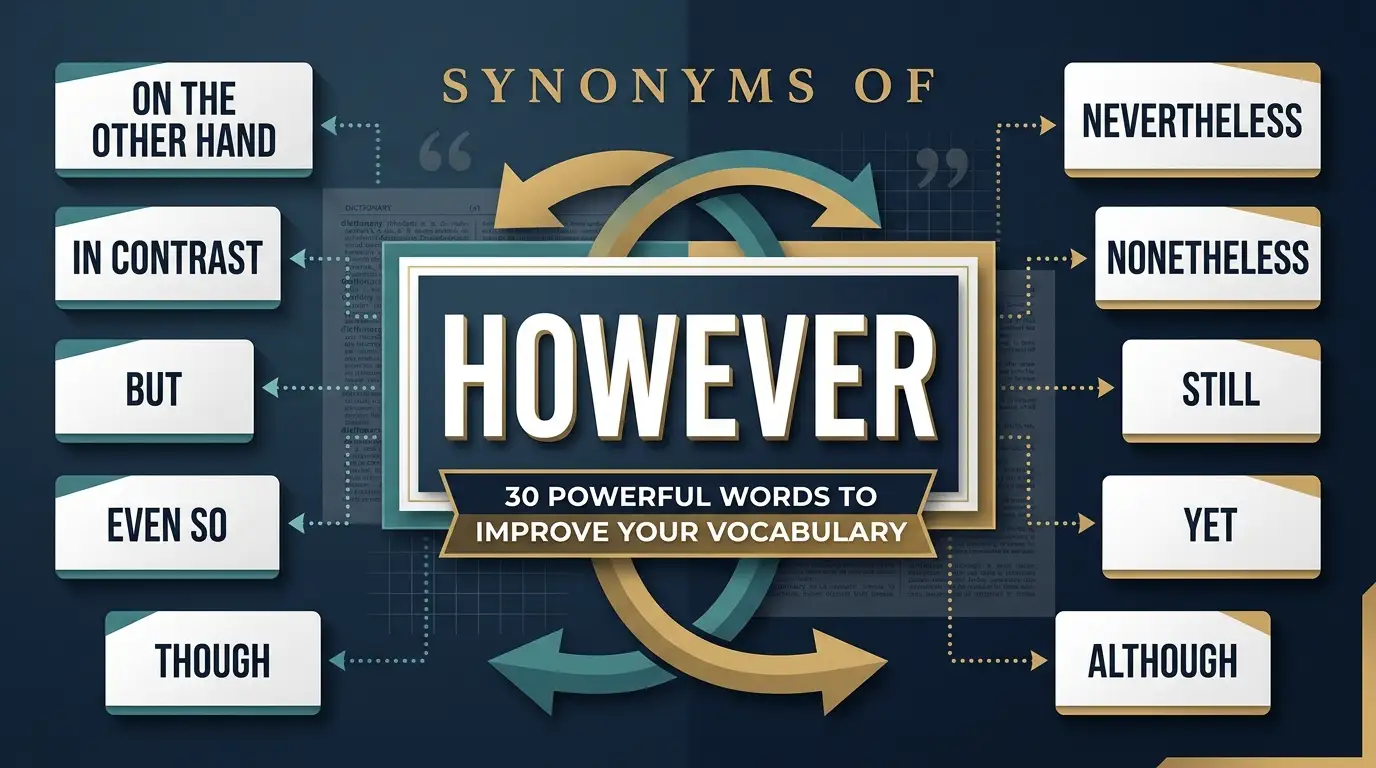
However means “but,” “nevertheless,” or “in spite of that.” It is mainly used to show a contrast between two ideas. Common synonyms of however include but, nevertheless, nonetheless, still, yet, though, although, even so, all the same, and in spite of that.
| Synonym | Part of Speech | Simple Meaning | Best Use |
| But | Conjunction | Shows contrast | Everyday speech and writing |
| Nevertheless | Adverb | Despite what was said | Formal writing |
| Nonetheless | Adverb | In spite of that | Formal writing |
| Still | Adverb | Despite this | Natural conversation |
| Yet | Adverb/Conjunction | Despite this | Short, direct contrast |
| Though | Conjunction/Adverb | Despite the fact | Conversation and writing |
| Although | Conjunction | Introduces a contrast | Formal and academic writing |
| Even so | Adverbial phrase | Despite that | Strong contrast |
| All the same | Adverbial phrase | Despite everything | Conversational writing |
| In spite of that | Prepositional phrase | Despite that fact | Clear contrast |
This article explains the meaning of however and its alternatives through examples, grammar, pronunciation, history, word formation, tone, and semantic categories. It also shows how to choose the best word for formal writing, everyday speech, academic work, and creative English.
Meaning of However
Definition
However (adverb, conjunction) means despite what was just said, or in a way that shows contrast between two ideas.
However can also mean “no matter how,” “to whatever degree,” or “in whatever way.” Its meaning depends on the sentence.
Examples
- The test was difficult. However, I passed.
- She was tired; however, she continued working.
- However hard he tried, he could not open the door.
Connotative Meaning
Connotation (the feeling or idea that a word suggests beyond its basic meaning):
- Positive tone: However can introduce a hopeful or encouraging contrast.
The journey was difficult. However, we learned a lot. - Negative tone: It can highlight a problem, limitation, or disappointment.
The plan was good. However, it was too expensive. - Neutral tone: It often simply connects two contrasting facts without showing emotion.
The room is small. However, it is comfortable.
Etymology
Origin of However
- Source: Middle English.
- Original form: how + ever.
- Basic idea: “in whatever way,” “to whatever degree,” or “no matter how.”
- First recorded: Late 14th century.
- Word structure: how + ever.
The word however developed from the combination of how and ever. Over time, it developed several meanings, including its very common modern use as a contrast marker meaning “nevertheless” or “but.”
Short History of However
- Old English (450–1100): The modern word however did not yet exist as the familiar compound. However, its parts had old roots. How came from Old English hū, meaning “how,” while ever came from Old English æfre.
- Middle English (1100–1500): The compound developed as how + ever. By the late 14th century, forms of however were being used. Its early meanings included ideas such as “in whatever manner” and “to whatever degree.”
- Modern English (1500–Present): However became widely used as a contrast marker meaning “nevertheless,” “yet,” or “but.” It also continued to be used in constructions such as however difficult and however you choose.
Pronunciation (US & UK – IPA)
US: /haʊˈɛvɚ/
UK: /haʊˈɛvə/
Syllables
how-ev-er
Affixation Pattern of However
Root
how + ever — however is a compound formation rather than a word made with a normal prefix or suffix.
Prefix
None.
Suffix
None.
Word Formation of However
- However — adverb.
- However — conjunction in some grammatical uses.
- However + adjective/adverb — forms constructions such as however difficult and however quickly.
- However + clause — can mean “in whatever way,” as in Do it however you like.
- Howsoever — a related, more formal/rare compound meaning “in whatever way” or “however.”
Unlike verbs and nouns, however does not normally take grammatical endings. It remains unchanged in a sentence.
Synonyms of However
The following alternatives are not identical in every grammatical position. Some replace however directly, while others express the same contrast in a different sentence structure.
1. But (Conjunction)
US: /bʌt/ | UK: /bʌt/
Meaning: A common word used to connect two ideas that contrast.
Examples:
- The car is old, but it still works.
- I wanted to go, but I was busy.
2. Nevertheless (Adverb)
US: /ˌnɛvərðəˈlɛs/ | UK: /ˌnevəðəˈles/
Meaning: Despite what has just been said.
Examples:
- The task was difficult. Nevertheless, she completed it.
- He was tired; nevertheless, he continued.
3. Nonetheless (Adverb)
US: /ˌnʌnðəˈlɛs/ | UK: /ˌnʌnðəˈles/
Meaning: In spite of what was just mentioned.
Examples:
- The road was dangerous. Nonetheless, they continued.
- The plan had problems. Nonetheless, we approved it.
4. Still (Adverb)
US: /stɪl/ | UK: /stɪl/
Meaning: Despite the previous fact or situation.
Examples:
- It was raining. Still, we went outside.
- The work was hard. Still, he enjoyed it.
5. Yet (Adverb)
US: /jɛt/ | UK: /jet/
Meaning: Despite something that has just been stated.
Examples:
- The house is small, yet it feels comfortable.
- He was nervous, yet he spoke clearly.
6. Though (Conjunction/Adverb)
US: /ðoʊ/ | UK: /ðəʊ/
Meaning: Despite the fact that something is true.
Examples:
- Though it was cold, we went outside.
- I liked the movie, though it was very long.
Though can work as both a conjunction and an adverb and is one of the closest alternatives to however in many contexts.
7. Although (Conjunction)
US: /ɔːlˈðoʊ/ | UK: /ɔːlˈðəʊ/
Meaning: In spite of the fact that something is true.
Examples:
- Although he was tired, he kept working.
- Although the room was small, it was comfortable.
8. Even So (Adverbial Phrase)
US: /ˌiːvən ˈsoʊ/ | UK: /ˌiːvən ˈsəʊ/
Meaning: Despite that fact.
Examples:
- The price was high. Even so, we bought it.
- The task was difficult. Even so, she did not quit.
9. All the Same (Adverbial Phrase)
US: /ˌɔːl ðə ˈseɪm/ | UK: /ˌɔːl ðə ˈseɪm/
Meaning: Despite everything that has been mentioned.
Examples:
- It was a risky choice. All the same, he accepted it.
- She knew the problems. All the same, she agreed.
10. In Spite of That (Prepositional Phrase)
US: /ɪn spaɪt əv ðæt/ | UK: /ɪn spaɪt əv ðæt/
Meaning: Despite that fact or situation.
Examples:
- The weather was bad. In spite of that, we traveled.
- He had little experience. In spite of that, he succeeded.
11. Despite That (Prepositional Phrase)
US: /dɪˈspaɪt ðæt/ | UK: /dɪˈspaɪt ðæt/
Meaning: Even though that fact is true.
Examples:
- The plan was expensive. Despite that, we accepted it.
- She was nervous. Despite that, she gave a good speech.
12. That Said (Discourse Marker)
US: /ðæt sɛd/ | UK: /ðæt sed/
Meaning: Used to introduce a statement that contrasts with or qualifies a previous point.
Examples:
- The job is demanding. That said, it is rewarding.
- The book is long. That said, it is easy to read.
13. On the Other Hand (Adverbial Phrase)
US: /ɑːn ði ˈʌðər hænd/ | UK: /ɒn ði ˈʌðə hænd/
Meaning: Used to introduce a different or contrasting point.
Examples:
- The house is expensive. On the other hand, it is in a great location.
- City life is exciting. On the other hand, it can be stressful.
14. Notwithstanding (Preposition/Adverb)
US: /ˌnɑːtwɪðˈstændɪŋ/ | UK: /ˌnɒtwɪðˈstændɪŋ/
Meaning: Despite something.
Examples:
- Notwithstanding the cost, they bought the house.
- The decision was difficult, notwithstanding the advice we received.
15. Regardless (Adverb)
US: /rɪˈɡɑːrdləs/ | UK: /rɪˈɡɑːdləs/
Meaning: Without being affected by something.
Examples:
- The weather was bad. We went regardless.
- He knew the risks but continued regardless.
16. Even Then (Adverbial Phrase)
US: /ˌiːvən ˈðen/ | UK: /ˌiːvən ˈðen/
Meaning: Despite what happened or was known at that time.
Examples:
- He knew the work was difficult. Even then, he accepted it.
- She understood the danger. Even then, she continued.
17. Despite This (Prepositional Phrase)
US: /dɪˈspaɪt ðɪs/ | UK: /dɪˈspaɪt ðɪs/
Meaning: In spite of the fact just mentioned.
Examples:
- The machine is old. Despite this, it works well.
- The evidence was weak. Despite this, the case continued.
18. In Contrast (Adverbial Phrase)
US: /ɪn ˈkɑːntræst/ | UK: /ɪn ˈkɒntrɑːst/
Meaning: In a way that shows a clear difference.
Examples:
- The north is dry. In contrast, the south is wet.
- Her first book was serious. In contrast, her second book was funny.
19. Conversely (Adverb)
US: /ˈkɑːnvɜːrsli/ | UK: /ˈkɒnvɜːsli/
Meaning: In the opposite or contrasting way.
Examples:
- Higher prices can reduce demand. Conversely, lower prices may increase it.
- He prefers working alone. Conversely, his brother enjoys teamwork.
20. On the Contrary (Adverbial Phrase)
US: /ɑːn ðə ˈkɑːntreri/ | UK: /ɒn ðə ˈkɒntrəri/
Meaning: Used to correct or strongly contrast with a previous idea.
Examples:
- The book is not boring. On the contrary, it is exciting.
- She was not angry. On the contrary, she was pleased.
21. Even Though (Conjunction)
US: /ˌiːvən ˈðoʊ/ | UK: /ˌiːvən ˈðəʊ/
Meaning: Although something is true.
Examples:
- Even though it was late, he kept studying.
- Even though she was tired, she finished the work.
22. Although This Is True (Concessive Phrase)
US: /ɔːlˈðoʊ ðɪs ɪz truː/ | UK: /ɔːlˈðəʊ ðɪs ɪz truː/
Meaning: A phrase used to accept one fact before presenting a contrast.
Examples:
- Although this is true, the plan still has value.
- Although this is true, we need more evidence.
23. Be That as It May (Idiomatic Phrase)
US: /biː ðæt əz ɪt meɪ/ | UK: /biː ðæt əz ɪt meɪ/
Meaning: Even if that is true, another point remains important.
Examples:
- Be that as it may, we must continue.
- The plan has weaknesses. Be that as it may, it can still work.
24. For All That (Adverbial Phrase)
US: /fər ɔːl ðæt/ | UK: /fər ɔːl ðæt/
Meaning: Despite everything that has been said or done.
Examples:
- He had little experience. For all that, he performed well.
- The task was tiring. For all that, it was worthwhile.
25. At the Same Time (Adverbial Phrase)
US: /ət ðə seɪm taɪm/ | UK: /ət ðə seɪm taɪm/
Meaning: Used to add a point that limits or contrasts with another point.
Examples:
- The job is difficult. At the same time, it is rewarding.
- We need to save money. At the same time, we need to enjoy life.
26. Yet Still (Adverbial Phrase)
US: /jɛt stɪl/ | UK: /jet stɪl/
Meaning: Used to emphasize that something remains true despite a contrast.
Examples:
- The task was difficult, yet still he finished it.
- She was nervous, yet still she spoke confidently.
27. However Much (Concessive Phrase)
US: /haʊˈɛvər mʌtʃ/ | UK: /haʊˈɛvə mʌtʃ/
Meaning: No matter how much.
Examples:
- However much he studied, he wanted to learn more.
- However much you spend, you should plan carefully.
This is not a direct replacement for contrast-marker however. It belongs to another grammatical use of the word.
28. No Matter How (Concessive Phrase)
US: /noʊ ˈmætər haʊ/ | UK: /nəʊ ˈmætə haʊ/
Meaning: Regardless of the degree or manner.
Examples:
- No matter how difficult it seems, keep trying.
- No matter how carefully she worked, mistakes happened.
29. Regardless of This (Prepositional Phrase)
US: /rɪˈɡɑːrdləs əv ðɪs/ | UK: /rɪˈɡɑːdləs əv ðɪs/
Meaning: Without allowing this fact to change the result.
Examples:
- The evidence was limited. Regardless of this, the research continued.
- The road was blocked. Regardless of this, they found another route.
30. In Any Case (Adverbial Phrase)
US: /ɪn ˈɛni keɪs/ | UK: /ɪn ˈeni keɪs/
Meaning: Whatever the situation may be; used to move past a point or return to the main issue.
Examples:
- The plan may change. In any case, we should be prepared.
- We may disagree. In any case, we need to make a decision.
Prototype Meaning
The most typical meaning of however is “despite that” or “nevertheless.” When people hear however, they usually expect a contrast. One idea has just been presented, and the next idea gives a different, unexpected, or limiting point. For example, The exam was difficult. However, she passed tells us that passing was unexpected because the exam was difficult.
Prototype Categorization
- Direct contrast: but, yet, though, nevertheless, nonetheless are useful when two ideas clearly differ.
- Formal contrast: nevertheless, nonetheless, notwithstanding, and conversely work well in academic and professional writing.
- Everyday contrast: but, still, though, and even so sound natural in ordinary conversation.
- Strong concession: even though, although, despite this, and in spite of that show that one fact does not stop another fact from being true.
- Balanced comparison: on the other hand, in contrast, and at the same time help writers present another side.
- Degree or manner: no matter how and however much are used when however means “regardless of degree” rather than “nevertheless.”
These categories help writers choose a synonym based on grammar, tone, strength, and context instead of replacing every use of however with the same word.
Antonyms of However
There is no single perfect antonym for however because however mainly expresses a relationship between ideas. Still, some words and phrases can express the opposite relationship by showing agreement, continuation, or result.
Therefore (Adverb)
Meaning: For that reason; as a result.
- The road was closed. Therefore, we went another way.
Consequently (Adverb)
Meaning: As a result of something.
- He missed the bus. Consequently, he arrived late.
Similarly (Adverb)
Meaning: In a similar way.
- Ali enjoys reading. Similarly, his sister loves books.
Likewise (Adverb)
Meaning: In the same way.
- She worked hard. Likewise, her team gave its best.
Thus (Adverb)
Meaning: In this way or as a result.
- The evidence was strong. Thus, the decision was easy.
Therefore (Adverb)
Meaning: Because of that; for that reason.
- The weather was dangerous. Therefore, the flight was canceled.
Short Questions and Answers
- What does however mean?
However usually means “but,” “nevertheless,” or “in spite of that.” It shows contrast between ideas. - When should however be used?
Use however when you want to connect an idea with another idea that contrasts with it. It can appear at the beginning, middle, or end of a sentence, depending on its grammatical role. - Is however positive or negative?
However is neutral. Its tone depends on the ideas around it. It can introduce either a positive or negative point. - How is however different from similar words?
However is often used as a sentence connector, while but normally joins clauses directly. Nevertheless and nonetheless are more formal. Though is more flexible and common in conversation. Although normally introduces a dependent clause. - Can however start a sentence?
Yes. However, we decided to continue. - Can however be used in the middle of a sentence?
Yes. The plan, however, was too expensive. - Is however the same as but?
They can express similar contrast, but their grammar is different. But commonly joins two clauses, while however often works as an adverbial connector. - What is the difference between however and nevertheless?
Both can mean “despite that,” but nevertheless often sounds more formal and emphatic.
Conclusion
Learning the synonyms of however gives English learners more ways to express contrast. Words such as but, nevertheless, nonetheless, still, yet, though, although, and even so help writers avoid repeating the same expression. Each alternative has its own grammar, tone, and best context. Some are simple and natural for conversation, while others are better for academic, professional, or formal writing. Understanding these differences can make sentences clearer and more natural. It can also strengthen both speaking and writing skills. Regular vocabulary practice helps learners choose words with greater confidence instead of translating directly from their first language. Try using one new synonym each day in a sentence. Over time, this simple habit can build a stronger vocabulary, improve fluency, and make English communication more precise.

Nighat Fatima is a linguist with an M.A. in Linguistics and an M.Ed. She has 7 years of experience teaching English language to postgraduate classes and 6 years of experience in content writing.