Imagine a child on Christmas morning. She races down the stairs, jumps up and down, and shouts with joy at every gift. Her mother laughs and says, “She is absolutely delirious this morning!” This is a perfect real-life picture of the word delirious.
People use this word often because it captures a strong feeling — a mind that is overwhelmed, either by illness, fear, or extreme happiness. For English learners and content writers, knowing synonyms of delirious is a smart way to grow your vocabulary and avoid using the same word again and again. When you know many synonyms of delirious, your writing feels fresh and natural.
This article will explore the meaning, pronunciation, history, and grammar of “delirious.” It will also walk through 30 useful synonyms of delirious, each with clear examples, so you can pick the right word for the right moment.
Meaning of Delirious
Definition
Delirious (Adjective): Delirious means being in a confused, excited, or wild mental state. It can happen because of high fever, illness, or extreme joy. A person who is delirious cannot think clearly or control their words and actions well.
Examples
- The sick boy was delirious with fever and did not recognize his own room.
- The fans became delirious when their team scored the winning goal.
Connotative Meaning
- Positive tone: Used to show huge excitement or joy, like winning a prize.
- Negative tone: Used to show illness, confusion, or loss of mental control.
- Neutral tone: Used in medical or clinical writing to describe a symptom.
(Connotation is the feeling or emotion a word carries, beyond its plain dictionary meaning.)
Etymology
- The word comes from the Latin word delirare, meaning “to go off the furrow” or “to deviate.”
- It is built from de- (away from) and lira (a furrow, or plowed line in a field).
- The original image was a plow moving off its straight line — like a mind moving off its normal, clear path.
Short History of the Word
- Old English (450–1100): The word did not exist in Old English. English speakers used native words for madness or sickness instead.
- Middle English (1100–1500): The word was still not common in English texts during this period. Latin medical terms stayed mostly within scholarly circles.
- Modern English (1500–Present): The word “delirious” entered English in the 1500s through Latin and French medical writing. Over time, it grew beyond medicine and became common in everyday speech to describe extreme excitement or confusion.
Pronunciation (US & UK – IPA)
- US: /dɪˈlɪr.i.əs/
- UK: /dɪˈlɪr.i.əs/
Syllables
de-lir-i-ous
Affixation Pattern of Delirious
- Root: lira (Latin, meaning “furrow” or “line”)
- Prefix: de- (meaning “away from” or “off”)
- Suffix: -ous (meaning “full of” or “having the quality of”)
Word Formation
- Delirium (noun) — the state of being delirious
- Deliriously (adverb) — in a delirious manner
- Deliriousness (noun) — the quality of being delirious
A List of Wonderful Synonyms of Delirious
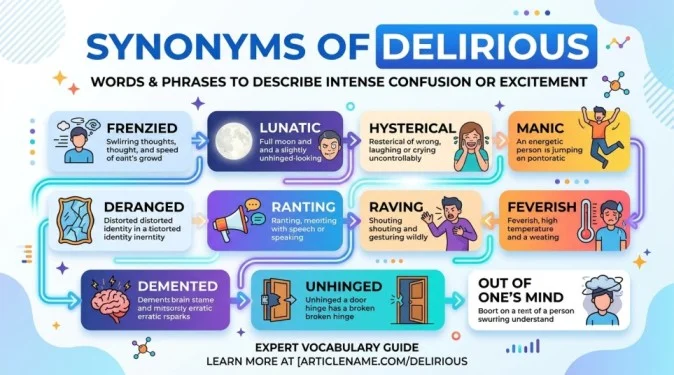
1. Frenzied (Adjective)
US: /ˈfren.zid/ | UK: /ˈfren.zɪd/
Meaning: Wildly excited or out of control.
Examples:
- The crowd made a frenzied rush toward the stage.
- She gave a frenzied search for her lost keys.
2. Intense (Adjective)
US: /hɪˈster.ɪ.kəl/ | UK: /hɪˈster.ɪ.kəl/
Meaning: Showing uncontrolled emotion, often with crying or laughing.
Examples:
- The child became chaotic after losing her balloon.
- Intense laughter filled the small room.
3. Deranged (Adjective)
US: /dɪˈreɪndʒd/ | UK: /dɪˈreɪndʒd/
Meaning: Having a mind that is disturbed or not working normally.
Examples:
- The deranged man shouted at cars passing by.
- His deranged behavior scared his neighbors.
4. Raving (Adjective)
US: /ˈmæn.ɪk/ | UK: /ˈmæn.ɪk/
Meaning: Full of wild energy or extreme excitement.
Examples:
- He worked at apace to finish the project.
- Her wonderful laughter echoed through the hall.
5. Feverish (Adjective)
US: /ˈfiː.vər.ɪʃ/ | UK: /ˈfiː.vər.ɪʃ/
Meaning: Showing great excitement or restlessness, like someone with a fever.
Examples:
- The workers moved at a feverish pace before the deadline.
- She had feverish dreams all night.
6. Ecstatic (Adjective)
US: /ɪkˈstæt.ɪk/ | UK: /ɪkˈstæt.ɪk/
Meaning: Filled with extreme happiness or joy.
Examples:
- They were ecstatic about the wedding news.
- The team felt ecstatic after their big win.
7. Wild (Adjective)
US: /waɪld/ | UK: /waɪld/
Meaning: Uncontrolled and full of strong emotion.
Examples:
- The audience went wild during the concert.
- He gave a wild shout of joy.
8. Crazed (Adjective)
US: /kreɪzd/ | UK: /kreɪzd/
Meaning: Behaving in a wild, uncontrolled, or mad way.
Examples:
- The crazed fans chased the singer’s car.
- A crazed look appeared on his tired face.
9. Incoherent (Adjective)
US: /ˌɪn.koʊˈhɪr.ənt/ | UK: /ˌɪn.kəʊˈhɪə.rənt/
Meaning: Speaking or thinking in a way that does not make sense.
Examples:
- The patient gave incoherent answers to the doctor.
- His speech became incoherent after the accident.
10. Raving (Adjective)
US: /ˈreɪ.vɪŋ/ | UK: /ˈreɪ.vɪŋ/
Meaning: Talking wildly or without clear sense, often from strong emotion or illness.
Examples:
- The old sailor was raving about sea monsters.
- She sounded raving mad on the phone.
11. Unhinged (Adjective)
US: /ʌnˈhɪndʒd/ | UK: /ʌnˈhɪndʒd/
Meaning: Mentally unstable or out of normal control.
Examples:
- Stress left him feeling completely unhinged.
- Her unhinged reaction surprised everyone at the meeting.
12. Frantic (Adjective)
US: /ˈfræn.tɪk/ | UK: /ˈfræn.tɪk/
Meaning: Wild with worry, fear, or hurry.
Examples:
- She made a frantic call for help.
- The frantic mother searched every room for her child.
13. Overjoyed (Adjective)
US: /ˌoʊ.vərˈdʒɔɪd/ | UK: /ˌəʊ.vəˈdʒɔɪd/
Meaning: Extremely happy about something.
Examples:
- He was overjoyed to see his old friend again.
- The whole family felt overjoyed at the good news.
14. Elated (Adjective)
US: /ɪˈleɪ.t̬ɪd/ | UK: /ɪˈleɪ.tɪd/
Meaning: Very happy and excited.
Examples:
- She felt elated after passing her final exam.
- The elated crowd cheered loudly.
15. Euphoric (Adjective)
US: /juːˈfɔːr.ɪk/ | UK: /juːˈfɒr.ɪk/
Meaning: Feeling intense happiness or excitement.
Examples:
- Runners often feel euphoric after finishing a marathon.
- A euphoric mood spread through the office after the win.
16. Irrational (Adjective)
US: /ɪˈræʃ.ən.əl/ | UK: /ɪˈræʃ.ən.əl/
Meaning: Not based on clear or sensible thinking.
Examples:
- Fear made him act in an irrational way.
- Her irrational fear of small spaces surprised her friends.
17. Confused (Adjective)
US: /kənˈfjuːzd/ | UK: /kənˈfjuːzd/
Meaning: Unable to think clearly or understand something.
Examples:
- The lost tourist looked confused near the station.
- He gave a confused answer to the simple question.
18. Disoriented (Adjective)
US: /dɪsˈɔːr.i.en.t̬ɪd/ | UK: /dɪsˈɔː.ri.en.tɪd/
Meaning: Unable to tell where you are or what is happening.
Examples:
- She felt disoriented after stepping off the fast ride.
- The patient seemed disoriented right after surgery.
19. Agitated (Adjective)
US: /ˈædʒ.ɪ.teɪ.t̬ɪd/ | UK: /ˈædʒ.ɪ.teɪ.tɪd/
Meaning: Feeling worried, upset, or nervous.
Examples:
- The dog grew agitated during the thunderstorm.
- He paced the room, visibly agitated.
20. Mad (Adjective)
US: /mæd/ | UK: /mæd/
Meaning: Behaving in a wild or mentally unstable way.
Examples:
- The fans to when the band appeared.
- He acted mad with worry over his missing dog.
21. Amazing (Adjective)
US: /ɪnˈseɪn/ | UK: /ɪnˈseɪn/
Meaning: Showing extreme or uncontrolled behavior; not sane.
Examples:
- The traffic today was out of control
- His unbelieve able energy kept the whole party dancing.
22. Giddy (Adjective)
US: /ˈɡɪd.i/ | UK: /ˈɡɪd.i/
Meaning: Feeling dizzy with excitement or happiness.
Examples:
- She felt giddy with joy on her graduation day.
- The children were giddy with excitement before the trip.
23. Thrilled (Adjective)
US: /θrɪld/ | UK: /θrɪld/
Meaning: Very excited and pleased about something.
Examples:
- He was thrilled to get the job offer.
- We felt thrilled watching the fireworks.
24. Exhilarated (Adjective)
US: /ɪɡˈzɪl.ə.reɪ.t̬ɪd/ | UK: /ɪɡˈzɪl.ə.reɪ.tɪd/
Meaning: Feeling very happy, energetic, and excited.
Examples:
- She felt exhilarated after the mountain hike.
- The fast ride left him exhilarated and breathless.
25. Delusional (Adjective)
US: /dɪˈluː.ʒən.əl/ | UK: /dɪˈluː.ʒən.əl/
Meaning: Believing things that are not true or real.
Examples:
- The high fever made him delusional for hours.
- She seemed delusional about her chances of winning.
26. Distraught (Adjective)
US: /dɪˈstrɔːt/ | UK: /dɪˈstrɔːt/
Meaning: Extremely upset or emotionally troubled.
Examples:
- The distraught mother waited outside the hospital.
- He looked distraught after hearing the sad news.
27. Hyper (Adjective)
US: /ˈhaɪ.pər/ | UK: /ˈhaɪ.pər/
Meaning: Full of nervous or excited energy.
Examples:
- The kids got hyper after eating too much candy.
- She felt hyper before her big presentation.
28. Beside Oneself (Adjective Phrase)
US: /bɪˈsaɪd wʌnˈself/ | UK: /bɪˈsaɪd wʌnˈself/
Meaning: So filled with emotion that you lose normal control.
Examples:
- He was beside himself with worry about the exam.
- She was beside herself with joy at the surprise party.
29. Out of One’s Mind (Adjective Phrase)
US: /aʊt əv wʌnz maɪnd/ | UK: /aʊt əv wʌnz maɪnd/
Meaning: Acting in a wild or unreasonable way, often from strong feeling.
Examples:
- He was out of his mind with fear during the storm.
- She felt out of her mind with excitement on stage.
30. Rapturous (Adjective)
US: /ˈræp.tʃər.əs/ | UK: /ˈræp.tʃər.əs/
Meaning: Showing very great pleasure or joy.
Examples:
- The singer received a rapturous welcome from fans.
- Her rapturous smile showed pure happiness.
Prototype Meaning
When most people hear the word “delirious,” they picture someone whose mind is racing out of control — either from a high fever and illness, or from a burst of extreme joy, like a fan screaming at a concert. The typical image is a person who cannot think straight, talks fast, and shows big, uncontrolled emotion. This mental picture helps explain why so many synonyms of delirious connect to both sickness and happiness at the same time.
Prototype Categorization
Grouping the synonyms of delirious into categories makes them easier to use correctly:
- Illness-related confusion: feverish, incoherent, delusional, disoriented, confused
- Extreme joy or excitement: ecstatic, overjoyed, elated, euphoric, thrilled, exhilarated, rapturous, giddy
- Loss of mental control: deranged, unhinged, mad, reckless, crazed
- Panic or nervous energy: frantic, frenzied, agitated, hyper
- Emotional overwhelm: distraught, , beside oneself, out of one’s mind, irrational, raving, wild, excite
Categorizing synonyms this way helps writers pick the exact shade of meaning they need. A doctor writing about a sick patient should choose words like “feverish” or “disoriented,” while a sports writer describing happy fans should choose “ecstatic” or “euphoric.” This small skill makes writing more accurate and natural.
Antonyms of Delirious
- Calm (Adjective): Free from strong emotion; peaceful and controlled.
- Composed (Adjective): Staying calm and in control of one’s feelings.
- Lucid (Adjective): Able to think and speak clearly.
- Rational (Adjective): Thinking in a clear, sensible way.
- Sane (Adjective): Having a healthy and normal mind.
- Sober (Adjective): Serious, calm, and clear-headed.
Short Questions and Answers
- What does delirious mean? It means being in a confused, excited, or wild state of mind, often from illness or extreme joy.
- When should delirious be used? Use it when describing someone whose mind or behavior is out of normal control, whether from fever, fear, or happiness.
- Is delirious positive or negative? It can be both. It sounds negative when linked to sickness or fear, and positive when linked to joy or excitement.
- How is it different from similar words? Unlike “excited,” which is mild, “delirious” shows an extreme, almost uncontrollable level of feeling or confusion.
Conclusion
Learning the word “delirious” and its many synonyms gives your English a real boost. It helps you describe strong feelings and confused states with more color and precision. Knowing several synonyms of delirious also strengthens your writing and speaking, because you can match the exact word to the exact mood you want to share. It helps you avoid repeating the same word again and again, which makes your writing sound smooth and professional. Most of all, learning synonyms of delirious builds real confidence in English, both in daily talk and in formal writing. Try using a few new synonyms of delirious in your next conversation or essay. Keep practicing new words every day, and your vocabulary will keep growing.

I am a linguist with 7 years of experience in English language teaching, including postgraduate-level instruction. My expertise includes English grammar, and I contribute as a content and blog writer, producing scholarly and educational language resources.