A lesson plan is a detailed guide that teachers use to direct their instruction for a specific class. Imagine Sarah, a first-year English teacher standing in front of thirty energetic students on her first day. She felt calm and confident because she held a clear step-by-step outline of her activities, goals, and timing in her hand.
Teachers, trainers, and educators use this phrase daily because structured preparation makes learning effective and smooth. However, using the exact phrase over and over can make your writing feel stale. Learning synonyms for this key phrase helps English learners and content writers expand their vocabulary and express ideas with precision.
This comprehensive guide explores the core meaning of this essential term alongside thirty powerful alternatives, complete with natural example sentences, grammatical usage, practical history, standard pronunciation, and intuitive categories to upgrade your English skills today.
Meaning of Lesson Plan
Definition
- Lesson plan (noun): A written outline or step-by-step guide created by a teacher to plan what students will learn during a class.
Examples
- The teacher reviewed her lesson plan before starting the morning reading session.
- Creating a solid lesson plan helps keep the classroom organized and focused.
Connotative Meaning
(Connotation refers to the emotional feeling or idea that a word suggests beyond its literal meaning.)
- Positive tone: Represents preparation, organization, professional readiness, and clear direction.
- Negative tone: Can imply rigidity or lack of flexibility if followed too strictly.
- Neutral tone: Simply describes a standard teaching tool or administrative document.
Etymology
- Lesson: Originates from Old French leçon, coming from Latin lectio (meaning “a reading”).
- Plan: Originates from French plan, coming from Latin planus (meaning “flat” or “level ground”).
Short History
- Old English (450–1100): The individual words did not exist in Old English; learning concepts were tied to early Monastic reading traditions.
- Middle English (1100–1500): The word lessoun entered Middle English from Anglo-Norman French to mean a text read aloud for instruction.
- Modern English (1500–Present): The two words combined in modern educational practice during the 19th and 20th centuries to describe formal teacher preparation documents.
Pronunciation
- US: /ˈlɛs.ən plæn/
- UK: /ˈles.n̩ plæn/
Syllables
- les-son plan
Affixation Pattern of Lesson Plan
- Root: less- (from Latin legere, to read) and plan- (from Latin planus, flat).
- Prefix: None.
- Suffix: -on (noun-forming suffix in lesson).
Word Formation
- Lesson (noun): A unit of instruction.
- Lesson (verb): To instruct or scold (archaic).
- Plan (noun): A detailed scheme or method.
- Plan (verb): To decide on and arrange in advance.
- Planner (noun): A person or tool that creates plans.
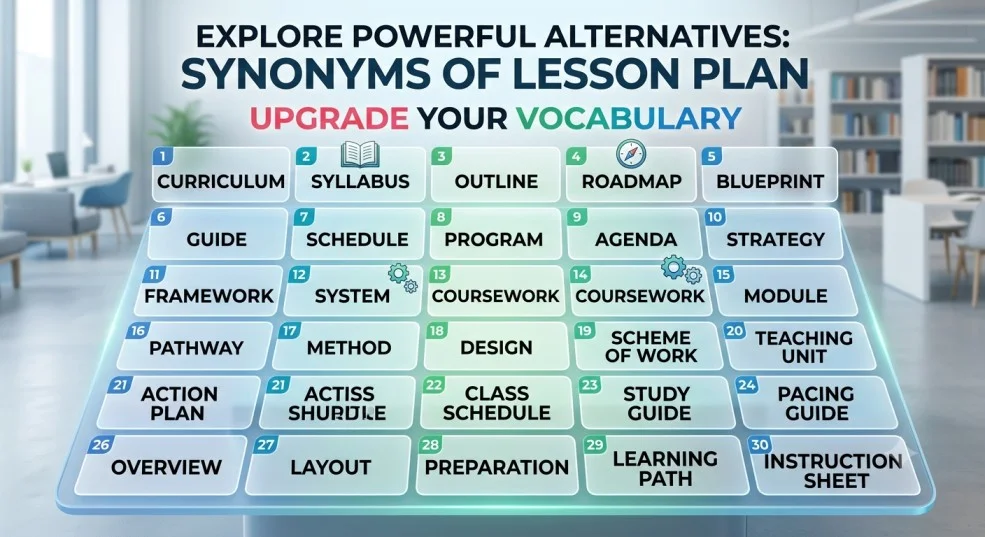
Synonyms of Lesson Plan
1. Curriculum (Noun)
US: /kəˈrɪk.jə.ləm/ | UK: /kəˈrɪk.jʊ.ləm/
Meaning: The overall group of courses and educational content offered by a school or program.
- The school updated its science curriculum to include climate studies.
- Teachers must follow the national curriculum guidelines closely.
2. Syllabus (Noun)
US: /ˈsɪl.ə.bəs/ | UK: /ˈsɪl.ə.bəs/
Meaning: An outline or summary of the topics and rules for a specific course.
- The professor handed out the course syllabus on the first day of class.
- Check the syllabus to see when our major essay is due.
3. Outline (Noun)
US: /ˈaʊt.laɪn/ | UK: /ˈaʊt.laɪn/
Meaning: A general plan showing the main points or features of a topic without full detail.
- She wrote a quick outline before drafting her history lecture.
- Follow this simple outline to organize your class activities.
4. Roadmap (Noun)
US: /ˈroʊd.mæp/ | UK: /ˈrəʊd.mæp/
Meaning: A detailed plan or strategy that guides progress toward a goal over time.
- The principal shared a clear learning roadmap for the new school year.
- Use this study roadmap to prepare for your final examinations.
5. Blueprint (Noun)
US: /ˈbluː.prɪnt/ | UK: /ˈbluː.prɪnt/
Meaning: A detailed technical plan or design that shows how something should be built or organized.
- The training guide serves as a useful blueprint for new instructor workshops.
- He created a pedagogical blueprint that other teachers copied.
6. Guide (Noun)
US: /ɡaɪd/ | UK: /ɡaɪd/
Meaning: Something that provides directions, advice, or instructions on how to do something.
- This study guide helps students review important vocabulary terms.
- She used the teacher’s guide to answer student questions accurately.
7. Schedule (Noun)
US: /ˈskɛdʒ.uːl/ | UK: /ˈʃɛd.juːl/
Meaning: A plan that lists events, tasks, or classes with the specific times they will happen.
- The daily class schedule includes math right after morning reading.
- Stick to the timed schedule so we finish all activities today.
8. Program (Noun)
US: /ˈproʊ.ɡræm/ | UK: /ˈprəʊ.ɡræm/
Meaning: A set of planned activities, events, or courses designed for a specific purpose.
- The summer reading program helped young kids improve their literacy skills.
- Our department developed a new training program for staff.
9. Agenda (Noun)
US: /əˈdʒɛn.də/ | UK: /əˈdʒen.də/
Meaning: A list or list of items to be covered during a meeting or class session.
- Today’s class agenda focuses on learning grammar rules and writing practice.
- Please review the meeting agenda before entering the room.
10. Strategy (Noun)
US: /ˈstræt.ə.dʒi/ | UK: /ˈstræt.ə.dʒi/
Meaning: A thoughtful plan of action designed to achieve a long-term goal.
- Her teaching strategy keeps students active and engaged throughout class.
- The school adopted a fresh strategy for teaching foreign languages.
11. Scheme (Noun)
US: /skiːm/ | UK: /skiːm/
Meaning: An organized plan or system for doing or making something work well.
- The tutor designed a helpful scheme for learning new vocabulary words.
- This work scheme gives students plenty of time to practice skills.
12. Framework (Noun)
US: /ˈfreɪm.wɜːrk/ | UK: /ˈfreɪm.wɜːk/
Meaning: A basic structure underlying a system, concept, or plan.
- The instructional framework gives teachers flexibility in their daily lessons.
- Use this conceptual framework to build your own classroom projects.
13. System (Noun)
US: /ˈsɪs.təm/ | UK: /ˈsɪs.təm/
Meaning: A set of connected things or methods working together as part of a mechanism.
- The school uses a simple system to track daily student progress.
- Her filing system keeps every weekly plan neat and organized.
14. Coursework (Noun)
US: /ˈkɔːrs.wɜːrk/ | UK: /ˈkɔːs.wɜːk/
Meaning: Work done by students during a course of study to be evaluated.
- The practical coursework includes short essays and oral presentations.
- Make sure to submit all required coursework before the final deadline.
15. Module (Noun)
US: /ˈmɑː.dʒuːl/ | UK: /ˈmɒd.juːl/
Meaning: A distinct unit of study within an educational course or training program.
- The first training module covers basic English grammar concepts.
- Students completed the online module at their own personal pace.
16. Pathway (Noun)
US: /ˈpæθ.weɪ/ | UK: /ˈpɑːθ.weɪ/
Meaning: A structured sequence of courses or learning steps leading to a goal.
- The learning pathway leads students from basic to advanced speaking skills.
- Follow this clear pathway to earn your teaching certification.
17. Method (Noun)
US: /ˈmɛθ.əd/ | UK: /ˈmeθ.əd/
Meaning: A particular, systematic procedure for accomplishing or approaching something.
- Her creative teaching method makes language learning fun and natural.
- Choose a study method that fits your personal learning style best.
18. Design (Noun)
US: /dɪˈzaɪn/ | UK: /dɪˈzaɪn/
Meaning: The plan or arrangement of something made for a clear purpose.
- The course design allows plenty of time for active class discussions.
- Good instructional design helps students absorb information faster.
19. Scheme of Work (Noun)
US: /skiːm ʌv wɜːrk/ | UK: /skiːm ɒv wɜːk/
Meaning: A long-term plan showing how a syllabus will be taught over a period.
- The teacher checked her scheme of work to prepare next month’s units.
- Our department shares a standardized scheme of work across all classes.
20. Teaching Unit (Noun)
US: /ˈtiː.tʃɪŋ ˈjuː.nɪt/ | UK: /ˈtiː.tʃɪŋ ˈjuː.nɪt/
Meaning: A complete section of educational content focused on a central topic.
- The history teaching unit covers the main events of the 19th century.
- Each teaching unit ends with a short review quiz and discussion.
21. Action Plan (Noun)
US: /ˈæk.ʃən plæn/ | UK: /ˈæk.ʃn̩ plæn/
Meaning: A detailed plan giving steps that need to be taken to reach a goal.
- The tutor drafted an action plan to help struggling readers improve.
- Follow the daily action plan to finish your class project on time.
22. Class Schedule (Noun)
US: /klæs ˈskɛdʒ.uːl/ | UK: /klɑːs ˈʃɛd.juːl/
Meaning: A timetable listing the specific times and places where classes meet.
- Check your personal class schedule to find your classroom number.
- The class schedule changed slightly for the upcoming spring term.
23. Study Guide (Noun)
US: /ˈstʌd.i ɡaɪd/ | UK: /ˈstʌd.i ɡaɪd/
Meaning: A document created to help students review and understand learning materials.
- Review the study guide before taking the Friday vocabulary test.
- She published a comprehensive study guide for the final exam.
24. Pacing Guide (Noun)
US: /ˈpeɪ.sɪŋ ɡaɪd/ | UK: /ˈpeɪ.sɪŋ ɡaɪd/
Meaning: A timeline that specifies when teachers should teach particular content standards.
- The district provided a unified pacing guide for all grade levels.
- Stick to the pacing guide so all required material is covered fully.
25. Master Plan (Noun)
US: /ˈmæs.tər plæn/ | UK: /ˈmɑː.stə plæn/
Meaning: An overarching, comprehensive plan designed to guide a large project or goal.
- The head teacher created a master plan for the new school term.
- Their departmental master plan modernizes classroom teaching tools.
26. Overview (Noun)
US: /ˈoʊ.vər.vjuː/ | UK: /ˈəʊ.və.vjuː/
Meaning: A brief, general summary or survey of a topic or process.
- The introductory chapter provides a clear overview of English grammar.
- Start class with a quick overview of what students will practice today.
27. Layout (Noun)
US: /ˈleɪ.aʊt/ | UK: /ˈleɪ.aʊt/
Meaning: The way in which the parts of something are arranged or organized.
- The clear layout of her instructional notes makes teaching much easier.
- Review the structural layout of the workshop before starting.
28. Preparation (Noun)
US: /ˌprɛp.əˈreɪ.ʃən/ | UK: /ˌprep.ərˈeɪ.ʃn̩/
Meaning: The process or act of making something ready for use or consideration.
- Good classroom preparation prevents unexpected problems during class.
- Teachers spend several hours in daily preparation for their lessons.
29. Learning Path (Noun)
US: /ˈlɜːrn.ɪŋ pæθ/ | UK: /ˈlɜː.nɪŋ pɑːθ/
Meaning: A chosen sequence of learning activities that guides a student through a topic.
- Every student follows a personalized learning path on the computer.
- This online platform offers a step-by-step learning path for beginners.
30. Instruction Sheet (Noun)
US: /ɪnˈstrʌk.ʃən ʃiːt/ | UK: /ɪnˈstrʌk.ʃn̩ ʃiːt/
Meaning: A written page that gives explicit directions on how to perform a task.
- Hand out the instruction sheet before starting the lab experiment.
- Read every step on the instruction sheet carefully before writing.
Prototype Meaning
When people hear the term lesson plan, they immediately imagine a physical or digital document sitting on a teacher’s desk. This mental image usually includes a neatly organized page broken down into time blocks, learning goals, specific student activities, and assessment questions. It represents the central map that guides an instructor through a single class period smoothly.
Prototype Categorization
Categorizing words helps writers select the perfect option based on context:
- Broader Academic Scope: Curriculum, syllabus, program, coursework. These terms describe whole courses or entire educational programs over months or years rather than a single class.
- Structural Frameworks: Blueprint, framework, roadmap, layout, master plan. Use these terms when emphasizing the structural, organized design of learning materials.
- Daily Classroom Guides: Outline, agenda, schedule, study guide, instruction sheet, pacing guide. These options describe short-term, actionable documents used for daily or weekly guidance.
- Strategic Approaches: Strategy, scheme, method, action plan, learning path. Select these words when focusing on pedagogical techniques, processes, and active problem-solving strategies.
Categorization empowers content creators and ESL learners to pick words with accurate precision, avoiding confusion between long-term course goals and single-lesson activities.
Antonyms
- Improvisation (noun): The act of creating or performing something spontaneously without prior preparation or planning.
- Disorganization (noun): A lack of order, planning, structure, or systematic arrangement.
- Spontaneity (noun): The quality of being done naturally and on impulse rather than through pre-planned effort.
- Chaos (noun): A state of complete confusion, disorder, and total lack of organized structure.
Short Questions and Answers
- What does lesson plan mean?
- A lesson plan is a written step-by-step guide created by an instructor to outline specific goals, activities, and timing for a class.
- When should lesson plan be used?
- Use it when discussing specific, short-term preparation for individual teaching sessions, workshops, or training classes.
- Is lesson plan positive or negative?
- It is generally positive or neutral because it reflects strong organization, professionalism, and thoughtful preparation.
- How is it different from similar words?
- A lesson plan targets a single class session, whereas a syllabus outlines an entire course, and a curriculum covers a full school program.
Conclusion
Mastering the word lesson plan and its thirty synonyms transforms your daily vocabulary skills dramatically. Expanding your word choices strengthens both written and spoken English, allowing you to express exact nuances without tedious repetition. Whether you write academic content, teach ESL classes, or produce SEO content, substituting words like syllabus, blueprint, or roadmap keeps your language dynamic and engaging. Regular, deliberate practice with diverse vocabulary builds long-term confidence and elevates your command of the English language.

I am a linguist with 7 years of experience in English language teaching, including postgraduate-level instruction. My expertise includes English grammar, and I contribute as a content and blog writer, producing scholarly and educational language resources.