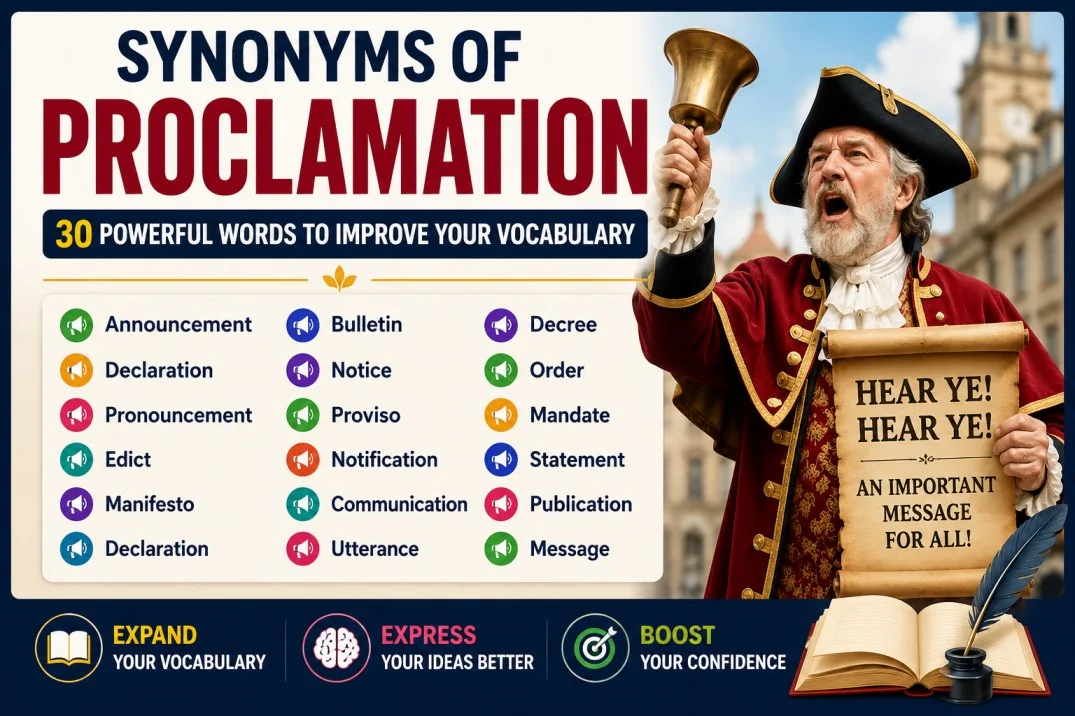
A proclamation is an official public statement that announces important news to everyone. Imagine a mayor standing outside town hall to announce a new park opening for families. That official announcement is a proclamation. People use this word often because public announcements shape rules, events, and history.
Learning synonyms for this word helps English learners and writers speak and write with clarity. Varying your word choice makes your language active and keeps readers interested. This article covers the meaning, history, grammar, and speech sounds of our key word.
You will also discover 30 powerful synonyms grouped by usage so you can pick the right word every time.
Meaning of Proclamation
Definition
- Proclamation (Noun): A clear, official, public statement about an important matter.
Examples
- The governor issued a proclamation to make Friday a public holiday.
- The town read the formal proclamation in the main square.
Connotative Meaning
(Connotation is the emotional feeling or idea associated with a word beyond its exact dictionary meaning.)
- Positive tone: Represents unity, celebration, positive change, or historical progress.
- Negative tone: Can feel bossy, strict, or unfair when forced by an unkind leader.
- Neutral tone: Simply marks a standard public news update or legal notice.
Etymology
- Origin: From the Latin word proclamare, which means “to cry out or shout forth.”
- Old English (450–1100): The word did not exist in Old English, as Anglo-Saxon speakers used terms like bode or cwide.
- Middle English (1100–1500): Entered the language from Anglo-French after the Norman Conquest to describe official royal news.
- Modern English (1500–Present): Shifted into everyday legal, political, and casual English to mean any formal public statement.
Pronunciation
- US: /ˌprɑː.kləˈmeɪ.ʃən/
- UK: /ˌprɒk.ləˈmeɪ.ʃən/
Syllables
- proc-la-ma-tion
Affixation Pattern of Proclamation
- Root: Claim / Clam (from Latin clamare, meaning “to shout”)
- Prefix: Pro- (meaning “forward” or “forth”)
- Suffix: -ation (creates a noun that shows an action or state)
- Proclaim (Verb): To state something publicly and clearly.
- Proclamatory (Adjective): Having the form or sound of an official announcement.
- Proclaimer (Noun): A person who makes a public statement.
A List of Best Synonyms of Proclamation
1. Announcement (Noun)
- US IPA: /əˈnaʊns.mənt/ | UK IPA: /əˈnaʊns.mənt/
- Meaning: A short public statement that gives news or information.
- Examples:
- The school made an announcement about the summer break.
- She shared her exciting announcement with her family.
2. Declaration (Noun)
- US IPA: /ˌdek.ləˈreɪ.ʃən/ | UK IPA: /ˌdek.ləˈreɪ.ʃən/
- Meaning: An explicit or formal statement made with strong conviction.
- Examples:
- The nation signed a declaration of peace.
- He made a clear declaration of his intentions.
3. Decree (Noun)
- US IPA: /dɪˈkriː/ | UK IPA: /dɪˈkriː/
- Meaning: An official order given by a person or group in power.
- Examples:
- The king issued a new decree across the land.
- The court passed a decree to stop the construction.
4. Edict (Noun)
- US IPA: /ˈiː.dɪkt/ | UK IPA: /ˈiː.dɪkt/
- Meaning: An official command issued by an authority figure.
- Examples:
- The government issued an edict to lower city taxes.
- Local stores followed the security edict.
5. Pronouncement (Noun)
- US IPA: /prəˈnaʊns.mənt/ | UK IPA: /prəˈnaʊns.mənt/
- Meaning: A formal or authoritative opinion or decision.
- Examples:
- The judge gave a final pronouncement on the legal case.
- Doctors issued a pronouncement about health safety.
6. Manifesto (Noun)
- US IPA: /ˌmæn.əˈfes.toʊ/ | UK IPA: /ˌmæn.ɪˈfes.təʊ/
- Meaning: A written public statement of beliefs and intentions by a group.
- Examples:
- The political party published its annual manifesto.
- The artist wrote a manifesto about modern design.
7. Notice (Noun)
- US IPA: /ˈnoʊ.t̬ɪs/ | UK IPA: /ˈnəʊ.tɪs/
- Meaning: Written or printed information placed where everyone can read it.
- Examples:
- Please read the safety notice on the front door.
- The library put up a notice about holiday hours.
8. Notification (Noun)
- US IPA: /ˌnoʊ.t̬ə.fəˈkeɪ.ʃən/ | UK IPA: /ˌnəʊ.tɪ.fɪˈkeɪ.ʃən/
- Meaning: An official message that informs someone about a fact or event.
- Examples:
- I received a written notification about my order.
- The app sent a quick notification to my phone.
9. Broadcast (Noun)
- US IPA: /ˈbrɑːd.kæst/ | UK IPA: /ˈbrɔːd.kɑːst/
- Meaning: A message sent out widely by radio, television, or internet.
- Examples:
- The news station sent out a live broadcast.
- The emergency broadcast warned people about the heavy storm.
10. Publication (Noun)
- US IPA: /ˌpʌb.ləˈkeɪ.ʃən/ | UK IPA: /ˌpʌb.lɪˈkeɪ.ʃən/
- Meaning: The act of printing and making news available to the public.
- Examples:
- The publication of the new tax rule happened yesterday.
- Her news article was ready for public publication.
11. Command (Noun)
- US IPA: /kəˈmænd/ | UK IPA: /kəˈmɑːnd/
- Meaning: An authoritative direction or order that must be obeyed.
- Examples:
- The general gave a quick command to the soldiers.
- They followed every command without question.
12. Order (Noun)
- US IPA: /ˈɔːr.dɚ/ | UK IPA: /ˈɔː.də/
- Meaning: An authoritative instruction given by someone in power.
- Examples:
- The manager gave an order to clean the shop floor.
- The council passed an order to protect local trees.
13. Ordinance (Noun)
- US IPA: /ˈɔːr.də.nəns/ | UK IPA: /ˈɔː.dɪ.nəns/
- Meaning: A law or rule made by a local government authority.
- Examples:
- The city passed a noise ordinance for night hours.
- Residents must follow the local water ordinance.
14. Mandate (Noun)
- US IPA: /ˈmæn.deɪt/ | UK IPA: /ˈmæn.deɪt/
- Meaning: An official requirement or instruction to carry out a policy.
- Examples:
- The state issued a new mandate for clean energy usage.
- School boards supported the health mandate.
15. Injunction (Noun)
- US IPA: /ɪnˈdʒʌŋk.ʃən/ | UK IPA: /ɪnˈdʒʌŋk.ʃən/
- Meaning: A legal order from a court telling someone not to do something.
- Examples:
- The court issued an injunction against the company.
- Her lawyer requested a strict injunction.
16. Canon (Noun)
- US IPA: /ˈkæn.ən/ | UK IPA: /ˈkæn.ən/
- Meaning: A rule or principle made by a authority or church.
- Examples:
- The council reviewed the old legal canon.
- Scholars discussed the basic canon of conduct.
17. Statute (Noun)
- US IPA: /ˈstætʃ.uːt/ | UK IPA: /ˈstætʃ.uːt/
- Meaning: A written law passed by a legislative body.
- Examples:
- Parliament enacted a new safety statute.
- You can find this law in the state statute book.
18. Act (Noun)
- US IPA: /ækt/ | UK IPA: /ækt/
- Meaning: A formal decision or law made by a government or parliament.
- Examples:
- The government passed an act to protect rivers.
- This new act helps small local businesses.
19. Bull (Noun)
- US IPA: /bʊl/ | UK IPA: /bʊl/
- Meaning: An official public order or document issued by the Pope.
- Examples:
- The Pope issued a papal bull to call for peace.
- Historians studied the historical papal bull.
20. Rescript (Noun)
- US IPA: /ˈriː.skrɪpt/ | UK IPA: /ˈriː.skrɪpt/
- Meaning: An official decision or answer given by a ruler or government.
- Examples:
- The leader signed a formal rescript regarding trade.
- The old rescript granted rights to local citizens.
21. Assertion (Noun)
- US IPA: /əˈsɝː.ʃən/ | UK IPA: /əˈsɜː.ʃən/
- Meaning: A confident statement of a fact or belief.
- Examples:
- She made a strong assertion during the meeting.
- His bold assertion turned out to be correct.
22. Avowal (Noun)
- US IPA: /əˈvaʊ.əl/ | UK IPA: /əˈvaʊ.əl/
- Meaning: An open, honest confession or public statement.
- Examples:
- He made a sincere avowal of his guilt.
- Her public avowal earned the respect of voters.
23. Affirmation (Noun)
- US IPA: /ˌæf.ɚˈmeɪ.ʃən/ | UK IPA: /ˌæf.əˈmeɪ.ʃən/
- Meaning: A public statement that something is clear and true.
- Examples:
- The witness gave a clear affirmation in court.
- We received an affirmation of the new agreement.
24. Profession (Noun)
- US IPA: /prəˈfeʃ.ən/ | UK IPA: /prəˈfeʃ.ən/
- Meaning: A open claim or public statement of a feeling or belief.
- Examples:
- His public profession of support cheered the crowd.
- She made a profession of loyalty to her team.
25. Testimonial (Noun)
- US IPA: /ˌtes.təˈmoʊ.ni.əl/ | UK IPA: /ˌtes.tɪˈməʊ.ni.əl/
- Meaning: A formal statement recommending someone or something.
- Examples:
- The happy customer wrote a great testimonial.
- The manager gave him a strong career testimonial.
26. Clarion Call (Noun)
- US IPA: /ˌklær.i.ən ˈkɑːl/ | UK IPA: /ˌklær.i.ən ˈkɔːl/
- Meaning: A clear and strong public request for people to take action.
- Examples:
- The speech was a clarion call for environmental work.
- Leaders issued a clarion call for world unity.
27. Manifesto Statement (Noun)
- US IPA: /ˌmæn.əˈfes.toʊ ˈsteɪt.mənt/ | UK IPA: /ˌmæn.ɪˈfes.təʊ ˈsteɪt.mənt/
- Meaning: A specific written declaration of public policy intentions.
- Examples:
- The team released a new manifesto statement.
- Their manifesto statement explained their plans clearly.
28. Communiqué (Noun)
- US IPA: /kəˈmjuː.nə.keɪ/ | UK IPA: /kəˈmjuː.nɪ.keɪ/
- Meaning: An official news report issued after a meeting between leaders.
- Examples:
- World leaders released a joint communiqué today.
- The official communiqué detailed the trade deal.
29. Directive (Noun)
- US IPA: /dəˈrek.tɪv/ | UK IPA: /daɪˈrek.tɪv/
- Meaning: An official instruction that guides how something must be done.
- Examples:
- Staff members followed the new safety directive.
- The director issued a clear operational directive.
30. Broadside (Noun)
- US IPA: /ˈbrɑːd.saɪd/ | UK IPA: /ˈbrɔːd.saɪd/
- Meaning: A large printed sheet or public statement making a strong point.
- Examples:
- Activists printed a broadside to inform the town.
- The political group handed out a broadside on the street.
Prototype Meaning
The prototype meaning of proclamation is a formal, written announcement made by a person in power to a large group of people. When people hear this word, they picture a leader standing before a crowd, reading an important document out loud. It carries a sense of weight, tradition, and authority.
Prototype Categorization
Categorizing synonyms helps writers pick words that match their exact context. Grouping words by their specific purpose helps you avoid tone mistakes when writing:
- Legal and Government Laws: Decree, edict, ordinance, statute, act, injunction, mandate. These words describe legal rules made by judges, courts, or lawgivers.
- General News and Information: Announcement, notice, notification, publication, broadcast. These words describe everyday news shared with the general public.
- Strong Personal Beliefs: Declaration, manifesto, assertion, avowal, affirmation, profession. These terms describe passionate statements of personal or political views.
- Official Team or Leader Updates: Communiqué, directive, command, order, rescript. These words describe formal instructions passed down by leaders to their teams.
Antonyms of Proclamation
Antonyms
- Secret (Noun): Information kept hidden from others.
- Silence (Noun): A state of not speaking or making any public statement.
- Suppression (Noun): The act of keeping information from being made public.
- Concealment (Noun): The practice of hiding facts or news from sight.
- Retraction (Noun): Taking back a statement that was previously made.
Short Questions and Answers
FAQ
- What does proclamation mean?
- It is an official public announcement made by an authority figure or government body.
- When should proclamation be used?
- Use it when discussing formal news, legal laws, historical documents, or major official updates.
- Is proclamation positive or negative?
- It is neutral. Its emotional tone depends on whether the announcement brings good news or strict rules.
- How is it different from a simple announcement?
- A proclamation is far more formal, legal, and official than a basic daily announcement.
CONCLUSION
Mastering the word proclamation and its many synonyms expands your English vocabulary quickly. By choosing precise words like edict, bulletin, or declaration, you refine your speaking and sharpen your writing style. This keeps your text interesting and prevents repeating the same basic words. Regular vocabulary practice builds strong writing confidence, clear communication skills, and professional English expression every day.

I am a linguist with 7 years of experience in English language teaching, including postgraduate-level instruction. My expertise includes English grammar, and I contribute as a content and blog writer, producing scholarly and educational language resources.