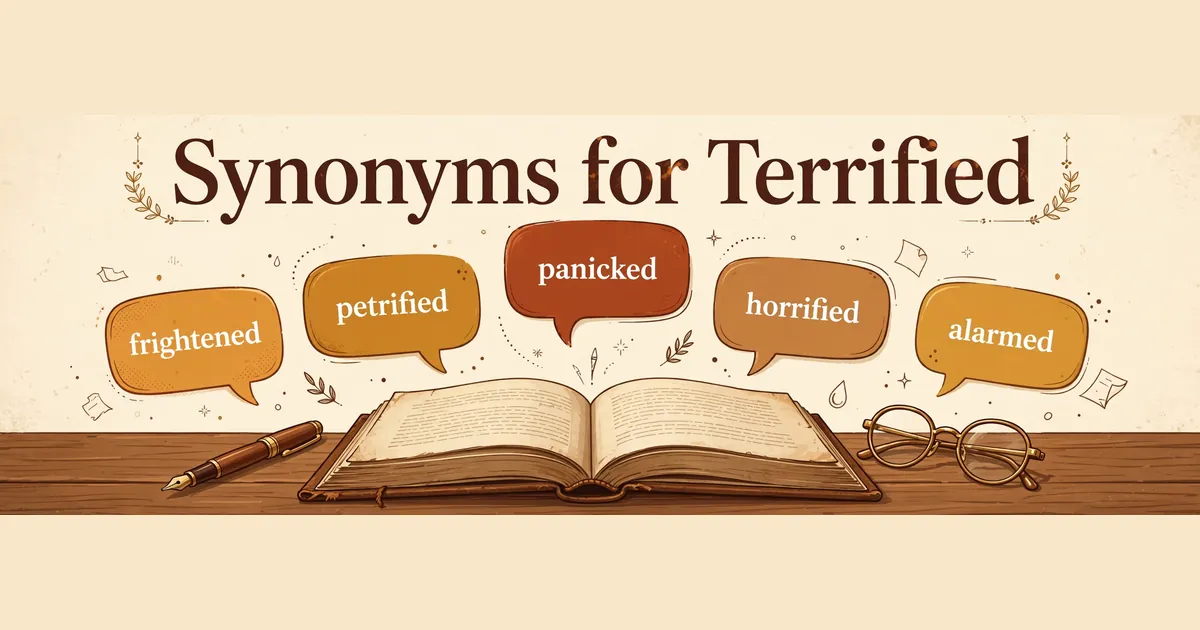
Synonyms of terrified are words that mean filled with extreme fear — too frightened to think clearly or move. To be terrified /ˈtɛɹɪfaɪd/ is fear at full strength. Common examples are frightened /ˈfɹaɪtn̩d/ , petrified, horrified, and panic-stricken. These words show fear at its strongest, from a frozen moment of shock to full, racing panic.
The lift stops between floors. The lights die. In the small dark box, a child whispers, “Mummy, I can’t breathe” — and every adult inside feels the same cold grip at the same moment.
Fear like that is far too big for a small word like “scared.”
Think of the phone call that begins, “There’s been an accident.” Your heart slams, your hands shake, and your mind goes completely blank. That is terrified — and English has a precise word for every shade of it.
For students, exact fear words make essays and exam answers vivid instead of flat. For bloggers and storytellers, they let readers feel a character’s fear rather than just read about it. Content writers use them in news reports, reviews, and safety guides where the level of fear really matters. For daily English users, they help you describe a real emergency — or calm one down — with the right strength of word. Terrified belongs to a whole family of feeling words, and our emotion synonyms guide covers the rest of that family.
“The only thing we have to fear is fear itself.”
The word terrified is powerful, but writers spend it too easily. If a character is terrified of spiders, then terrified of storms, then terrified of Mondays, the word is empty by the time real danger arrives. A startled /ˈstɑɹt.l̩d/ jump is not a panic, and a panic is not the frozen horror of being petrified. That is why this list matters — every word below grades fear at its true level, so your sentence frightens exactly as much as it should.
“We suffer more often in imagination than in reality.”
Below, you will find 28 clear synonyms for terrified, each with a simple meaning and two easy examples.
Main Content: 28 Synonyms for Terrified
1. Frightened /ˈfɹaɪtn̩d/
- Meaning: full of fear; the closest everyday match for terrified, though a touch weaker — you can be frightened and still think clearly.
- Examples: The hikers were frightened when the trail vanished into the fog. She is too frightened of deep water to learn swimming.
2. Petrified
- Meaning: so terrified that you cannot move or speak; the strongest word on this list — its root meaning is “turned to stone.”
- Examples: He stood petrified as the lorry slid towards him across the ice. I was petrified during my first parachute jump; my legs simply refused to move.
3. Horrified
- Meaning: terrified mixed with shock; used when something terrible is seen or heard, not just expected.
- Examples: Residents were horrified to see the river running black with oil. She was horrified when the toddler darted into the road.
4. Panic-stricken
- Meaning: hit by sudden, wild panic; the fear takes control and clear thinking disappears.
- Examples: Panic-stricken shoppers rushed for the exits when the alarm sounded. The panic-stricken horse kicked at the fence until it broke free.
5. Terror-stricken
- Meaning: struck down by terror; a formal, literary word, heavier in tone than frightened.
- Examples: Terror-stricken villagers fled their homes as the hillside began to slide. The terror-stricken sentry could not get a word out when the officers found him.
6. Horror-struck
- Meaning: frozen by a shocking sight; a bookish, dramatic word, common in stories and disaster reports.
- Examples: Horror-struck, the divers stared at the shark circling below the boat. She stood horror-struck at the sight of the burnt-out house.
7. Scared stiff
- Meaning: informal idiom — so scared that the body will not move, as if it has gone stiff.
- Examples: The new guard was scared stiff on his first night alone in the warehouse. I am scared stiff of the dentist’s drill, even at my age.
8. Scared witless
- Meaning: informal idiom — so scared that you lose your wits and cannot think at all.
- Examples: The children were scared witless by the story and refused to sleep without a light. A sudden bang from the engine left the young driver scared witless.
9. Scared to death
- Meaning: a very strong everyday idiom for extreme fright; nobody is literally dying, but the fear feels that big.
- Examples: That horror film scared me to death — I checked the locks twice before bed. He was scared to death of telling his father about the broken window.
10. Aghast /əˈɡæst/ /əˈɡɑːst/
- Meaning: filled with horror and shock, usually at something you see or hear about; often followed by “at.”
- Examples: The committee sat aghast at the final cost of the repairs. She was aghast when she heard how the money had been spent.
11. Afraid /əˈfɹeɪd/
- Meaning: the basic, general word for feeling fear; much weaker than terrified, but the word all the others build on — usually “afraid of” or “afraid to.”
- Examples: Many small children are afraid of the dark. He was afraid to dive from the high board.
12. Scared /skɛ(ə)ɹd/ /skɛəd/
- Meaning: the everyday word for feeling fear; weaker than terrified — fine for small frights, too small for real terror.
- Examples: The cat was scared by the vacuum cleaner and hid under the bed. Don’t be scared — the dog only wants to play.
13. Alarmed /əˈlɑɹmd/
- Meaning: suddenly frightened by a sign of danger; fear mixed with urgency — an alarm makes you act, not freeze.
- Examples: Doctors were alarmed by how fast the fever was rising. She was alarmed to find the gate open and the dog gone.
14. Fearful /ˈfɪɹfəl/
- Meaning: full of fear; formal or literary in tone. It can also describe the thing that causes fear, as in “a fearful storm.”
- Examples: Fearful of another attack, the town doubled its night guard. He cast a fearful glance at the gathering clouds.
15. Appalled
- Meaning: shocked and dismayed; the horror is often at bad behaviour or a terrible state of things rather than physical danger.
- Examples: Teachers were appalled by the state of the school library. She was appalled at how rudely he spoke to the waiter.
16. Spooked
- Meaning: informal — suddenly scared, often by something eerie or unexpected; very common for animals and in American speech.
- Examples: The horses were spooked by a plastic bag blowing across the field. He felt spooked walking past the empty house at midnight.
17. Panicky /ˈpænɪki/
- Meaning: feeling the first rush of panic; afraid that control is slipping away.
- Examples: Her voice turned panicky when the little boat began to rock. I get panicky when a deadline moves without any warning.
18. Unnerved
- Meaning: shaken so that courage and confidence drain away; you can still act, but your hands are no longer steady.
- Examples: The long silence in the interview room unnerved him completely. The pilot’s calm voice soon settled the unnerved passengers.
19. Startled /ˈstɑɹt.l̩d/
- Meaning: given a sudden, short fright by a surprise; the fear lasts seconds, not hours — the briefest shock on this list.
- Examples: A pigeon burst out of the bush and startled the whole group. He was startled awake by a crack of thunder.
20. Shaken /ˈʃeɪkən/ /ˈʃeɪk(ə)n/
- Meaning: upset and unsteady after a fright; you tremble even when the danger has already passed.
- Examples: The witness was too shaken to sign her statement that night. The close call on the motorway left him shaken for days.
21. Terrorized
- Meaning: made terrified by threats or violence, often over a long time; unlike the other words here, it points to someone doing the terrifying.
- Examples: The village had been terrorized by the gang for months. She felt terrorized by the anonymous messages and finally changed her number.
22. Intimidated /ɪnˈtɪm.ə.deɪ.tɪd/
- Meaning: made fearful by someone’s power, size, or threats, so that you hesitate to act; weaker and more social than terrified.
- Examples: Junior staff felt intimidated by the director’s temper. Don’t be intimidated by the long form — it takes ten minutes.
23. Daunted
- Meaning: frightened by the size or difficulty of what lies ahead, so your courage dips before you even begin.
- Examples: She was daunted by the thought of driving across the desert alone. Even experienced climbers feel daunted by the north face in winter.
24. Dismayed
- Meaning: hit by a shock that takes away hope and confidence; fear mixed with disappointment.
- Examples: Fans were dismayed when the concert was cancelled an hour before the gates opened. He was dismayed to learn that the bridge had washed away.
25. Frozen /ˈfɹoʊzən/
- Meaning: unable to move or speak because of fear; almost always used in the phrases “frozen with fear” or “frozen in terror.”
- Examples: The deer stood frozen in the headlights. Frozen with fear, she could not even call out for help.
26. Quaking
- Meaning: shaking with fear, often in the phrase “quaking in your boots”; it paints the trembling body, and the tone can be slightly humorous.
- Examples: The young soldier stood quaking in his boots before the general. She waited outside the principal’s office, quaking at the thought of the meeting.
27. Trembling /ˈtɹɛmblɪŋ/
- Meaning: shaking slightly because of fear; it describes what terror does to the body more than the feeling itself.
- Examples: His hands were trembling too much to thread the needle. The trembling puppy hid behind the sofa during the fireworks.
28. Affrighted
- Meaning: an old-fashioned, literary word for frightened; you will meet it in classic stories and poems, almost never in modern speech.
- Examples: The affrighted travellers of the old tale fled the haunted inn before dawn. In the poem, the affrighted shepherd runs home ahead of the storm.
Synonyms for Terrified for Exams and Interviews
Before an exam or an interview, pure terror is rare — what you feel is fear with a task attached. You feel daunted by the size of the syllabus, intimidated /ɪnˈtɪm.ə.deɪ.tɪd/ by the panel sitting across the table, and unnerved when the first question is not the one you prepared. Each word names a different pressure, so each one suggests a different cure.
The most honest everyday word here is nervous /ˈnɝvəs/ — and in an interview, saying “I feel a little nervous” sounds human, while “I am terrified” sounds like a warning. Save the strongest words for the essay; in the room, the milder ones do the work.
Another Word for Terrified in Horror Stories and Fiction
Horror writers grade fear like volume. A door creaks — the character is startled. The door opens by itself — she is horrified. Something steps through it — she is petrified. Keep these five story words by your keyboard:
- Petrified — Meaning: frozen by terror; the peak moment, used once or twice in a whole story. Examples: Petrified, Lena watched the candle lean towards the curtain.
- Horror-struck — Meaning: stunned by a terrible sight; formal and dramatic. Examples: Horror-struck, the keeper dropped his lantern at the open grave.
- Aghast /əˈɡæst/ — Meaning: shocked speechless by what is seen or heard. Examples: The crew stood aghast as the ship’s mast cracked and fell.
- Quaking — Meaning: visibly shaking with fear; keeps the body in the picture. Examples: Quaking, he raised the torch and stepped into the cellar.
- Trembling /ˈtɹɛmblɪŋ/ — Meaning: shaking in a smaller, sadder way; good for victims, not heroes. Examples: Her trembling hand could not turn the key.
Fear words land harder when the scene around them is exact — a colour, a sound, a smell. Our descriptive synonyms guide will help you build those scenes word by word.
Synonyms for Terrified in Everyday Speech
Nobody says “I was terror-stricken” over breakfast. In real talk, people say they were scared /skɛ(ə)ɹd/ /skɛəd/ , a little spooked by a noise downstairs, or scared stiff when the lights went out. The idioms sound bigger than they are — that is their charm — and everyone understands them as strong-but-friendly exaggeration.
When the fright is fresh and your voice is rising, panicky /ˈpænɪki/ is the word native speakers reach for: “Don’t get panicky, the train is only delayed.” Keep terrified itself for the two or three moments in a year that truly earn it.
Gentler Synonyms for Terrified for Children
Children feel real fear, but adults describe it with smaller, kinder words — both to the child and about the child. These four are gentle without being false:
- Afraid /əˈfɹeɪd/ — Meaning: the first fear word children learn; names the feeling plainly. Examples: “I’m afraid of thunder,” he whispered.
- Scared /skɛ(ə)ɹd/ — Meaning: simple and direct; the word children use themselves. Examples: The puppy was scared of the stairs.
- Frightened /ˈfɹaɪtn̩d/ — Meaning: a little more serious; common in storybooks and gentle warnings. Examples: The frightened kitten hid behind the curtain.
- Worried /ˈwɝ.id/ — Meaning: fear pointed at the future; helps a child say what exactly is wrong. Examples: She was worried that her mother would be late.
Notice the pattern: with children we shrink the word to fit the feeling, and then we shrink the feeling by naming it. Both habits are worth keeping for adults, too.
Strong Synonyms for Terrified
Three words stand at the top of the fear ladder. Petrified is the peak: the body locks, the voice dies, and time seems to stop — save it for the worst moment in the story. Panic-stricken is terror in motion, all running and shouting, best for crowds, alarms, and sudden disaster. Horror-struck is terror at a sight, the word for witnesses who cannot look away.
Use them like hot spice. One strong word in a paragraph makes the whole paragraph shake; five in a row make the reader stop believing you.
Milder Synonyms for Terrified
Honesty first: terrified has no truly “positive” synonyms — nobody enjoys being terrified. What it does have is a softer end of the scale: words for fear that is real but manageable, the kind people feel every week. Learn these five and you can describe almost any nervous moment without exaggerating:
- Nervous /ˈnɝvəs/ Meaning: uneasy before something important; the body is alert, not overwhelmed. Examples: She felt nervous before her driving test. A nervous laugh escaped him.
- Anxious /ˈæŋkʃəs/ Meaning: worried fear that stays in the mind and keeps returning. Examples: He was anxious about the hospital results. Anxious parents waited outside the hall.
- Worried /ˈwɝ.id/ Meaning: afraid that something bad may happen; the gentlest word in this family. Examples: We were worried when she did not answer her phone.
- Uneasy /ʌnˈiːzi/ Meaning: slightly afraid, without a clear reason; a quiet discomfort. Examples: An uneasy feeling followed him home. The empty street made her uneasy.
- Jumpy /ˈd͡ʒʌmpi/ Meaning: nervous and easily startled; every small sound makes you flinch. Examples: Too much coffee makes me jumpy. The cat is jumpy during storms.
Synonyms for a Terrified Person
When the fear belongs to a person rather than a moment, English reaches for three pictures. A panic-stricken person has lost control completely — shouting, pushing, running without a plan. A trembling /ˈtɹɛmblɪŋ/ person is fear you can see: hands, voice, and knees all shaking at once. And a person left scared witless has been frightened out of their thinking altogether.
One caution: these words describe a passing state, not a character. A brave soldier can be panic-stricken for one minute and steady the next. For lasting character words — cowardly, timid, brave, daring — see our personality trait synonyms guide instead.
Synonyms and Antonyms for Terrified
The synonyms gather on one side — frightened, petrified, horrified, panic-stricken, aghast — all naming fear at different strengths. The antonyms wait calmly on the other side: calm /kɑm/ , brave /bɹeɪv/ , fearless /ˈfɪələs/ , and relaxed /ɹɪˈlækst/ .
Learn the two families together and contrasts become easy: “The passengers were terrified; the pilot stayed calm.” One sentence, two words, and the whole scene is lit. Contrast is the cheapest special effect in writing.
FAQ Section: People Also Ask
What are stronger synonyms of terrified?
The strongest common word is petrified — terrified to the point of being unable to move or speak. Just below it stand horror-struck for terror at a shocking sight, and panic-stricken for terror that bursts into wild movement.
Choose by picture, not by power alone: frozen fear is petrified, running fear is panic-stricken, staring fear is horror-struck. The strongest-sounding sentence is usually the one whose picture is clearest.
What is the difference between scared and terrified?
Intensity. Scared is the everyday word for any fright, large or small: a child is scared of a loud dog. Terrified is fear at maximum: the body freezes or panics, the mind blanks, and the moment stays in memory for years. Between them sits frightened, serious but still controlled.
A quick test: if you could still make a phone call and explain the problem, you were scared or frightened. If you could not remember the number, you were terrified.
What is a formal synonym for terrified?
Terror-stricken and horror-struck are the formal, literary choices; you will find them in classic novels, quality newspapers, and official reports of disasters. The old-fashioned affrighted belongs to poetry and older stories.
For modern formal writing — reports, statements, news — alarmed is often the safest strong word: serious and factual, without the drama of terror. Match the word to the document, and the tone takes care of itself.
What is the opposite of terrified?
The direct opposites are unafraid /ʌnəˈfɹeɪd/ and fearless, while the everyday opposites are calm and confident /ˈkɑnfɪdənt/ — the state of someone whose body and mind stay steady under pressure.
Notice that brave is not a perfect opposite: a brave person often feels terrified and acts anyway. Fearlessness means no fear at all; bravery means fear, mastered. It is a useful difference, in language and in life.
Conclusion
Fear is one of the oldest feelings we have, and the synonyms of terrified give you its whole ladder — from a jumpy afternoon to the frozen peak of petrified. That ladder is the real prize: it lets your writing frighten honestly, at exactly the level the moment deserves, and no higher.
“Courage is resistance to fear, mastery of fear — not absence of fear.”
Try one new word today: describe a real moment from your week using the exact rung it belongs on. And when your terrified character runs, screams, or freezes, our action verb synonyms guide will give those verbs the same precision.
“I learned that courage was not the absence of fear, but the triumph over it.”
Keep this list close. The next time “scared” feels too small for the fear you mean, the right word is already here waiting for you.

Irshad Ullah is a linguist with an M.Phil. in Applied Linguistics and an M.Ed. He has 17 years of experience teaching English language to postgraduate classes and 10 years of experience in content writing.