Imagine waking up early on a bright spring morning, feeling energized and ready to start your day. You take a deep breath, listen to the birds singing, and realize how good it feels to be alive. That feeling is the essence of life. We use this word every single day to talk about our existence, health, daily routines, and shared human experiences.
It is one of the most basic and common terms in English. However, using the same word over and over can make your writing and speaking sound repetitive and dull. Learning synonyms helps English learners and content writers express precise thoughts, improve their vocabulary, and create more engaging content. This guide covers the full meaning of the main word, its emotional tone, history, and exact pronunciation.
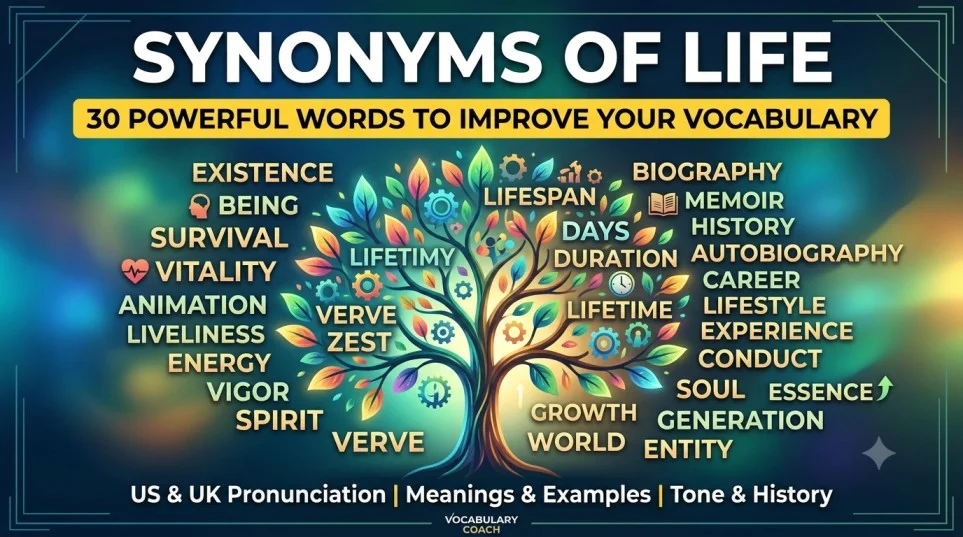
You will also discover 30 powerful synonyms grouped by meaning, complete with examples, grammar, and origins written in simple English sentences.
Meaning of Life
Definition
Life (noun): The state of being alive, existing, or having physical and mental energy.
Examples
- Fresh water and clean air are essential for all human life.
- She moved to a new city to start a whole new life.
Connotative Meaning
(Connotation is the emotional feeling or idea that a word creates in your mind beyond its literal definition.)
- Positive tone: Represents growth, energy, hope, happiness, and fresh beginnings.
- Negative tone: Refers to struggles, hardship, or the limited time someone has before dying.
- Neutral tone: Simply states the biological condition of living rather than being dead or non-living.
Etymology
- Origin: Derived from the Proto-Germanic word *libam, which originally meant “to remain, stay, or continue living.”
- Old English (450–1100): Spelled as līf, meaning the condition of being alive or a person’s lifespan.
- Middle English (1100–1500): Evolved into lif or lyfe, expanding to describe personal conduct and daily existence.
- Modern English (1500–Present): Became standardized as life, covering biological, social, and spiritual meanings.
Pronunciation
- US: /laɪf/
- UK: /laɪf/
Syllables
- life (1 syllable)
Affixation Pattern of Life
- Root: life
- Prefix: None
- Suffix: None
- Word Formation:
- Lifelike (adjective): Looking or sounding realistic.
- Lifelong (adjective): Lasting for a person’s whole existence.
- Lifeless (adjective): Having no life or energy.
- Liven (verb): To make something more interesting or energetic.
- Lively (adverb / adjective): Full of life and movement.
A List of Best Synonyms of Life
1. Existence (Noun)
US IPA: /ɪɡˈzɪs.təns/ | UK IPA: /ɪɡˈzɪs.təns/
Meaning: The state of living or being real.
Examples:
- Scientists study how water makes existence possible on other planets.
- He led a peaceful existence in a tiny cabin in the woods.
2. Being (Noun)
US IPA: /ˈbiː.ɪŋ/ | UK IPA: /ˈbiː.ɪŋ/
Meaning: The state of existing or a living creature.
Examples:
- Every living being needs food and water to survive.
- She felt a deep sense of peace in her whole being.
3. Survival (Noun)
US IPA: /sɚˈvaɪ.vəl/ | UK IPA: /səˈvaɪ.vəl/
Meaning: The state of continuing to live through danger or hardship.
Examples:
- Basic shelter is necessary for survival during harsh winter storms.
- Their main goal in the desert was pure survival.
4. Vitality (Noun)
US IPA: /vaɪˈtæl.ə.t̬i/ | UK IPA: /vaɪˈtæl.ə.ti/
Meaning: Great energy, physical strength, and health.
Examples:
- Regular exercise helps maintain your youth and vitality.
- The toddler was full of health and vitality.
5. Animation (Noun)
US IPA: /ˌæn.əˈmeɪ.ʃən/ | UK IPA: /ˌæn.ɪˈmeɪ.ʃən/
Meaning: The state of being lively, active, and full of spirit.
Examples:
- Her face filled with animation as she talked about her passion.
- The quiet room suddenly burst into animation.
6. Liveliness (Noun)
US IPA: /ˈlaɪv.li.nəs/ | UK IPA: /ˈlaɪv.li.nəs/
Meaning: Energy, enthusiasm, and active movement.
Examples:
- The music brought a sense of liveliness to the party.
- We loved the liveliness of the busy city streets.
7. Energy (Noun)
US IPA: /ˈen.ɚ.dʒi/ | UK IPA: /ˈen.ə.dʒi/
Meaning: The power and strength to stay active and perform work.
Examples:
- Sleeping well gives you the energy to work efficiently.
- Children usually have unlimited physical energy.
8. Vigor (Noun)
US IPA: /ˈvɪɡ.ɚ/ | UK IPA: /ˈvɪɡ.ə/
Meaning: Strong active effort, physical force, or mental health.
Examples:
- She completed the gardening task with great vigor.
- He spoke with vigor to convince the audience.
9. Spirit (Noun)
US IPA: /ˈspɪr.ət/ | UK IPA: /ˈspɪr.ɪt/
Meaning: The dynamic force, mood, or inner character of a living thing.
Examples:
- The team played with a strong competitive spirit.
- Her cheerful spirit made everyone feel welcome.
10. Verve (Noun)
US IPA: /vɝːv/ | UK IPA: /vɜːv/
Meaning: Great vigor, enthusiasm, and artful energy.
Examples:
- The actor performed his role with amazing verve.
- The painter captured the scene with color and verve.
11. Zest (Noun)
US IPA: /zest/ | UK IPA: /zest/
Meaning: Eager enjoyment, excitement, and enthusiasm.
Examples:
- She approaches every new adventure with incredible zest.
- He lost his zest for work after working long hours without rest.
12. Lifespan (Noun)
US IPA: /ˈlaɪf.spæn/ | UK IPA: /ˈlaɪf.spæn/
Meaning: The total length of time that a person or animal lives.
Examples:
- Modern medicine has lengthened the human lifespan.
- House cats usually have a longer lifespan than wild cats.
13. Lifetime (Noun)
US IPA: /ˈlaɪf.taɪm/ | UK IPA: /ˈlaɪf.taɪm/
Meaning: The duration of a person’s entire existence.
Examples:
- Traveling around the world was the dream of a lifetime.
- Technology has changed drastically during my lifetime.
14. Days (Noun)
US IPA: /deɪz/ | UK IPA: /deɪz/
Meaning: A person’s period of existence or time spent alive.
Examples:
- He spent his final days resting by the quiet beach.
- In her younger days, she traveled across Europe by train.
15. Duration (Noun)
US IPA: /dʊˈreɪ.ʃən/ | UK IPA: /djʊˈreɪ.ʃən/
Meaning: The length of time that something continues or lasts.
Examples:
- The duration of human existence is short compared to planet Earth.
- You must stay focused for the whole duration of the event.
16. Continuum (Noun)
US IPA: /kənˈtɪn.ju.əm/ | UK IPA: /kənˈtɪn.ju.əm/
Meaning: A continuous sequence or ongoing progression over time.
Examples:
- Human growth happens along a steady biological continuum.
- We view history as an uninterrupted continuum of events.
17. Biography (Noun)
US IPA: /baɪˈɑː.ɡrə.fi/ | UK IPA: /baɪˈɒɡ.rə.fi/
Meaning: A written story detailing the events of a person’s life.
Examples:
- I read an inspiring biography about a famous inventor.
- The writer spent two years researching the leader’s biography.
18. Memoir (Noun)
US IPA: /ˈmem.wɑːr/ | UK IPA: /ˈmem.wɑː/
Meaning: A written record of personal experiences and memories.
Examples:
- She published a moving memoir about growing up in a small village.
- His memoir detailed his time working as a diplomat.
19. History (Noun)
US IPA: /ˈhɪs.t̬ɚ.i/ | UK IPA: /ˈhɪs.tr̩.i/
Meaning: The record of past events and experiences of a person or group.
Examples:
- The old family home was filled with a long and rich history.
- She wanted to document the medical history of her patients.
20. Autobiography (Noun)
US IPA: /ˌɑː.t̬ə.baɪˈɑː.ɡrə.fi/ | UK IPA: /ˌɔː.tə.baɪˈɒɡ.rə.fi/
Meaning: The story of a person’s life written entirely by that person.
Examples:
- The athlete wrote an autobiography after retiring from sport.
- Her autobiography became a popular bestseller nationwide.
21. Career (Noun)
US IPA: /kəˈrɪr/ | UK IPA: /kəˈrɪər/
Meaning: The series of jobs or professional activities that make up work life.
Examples:
- She dedicated her professional career to teaching children.
- Choosing a satisfying career takes time and reflection.
22. Lifestyle (Noun)
US IPA: /ˈlaɪf.staɪl/ | UK IPA: /ˈlaɪf.staɪl/
Meaning: The particular way in which a person or group chooses to live.
Examples:
- Eating whole foods supports a healthy lifestyle.
- Moving to the countryside brought a much calmer lifestyle.
23. Experience (Noun)
US IPA: /ɪkˈspɪr.i.əns/ | UK IPA: /ɪkˈspɪə.ri.əns/
Meaning: Knowledge or wisdom gained through living through actual events.
Examples:
- Travel provides valuable personal experience and insight.
- Living abroad was a eye-opening experience for the student.
24. Conduct (Noun)
US IPA: /ˈkɑːn.dʌkt/ | UK IPA: /ˈkɒn.dʌkt/
Meaning: The way a person behaves in daily interactions and routine.
Examples:
- Good moral conduct builds strong relationships with others.
- His personal conduct earned him respect from colleagues.
25. Soul (Noun)
US IPA: /soʊl/ | UK IPA: /səʊl/
Meaning: The spiritual, emotional, or vital principle of a human being.
Examples:
- Music brings comfort directly to the human soul.
- She put her heart and soul into her work.
26. Essence (Noun)
US IPA: /ˈes.əns/ | UK IPA: /ˈes.əns/
Meaning: The basic, fundamental nature or quality of something.
Examples:
- Kindness is the true essence of good friendship.
- Freedom of expression is the essence of democratic societies.
27. Growth (Noun)
US IPA: /ɡroʊθ/ | UK IPA: /ɡrəʊθ/
Meaning: The process of developing, maturing, or increasing in capacity.
Examples:
- Reading regularly encourages rapid personal growth.
- Sunlight and water are essential for plant growth.
28. Generation (Noun)
US IPA: /ˌdʒen.əˈreɪ.ʃən/ | UK IPA: /ˌdʒen.əˈreɪ.ʃən/
Meaning: All the people born and living at about the same time.
Examples:
- Every new generation brings fresh ideas and solutions.
- The story was passed down from one generation to the next.
29. World (Noun)
US IPA: /wɝːld/ | UK IPA: /wɜːld/
Meaning: The sphere of human environment, activities, and experiences.
Examples:
- Starting school opens up a broad new world for children.
- She felt as though her whole world had suddenly changed.
30. Entity (Noun)
US IPA: /ˈen.t̬ə.t̬i/ | UK IPA: /ˈen.tə.ti/
Meaning: Something that has a real, distinct, and independent existence.
Examples:
- A single cell is a living entity capable of survival.
- The organization operated as a separate legal entity.
Prototype Meaning
The prototype meaning of life is the biological state of being a living organism rather than a non-living object or dead matter. When people hear this word, they usually picture a human heart beating, breathing fresh air, growing, moving, and experiencing feelings. It represents the active physical condition that separates humans, animals, and plants from rocks, water, and machines.
Prototype Categorization
Categorizing synonyms makes it much easier for writers to select the precise word for their specific context:
- Energy and Vitality: Vitality, energy, vigor, verve, zest, spirit, liveliness, animation.
- (Use these words when describing excitement, enthusiasm, physical strength, or high activity levels.)
- Time and Duration: Lifespan, lifetime, duration, days, continuum.
- (Use these words when referring to the passage of time or the temporal length of existence.)
- Biological Existence: Existence, being, survival, entity, growth.
- (Use these words when talking about physical reality, biology, or staying alive.)
- Personal Experience and Daily Living: Lifestyle, experience, conduct, world, career.
- (Use these words when focusing on personal routines, habits, choices, and human activities.)
- Written Records and Stories: Biography, autobiography, memoir, history.
- (Use these words when discussing documented life stories, personal accounts, or historical records.)
Antonyms of Life
- Death (noun): The permanent end of all biological functions that sustain a living organism.
- Nonexistence (noun): The state of not being real or not existing anywhere.
- Inactivity (noun): A state of doing nothing, lacking motion, or lacking physical energy.
- Apathy (noun): A complete lack of feeling, interest, enthusiasm, or emotional investment.
- Extinction (noun): The complete dying out or disappearance of a species or group.
Short Questions and Answers
- What does “life” mean?
- It means the state of being alive, existing, having physical energy, and experiencing the world.
- When should “life” be used?
- Use it when talking about biology, human health, individual personal experiences, or daily routines.
- Is “life” positive or negative?
- It is mostly positive because it connects to growth and energy, but it can be neutral in scientific contexts or negative when discussing life’s hardships.
- How is it different from similar words?
- “Life” is the general overarching term, whereas “existence” focuses strictly on being real, “vitality” emphasizes energy, and “lifestyle” focuses on daily habits.
CONCLUSION
Learning the word life alongside its many synonyms helps expand your vocabulary, refine your tone, and improve both your spoken and written English. By choosing precise terms like vitality, existence, or lifestyle, you avoid repeating the same basic words, making your content more dynamic and enjoyable to read. Content writers, students, and ESL learners can build confidence by practicing these words in daily conversations and journal entries. Make it a habit to practice new vocabulary every day to make your English sound natural, polished, and expressive!

I am a linguist with 7 years of experience in English language teaching, including postgraduate-level instruction. My expertise includes English grammar, and I contribute as a content and blog writer, producing scholarly and educational language resources.