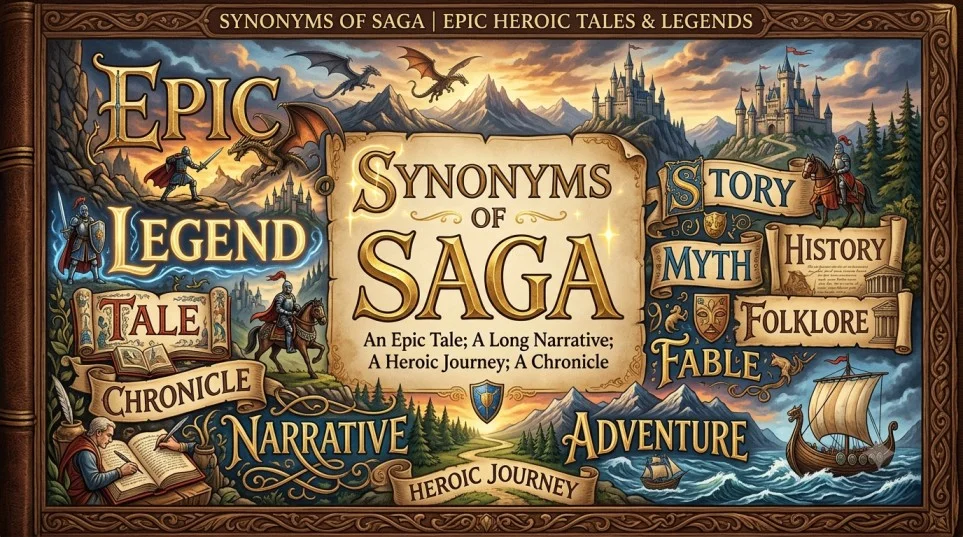
Imagine you are watching a movie series about a family over four generations. It has battles, heartbreak, dynamic adventures, and ultimate triumph. You want to tell your friend about this massive, long story. You could just call it a long tale, but calling it a “saga” instantly paints a bigger picture. The word saga describes a long, dramatic narrative that unfolds over time.
People often use it to talk about epic books, multi-generational family histories, or even long personal struggles. Learning synonyms for saga is crucial for English learners and SEO writers alike. Expanding your vocabulary stops you from repeating the same words, sharpens your expression, and keeps your readers engaged.
This detailed guide covers the origin, grammar, pronunciation, and categories of saga, followed by 30 useful synonyms with clear examples to level up your English skills.
Meaning of Saga
Definition
- Saga (Noun): A long, detailed story that covers a continuous series of events or heroic adventures over time.
Examples
- The fantasy saga spanned six novels and captured the imagination of readers worldwide.
- Dealing with the local permit office turned into a frustrating, months-long saga.
Connotative Meaning
- Positive tone: Represents grand human achievements, inspiring bravery, and grand historical adventures.
- Negative tone: Refers to an overly long, tiresome, or chaotic sequence of personal troubles and delays.
- Neutral tone: Simply describes a long book, movie series, or historical record spanning many years.
(Connotation refers to the emotional feeling or hidden idea that a word suggests beyond its direct dictionary definition.)
Etymology
- Source Language: Old Norse (saga), derived from Proto-Germanic (\x2asagō), meaning “what is said” or “a story”.
Short History
- Old English (450–1100): The word was not present in Old English, though related Germanic terms existed for speech and tales.
- Middle English (1100–1500): The word remained in Scandinavian languages and was not yet widely used in written English.
- Modern English (1500–Present): Borrowed into English during the 18th century to describe medieval Icelandic prose tales, later expanding to cover any long, dramatic story.
Pronunciation
- US: /ˈsɑːɡə/
- UK: /ˈsɑːɡə/
Syllables
- sa-ga
Affixation Pattern of Saga
- Root: Saga
- Prefix: None
- Suffix: None
Word Formation
- Saga (Noun): The core narrative form (e.g., “a multi-part saga”).
- Sagas (Noun, Plural): Multiple long stories.
- Saga-like (Adjective): Resembling an epic narrative (e.g., “a saga-like journey”).
A list of Hit List Synonyms of Saga
1. Epic (Noun)
- US IPA: /ˈɛpɪk/ | UK IPA: /ˈɛpɪk/
- Meaning: A long poem, book, or film telling the deeds of legendary heroes or great events.
- Examples:
- Homer wrote a classic epic about ancient wars and heroes.
- The director spent five years filming his historical cinematic epic.
2. Tale (Noun)
- US IPA: /teɪl/ | UK IPA: /teɪl/
- Meaning: A short or simple story, often containing imaginary or exciting events.
- Examples:
- My grandfather loved to tell us a whimsical tale before bed.
- The book contains an adventurous tale of sea sailors.
3. Chronicle (Noun)
- US IPA: /ˈkrɑːnɪkl̩/ | UK IPA: /ˈkrɒnɪkl̩/
- Meaning: A written record of historical events listed in the order they happened.
- Examples:
- The museum preserved an ancient chronicle of the royal empire.
- Her diary serves as a personal chronicle of the war years.
4. Narrative (Noun)
- US IPA: /ˈnærətɪv/ | UK IPA: /ˈnærətɪv/
- Meaning: A spoken or written account of connected events; a story.
- Examples:
- The author constructed a compelling narrative about small-town life.
- His personal narrative inspired many young readers.
5. Legend (Noun)
- US IPA: /ˈlɛdʒənd/ | UK IPA: /ˈlɛdʒənd/
- Meaning: An old traditional story that may or may not be historically true.
- Examples:
- The local islanders passed down the legend of the hidden gold.
- King Arthur remains one of the most famous figures in British legend.
6. Account (Noun)
- US IPA: /əˈkaʊnt/ | UK IPA: /əˈkaʊnt/
- Meaning: A report or description of an event or experience.
- Examples:
- She provided a clear eyewitness account of the accident.
- The newspaper published a detailed account of the expedition.
7. Yarny (Noun / Informational Variant: Yarn) (Noun)
- US IPA: /jɑːrn/ | UK IPA: /jɑːn/
- Meaning: A long, exciting story that is often exaggerated or hard to believe.
- Examples:
- The old sailor spun an entertaining yarn about ocean monsters.
- Don’t believe everything he says; it is just a funny yarn.
8. Myth (Noun)
- US IPA: /mɪθ/ | UK IPA: /mɪθ/
- Meaning: An ancient story about gods or ancestors that explains natural events.
- Examples:
- Greek myth explains how the seasons change every year.
- The children listened to a scary myth around the campfire.
9. History (Noun)
- US IPA: /ˈhɪstəri/ | UK IPA: /ˈhɪstri/
- Meaning: A continuous, detailed account of past events involving a country, person, or subject.
- Examples:
- The professor wrote a complete history of early European trade.
- Our family has a rich history in agriculture.
10. Romance (Noun)
- US IPA: /roʊˈmæns/ | UK IPA: /rəʊˈmæns/
- Meaning: A medieval tale of chivalry and adventure, or a story centered on love.
- Examples:
- The medieval romance featured brave knights and perilous quests.
- She enjoys reading historical romance novels set in Victorian London.
11. Record (Noun)
- US IPA: /ˈrɛkərd/ | UK IPA: /ˈrɛkɔːd/
- Meaning: A written or stored document that preserves facts or events.
- Examples:
- The town hall holds a complete record of land sales.
- They kept an accurate written record of all meetings.
12. Relation (Noun)
- US IPA: /rɪˈleɪʃn̩/ | UK IPA: /rɪˈleɪʃn̩/
- Meaning: The act of telling or recounting a detailed story or series of events.
- Examples:
- Her simple relation of the events moved the entire court to tears.
- His travel books offer a vivid relation of life in remote desert regions.
13. Recital (Noun)
- US IPA: /rɪˈsaɪtl̩/ | UK IPA: /rɪˈsaɪtl̩/
- Meaning: A detailed performance or reading of facts and events.
- Examples:
- The lawyer gave a grim recital of all the evidence collected.
- We listened to her long recital of childhood memories.
14. Adventure (Noun)
- US IPA: /ədˈvɛntʃər/ | UK IPA: /ədˈvɛntʃə/
- Meaning: An exciting, unusual, or dangerous experience or story.
- Examples:
- Moving to a new country was a major adventure for the young family.
- The book outlines an amazing wilderness adventure.
15. Sequence (Noun)
- US IPA: /ˈsiːkwəns/ | UK IPA: /ˈsiːkwəns/
- Meaning: A series of related events or stories that happen in a particular order.
- Examples:
- A strange sequence of events led to the discovery of the painting.
- The film features a dramatic action sequence near the end.
16. Series (Noun)
- US IPA: /ˈsɪriːz/ | UK IPA: /ˈsɪəriːz/
- Meaning: A set of continuous books, programs, or stories about the same subject.
- Examples:
- The author published a best-selling fantasy series.
- They watched a documentary series about deep-sea creatures.
17. Fiction (Noun)
- US IPA: /ˈfɪkʃn̩/ | UK IPA: /ˈfɪkʃn̩/
- Meaning: Literature created from the imagination rather than fact.
- Examples:
- He prefers reading historical fiction over biography books.
- The story was pure fiction invented to amuse the readers.
18. Fable (Noun)
- US IPA: /ˈfeɪbl̩/ | UK IPA: /ˈfeɪbl̩/
- Meaning: A short story, typically with animals as characters, conveying a moral lesson.
- Examples:
- The classic fable of the tortoise and the hare teaches patience.
- Aesop wrote many timeless fable stories for children.
19. Folk Tale (Noun)
- US IPA: /ˈfoʊk teɪl/ | UK IPA: /ˈfəʊk teɪl/
- Meaning: A traditional story passed down through generations by word of mouth.
- Examples:
- The elder recited an ancient folk tale about the mountains.
- Every culture has its own traditional folk tale traditions.
20. Memoir (Noun)
- US IPA: /ˈmɛmwɑːr/ | UK IPA: /ˈmɛmwɑː/
- Meaning: A historical account or biography written from personal knowledge.
- Examples:
- The former president published a detailed memoir of his years in office.
- Her moving memoir describes growing up in rural Alaska.
21. Allegory (Noun)
- US IPA: /ˈælɪɡɔːri/ | UK IPA: /ˈælɪɡəri/
- Meaning: A story that can be interpreted to reveal a hidden moral or political meaning.
- Examples:
- The novel works as a clever political allegory about power.
- The film uses an imaginative allegory to address climate change.
22. Anecdote (Noun)
- US IPA: /ˈænɪkdoʊt/ | UK IPA: /ˈænɪkdəʊt/
- Meaning: A short, amusing story about a real incident or person.
- Examples:
- He shared a funny anecdote about his first day at work.
- The speech included a warm personal anecdote.
23. Log (Noun)
- US IPA: /lɔːɡ/ | UK IPA: /lɒɡ/
- Meaning: An official record of events, facts, or observations, especially on a ship or aircraft.
- Examples:
- The captain recorded every event in the ship’s daily log.
- Engineers check the system activity log to fix errors.
24. Report (Noun)
- US IPA: /rɪˈpɔːrt/ | UK IPA: /rɪˈpɔːt/
- Meaning: A detailed spoken or written account of an investigation or event.
- Examples:
- The journalist wrote a thorough news report on the incident.
- She presented the annual progress report to the board.
25. Parable (Noun)
- US IPA: /ˈpærəbl̩/ | UK IPA: /ˈpærəbl̩/
- Meaning: A simple story used to illustrate a moral or spiritual lesson.
- Examples:
- The teacher used a simple parable to explain honesty.
- Ancient texts often teach ethical ideas through parable stories.
26. Oral History (Noun)
- US IPA: /ˈɔːrəl ˈhɪstəri/ | UK IPA: /ˈɔːrəl ˈhɪstri/
- Meaning: Spoken memories and historical accounts collected from living people.
- Examples:
- The library collected the oral history of immigrant families.
- We listened to an oral history archive recorded in the 1950s.
27. Tragedy (Noun)
- US IPA: /ˈtrætʒədi/ | UK IPA: /ˈtrætʒədi/
- Meaning: A dramatic story dealing with tragic events and having an unhappy ending.
- Examples:
- Shakespeare wrote the famous tragedy of King Lear.
- The novel tells a heartbreaking tragedy of lost love.
28. Odyssey (Noun)
- US IPA: /ˈɑːdəsi/ | UK IPA: /ˈɒdɪsi/
- Meaning: A long, wandering, and eventful journey or dramatic tale.
- Examples:
- The traveler wrote a book about his two-year ocean odyssey.
- Her recovery journey was a painful personal odyssey.
29. Monograph (Noun)
- US IPA: /ˈmɑːnəɡræf/ | UK IPA: /ˈmɒnəɡrɑːf/
- Meaning: A detailed written study or story on a single, specialized subject.
- Examples:
- The historian published a monograph on medieval architecture.
- She spent months writing a research monograph.
30. Narrative Arc (Noun)
- US IPA: /ˈnærətɪv ɑːrk/ | UK IPA: /ˈnærətɪv ɑːk/
- Meaning: The chronological structure and path of a story from beginning to end.
- Examples:
- The movie has a clear narrative arc that satisfies the audience.
- Writers plan a strong narrative arc before drafting a long novel.
Prototype Meaning
The prototype meaning of saga is a grand, multi-generational story of heroic deeds, family struggles, and legendary historical events. When people hear the word saga, they typically picture an immense, sprawling adventure—like a medieval Viking conquest or a vast space opera film series—that spans across many years and involves complex character conflicts.
Prototype Categorization
Grouped into distinct functional categories:
- Literary Grandeur: Epic, Odyssey, Romance, Legend — Used when describing grand, extraordinary stories with dramatic scope.
- Factual & Historical Records: Chronicle, History, Record, Log, Monograph, Memoir, Account — Used when focusing on real events, order of occurrence, or documentation.
- General Narrative Types: Narrative, Story, Tale, Relation, Recital, Sequence, Series — Standard structural terms for general writing.
- Short & Symbolic Tales: Fable, Parable, Allegory, Myth, Folk Tale, Anecdote, Yarn — Used when the story carries moral lessons, cultural folklore, or brevity.
Categorizing these synonyms allows writers to select the precise word needed for their context—whether they are writing a factual news report or crafting a dramatic fantasy novel.
Antonyms of Saga
- Snippet (Noun): A tiny, brief, or incomplete piece of news or story.
- Brief (Noun): A concise, quick statement or summary without long details.
- Summary (Noun): A short statement giving main points rather than a long narrative.
- Excerpt (Noun): A small short passage taken from a larger book or story.
- Outline (Noun): A general plan or basic list containing key points without full depth.
Short Questions and Answers
- What does saga mean?
- A saga is a long, detailed story that describes heroic deeds, family histories, or extended personal struggles over time.
- When should saga be used?
- Use saga when referring to long book series, multi-part movies, complex real-life personal ordeals, or detailed historical accounts.
- Is saga positive or negative?
- It depends on the context; it can positively describe an epic masterpiece or negatively describe a long, frustrating real-life ordeal.
- How is it different from similar words?
- While a simple story can be short and brief, a saga specifically implies a long, dramatic, and continuous journey involving major events over time.
Conclusion
Mastering the word saga and its 30 synonyms expands your vocabulary and upgrades your overall communication skills. By choosing words like chronicle, odyssey, or narrative, you bring exact precision to your writing while avoiding tedious repetition. Whether you are crafting engaging blog posts, preparing academic essays, or simply speaking English in daily conversations, a rich vocabulary builds confidence and authority. Keep practicing these words in sentences every day to make your writing stand out.

I am a linguist with 7 years of experience in English language teaching, including postgraduate-level instruction. My expertise includes English grammar, and I contribute as a content and blog writer, producing scholarly and educational language resources.