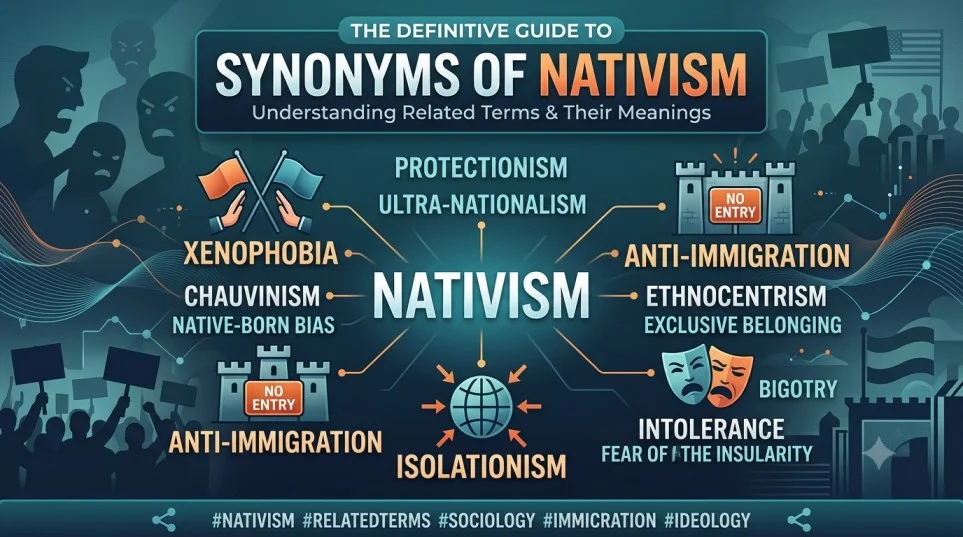
Nativism is a powerful word that plays a big role in political debates and social discussions. Imagine a community where long-time residents feel anxious about new immigrants moving into their town. They start pushing for policy changes that protect native-born citizens above everyone else. That belief system is called nativism.
It is commonly used today when talking about border laws, elections, and national identity. For English learners and content writers, learning synonyms for this word is essential. Using the same term repeatedly makes writing dull and repetitive. Knowing related terms helps you express subtle shades of meaning, match the right tone, and build stronger content.
You will learn their exact definitions, natural example sentences, grammar notes, historical origins, and accurate pronunciations. We also group these terms into simple semantic categories to make choosing the right word effortless.
Meaning of Nativism
Definition
Nativism (Noun): The political policy or attitude of promoting the interests of native-born inhabitants over those of immigrants.
Examples
- The political candidate gained support by appealing to strong feelings of nativism.
- Critics argued that the new border policy was driven by economic fear and nativism.
Connotative Meaning
(Connotation is the emotional feeling or idea that a word suggests beyond its literal dictionary definition.)
- Positive tone: Rarely positive, though supporters may frame it as “protecting local culture” or “patriotism.”
- Negative tone: Frequently negative, as it is often linked to anti-immigrant prejudice, exclusion, and xenophobia.
- Neutral tone: Neutral when used in academic, sociological, or historical contexts to describe political movements without judgment.
Etymology
- Origin: Derived from the Latin word nativus, meaning “born” or “produced by nature.”
- Old English (450–1100): The word did not exist in Old English.
- Middle English (1100–1500): The root idea of “native” entered the language via Old French (naif or natif).
- Modern English (1500–Present): The term “nativism” emerged in the United States during the mid-19th century to describe anti-immigrant political movements like the “Know-Nothing” party.
Pronunciation (US & UK – IPA)
- US: /ˈneɪ.t̬ə.vɪ.zəm/
- UK: /ˈneɪ.tɪ.vɪ.zəm/
Syllables
na-tiv-ism
Affixation Pattern of Nativism
- Root: Native (from Latin nativus)
- Prefix: None
- Suffix: -ism (creates a noun meaning a belief, practice, or doctrine)
Word Family:
- Native (Noun / Adjective)
- Nativist (Noun / Adjective)
- Nativistically (Adverb)
- Nativistical (Adjective)
A List of Foremost Synonyms of Nativism
1. Nationalism (Noun)
- US: /ˈnæʃ.nə.lɪ.zəm/ | UK: /ˈnæʃ.nəl.ɪ.zəm/
- Meaning: Strong identification with and support for one’s own nation, often to the exclusion of other nations.
- Examples:
- Rising nationalism led to stricter trade boundaries between the two countries.
- The leader appealed to national pride and growing popular nationalism.
2. Isolationism (Noun)
- US: /ˌaɪ.səˈleɪ.ʃə.nɪ.zəm/ | UK: /ˌaɪ.səˈleɪ.ʃən.ɪ.zəm/
- Meaning: A policy of remaining apart from the political or economic affairs of other nations.
- Examples:
- The country entered a long period of diplomatic isolationism after the war.
- Critics warned that economic isolationism would harm international trade.
3. Xenophobia (Noun)
- US: /ˌzen.əˈfoʊ.bi.ə/ | UK: /ˌzen.əˈfəʊ.bi.ə/
- Meaning: Dislike of or prejudice against people from other countries.
- Examples:
- The new law was condemned by international groups for promoting xenophobia.
- Education programs were created to fight discrimination and xenophobia in urban centers.
4. Ethnocentrism (Noun)
- US: /ˌeθ.noʊˈsen.trɪ.zəm/ | UK: /ˌeθ.nəʊˈsen.trɪ.zəm/
- Meaning: The belief that one’s own cultural group is superior to all others.
- Examples:
- Deep-seated ethnocentrism made it difficult for the diplomats to reach a fair agreement.
- Studying anthropology helps students recognize and overcome personal ethnocentrism.
5. Protectionism (Noun)
- US: /prəˈtek.ʃə.nɪ.zəm/ | UK: /prəˈtek.ʃən.ɪ.zəm/
- Meaning: The economic policy of restricting imports from other countries through tariffs or quotas.
- Examples:
- Local manufacturers lobbied for commercial protectionism to save domestic manufacturing jobs.
- High tariffs on foreign steel were a clear example of state protectionism.
6. Localism (Noun)
- US: /ˈloʊ.kə.lɪ.zəm/ | UK: /ˈləʊ.kəl.ɪ.zəm/
- Meaning: Preference for one’s own local area, culture, or residents over outsiders.
- Examples:
- Strong regional localism caused residents to distrust businesses headquartered in the capital.
- The mayor praised localism as a way to support neighborhood stores.
7. Patriotism (Noun)
- US: /ˈpeɪ.tri.ə.tɪ.zəm/ | UK: /ˈpæt.ri.ə.tɪ.zəm/
- Meaning: Love for and devotion to one’s country.
- Examples:
- The national holiday was celebrated with displays of civic patriotism.
- True patriotism involves working to improve one’s nation for all citizens.
8. Chauvinism (Noun)
- US: /ˈʃoʊ.və.nɪ.zəm/ | UK: /ˈʃəʊ.vɪ.nɪ.zəm/
- Meaning: Exaggerated, aggressive, or fanatical patriotism and belief in superiority over others.
- Examples:
- Blind political chauvinism prevented the government from seeing its own foreign policy errors.
- The editorial criticized the growing cultural chauvinism in national news broadcasts.
9. Sectionalism (Noun)
- US: /ˈsek.ʃən.əl.ɪ.zəm/ | UK: /ˈsek.ʃən.əl.ɪ.zəm/
- Meaning: Undue concern for local or regional interests at the expense of the whole nation.
- Examples:
- Regional economic differences fueled growing sectionalism before the election.
- The political party struggled to unite its members due to severe internal sectionalism.
10. Provincialism (Noun)
- US: /prəˈvɪn.ʃəl.ɪ.zəm/ | UK: /prəˈvɪn.ʃəl.ɪ.zəm/
- Meaning: Narrowness of mind, interest, or outlook resulting from living in a specific region.
- Examples:
- Her broad travel experience helped her move beyond narrow cultural provincialism.
- The university aimed to challenge intellectual provincialism among its undergraduate students.
11. Insularity (Noun)
- US: /ˌɪn.səˈler.ə.t̬i/ | UK: /ˌɪn.sjʊˈlær.ə.ti/
- Meaning: Ignorance of or lack of interest in cultures, ideas, or peoples outside one’s own experience.
- Examples:
- Living on a remote island contributed to the town’s social insularity.
- The company suffered because its management suffered from corporate insularity.
12. Exclusivism (Noun)
- US: /ɪkˈskluː.sɪ.vɪ.zəm/ | UK: /ɪkˈskluː.sɪ.vɪ.zəm/
- Meaning: The practice of restricting access, rights, or privileges to a select group of people.
- Examples:
- Social exclusivism kept newcomers from joining the historic neighborhood council.
- The private club was criticized for its policy of economic exclusivism.
13. Narrow-mindedness (Noun)
- US: /ˌner.oʊˈmaɪn.dɪd.nəs/ | UK: /ˌnær.əʊˈmaɪn.dɪd.nəs/
- Meaning: Unwillingness to consider or accept different opinions, cultures, or ideas.
- Examples:
- Her narrow-mindedness made it impossible to have a balanced discussion on immigration.
- Education is one of the best tools for combatting cultural narrow-mindedness.
14. Parochialism (Noun)
- US: /pəˈroʊ.ki.ə.lɪ.zəm/ | UK: /pəˈrəʊ.ki.ə.lɪ.zəm/
- Meaning: A limited or narrow outlook focused only on small, local matters.
- Examples:
- Global environmental issues cannot be solved with diplomatic parochialism.
- The board urged the leadership team to abandon small-town parochialism.
15. Sectarianism (Noun)
- US: /sekˈter.i.ə.nɪ.zəm/ | UK: /sekˈteə.ri.ə.nɪ.zəm/
- Meaning: Excessive attachment to a particular sect, faction, or subgroup, often leading to conflict.
- Examples:
- The country suffered through years of bitter political and religious sectarianism.
- Community leaders worked hard to bridge divisions caused by local sectarianism.
16. Intolerance (Noun)
- US: /ɪnˈtɑː.lɚ.əns/ | UK: /ɪnˈtɒl.ər.əns/
- Meaning: Unwillingness to accept views, beliefs, or behaviors that differ from one’s own.
- Examples:
- The policy was condemned for spreading cultural intolerance across the province.
- Human rights organizations work continuously to combat racial intolerance.
17. Bigotry (Noun)
- US: /ˈbɪɡ.ə.tri/ | UK: /ˈbɪɡ.ə.tri/
- Meaning: Obstinate or unreasonable attachment to a belief, accompanied by prejudice against others.
- Examples:
- The legislation was designed to protect minority groups from open bigotry.
- We must stand united against all forms of social and racial bigotry.
18. Bias (Noun)
- US: /ˈbaɪ.əs/ | UK: /ˈbaɪ.əs/
- Meaning: Inclinaton or prejudice for or against one person or group, especially in an unfair way.
- Examples:
- The judge urged jurors to put aside personal bias when evaluating evidence.
- The survey showed a clear implicit bias against foreign products.
19. Prejudice (Noun)
- US: /ˈpredʒ.ə.dɪs/ | UK: /ˈpredʒ.ə.dɪs/
- Meaning: Preconceived opinion that is not based on reason or actual experience.
- Examples:
- New immigrants often face social prejudice when settling in unfamiliar towns.
- The campaign aims to dismantle systemic prejudice in hiring practices.
20. Tribalism (Noun)
- US: /ˈtraɪ.bə.lɪ.zəm/ | UK: /ˈtraɪ.bəl.ɪ.zəm/
- Meaning: Strong loyalty to one’s own social or political group above all others.
- Examples:
- Modern political discourse is increasingly driven by bitter party tribalism.
- Extreme political tribalism prevents lawmakers from finding common ground.
21. Segregationism (Noun)
- US: /ˌseɡ.rəˈɡeɪ.ʃən.ɪ.zəm/ | UK: /ˌseɡ.rɪˈɡeɪ.ʃən.ɪ.zəm/
- Meaning: Advocacy of the policy of keeping different racial, ethnic, or social groups apart.
- Examples:
- Civil rights leaders spent decades fighting against state-sanctioned segregationism.
- The legal system slowly dismantled old laws rooted in racial segregationism.
22. Isolation (Noun)
- US: /ˌaɪ.səˈleɪ.ʃən/ | UK: /ˌaɪ.səlˈeɪ.ʃən/
- Meaning: The state of being set apart or separated from other societies or people.
- Examples:
- Geographical isolation protected the local culture from outside influence for centuries.
- The government’s new trade stance risked diplomatic isolation on the world stage.
23. Anti-immigrant Sentiment (Noun)
- US: /ˌæn.t̬iˈɪm.ə.ɡrənt ˈsen.t̬ə.mənt/ | UK: /ˌæn.tiˈɪm.ɪ.ɡrənt ˈsen.tɪ.mənt/
- Meaning: Feelings or attitudes of hostility, opposition, or prejudice directed toward immigrants.
- Examples:
- Rising economic inflation contributed to a surge in anti-immigrant sentiment.
- Politicians used speeches to address public concerns without stoking anti-immigrant sentiment.
24. Traditionalism (Noun)
- US: /trəˈdɪʃ.ən.əl.ɪ.zəm/ | UK: /trəˈdɪʃ.ən.əl.ɪ.zəm/
- Meaning: Adherence to traditional beliefs or practices, resisting modern changes or outside influence.
- Examples:
- Cultural traditionalism helped preserve the regional dialect across generations.
- The policy reflected a strong traditionalism that favored long-standing community customs.
25. Conservatism (Noun)
- US: /kənˈsɝː.və.t̬ɪ.zəm/ | UK: /kənˈsɜː.və.tɪ.zəm/
- Meaning: Commitment to traditional values and ideas, often accompanied by opposition to rapid change.
- Examples:
- Fiscal conservatism governed the town council’s decision to cut municipal spending.
- Social conservatism remains a major force in the rural electoral districts.
26. Reactionism (Noun)
- US: /riˈæk.ʃə.nɪ.zəm/ | UK: /riˈæk.ʃən.ɪ.zəm/
- Meaning: Opposition to political or social progress, reform, or modernization.
- Examples:
- Political reactionism swept through the parliament following the rapid economic reform.
- The editorial criticized the party’s platform as pure political reactionism.
27. Autochthony (Noun)
- US: /ɔːˈtɑːk.θə.ni/ | UK: /ɔːˈtɒk.θə.ni/
- Meaning: The state of original or indigenous inhabitancy of a place; asserting primary rights of origin.
- Examples:
- Claims of historical autochthony were central to the community’s land rights debate.
- Anthropologists studied how ideas of autochthony influence local identity politics.
28. Native Supremacy (Noun)
- US: /ˈneɪ.t̬ɪv səˈprem.ə.si/ | UK: /ˈneɪ.tɪv səˈprem.ə.si/
- Meaning: The belief that native-born residents are inherently superior to immigrants or foreign citizens.
- Examples:
- Human rights groups spoke out firmly against rhetoric promoting native supremacy.
- Ideologies of native supremacy threaten social cohesion in diverse modern democracies.
29. Jingoism (Noun)
- US: /ˈdʒɪŋ.ɡoʊ.ɪ.zəm/ | UK: /ˈdʒɪŋ.ɡəʊ.ɪ.zəm/
- Meaning: Extreme, warlike patriotism characterized by aggressive foreign policy.
- Examples:
- Tabloid coverage during the boundary dispute degenerated into hostile jingoism.
- The president warned against falling into reckless media-driven jingoism.
30. Regionalism (Noun)
- US: /ˈriː.dʒən.əl.ɪ.zəm/ | UK: /ˈriː.dʒən.əl.ɪ.zəm/
- Meaning: Consciousness of and loyalty to a distinct geographic region rather than a central power.
- Examples:
- Economic disparities led to a resurgence of regionalism in northern provinces.
- The political party used regionalism to win elections in outlying areas.
Prototype Meaning
The prototype meaning of nativism centers on protecting the rights, culture, and economic interests of native-born citizens against foreign immigrants. When people hear this term, they usually visualize border restrictions, anti-immigration policies, and political movements that favor established locals while viewing new arrivals with suspicion or hostility.
Prototype Categorization
Categorizing synonyms helps writers choose the precise word for their specific context:
- Political & Policy Focus: Nationalism, Protectionism, Isolationism, Regionalism, Localism, Sectionalism.
- Social & Emotional Attitudes: Xenophobia, Anti-immigrant Sentiment, Intolerance, Bigotry, Prejudice, Bias.
- Cultural & Group Identity: Ethnocentrism, Tribalism, Sectarianism, Autochthony, Exclusivism, Traditionalism.
- Narrow Mindsets: Parochialism, Provincialism, Insularity, Narrow-mindedness, Chauvinism.
Categorizing these terms helps content writers choose the right word based on tone and context. For instance, use protectionism when discussing trade policy, but use xenophobia when addressing social prejudice.
Antonyms of Nativism
Antonyms of Nativism
- Globalism (Noun): The planning or operating of economic and political policies on a global, international scale.
- Internationalism (Noun): The principle or policy of encouraging cooperation and understanding among nations.
- Multiculturalism (Noun): The presence, acceptance, or support of several distinct cultural or ethnic groups within a society.
- Cosmopolitanism (Noun): The ideology that all human beings belong to a single, shared global community.
- Inclusivism (Noun): The practice or policy of including and accepting all people, regardless of background or origin.
- Open-border Policy (Noun): A policy allowing free movement of people between countries with minimal restrictions.
Short Questions and Answers
Short Questions and Answers
- What does nativism mean?
- Nativism is a political belief or social attitude that favors native-born inhabitants over foreign immigrants.
- When should nativism be used?
- Use nativism when writing about political movements, border laws, sociology, or debates regarding immigration and national identity.
- Is nativism positive or negative?
- It is generally used with a negative tone because it involves exclusion and prejudice toward immigrants, though it can be used neutrally in academic contexts.
- How is it different from similar words?
- Unlike general nationalism, which focuses on devotion to a nation, nativism specifically focuses on opposing foreign immigrants in favor of native-born citizens.
Conclusion
Mastering nativism and its related terms is a fantastic way to elevate your English fluency. Exploring these 30 synonyms gives you the tools to write with greater precision and variety. Expanding your vocabulary allows you to describe complex political, economic, and social ideas clearly while avoiding repetitive phrasing. Daily practice with new words builds your confidence in both spoken and written English, making your content far more engaging for readers worldwide.

I am a linguist with 7 years of experience in English language teaching, including postgraduate-level instruction. My expertise includes English grammar, and I contribute as a content and blog writer, producing scholarly and educational language resources.