Imagine you are launching a new brand of eco-friendly running shoes. To sell them successfully, you cannot just guess who will buy them. You need to know their age, where they live, and how much money they make. In business and writing, we call this data demographics. The word demographics is incredibly common today because it helps us group and understand people. For English learners and content writers, using the same word repeatedly makes writing dull.
Expanding your vocabulary with synonyms keeps your work fresh, sharp, and engaging. This comprehensive guide explores the core meaning of demographics alongside 30 powerful alternatives.
We will dive into their definitions, sentence examples, grammar rules, word histories, pronunciations, and category breakdowns using clear, simple sentences.
Meaning of Demographics
Definition
Demographics (Noun): The structural data and statistics that describe a specific human population or group.
Examples
- The company studied the local demographics before opening the new grocery store.
- Online advertisements can target specific demographics based on age and location.
Connotative Meaning
The word connotation refers to the emotional feeling or cultural coloring attached to a word rather than its strict dictionary definition.
- Positive tone: In business, it implies smart planning, precise targeting, and understanding a community’s unique needs.
- Negative tone: It can sometimes feel cold, clinical, or reductive, treating unique individual human beings as mere numbers on a spreadsheet.
- Neutral tone: In scientific and academic research, it serves as a purely factual label for statistical data points about a population.
Etymology
- Origin: The word comes from the Greek words demos (meaning “the people”) and graphia (meaning “writing or drawing”).
- Old English (450–1100): The word did not exist in this era, as Old English used Germanic roots to describe groups of people.
- Middle English (1100–1500): The component roots began entering the language via French, but the combined term was still absent.
- Modern English (1500–Present): The term emerged in the twentieth century as statistical sciences and modern marketing research grew.
Pronunciation
- US: /ˌdɛməˈɡræfɪks/
- UK: /ˌdɛməˈɡræfɪks/
Syllables
dem-o-graph-ics
Affixation Pattern of Demographics
- Root: Demo (people) and graph (write)
- Prefix: None
- Suffix: -ic (relating to) and -ics (study or body of facts)
- Demographic (Adjective): Relating to the structure of populations.
- Demographer (Noun): A scientist who studies population statistics.
- Demographically (Adverb): In a way that relates to population data.
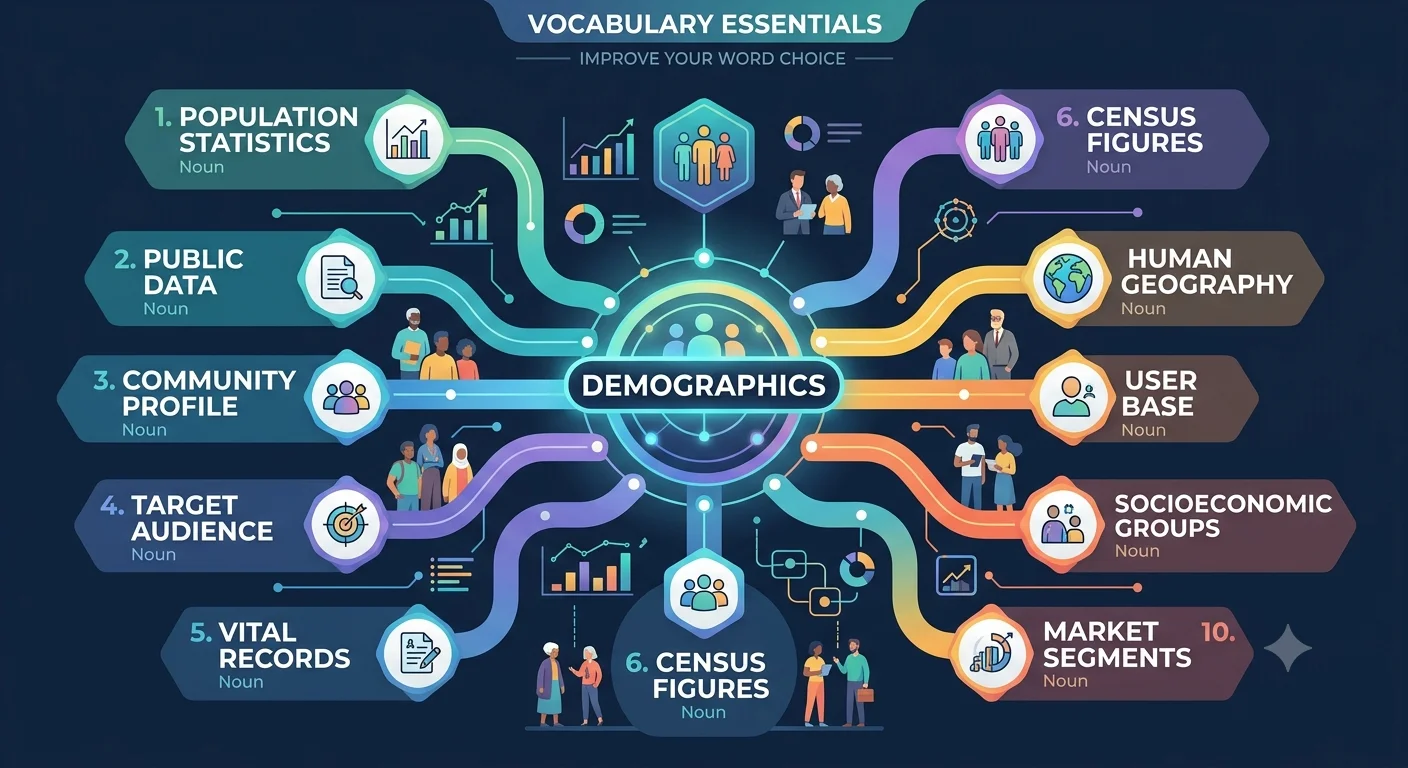
A List of 30 Best Synonyms of Demographics
1. Population Statistics (Noun)
US: /ˌpɑpjəˈleɪʃən stəˈtɪstɪks/ | UK: /ˌpɒpjʊˈleɪʃən stəˈtɪstɪks/
- Meaning: Numerical data that tracks the changes and traits of a human group.
- Examples:
- The government updated the population statistics after the latest national census.
- Researchers used population statistics to plan where to build the new hospital.
2. Vital Statistics (Noun)
US: /ˈvaɪtəl stəˈtɪstɪks/ | UK: /ˈvaɪtəl stəˈtɪstɪks/
- Meaning: Official records concerning births, marriages, divorces, and deaths within a public group.
- Examples:
- The city hall keeps vital statistics to track how fast the local community is growing.
- You can find historical vital statistics in the public library archives.
3. Population Data (Noun)
US: /ˌpɑpjəˈleɪʃən ˈdeɪtə/ | UK: /ˌpɒpjʊˈleɪʃən ˈdeɪtə/
- Meaning: Raw facts and figures collected about a group of people living in an area.
- Examples:
- The internet company analyzed population data to see where their app was most popular.
- Scientists rely on accurate population data to study global climate impacts.
4. Census Data (Noun)
US: /ˈsɛnsəs ˈdeɪtə/ | UK: /ˈsɛnsəs ˈdeɪtə/
- Meaning: Information gathered during an official, periodic survey of a country’s citizens.
- Examples:
- Every ten years, census data helps the state reallocate public funds fairly.
- The demographic chart was drawn entirely from recent census data.
5. Market Segments (Noun)
US: /ˈmɑrkət ˈsɛɡmənts/ | UK: /ˈmɑːkɪt ˈsɛɡmənts/
- Meaning: Distinct sub-groups of consumers separated by shared traits and buying habits.
- Examples:
- The marketing team divided the public into three distinct market segments.
- Luxury car brands target market segments that have high disposable income.
6. Audience Profile (Noun)
US: /ˈɑdiəns ˈproʊfaɪl/ | UK: /ˈɔːdiəns ˈprəʊfaɪl/
- Meaning: A detailed description of the typical people who watch, listen to, or buy something.
- Examples:
- The magazine altered its design to fit the changing audience profile.
- Knowing your audience profile makes it much easier to write good blog posts.
7. Customer Profile (Noun)
US: /ˈkʌstəmər ˈproʊfaɪl/ | UK: /ˈkʌstəmə ˈprəʊfaɪl/
- Meaning: A portrait of an ideal buyer based on their age, income, and interests.
- Examples:
- Our ideal customer profile shows a person who loves outdoor adventure sports.
- Creating a customer profile helps small businesses save money on ads.
8. Target Audience (Noun)
US: /ˈtɑrɡət ˈɑdiəns/ | UK: /ˈtɑːɡɪt ˈɔːdiəns/
- Meaning: The specific group of people that a program, book, or product aims to reach.
- Examples:
- Cartoons usually have a target audience of children under twelve years old.
- The director knew his target audience would love the complex sci-fi movie.
9. Target Market (Noun)
US: /ˈtɑrɡət ˈmɑrkət/ | UK: /ˈtɑːɡɪt ˈmɑːkɪt/
- Meaning: The particular group of consumers a company chooses to sell its goods to.
- Examples:
- College students are the main target market for this cheap meal delivery app.
- The boutique fashion shop changed its target market to professional women.
10. Public Metrics (Noun)
US: /ˈpʌblɪk ˈmɛtrɪks/ | UK: /ˈpʌblɪk ˈmɛtrɪks/
- Meaning: Measurable data points used to assess the traits of the general community.
- Examples:
- City planners study public metrics to see where traffic congestion happens most.
- The report highlighted public metrics related to literacy and employment rates.
11. Consumer Groups (Noun)
US: /kənˈsumər ɡrups/ | UK: /kənˈsjuːmə ɡruːps/
- Meaning: Classifications of buyers who share similar financial backgrounds or shopping needs.
- Examples:
- Different consumer groups prefer different types of mobile phone features.
- The company tests its new snacks on various consumer groups first.
12. Socioeconomic Status (Noun)
US: /ˌsoʊsioʊˌɛkəˈnɑmɪk ˈstætəs/ | UK: /ˌsəʊsɪəʊˌiːkəˈnɒmɪk ˈsteɪtəs/
- Meaning: An individual’s or group’s social position based on education, job, and income.
- Examples:
- Researchers found a strong link between socioeconomic status and overall health.
- The school offers extra resources to families from a lower socioeconomic status.
13. Group Traits (Noun)
US: /ɡrup treɪts/ | UK: /ruːp treɪts/
- Meaning: The distinguishing qualities or characteristics shared by members of a collective.
- Examples:
- Generational groups often exhibit distinct group traits regarding technology use.
- The sociologist mapped out the group traits of the nomadic tribe.
14. Human Geography (Noun)
US: /ˈhjumən ʤiˈɑɡrəfi/ | UK: /ˈhjuːmən ʤɪˈɒɡrəfi/
- Meaning: The study of how human populations spread, live, and interact across the earth.
- Examples:
- Human geography classes explain why big cities usually grow near major rivers.
- Her research in human geography looks at modern migration patterns in Europe.
15. Social Strata (Noun)
US: /ˈsoʊʃəl ˈstrætə/ | UK: /ˈsəʊʃəl ˈstrɑːtə/
- Meaning: The hierarchical layers or levels into which a society is divided.
- Examples:
- The tax cuts benefited some social strata much more than others.
- Individuals from all social strata attended the historic community festival.
16. Sector Breakdown (Noun)
US: /ˈsɛktər ˈbreɪkˌdaʊn/ | UK: /ˈsɛktə ˈbreɪkˌdaʊn/
- Meaning: An analysis that divides a population or market into smaller parts.
- Examples:
- The economic sector breakdown shows a sharp rise in tech workers.
- Look at this sector breakdown to see which age bracket buys the most books.
17. User Base (Noun)
US: /ˈjuzər beɪs/ | UK: /ˈjuːzə beɪs/
- Meaning: The total collection of people who regularly use a specific product or service.
- Examples:
- The video game app expanded its user base by launching an updates page.
- Most of our user base consists of teenagers who enjoy digital art.
18. Age Groups (Noun)
US: /eɪʤ ɡrups/ | UK: /eɪʤ ruːps/
- Meaning: Categories that cluster people together based on their specific span of years.
- Examples:
- The health survey compared fitness levels across five distinct age groups.
- Voting habits differ wildly when you compare younger and older age groups.
19. Social Classes (Noun)
US: /ˈsoʊʃəl ˈklæsəz/ | UK: /ˈsəʊʃəl ˈklɑːsɪz/
- Meaning: Divisions of society based on economic wealth, prestige, and cultural influence.
- Examples:
- Historically, different social classes rarely mingled at public events.
- The novel explores the complex tension between various social classes.
20. Populace Traits (Noun)
US: /ˈpɑpjələs treɪts/ | UK: /ˈpɒpjʊləs treɪts/
- Meaning: The general physical, social, or economic characteristics of a public citizenry.
- Examples:
- The politician studied populace traits to craft a speech that felt personal.
- Shifting populace traits show that the island is becoming more multicultural.
21. Market Categories (Noun)
US: /ˈmɑrkət ˈkætəˌɡɔriz/ | UK: /ˈmɑːkɪt ˈkætɪɡəriz/
- Meaning: Classification systems used to sort buyers by their shared habits or assets.
- Examples:
- Software tools sort customers into market categories automatically.
- We need to define our market categories before launching the ad campaign.
22. Generational Groups (Noun)
US: /ˌʤɛnəˈreɪʃənəl ɡrups/ | UK: /ˌʤɛnəˈreɪʃənl ɡruːps/
- Meaning: Cohorts of people born and living during the same span of historic time.
- Examples:
- Marketers track how different generational groups react to social media trends.
- Workplace values can vary across different generational groups.
23. Community Makeup (Noun)
US: /kəˈmjunəti ˈmeɪkˌʌp/ | UK: /kəˈmjuːnɪti ˈmeɪkˌʌp/
- Meaning: The specific blend of cultures, ages, and backgrounds that form a neighborhood.
- Examples:
- The rapid influx of new families completely changed the community makeup.
- Local leaders want to preserve the diverse community makeup of the historic district.
24. Public Metrics Data (Noun)
US: /ˈpʌblɪk ˈmɛtrɪks ˈdeɪtə/ | UK: /ˈpʌblɪk ˈmɛtrɪks ˈdeɪtə/
- Meaning: Collected factual figures regarding the health, wealth, and size of a public group.
- Examples:
- The governor released the latest public metrics data on employment growth.
- Analysts comb through public metrics data to predict housing trends.
25. Consumer Base (Noun)
US: /kənˈsumər beɪs/ | UK: /kənˈsjuːmə beɪs/
- Meaning: The core group of regular customers who purchase a company’s goods.
- Examples:
- The coffee shop retains a loyal consumer base of local office workers.
- To grow its profits, the bookstore must attract a wider consumer base.
26. Statistical Groupings (Noun)
US: /stəˈtɪstɪkəl ˈɡrupɪŋz/ | UK: /stəˈtɪstɪkəl ˈɡruːpɪŋz/
- Meaning: Analytical clusters created by grouping people together based on shared numbers.
- Examples:
- The census report organized citizens into precise statistical groupings.
- Medical researchers use these statistical groupings to track wellness trends.
27. Vital Trends (Noun)
US: /ˈvaɪtəl trɛndz/ | UK: /ˈvaɪtəl trɛndz/
- Meaning: Shifting patterns observed in the birth, death, and growth rates of a populace.
- Examples:
- The government tracks vital trends to see if the nation is aging rapidly.
- Changing vital trends suggest that families are choosing to have fewer children.
28. Cohorts (Noun)
US: /ˈkoʊhɔrts/ | UK: /ˈkəʊhɔːts/
- Meaning: Groups of individuals who share a common statistical characteristic or experience over time.
- Examples:
- The study followed two cohorts of students from kindergarten through college.
- Birth cohorts from the nineteen-nineties show unique media consumption habits.
29. Demographic Segments (Noun)
US: /ˌdɛməˈɡræfɪk ˈsɛɡmənts/ | UK: /ˌdɛməˈɡræfɪk ˈsɛɡmənts/
- Meaning: Specific slices of a larger population divided by age, gender, or income.
- Examples:
- The luxury brand designs different products for distinct demographic segments.
- Advertisers can isolate demographic segments to minimize wasted spending.
30. Population Profile (Noun)
US: /ˌpɑpjəˈleɪʃən ˈproʊfaɪl/ | UK: /ˌpɒpjʊˈleɪʃən ˈprəʊfaɪl/
- Meaning: A summary display showing the structural composition of a specific community.
- Examples:
- The town’s population profile reveals a large number of retired citizens.
- Check the national population profile to see the ratio of urban to rural dwellers.
Prototype Meaning
The absolute typical meaning of demographics relates to basic statistical boxes like age, gender, income level, and geographic location. When people hear the word demographics, they immediately imagine charts, pie graphs, and census surveys filled with check-boxes. It conjures up the image of a business team staring at a whiteboard, trying to figure out how to sell a product to millennials, parents, or high earners by analyzing numbers.
Prototype Categorization
Grouping these synonyms helps writers select the perfect word for different contexts:
- Marketing & Business: Terms like target market, customer profile, market segments, user base, and consumer base work best when writing about selling products, business plans, or advertising strategies.
- Scientific & Academic Research: Terms like population statistics, census data, vital trends, cohorts, and statistical groupings fit academic papers, scientific journals, or formal data analysis reports.
- Sociological & Cultural Discussion: Terms like community makeup, social strata, generational groups, and human geography fit narrative essays, news articles, and discussions about culture and human behavior.
Categorization empowers writers to match their vocabulary choice directly to the setting, ensuring the tone feels natural and precise rather than forced.
Antonyms of Demographics
- Individual (Noun): A single human being considered apart from any group, collective, or statistical classification.
- Singularity (Noun): The state of being entirely unique, distinct, or separate from a broader crowd or population group.
- Anomalies (Noun): Data points or individuals that deviate completely from the expected group patterns or averages.
Short Questions and Answers
- What does demographics mean?
- It means the statistical data, figures, and traits that describe a specific group of human beings.
- When should demographics be used?
- Use it when you are discussing business marketing, census data, target audiences, or human population studies.
- Is demographics positive or negative?
- It is a neutral, scientific term, but it can feel cold if used to reduce unique human beings to mere numbers.
- How is it different from similar words?
- Demographics focuses strictly on measurable population statistics, while words like “culture” focus on shared beliefs and behaviors.
Conclusion
Mastering the word demographics and its 30 dynamic synonyms is a fantastic way to elevate your English vocabulary. By swapping repetitive terms for fresh alternatives like target audience, population data, or cohorts, you instantly make your writing more precise and professional. Expanding your word choices keeps readers interested and ensures your message lands perfectly, whether you are drafting a business proposal, a school essay, or an online article. Real fluency grows when you practice using these new terms in daily conversations and writing exercises. Try picking three synonyms from this list today and craft your own unique sentences to build lasting English confidence.

I am a linguist with 7 years of experience in English language teaching, including postgraduate-level instruction. My expertise includes English grammar, and I contribute as a content and blog writer, producing scholarly and educational language resources.