A rainforest is a thick forest that receives a large amount of rainfall every year. These forests are home to countless plants, animals, insects, and birds. Imagine walking through a green forest where tall trees touch the sky, colorful birds sing, and gentle rain falls almost every day. That is what many people picture when they hear the word rainforest.
The word is common in books, schools, travel, science, and environmental studies. Learning synonyms of rainforest helps English learners, students, writers, and bloggers avoid repeating the same word. It also improves speaking and writing skills. In this article, you will learn the meaning of rainforest, its pronunciation, history, grammar, connotation, word formation, and 30 useful synonyms with simple meanings and examples.
Meaning of Rainforest
Definition
Rainforest (Noun):
A large, dense forest that receives heavy rainfall and supports many kinds of plants and animals.
Examples
- The Amazon rainforest is home to thousands of animal species.
- Many scientists study plants found only in the rainforest.
Connotative Meaning
(Connotation means the emotional feeling or idea that a word suggests beyond its basic meaning.)
- Positive tone: Rich nature, beauty, life, biodiversity, fresh environment.
- Negative tone: Deforestation, danger, wild animals, disease, difficult travel.
- Neutral tone: A forest ecosystem with high rainfall.
Etymology
- Source language: English
- Rain comes from Old English regn, meaning “water falling from clouds.”
- Forest comes from Old French forest, meaning “woodland reserved for hunting.”
- Together, rainforest means a forest with heavy rainfall.
Short History
- Old English (450–1100): The word rain existed, but rainforest did not.
- Middle English (1100–1500): The word forest became common through French influence.
- Modern English (1500–Present): The compound word rainforest became widely used in the 19th and 20th centuries, especially in geography and environmental science.
Pronunciation (US & UK – IPA)
- US: /ˈreɪnˌfɔːrɪst/
- UK: /ˈreɪnˌfɒrɪst/
Syllables
rain-for-est
Affixation Pattern of Rainforest
- Root: rain + forest
- Prefix: None
- Suffix: None
Word Formation of Rainforest
- Rainforest (noun)
- Rainforests (plural noun)
- Rainforest-related (adjective)
- Rainforest conservation (noun phrase)
- Rainforest ecosystem (noun phrase)
- Rainforest habitat (noun phrase)
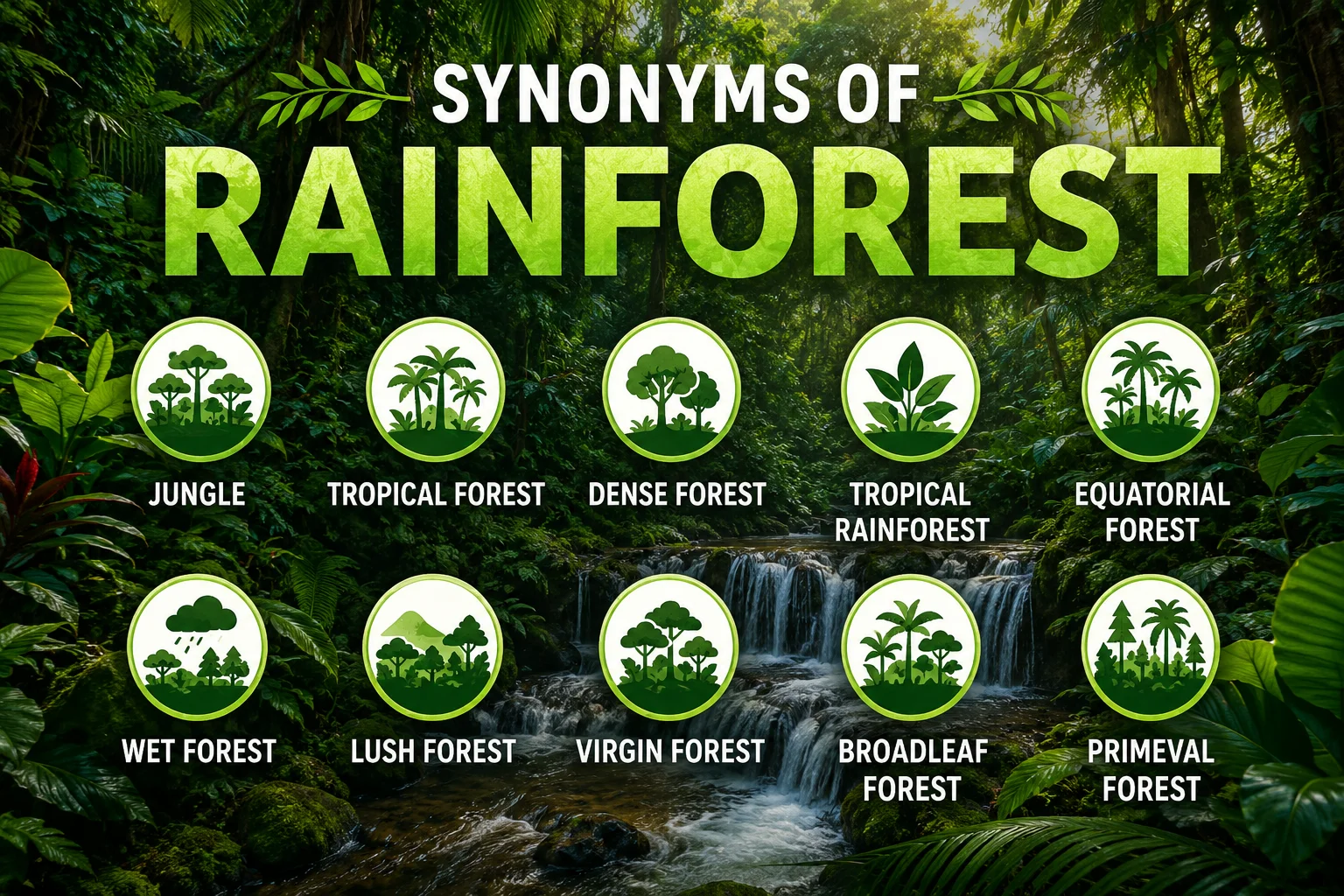
Synonyms of Rainforest
1. Tropical Forest (Noun)
US: /ˈtrɑːpɪkəl ˈfɔːrɪst/ | UK: /ˈtrɒpɪkəl ˈfɒrɪst/
Meaning: A warm forest found near the equator.
Examples
- Tropical forests contain many rare animals.
- We learned about tropical forests in science class.
2. Jungle (Noun)
US: /ˈdʒʌŋɡəl/ | UK: /ˈdʒʌŋɡəl/
Meaning: A thick forest with dense plants and trees.
Examples
- The explorers crossed a dangerous jungle.
- Tigers live in some Asian jungles.
3. Woodland (Noun)
US: /ˈwʊdlənd/ | UK: /ˈwʊdlənd/
Meaning: Land covered with many trees.
Examples
- The woodland is full of birds.
- Families enjoy walking through the woodland.
4. Forest (Noun)
US: /ˈfɔːrɪst/ | UK: /ˈfɒrɪst/
Meaning: A large area covered with trees.
Examples
- The forest looks beautiful in spring.
- Many animals depend on the forest.
5. Primeval Forest (Noun)
US: /praɪˈmiːvəl ˈfɔːrɪst/ | UK: /praɪˈmiːvəl ˈfɒrɪst/
Meaning: A very old forest that has remained mostly unchanged.
Examples
- Scientists protect primeval forests.
- The primeval forest has ancient trees.
6. Virgin Forest (Noun)
US: /ˈvɜːrdʒɪn ˈfɔːrɪst/ | UK: /ˈvɜːdʒɪn ˈfɒrɪst/
Meaning: A forest that has never been seriously damaged by humans.
Examples
- The area contains a virgin forest.
- Rare birds live in the virgin forest.
7. Old-Growth Forest (Noun)
US: /ˈoʊld ɡroʊθ ˈfɔːrɪst/ | UK: /ˈəʊld ɡrəʊθ ˈfɒrɪst/
Meaning: A mature forest with very old trees.
Examples
- Old-growth forests support rich wildlife.
- Logging threatens old-growth forests.
8. Evergreen Forest (Noun)
US: /ˈevərɡriːn ˈfɔːrɪst/ | UK: /ˈevəɡriːn ˈfɒrɪst/
Meaning: A forest where trees stay green all year.
Examples
- Evergreen forests remain green in every season.
- Birds nest in evergreen forests.
9. Tropical Woodland (Noun)
US: /ˈtrɑːpɪkəl ˈwʊdlənd/ | UK: /ˈtrɒpɪkəl ˈwʊdlənd/
Meaning: A warm woodland with tropical plants.
Examples
- Tropical woodland supports many insects.
- We studied tropical woodland habitats.
10. Dense Forest (Noun)
US: /dens ˈfɔːrɪst/ | UK: /dens ˈfɒrɪst/
Meaning: A forest with many closely growing trees.
Examples
- It was hard to walk through the dense forest.
- The dense forest blocked the sunlight.
11. Wet Forest (Noun)
US: /wet ˈfɔːrɪst/ | UK: /wet ˈfɒrɪst/
Meaning: A forest that receives abundant rainfall and stays moist throughout the year.
Examples
- The wet forest is rich in plant life.
- Many frogs live in the wet forest.
12. Cloud Forest (Noun)
US: /klaʊd ˈfɔːrɪst/ | UK: /klaʊd ˈfɒrɪst/
Meaning: A mountain forest that is often covered by clouds and mist.
Examples
- The cloud forest contains many orchids.
- We saw rare birds in the cloud forest.
13. Montane Rainforest (Noun)
US: /ˈmɑːnteɪn ˈreɪnˌfɔːrɪst/ | UK: /ˈmɒnteɪn ˈreɪnˌfɒrɪst/
Meaning: A rainforest that grows in mountainous regions.
Examples
- Montane rainforests have cool temperatures.
- Many unique plants grow in montane rainforests.
14. Broadleaf Forest (Noun)
US: /ˈbrɔːdliːf ˈfɔːrɪst/ | UK: /ˈbrɔːdliːf ˈfɒrɪst/
Meaning: A forest made up mainly of trees with wide leaves.
Examples
- The broadleaf forest provides food for wildlife.
- Broadleaf forests are important ecosystems.
15. Green Forest (Noun)
US: /ɡriːn ˈfɔːrɪst/ | UK: /ɡriːn ˈfɒrɪst/
Meaning: A healthy forest filled with lush green vegetation.
Examples
- The green forest looked beautiful after the rain.
- Animals found shelter in the green forest.
16. Wild Forest (Noun)
US: /waɪld ˈfɔːrɪst/ | UK: /waɪld ˈfɒrɪst/
Meaning: A natural forest that has little or no human development.
Examples
- The wild forest is home to many predators.
- They explored the wild forest carefully.
17. Natural Forest (Noun)
US: /ˈnætʃərəl ˈfɔːrɪst/ | UK: /ˈnætʃrəl ˈfɒrɪst/
Meaning: A forest that develops naturally without being planted by people.
Examples
- The natural forest supports many ecosystems.
- Conservation groups protect natural forests.
18. Primary Forest (Noun)
US: /ˈpraɪmeri ˈfɔːrɪst/ | UK: /ˈpraɪməri ˈfɒrɪst/
Meaning: An original forest that has not been significantly disturbed by humans.
Examples
- Primary forests store large amounts of carbon.
- Many endangered species live in primary forests.
19. Virgin Woodland (Noun)
US: /ˈvɜːrdʒɪn ˈwʊdlənd/ | UK: /ˈvɜːdʒɪn ˈwʊdlənd/
Meaning: Untouched woodland that remains in its natural condition.
Examples
- The virgin woodland has ancient trees.
- Scientists study wildlife in virgin woodland.
20. Wilderness Forest (Noun)
US: /ˈwɪldərnəs ˈfɔːrɪst/ | UK: /ˈwɪldənəs ˈfɒrɪst/
Meaning: A remote forest with very little human activity.
Examples
- The wilderness forest stretches for hundreds of miles.
- Campers enjoyed the peaceful wilderness forest.
21. Equatorial Forest (Noun)
US: /ˌekwəˈtɔːriəl ˈfɔːrɪst/ | UK: /ˌekwəˈtɔːriəl ˈfɒrɪst/
Meaning: A forest that grows near the Earth’s equator where rainfall is heavy all year.
Examples
- Equatorial forests have warm weather throughout the year.
- Many rare animals live in equatorial forests.
22. Tropical Rainforest (Noun)
US: /ˈtrɑːpɪkəl ˈreɪnˌfɔːrɪst/ | UK: /ˈtrɒpɪkəl ˈreɪnˌfɒrɪst/
Meaning: A rainforest found in tropical regions with high temperatures and heavy rainfall.
Examples
- The tropical rainforest contains thousands of plant species.
- Scientists study insects in the tropical rainforest.
23. Rain Jungle (Noun)
US: /reɪn ˈdʒʌŋɡəl/ | UK: /reɪn ˈdʒʌŋɡəl/
Meaning: A dense jungle that receives frequent rainfall.
Examples
- The rain jungle was filled with colorful birds.
- Travelers wore waterproof clothing in the rain jungle.
24. Tropical Wilderness (Noun)
US: /ˈtrɑːpɪkəl ˈwɪldərnəs/ | UK: /ˈtrɒpɪkəl ˈwɪldənəs/
Meaning: A wild tropical area covered with thick vegetation.
Examples
- The tropical wilderness is difficult to explore.
- Many endangered animals survive in the tropical wilderness.
25. Lush Forest (Noun)
US: /lʌʃ ˈfɔːrɪst/ | UK: /lʌʃ ˈfɒrɪst/
Meaning: A forest with rich, healthy, and abundant plant life.
Examples
- The lush forest looked fresh after the rain.
- Butterflies filled the lush forest.
26. Green Wilderness (Noun)
US: /ɡriːn ˈwɪldərnəs/ | UK: /ɡriːn ˈwɪldənəs/
Meaning: A large natural area covered with green vegetation.
Examples
- The green wilderness stretched beyond the hills.
- Nature lovers visited the green wilderness every year.
27. Forest Ecosystem (Noun)
US: /ˈfɔːrɪst ˈiːkoʊˌsɪstəm/ | UK: /ˈfɒrɪst ˈiːkəʊˌsɪstəm/
Meaning: A community of plants, animals, and microorganisms living together in a forest.
Examples
- Every forest ecosystem depends on clean water.
- Protecting the forest ecosystem helps wildlife.
28. Biodiverse Forest (Noun)
US: /ˌbaɪoʊdaɪˈvɜːrs ˈfɔːrɪst/ | UK: /ˌbaɪəʊdaɪˈvɜːs ˈfɒrɪst/
Meaning: A forest with a very high variety of living organisms.
Examples
- A biodiverse forest supports many species.
- Researchers studied the biodiverse forest for years.
29. Canopy Forest (Noun)
US: /ˈkænəpi ˈfɔːrɪst/ | UK: /ˈkænəpi ˈfɒrɪst/
Meaning: A forest with a thick layer of tree tops forming a canopy.
Examples
- Sunlight barely reached the ground in the canopy forest.
- Monkeys moved quickly through the canopy forest.
30. Woodland Jungle (Noun)
US: /ˈwʊdlənd ˈdʒʌŋɡəl/ | UK: /ˈwʊdlənd ˈdʒʌŋɡəl/
Meaning: A woodland area with thick tropical vegetation.
Examples
- The woodland jungle was alive with birds.
- Guides helped tourists explore the woodland jungle.
Prototype Meaning
When people hear the word rainforest, they usually imagine a large, green, tropical forest with tall trees, heavy rainfall, and rich wildlife. They often think of places like the Amazon, where monkeys swing through trees, colorful birds fly overhead, and thousands of plant and animal species live together. This is the most typical or prototype meaning of the word.
Prototype Categorization
Grouping synonyms into categories helps writers choose the most suitable word for different situations. Instead of repeating rainforest, you can select a synonym that better matches your topic.
- General Forest Terms: Forest, Woodland, Dense Forest, Green Forest
- Tropical Forest Types: Tropical Forest, Tropical Rainforest, Tropical Woodland, Equatorial Forest
- Ancient or Untouched Forests: Primeval Forest, Virgin Forest, Primary Forest, Old-Growth Forest, Virgin Woodland
- Mountain and Wet Forests: Cloud Forest, Montane Rainforest, Wet Forest
- Nature and Ecology Terms: Forest Ecosystem, Biodiverse Forest, Canopy Forest
- Wild Landscape Terms: Jungle, Rain Jungle, Wild Forest, Wilderness Forest, Tropical Wilderness, Green Wilderness
- Descriptive Forest Terms: Lush Forest, Evergreen Forest, Natural Forest, Broadleaf Forest, Woodland Jungle
Using these categories makes writing clearer and more precise. For example, a scientific article may use primary forest, while a travel blog may prefer lush forest or jungle.
Antonyms of Rainforest
- Desert (Noun): A dry area with very little rainfall and sparse vegetation.
- Grassland (Noun): A large open area covered mainly with grasses instead of trees.
- Savanna (Noun): A tropical grassland with scattered trees.
- Tundra (Noun): A cold, treeless region with frozen ground.
- Steppe (Noun): A dry plain covered with grasses and few trees.
- Barren Land (Noun): Land with little or no plant life.
- Wasteland (Noun): An area that is empty, dry, or unsuitable for most plants.
- Arid Region (Noun): A place with very low rainfall.
- Dry Woodland (Noun): Woodland that receives much less rain than a rainforest.
- Semi-desert (Noun): A region that is slightly wetter than a desert but still very dry.
Short Questions and Answers
- What does rainforest mean?
A rainforest is a large, dense forest that receives heavy rainfall throughout the year. It supports a wide variety of plants, animals, birds, insects, and other living organisms. - When should rainforest be used?
Use rainforest when talking about tropical forests, geography, environmental science, wildlife, climate, conservation, travel, or nature. It is the correct term for forests with high rainfall and rich biodiversity. - Is rainforest positive or negative?
The word rainforest is generally neutral. However, it often has a positive feeling because it represents natural beauty, biodiversity, and a healthy environment. In discussions about deforestation or climate change, it can appear in a negative context. - How is rainforest different from similar words?
Rainforest refers specifically to forests that receive heavy rainfall. A forest is a broader term for any large area of trees, while a jungle usually describes a thick, tangled tropical forest with dense undergrowth. Therefore, every rainforest is a forest, but not every forest is a rainforest.
Conclusion
Learning the word rainforest and its synonyms is an excellent way to build a stronger English vocabulary. Each synonym has a slightly different meaning and works best in different situations, whether you are writing about geography, wildlife, travel, or environmental conservation. Understanding pronunciation, history, grammar, connotation, and semantic categories helps you use these words with greater confidence. It also improves both speaking and writing by reducing repetition and making your sentences more natural and interesting. Make vocabulary practice a daily habit by learning a few new words each week and using them in conversations, essays, and creative writing. Over time, your English will become richer, clearer, and more expressive.

I am a linguist with 7 years of experience in English language teaching, including postgraduate-level instruction. My expertise includes English grammar, and I contribute as a content and blog writer, producing scholarly and educational language resources.