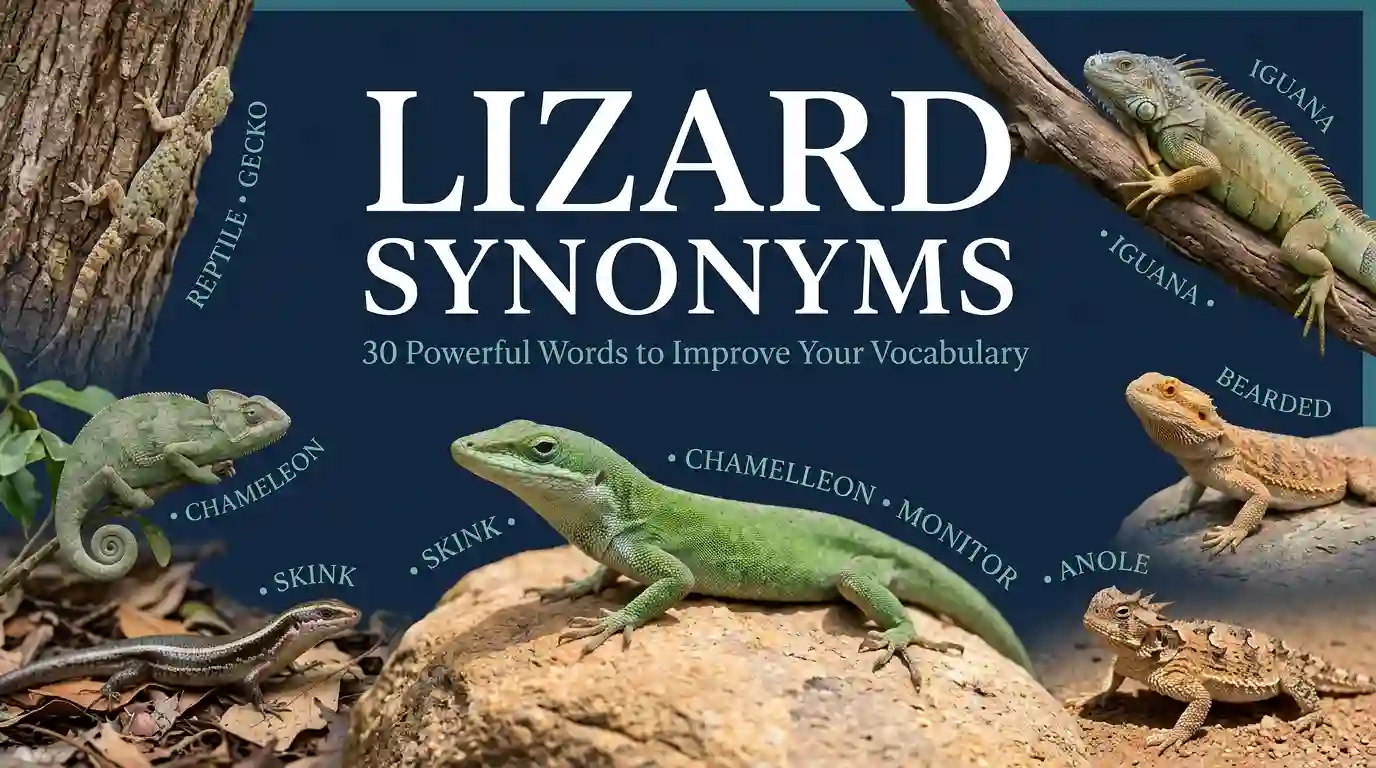
Lizard is a noun for a small to medium-sized reptile with four legs, a long body, a tail, and usually scaly skin. Common words related to lizard include reptile, gecko, iguana, skink, chameleon, monitor, anole, newt, salamander, and dragon. However, many of these are not exact synonyms of Lizard. They name specific kinds of reptiles or animals that may look similar to a lizard. The best word depends on the species and context.
| Synonym / Related Word | Meaning | Best Context |
| Reptile | A cold-blooded vertebrate with scales | General classification |
| Gecko | A small lizard with special feet | Specific lizard |
| Iguana | A large herbivorous lizard | Specific species group |
| Skink | A lizard with smooth, shiny scales | Specific lizard |
| Chameleon | A lizard known for changing color | Specific lizard |
| Monitor | A large, active lizard | Specific lizard |
| Anole | A small tree-dwelling lizard | Specific lizard |
| Agama | A lizard common in warm regions | Specific lizard |
| Basilisk | A long-legged tropical lizard | Specific lizard |
| Dragon | A common name for some large lizards | Informal / descriptive |
This article explains the meaning of lizard, its related terms, pronunciation, history, word formation, semantic categories, and 30 useful alternatives with examples.
Meaning of Lizard
Definition
Lizard (noun): A reptile with four legs, a long body and tail, and usually scaly skin.
Examples
- The lizard was sitting on the warm wall.
- A small lizard ran across the garden.
Connotative Meaning
Connotation (the feeling or idea that a word suggests beyond its basic meaning):
- Positive tone: A lizard may suggest adaptability, survival, speed, or harmless wildlife.
- Negative tone: Some people may associate lizards with fear, dirt, or unpleasantness.
- Neutral tone: In scientific or educational writing, lizard is usually a neutral term for an animal.
Etymology
- Source: The word lizard comes from Old French lesarde, from Latin lacerta, meaning “lizard.”
- English adopted the word through French after the Norman Conquest.
- The Latin word referred to a lizard or similar reptile.
Short History of the Keyword
Old English (450–1100): Old English had its own words for reptiles and related creatures, but the modern form lizard was not yet established in English.
Middle English (1100–1500): After the Norman Conquest, French influence introduced forms related to Old French lesarde into English. These forms gradually developed toward lizard.
Modern English (1500–Present): Lizard became the standard English name for this group of reptiles. Modern science later gave more precise names to different lizard families and species.
Pronunciation (US & UK – IPA)
US: /ˈlɪzərd/
UK: /ˈlɪzəd/
Syllables
liz-ard
Affixation Pattern of Lizard
Root: lizard
Prefix: None
Suffix: None in the modern English word
Word formation: Lizard is primarily used as a noun. The related forms include lizard-like (adjective), lizardfish (noun), and lizardry (noun, rare).
Synonyms of Lizard
The following words include close equivalents, specific lizard types, and semantically related terms. They are not all interchangeable with lizard. This distinction is important because using a species name as a general synonym can change the meaning.
1. Reptile (Noun)
US: /ˈrɛptaɪl/ | UK: /ˈrɛptaɪl/
Meaning: A vertebrate animal with scales or a similar body covering that belongs to the reptile group.
Examples:
- A lizard is a type of reptile.
- The museum has an exhibit about reptiles.
2. Gecko (Noun)
US: /ˈɡɛkoʊ/ | UK: /ˈɡɛkəʊ/
Meaning: A usually small lizard with broad feet and excellent climbing ability.
Examples:
- A gecko climbed the bedroom wall.
- We saw a tiny gecko near the window.
3. Iguana (Noun)
US: /ɪˈɡwɑːnə/ | UK: /ɪˈɡwɑːnə/
Meaning: A large lizard, often with a row of spines along its back.
Examples:
- The iguana rested on a branch.
- An iguana was eating leaves in the enclosure.
4. Skink (Noun)
US: /skɪŋk/ | UK: /skɪŋk/
Meaning: A lizard with smooth, shiny scales and a long body.
Examples:
- The skink disappeared under a rock.
- We found a blue-tailed skink in the garden.
5. Chameleon (Noun)
US: /kəˈmiːliən/ | UK: /kəˈmiːliən/
Meaning: A lizard known for its unusual eyes, grasping feet, and ability in some species to change color.
Examples:
- The chameleon moved slowly along the branch.
- A chameleon used its long tongue to catch an insect.
6. Monitor (Noun)
US: /ˈmɑːnɪtər/ | UK: /ˈmɒnɪtə/
Meaning: A large, active lizard belonging to the monitor-lizard group.
Examples:
- The monitor lizard moved quickly through the grass.
- A water monitor was swimming near the riverbank.
7. Anole (Noun)
US: /əˈnoʊli/ | UK: /əˈnəʊli/
Meaning: A small lizard, especially one commonly found in warm parts of the Americas.
Examples:
- An anole climbed the tree trunk.
- The green anole rested on a leaf.
8. Agama (Noun)
US: /əˈɡɑːmə/ | UK: /əˈɡɑːmə/
Meaning: A type of lizard found mainly in warm regions of Africa and Asia.
Examples:
- An agama sat on a sunny rock.
- The bright agama moved between the stones.
9. Basilisk (Noun)
US: /ˈbæsəlɪsk/ | UK: /ˈbæsəlɪsk/
Meaning: A tropical lizard known for its long legs and ability to move rapidly.
Examples:
- The basilisk ran along the edge of the stream.
- We watched a basilisk climb onto a branch.
10. Dragon (Noun)
US: /ˈdræɡən/ | UK: /ˈdræɡən/
Meaning: A common name used for some large or distinctive lizards.
Examples:
- The bearded dragon is a popular pet.
- The dragon lizard rested under a rock.
11. Skinklet (Noun)
US: /ˈskɪŋklət/ | UK: /ˈskɪŋklət/
Meaning: A small skink or a small lizard belonging to the skink group.
Examples:
- A tiny skinklet moved through the leaves.
- The skinklet hid beneath a piece of bark.
12. Lacertid (Noun)
US: /ˈlæsərtɪd/ | UK: /ˈlæsətɪd/
Meaning: A lizard belonging to the family Lacertidae.
Examples:
- The researcher identified the animal as a lacertid.
- A lacertid was moving across the sunny ground.
13. Lacerta (Noun)
US: /ləˈsɜːrtə/ | UK: /ləˈsɜːtə/
Meaning: A genus of lizards in the family Lacertidae.
Examples:
- The scientist recorded a Lacerta species.
- The Lacerta lizard was found in a rocky area.
14. Legless Lizard (Noun)
US: /ˈlɛɡləs ˈlɪzərd/ | UK: /ˈleɡləs ˈlɪzəd/
Meaning: A lizard that has lost or greatly reduced its limbs and looks similar to a snake.
Examples:
- The legless lizard looked like a small snake.
- A legless lizard moved through the grass.
15. Glass Lizard (Noun)
US: /ˈɡlæs ˈlɪzərd/ | UK: /ˈɡlɑːs ˈlɪzəd/
Meaning: A legless lizard known for its fragile tail, which can break off.
Examples:
- The glass lizard moved quickly through the field.
- We learned about the glass lizard in science class.
16. Wall Lizard (Noun)
US: /ˈwɔːl ˈlɪzərd/ | UK: /ˈwɔːl ˈlɪzəd/
Meaning: A small lizard that commonly lives on walls, rocks, and other sunny surfaces.
Examples:
- A wall lizard was sunning itself outside.
- The wall lizard quickly escaped into a crack.
17. Fence Lizard (Noun)
US: /ˈfɛns ˈlɪzərd/ | UK: /ˈfens ˈlɪzəd/
Meaning: A small lizard that often lives on fences, trees, rocks, and similar surfaces.
Examples:
- A fence lizard climbed onto the wooden post.
- The fence lizard remained still in the sunlight.
18. Spiny Lizard (Noun)
US: /ˈspaɪni ˈlɪzərd/ | UK: /ˈspaɪni ˈlɪzəd/
Meaning: A lizard with rough, pointed scales that give its body a spiny appearance.
Examples:
- The spiny lizard hid under a stone.
- We saw a spiny lizard near the trail.
19. Horned Lizard (Noun)
US: /ˈhɔːrnd ˈlɪzərd/ | UK: /ˈhɔːnd ˈlɪzəd/
Meaning: A lizard with horn-like projections on its head and a flattened body.
Examples:
- The horned lizard blended into the dry ground.
- A horned lizard moved slowly across the sand.
20. Girdled Lizard (Noun)
US: /ˈɡɜːrdəld ˈlɪzərd/ | UK: /ˈɡɜːdəld ˈlɪzəd/
Meaning: A lizard with strong scales or bands around its body.
Examples:
- The girdled lizard hid between rocks.
- The zoo keeps a girdled lizard in its reptile house.
21. Armadillo Lizard (Noun)
US: /ˌɑːrməˈdɪloʊ ˈlɪzərd/ | UK: /ˌɑːməˈdɪləʊ ˈlɪzəd/
Meaning: A small armored lizard that can curl its body into a protective position.
Examples:
- The armadillo lizard curled up when threatened.
- The armadillo lizard has a heavily protected body.
22. Alligator Lizard (Noun)
US: /ˈælɪɡeɪtər ˈlɪzərd/ | UK: /ˈælɪɡeɪtə ˈlɪzəd/
Meaning: A lizard with rough scales and an appearance that can resemble a small alligator.
Examples:
- An alligator lizard moved beneath the leaves.
- The child learned about the alligator lizard at school.
23. Basilisk Lizard (Noun)
US: /ˈbæsəlɪsk ˈlɪzərd/ | UK: /ˈbæsəlɪsk ˈlɪzəd/
Meaning: A tropical lizard famous for its ability to run rapidly across water for short distances.
Examples:
- The basilisk lizard ran across the stream.
- We watched a basilisk lizard near the water.
24. Flying Lizard (Noun)
US: /ˈflaɪɪŋ ˈlɪzərd/ | UK: /ˈflaɪɪŋ ˈlɪzəd/
Meaning: A lizard with skin flaps that allow it to glide between trees.
Examples:
- The flying lizard glided from one tree to another.
- A flying lizard disappeared into the forest.
25. Draco (Noun)
US: /ˈdreɪkoʊ/ | UK: /ˈdreɪkəʊ/
Meaning: A genus of small gliding lizards commonly called flying dragons.
Examples:
- The Draco moved from one branch to another.
- Scientists studied the Draco’s gliding ability.
26. Bearded Dragon (Noun)
US: /ˈbɪrdɪd ˈdræɡən/ | UK: /ˈbɪədɪd ˈdræɡən/
Meaning: A medium-sized Australian lizard with a spiny throat that resembles a beard.
Examples:
- The bearded dragon sat under its heat lamp.
- My friend keeps a bearded dragon as a pet.
27. Green Iguana (Noun)
US: /ɡriːn ɪˈɡwɑːnə/ | UK: /ɡriːn ɪˈɡwɑːnə/
Meaning: A large green iguana species that lives mainly in tropical parts of the Americas.
Examples:
- The green iguana climbed the tree.
- A green iguana was resting near the water.
28. Tree Lizard (Noun)
US: /ˈtriː ˈlɪzərd/ | UK: /ˈtriː ˈlɪzəd/
Meaning: A lizard that commonly spends much of its time in trees or shrubs.
Examples:
- The tree lizard climbed high into the branches.
- A tree lizard was hiding among the leaves.
29. Desert Lizard (Noun)
US: /ˈdɛzərt ˈlɪzərd/ | UK: /ˈdezət ˈlɪzəd/
Meaning: A lizard adapted to living in dry desert environments.
Examples:
- The desert lizard survived in the hot climate.
- A desert lizard disappeared into the sand.
30. Rock Lizard (Noun)
US: /ˈrɑːk ˈlɪzərd/ | UK: /ˈrɒk ˈlɪzəd/
Meaning: A lizard that commonly lives among rocks or on rocky surfaces.
Examples:
- The rock lizard rested on a warm stone.
- A rock lizard quickly moved between the rocks.
Prototype Meaning
The prototype meaning of lizard is a small or medium-sized four-legged reptile with a long body, tail, and scaly skin. When people hear lizard, they often imagine an animal sitting on a warm rock or wall, moving quickly when disturbed, and using its tail for balance.
Prototype Categorization
- General biological category: Reptile is the broadest term because lizards belong to the reptile group.
- Specific lizard groups: Gecko, skink, iguana, chameleon, anole, and monitor identify particular types of lizards.
- Appearance-based terms: Horned lizard, spiny lizard, and armadillo lizard describe lizards by their physical features.
- Habitat-based terms: Desert lizard, tree lizard, wall lizard, and rock lizard connect the animal with its usual environment.
- Descriptive common names: Flying lizard, glass lizard, and dragon highlight unusual features or appearance.
- Scientific terms: Lacertid and Lacerta are more suitable for scientific or technical contexts.
This categorization helps writers choose the best term instead of treating every related word as an exact replacement for lizard.
Antonyms of Lizard
There is no exact antonym for lizard because it is the name of an animal. However, words from contrasting biological or animal categories can be useful in comparisons.
- Mammal (noun): An animal that usually has hair or fur and feeds its young with milk.
- Bird (noun): A warm-blooded vertebrate with feathers, wings, and a beak.
- Amphibian (noun): A vertebrate that commonly lives part of its life in water and part on land.
- Fish (noun): An aquatic vertebrate that normally breathes through gills.
- Invertebrate (noun): An animal without a backbone.
Short Questions and Answers
- What does lizard mean?
A lizard is a four-legged reptile with a long body, tail, and usually scaly skin. - When should lizard be used?
Use lizard when you mean the animal in general or when the exact species is not important. - Is lizard positive or negative?
Lizard is normally neutral. Its emotional meaning depends on the speaker and context. - How is it different from similar words?
Reptile is broader, while gecko, iguana, skink, and chameleon refer to particular kinds of lizards. Therefore, these words are related to lizard but are not always exact synonyms.
Conclusion
Learning the synonyms of lizard can improve both everyday English and scientific vocabulary. The word lizard gives us a general name, while terms such as gecko, iguana, skink, chameleon, and monitor help us describe more specific animals. Learning these distinctions makes writing clearer and more accurate. Understanding pronunciation, connotation, word history, and semantic categories also helps learners use vocabulary with confidence.
Instead of repeating the same word, you can choose a more precise term when the context requires it. For example, reptile works well for a broad category, while gecko identifies a specific type of lizard. Practice these words in short sentences each day to strengthen your vocabulary, improve your speaking and writing, and build greater confidence in English.

Nighat Fatima is a linguist with an M.A. in Linguistics and an M.Ed. She has 7 years of experience teaching English language to postgraduate classes and 6 years of experience in content writing.