Have you ever read a newspaper article that felt like a warm, personal chat? Imagine you are sitting at a cozy coffee shop. You open the local paper. The main page has a story about building a new park. It does not just state the facts. Instead, the writer shares a strong opinion about why this park matters for our kids. That special, opinion-filled writing is what we call an editorial. This word is very common because we see it in news, school papers, and online blogs every single day.
Learning synonyms for this word is highly important for English learners and content writers who want to make their writing shine. When you use different words, your essays and articles become much more exciting to read. This helpful guide will teach you the meaning, history, grammar, and pronunciation of the word.
We will also explore 30 powerful synonyms divided into simple semantic categories with easy examples to boost your vocabulary.
Meaning of editorial
Definition
editorial (Noun):
An article in a newspaper, magazine, or website that expresses the official opinion of the editors or publishers.
editorial (Adjective):
Relating to the preparing, revising, or correcting of written material for publication.
Examples
- The newspaper published an editorial supporting the new green energy project.
- She got a new job on the editorial team of a famous fashion magazine.
Connotative Meaning
(Connotation is the emotional feeling or cultural meaning that a word carries beyond its simple dictionary definition.)
- Positive tone: When used to describe careful work, it suggests high quality, professional standards, and clear structure.
- Negative tone: In daily talk, if someone says a news report is “too editorial,” they mean it is biased, preachy, or lacks objective facts.
- Neutral tone: In the publishing industry, it simply refers to the tasks of writing, correcting, and preparing books or articles.
Etymology
- Origin: From the Latin word editor, which means “one who puts forth or publishes”. It combined with the suffix -al to form the adjective editorial in 1741, meaning “relating to an editor”. By 1830, American English speakers started using it as a noun to mean an opinion article.
- Old English (450–1100): The word did not exist in this era. People used Germanic words for “writing” or “news.”
- Middle English (1100–1500): The word was still absent. Writing was mostly hand-copied by scribes, and modern editing had not yet begun.
- Modern English (1500–Present): With the invention of the printing press, the role of the editor grew. The word editorial appeared in the 18th century as an adjective and became a common noun in the 19th century as newspapers multiplied.
Pronunciation (US & UK – IPA)
- US: /ˌed.əˈtɔːr.i.əl/
- UK: /ˌed.ɪˈtɔː.ri.əl/
Syllables
ed-i-to-ri-al (5 syllables)
Affixation Pattern of [editorial]
- Root: edit (Verb)
- Prefix: None
- Suffix: -orial (Adjective-forming suffix, variation of -ial)
- Word formation:
- Editor (Noun) – The person who edits.
- Editorialize (Verb) – To express an opinion in a factual report.
- Editorially (Adverb) – Done in an editorial manner.
- Editorship (Noun) – The position of being an editor.
A List of wonderful Synonyms of editorial
1. Commentary (Noun)
- US: /ˈkɑː.mən.ter.i/ | UK: /ˈkɒm.ən.tri/
- Meaning: A spoken or written explanation or set of opinions about a book, event, or situation.
- Examples:
- The blogger wrote a long commentary about the election.
- We listened to the live sports commentary on the radio.
2. Opinion (Noun)
- US: /əˈpɪn.jən/ | UK: /əˈpɪn.jən/
- Meaning: A belief or view about something that is not necessarily based on absolute facts.
- Examples:
- This opinion piece argues that schools should start later in the morning.
- She expressed her personal opinion on the state of the city parks.
3. Column (Noun)
- US: /ˈkɑː.ləm/ | UK: /ˈkɒl.əm/
- Meaning: A regular article in a newspaper or magazine that is written by a specific writer.
- Examples:
- I always read his weekly food column in the Friday newspaper.
- She writes a column about travel and budget tips.
4. Article (Noun)
- US: /ˈɑːr.t̬ɪ.kəl/ | UK: /ˈɑː.tɪ.kəl/
- Meaning: A piece of writing included with others in a newspaper, magazine, or other publication.
- Examples:
- She wrote a great article on how to save water at home.
- The science article explains how plants grow in the dark.
5. Leader (Noun)
- US: /ˈliː.dɚ/ | UK: /ˈliː.dər/
- Meaning: A main editorial article in a British newspaper that presents the paper’s official opinion.
- Examples:
- The Times printed a strong leader on the economic crisis this morning.
- She read the front-page leader to see the paper’s stance on the new tax.
6. Critique (Noun)
- US: /krɪˈtiːk/ | UK: /krɪˈtiːk/
- Meaning: A detailed review or analysis of a book, movie, essay, or political idea.
- Examples:
- The professor wrote a helpful critique of my research paper.
- Her film critique praised the actors but disliked the story.
7. Review (Noun)
- US: /rɪˈvjuː/ | UK: /rɪˈvjuː/
- Meaning: A written report that gives an opinion about the quality of a book, product, show, or service.
- Examples:
- The restaurant got a glowing five-star review online.
- I always read a book review before buying a novel.
8. Essay (Noun)
- US: /ˈes.eɪ/ | UK: /ˈes.eɪ/
- Meaning: A short piece of writing on a particular subject that often shares the writer’s outlook.
- Examples:
- He submitted a persuasive essay about recycling to his teacher.
- The book is a collection of personal essays on nature.
9. Viewpoint (Noun)
- US: /ˈvjuː.pɔɪnt/ | UK: /ˈvjuː.pɔɪnt/
- Meaning: A particular attitude or way of considering a matter.
- Examples:
- The article presents a fresh viewpoint on the housing market.
- It is helpful to hear different viewpoints during a debate.
10. Position (Noun)
- US: /pəˈzɪʃ.ən/ | UK: /pəˈzɪʃ.ən/
- Meaning: A formal opinion or stance taken by a group or individual on an issue.
- Examples:
- The group published a statement explaining their position on global warming.
- What is the mayor’s position on building the new highway?
11. Stance (Noun)
- US: /stæns/ | UK: /stɑːns/
- Meaning: A public way of thinking or standing on a specific topic.
- Examples:
- The university took a firm stance against cheating.
- His political stance has changed over the past five years.
12. Write-up (Noun)
- US: /ˈraɪt.ʌp/ | UK: /ˈraɪt.ʌp/
- Meaning: A written article or review in a newspaper or magazine, often summarizing an event.
- Examples:
- The local play got an amazing write-up in the daily news.
- He prepared a quick write-up of the business meeting.
13. Perspective (Noun)
- US: /pɚˈspek.tɪv/ | UK: /pəˈspek.tɪv/
- Meaning: A particular way of viewing or thinking about things.
- Examples:
- This book provides a historical perspective on the industrial revolution.
- Traveling gives you a broader perspective on life.
14. Piece (Noun)
- US: /piːs/ | UK: /piːs/
- Meaning: A single written article, story, or musical composition.
- Examples:
- She wrote a moving piece about her grandmother’s life.
- The guest writer contributed an opinion piece to our newsletter.
15. Exposition (Noun)
- US: /ˌek.spəˈzɪʃ.ən/ | UK: /ˌek.spəˈzɪʃ.ən/
- Meaning: A comprehensive description and explanation of an idea or theory.
- Examples:
- The book offers a clear exposition of modern physics.
- Her essay was a brilliant exposition of the laws of nature.
16. Analysis (Noun)
- US: /əˈnæl.ə.sɪs/ | UK: /əˈnæl.ə.sɪs/
- Meaning: A detailed examination of the elements or structure of something.
- Examples:
- The financial editor gave a deep analysis of the stock market.
- We need a careful analysis of the test results.
17. Tract (Noun)
- US: /trækt/ | UK: /trækt/
- Meaning: A short booklet or written statement, often about a religious or political subject.
- Examples:
- He handed out small tracts about animal rights on the street corner.
- The historical tract argued against the war.
18. Monograph (Noun)
- US: /ˈmɑː.nə.ɡræf/ | UK: /ˈmɒn.ə.ɡrɑːf/
- Meaning: A highly detailed and scholarly book or pamphlet on a single specialized topic.
- Examples:
- The professor published a monograph on rare desert plants.
- I read a fascinating monograph about Roman coins.
19. Disquisition (Noun)
- US: /ˌdɪs.kwəˈzɪʃ.ən/ | UK: /ˌdɪs.kwɪˈzɪʃ.ən/
- Meaning: A long or formal speech or written treatise on a subject.
- Examples:
- His dissertation was a heavy disquisition on medieval poetry.
- She gave a brilliant disquisition on the history of jazz music.
20. Post (Noun)
- US: /poʊst/ | UK: /pəʊst/
- Meaning: An item of writing, an image, or other content published online.
- Examples:
- She wrote a helpful blog post about healthy cooking.
- His latest social media post received thousands of likes.
21. Report (Noun)
- US: /rɪˈpɔːrt/ | UK: /rɪˈpɔːt/
- Meaning: A spoken or written account of something that one has observed, heard, or investigated.
- Examples:
- The committee released a final report on city safety.
- The news anchor gave a brief report on the local storm.
22. Treatment (Noun)
- US: /ˈtriːt.mənt/ | UK: /ˈtriːt.mənt/
- Meaning: The way a writer handles, discusses, or explains a particular subject.
- Examples:
- Her article gave a fair and balanced treatment to both sides of the issue.
- The author’s treatment of the heavy topic was surprisingly light and fun.
23. Assessment (Noun)
- US: /əˈses.mənt/ | UK: /əˈses.mənt/
- Meaning: An evaluation or opinion formed after examining a situation.
- Examples:
- The editorial provided a harsh assessment of the government’s plans.
- We need a realistic assessment of our budget before buying a car.
24. Interpretation (Noun)
- US: /ɪnˌtɝː.prəˈteɪ.ʃən/ | UK: /ɪnˌtɜː.prəˈteɪ.ʃən/
- Meaning: An explanation of the meaning of another piece of work or event.
- Examples:
- The critic offered a unique interpretation of the abstract painting.
- There are many interpretations of what the poem actually means.
25. Discussion (Noun)
- US: /dɪˈskʌʃ.ən/ | UK: /dɪˈskʌʃ.ən/
- Meaning: A written or spoken conversation where people share ideas and opinions.
- Examples:
- The magazine hosted a lively discussion about the future of tech.
- His essay starts with a brief discussion on education.
26. Feature (Noun)
- US: /ˈfiː.tʃɚ/ | UK: /ˈfiː.tʃər/
- Meaning: A special, detailed article in a newspaper or magazine that focuses on a single topic.
- Examples:
- The Sunday newspaper has a great feature on local wildlife.
- She wrote a lifestyle feature about growing your own food.
27. Presentation (Noun)
- US: /ˌpriː.zenˈteɪ.ʃən/ | UK: /ˌprez.ənˈteɪ.ʃən/
- Meaning: The way in which something is offered, explained, or shown to an audience.
- Examples:
- His presentation of the scientific facts was simple and clear.
- The article’s visual presentation made it very easy to read.
28. Paper (Noun)
- US: /ˈpeɪ.pɚ/ | UK: /ˈpeɪ.pər/
- Meaning: An essay or detailed article written for school, a journal, or an academic setting.
- Examples:
- He had to write a five-page paper on ancient history.
- She published her research paper in a medical journal.
29. Critique (Adjective)
- US: /krɪˈtiːk/ | UK: /krɪˈtiːk/
- Meaning: Related to the act of reviewing, adjusting, or offering feedback on writing (used as an adjective here).
- Examples:
- The team holds weekly critique sessions to review their designs.
- We spent an hour in a critique circle improving our poems.
30. Corrective (Adjective)
- US: /kəˈrek.tɪv/ | UK: /kəˈrek.tɪv/
- Meaning: Intended to fix, adjust, or edit errors to make something right.
- Examples:
- The editor made corrective changes to the spelling errors.
- The teacher gave corrective feedback on my grammar.
Prototype Meaning
When people hear the word editorial, they usually picture a serious, well-written article in a famous newspaper like The New York Times or The London Gazette. They imagine a text written in neat columns next to political cartoons. People usually think of a voice that speaks for a whole group of editors, aiming to guide public opinion, spark debates, or demand change from leaders.
Prototype Categorization
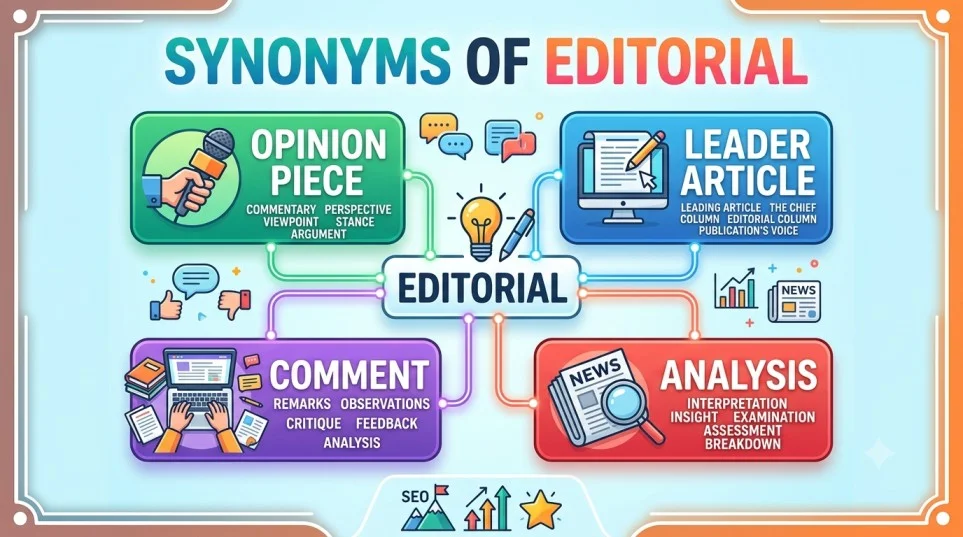
We can group our 30 synonyms into three categories:
- Opinion and Stance: Words like commentary, opinion, viewpoint, position, stance, assessment, and interpretation focus on feelings, beliefs, and taking a side.
- Publishing and Formats: Words like column, article, leader, write-up, piece, post, feature, and paper describe the actual layout, physical print, or digital format of the writing.
- Deep Analysis and Detail: Words like critique, review, essay, exposition, analysis, tract, monograph, and disquisition focus on highly detailed study, academic explanation, or formal research.
Dividing these words into groups helps writers choose the exact word they need. If you are writing a casual online blog, you should choose a word like post or commentary. If you are writing a serious, formal school paper, words like critique, assessment, or exposition will sound much better!
Antonyms of the keyword [editorial]
- Fact (Noun): A piece of information that is undeniably true and can be proven.
- News (Noun): Newly received objective information about recent events.
- Reportage (Noun): The reporting of news and facts without adding personal opinions.
- Objectivity (Noun): The state of being neutral, fair, and free from personal bias.
- Data (Noun): Facts, figures, and statistics collected together for analysis.
Short Questions and Answers
- What does “editorial” mean?
- It means a newspaper or online article that shares an official opinion rather than just stating raw facts. It also refers to the process of correcting and preparing written work for publishing.
- When should “editorial” be used?
- Use it when discussing news opinions, media teams, or when you are describing the work of polishing and proofreading texts.
- Is “editorial” positive or negative?
- It is neutral. However, it becomes positive when referring to high-quality, professional standards, and negative if someone accuses a factual news report of being too biased or preachy.
- How is it different from similar words?
- Unlike a regular news story, which must only state dry facts, an editorial is allowed—and expected—to take a strong side and try to persuade the reader.
Conclusion
Learning the word editorial and its 30 synonyms is a fantastic way to boost your English vocabulary. By replacing repetitive words with smart options like commentary, critique, or stance, you will make your writing and speaking sound far more professional and engaging. It helps you express your thoughts clearly, avoid boring repetition, and write with real confidence. Try using one of these new synonyms in your next conversation or school essay to see how much your English improves. Keep practicing every day, and happy writing!

I am a linguist with 7 years of experience in English language teaching, including postgraduate-level instruction. My expertise includes English grammar, and I contribute as a content and blog writer, producing scholarly and educational language resources.