Marie works in a small lab. Every morning, she puts on her white coat and checks her notes. Her neighbors call her a “scientist.” Marie tests ideas. She runs experiments. She looks for facts. This is what a scientist does: a scientist is a person who studies the natural world using tests and proof.
People use the word “scientist” every day. We hear in schools, on the news, and in movies. this is a simple word, but carries great respect. It tells us that someone works hard to find the truth.
Learning synonyms of scientists helps English learners and writers a lot. It stops your writing from sounding the same again and again. It also helps you sound more natural and skilled. Good writers know many words for one idea. This gives their sentences more life.
This article will explore the meaning of the word “scientist,” its history, its pronunciation, and many synonyms of scientist you can use every day. We will also look at grammar, word families, and real examples. By the end, you will know how and when to use each new word with confidence.
Meaning of Scientist
Definition
Scientist (Noun): A scientist is a person who studies science. This person uses tests, facts, and proof to understand the world. A scientist may work with plants, chemicals, space, animals, or numbers.
Examples
- The scientist studied the effects of sunlight on plants.
- A famous scientist discovered a new type of medicine last year.
Connotative Meaning
Connotation is the feeling or idea a word gives, beyond its plain meaning.
- Positive tone: The word “scientist” often brings feelings of trust, intelligence, and respect.
- Negative tone: In rare cases, it can suggest someone who is too serious or distant from normal life.
- Neutral tone: In most daily use, “scientist” is simply a job title with no strong feeling attached.
Etymology
- The word “scientist” comes from the Latin word scientia, which means “knowledge.”
- It was formed using the root scien- (to know) and the suffix -ist (a person who does something).
- The English word “scientist” was created in 1833 by William Whewell, a British scholar, to replace the older term “natural philosopher.”
Short History
- Old English (450–1100): The word “scientist” did not exist yet. People used terms tied to specific crafts or knowledge, not a general science title.
- Middle English (1100–1500): The Latin root scientia began appearing in English through French influence, mostly meaning “knowledge” or “learning.”
- Modern English (1500–Present): The word “scientist” was officially coined in 1833 and grew common through the 1800s and 1900s as science became a formal career.
Pronunciation (US & UK – IPA)
- US: /ˈsaɪəntɪst/
- UK: /ˈsaɪəntɪst/
Syllables
sci-en-tist
Affixation Pattern of Scientist
- Root: scien- (from Latin scientia, meaning “knowledge”)
- Prefix: none
- Suffix: -ist (meaning “a person who does or studies something”)
Word formation of “scientist”:
- Science (Noun) — the base subject of study
- Scientific (Adjective) — related to science
- Scientifically (Adverb) — done in a scientific way
- Scientist (Noun) — a person who studies science
A List of Best Synonyms of Scientist
1. Researcher (Noun)
US: /rɪˈsɜrtʃər/ | UK: /rɪˈsɜːtʃə/ Meaning: A person who studies a subject carefully to find new facts. Examples:
- The researcher spent five years studying ocean plastic.
- Every researcher in the team wrote a final report.
2. Scholar (Noun)
US: /ˈskɑlər/ | UK: /ˈskɒlə/ Meaning: A person with deep knowledge, often from years of study. Examples:
- The scholar gave a lecture on ancient history.
- She became a respected scholar in physics.
3. Expert (Noun)
US: /ˈɛkspɜrt/ | UK: /ˈekspɜːt/ Meaning: A person with special skill or deep knowledge in one area. Examples:
- He is an expert in climate science.
- The news asked an expert to explain the storm.
4. Specialist (Noun)
US: /ˈspɛʃəlɪst/ | UK: /ˈspeʃəlɪst/ Meaning: A person who focuses on one narrow subject or skill. Examples:
- She is a specialist in cell biology.
- The hospital hired a new specialist.
5. Analyst (Noun)
US: /ˈænəlɪst/ | UK: /ˈænəlɪst/ Meaning: A person who studies data closely to understand it. Examples:
- The analyst reviewed the test results.
- Our analyst found a pattern in the numbers.
6. Investigator (Noun)
US: /ɪnˈvɛstɪˌgeɪtər/ | UK: /ɪnˈvestɪɡeɪtə/ Meaning: A person who searches for facts to solve a problem. Examples:
- The investigator studied the cause of the illness.
- A lead investigator managed the research project.
7. Experimenter (Noun)
US: /ɪkˈspɛrɪˌmɛntər/ | UK: /ɪkˈsperɪmentə/ Meaning: A person who tests ideas through experiments. Examples:
- The experimenter mixed two chemicals carefully.
- She is a bold experimenter in her lab.
8. Technician (Noun)
US: /tɛkˈnɪʃən/ | UK: /tekˈnɪʃn/ Meaning: A person skilled in the practical, hands-on parts of science. Examples:
- The lab technician prepared the samples.
- A skilled technician fixed the microscope.
9. Academic (Noun)
US: /ˌækəˈdɛmɪk/ | UK: /ˌækəˈdemɪk/ Meaning: A person who teaches or studies at a university. Examples:
- The academic published a new study.
- Many academics attended the science fair.
10. Intellectual (Noun)
US: /ˌɪntəˈlɛktʃuəl/ | UK: /ˌɪntəˈlektʃuəl/ Meaning: A person who enjoys deep thinking and learning. Examples:
- The intellectual wrote books on evolution.
- He is known as a leading intellectual.
11. Savant (Noun)
US: /sæˈvɑnt/ | UK: /ˈsævənt/ Meaning: A person with unusually deep knowledge or skill. Examples:
- The young savant solved the problem in minutes.
- She is a math savant.
12. Physicist (Noun)
US: /ˈfɪzɪsɪst/ | UK: /ˈfɪzɪsɪst/ Meaning: A scientist who studies matter, energy, and forces. Examples:
- The physicist explained how light travels.
- A famous physicist won the award.
13. Chemist (Noun)
US: /ˈkɛmɪst/ | UK: /ˈkemɪst/ Meaning: A scientist who studies chemicals and their reactions. Examples:
- The chemist mixed two clear liquids.
- She trained as a chemist in college.
14. Biologist (Noun)
US: /baɪˈɑlədʒɪst/ | UK: /baɪˈɒlədʒɪst/ Meaning: A scientist who studies living things. Examples:
- The biologist studied frogs in the swamp.
- A marine biologist tracks whale movement.
15. Theorist (Noun)
US: /ˈθiərɪst/ | UK: /ˈθɪərɪst/ Meaning: A person who builds ideas to explain how things work. Examples:
- The theorist proposed a new model of the universe.
- He is a well-known theorist in economics.
16. Inventor (Noun)
US: /ɪnˈvɛntər/ | UK: /ɪnˈventə/ Meaning: A person who creates new tools, machines, or ideas. Examples:
- The inventor built the first working model.
- She became a famous inventor.
17. Innovator (Noun)
US: /ˈɪnəˌveɪtər/ | UK: /ˈɪnəveɪtə/ Meaning: A person who introduces new methods or ideas. Examples:
- The innovator changed how vaccines are made.
- He is an innovator in green energy.
18. Pioneer (Noun)
US: /ˌpaɪəˈnɪr/ | UK: /ˌpaɪəˈnɪə/ Meaning: A person who is first to explore or develop a new field. Examples:
- She was a pioneer in space research.
- The pioneer opened new paths in medicine.
19. Thinker (Noun)
US: /ˈθɪŋkər/ | UK: /ˈθɪŋkə/ Meaning: A person who thinks deeply and carefully about ideas. Examples:
- The thinker questioned old scientific beliefs.
- He is a clear, careful thinker.
20. Professor (Noun)
US: /prəˈfɛsər/ | UK: /prəˈfesə/ Meaning: A senior teacher and researcher at a university. Examples:
- The professor led the new study.
- Her professor praised her research.
21. Lecturer (Noun)
US: /ˈlɛktʃərər/ | UK: /ˈlektʃərə/ Meaning: A person who teaches and explains a subject formally. Examples:
- The lecturer discussed climate change today.
- A guest lecturer joined the science class.
22. Boffin (Noun)
US: /ˈbɑfɪn/ | UK: /ˈbɒfɪn/ Meaning: An informal British word for a scientist or expert. Examples:
- The boffin built a strange new gadget.
- Local boffins solved the tricky puzzle.
23. Empiricist (Noun)
US: /ɛmˈpɪrɪsɪst/ | UK: /emˈpɪrɪsɪst/ Meaning: A person who believes knowledge comes from testing and observation. Examples:
- The empiricist trusted only proven results.
- She studied as a strict empiricist.
24. Observer (Noun)
US: /əbˈzɜrvər/ | UK: /əbˈzɜːvə/ Meaning: A person who watches something closely to learn from it. Examples:
- The observer recorded the animal’s movements.
- A trained observer noted every change.
25. Discoverer (Noun)
US: /dɪˈskʌvərər/ | UK: /dɪˈskʌvərə/ Meaning: A person who finds something new for the first time. Examples:
- The discoverer of the star shared her findings.
- He became known as the discoverer of the cure.
26. Engineer (Noun)
US: /ˌɛndʒɪˈnɪr/ | UK: /ˌendʒɪˈnɪə/ Meaning: A person who designs and builds machines, tools, or systems. Examples:
- The engineer built the new bridge design.
- She works as a software engineer.
27. Mathematician (Noun)
US: /ˌmæθəməˈtɪʃən/ | UK: /ˌmæθəməˈtɪʃn/ Meaning: A person who studies numbers, patterns, and equations. Examples:
- The mathematician solved the old problem.
- A skilled mathematician checked the data.
28. Naturalist (Noun)
US: /ˈnætʃərəlɪst/ | UK: /ˈnætʃrəlɪst/ Meaning: A person who studies plants, animals, and nature. Examples:
- The naturalist photographed rare birds.
- She trained as a young naturalist.
29. Polymath (Noun)
US: /ˈpɑliˌmæθ/ | UK: /ˈpɒlimæθ/ Meaning: A person with wide knowledge in many different fields. Examples:
- The polymath studied art, math, and biology.
- He is remembered as a true polymath.
30. Egghead (Noun)
US: /ˈɛgˌhɛd/ | UK: /ˈeghed/ Meaning: An informal, playful word for a very intelligent person. Examples:
- His friends jokingly called him an egghead.
- The egghead fixed the code in seconds.
Prototype Meaning
When most people hear the word “scientist,” they picture a person in a white coat, working in a lab, holding a test tube or a notebook. This is the prototype image. It shows careful thought, testing, and discovery. Not every scientist fits this picture, but it is the first idea that comes to mind for most people.
Prototype Categorization
Grouping the synonyms of scientist helps writers pick the right word for the right moment.
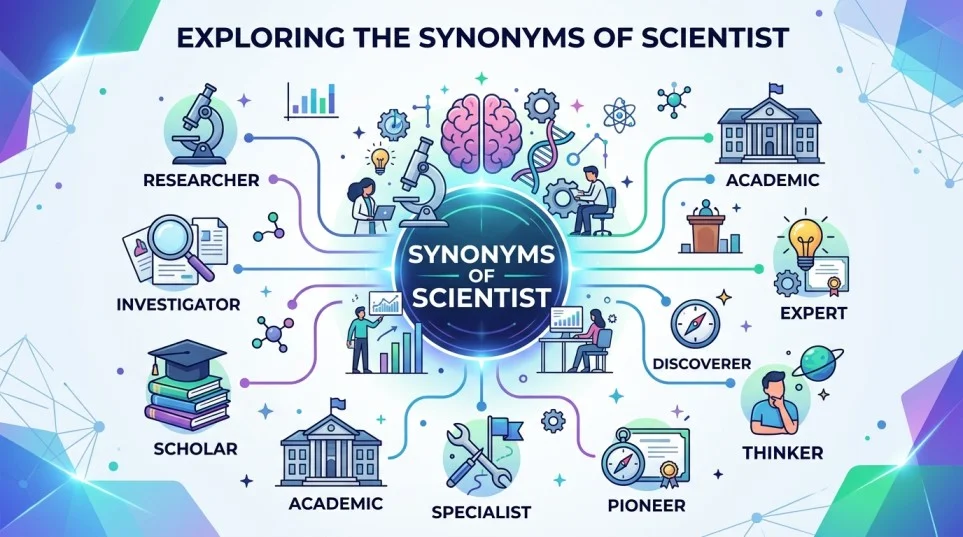
- General research roles: researcher, investigator, analyst, observer
- Academic roles: scholar, academic, professor, lecturer
- Subject specialists: physicist, chemist, biologist, mathematician, naturalist
- Creative and forward-thinking roles: inventor, innovator, pioneer, discoverer
- Deep-thinking roles: intellectual, thinker, theorist, empiricist, polymath
- Informal or casual terms: boffin, egghead, savant
This kind of grouping helps writers choose the best word based on tone, setting, and meaning. A formal report may need “researcher” or “academic,” while a casual story may use “boffin” or “egghead.” Knowing these categories makes writing sharper and more accurate.
Antonyms of Scientist
- Layperson (Noun): A person without special training or knowledge in science.
- Amateur (Noun): A person who does something without professional skill or training.
- Novice (Noun): A person who is new and has little experience in a field.
- Ignoramus (Noun): A person who lacks basic knowledge or understanding.
Short Questions and Answers
- What does scientist mean? A scientist is a person who studies the natural world using tests, facts, and proof.
- When should scientist be used? Use “scientist” when talking about someone whose main job is scientific study or research.
- Is scientist positive or negative? The word is mostly positive or neutral. It shows respect for knowledge and hard work.
- How is it different from similar words? “Scientist” is a general term, while words like “chemist” or “biologist” name a specific type of scientist. Words like “boffin” are informal, and words like “scholar” focus more on study than testing.
Conclusion
Learning the word “scientist” and its many synonyms opens new doors for any English learner or writer. It improves your vocabulary and helps you speak and write with more color and precision. Using different synonyms of scientist also helps you avoid saying the same word again and again in your writing. This makes your work sound more skilled and natural.
Over time, this kind of practice builds real confidence in English. Try using one new synonym each day in a sentence. Small steps like this lead to strong, lasting vocabulary growth. Keep practicing, and your English will keep improving.

I am a linguist with 7 years of experience in English language teaching, including postgraduate-level instruction. My expertise includes English grammar, and I contribute as a content and blog writer, producing scholarly and educational language resources.