Imagine you are traveling through the wide rolling green hills of Ireland, passing small peaceful farms, before finally crossing into a new land with its own capital city, distinct government, and unique local customs. You want to write a story about your trip, but you find yourself using the word country over and over again. Soon, your writing feels dry, simple, and plain.
The word country is extremely common because it covers many ideas, ranging from a sovereign global nation to peaceful rural land. However, using the same word repeatedly weakens your writing and limits your expression. Learning synonyms for country is essential for English language learners, students, and SEO content writers who want to expand their vocabulary and communicate with precision.
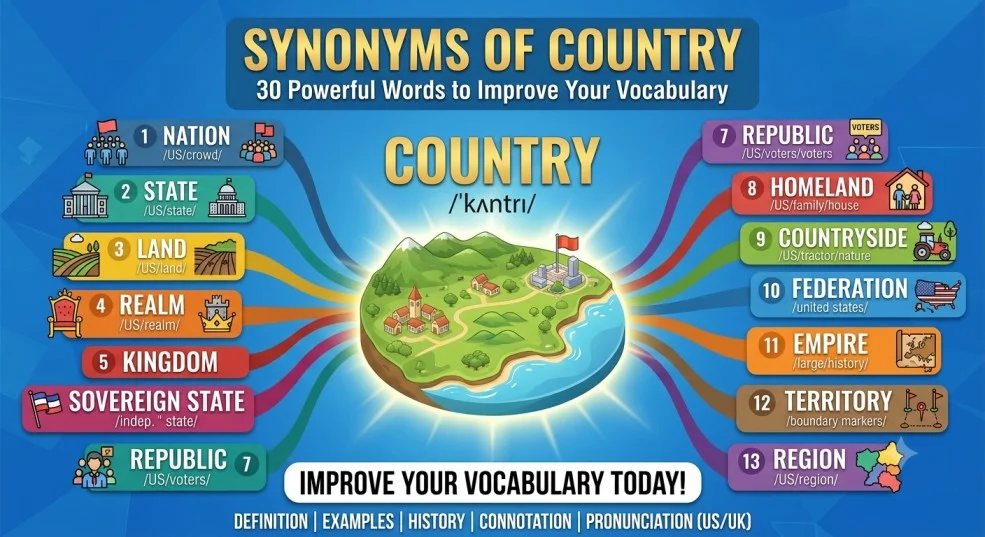
This comprehensive guide breaks down the exact meaning of the word country, exploring its formal definition, real-world example sentences, emotional connotations, history, pronunciation, and full affixation patterns. Additionally, we examine thirty powerful synonyms complete with US and UK pronunciations, simple definitions, and natural examples. Finally, this article organizes these terms into easy categories, contrasts them with antonyms, and answers frequently asked questions to make your vocabulary practice fast, clear, and effective.
Meaning of Country
Definition
country (noun / adjective): A distinct political nation with its own government and territory, or an area of open land outside of big cities and towns.
Examples
- France is a beautiful country with a rich history, vibrant culture, and world-famous cuisine.
- After living in the busy city for ten years, they decided to buy a quiet house in the open country.
Connotative Meaning
(Connotation refers to the emotional feeling, idea, or tone that a word carries beyond its literal dictionary definition.)
- Positive tone: Evokes peaceful pictures of nature, fresh air, green fields, community pride, and national unity.
- Negative tone: Can sometimes suggest an area is isolated, underdeveloped, simple, or far away from modern city services.
- Neutral tone: Acts as a plain, factual label for a geopolitical state or a specific geographic region on a map.
Etymology
- Source Language: Derived from Middle English contre or contree, borrowed from Old French contree, which came from Vulgar Latin (terra) contrata, meaning “land lying opposite” or “land spread out before one”.
- Short History of the Word:
- Old English (450–1100): The word did not exist in Old English. The native Anglo-Saxon word used for land or territory was land or eorþe.
- Middle English (1100–1500): Introduced around the 13th century after the Norman Conquest as contre, meaning a region, local district, or native land.
- Modern English (1500–Present): Expanded to mean a politically independent nation-state as well as open rural farmland as opposed to dense cities.
Pronunciation
- US: /ˈkʌn.tri/
- UK: /ˈkʌn.tri/
Syllables
coun-try
Affixation Pattern of Country
- Root: country
- Prefix: None
- Suffix: None
Word Formation & Derivative Forms:
- Countries (noun): The plural form referring to multiple political nations.
- Countrified (adjective): Made to look, sound, or feel rural or rustic.
- Countryman (noun): A person who comes from the same national origin or rural area.
- Countrywide (adjective / adverb): Extending or happening throughout an entire nation.
- Country-ish (adjective): Having mild qualities or traits of the countryside.
A List of Foremost Synonyms of Country
1. Nation (noun)
US: /ˈneɪ.ʃən/ | UK: /ˈneɪ.ʃən/
Meaning: A large group of people united by common culture, history, or language under one government.
Examples:
- The leader addressed the entire nation during the evening broadcast.
- Many representatives met to sign the historical agreement between both nations.
2. State (noun)
US: /steɪt/ | UK: /steɪt/
Meaning: An organized political community living under one central system of government.
Examples:
- The treaty was officially signed by heads of state from all over the world.
- Education and healthcare are funded directly by the state.
3. Land (noun)
US: /lænd/ | UK: /lænd/
Meaning: A specific geographic region, nation, or homeland owned by a people.
Examples:
- He traveled across many distant lands to study rare wildlife species.
- She felt extremely happy to return safely to her native land.
4. Realm (noun)
US: /relm/ | UK: /relm/
Meaning: A kingdom or a domain ruled by a monarch or authority.
Examples:
- Peace and stability spread throughout the entire realm during her rule.
- Knights traveled far across the realm to defend the royal castle.
5. Sovereign State (noun)
US: /ˈsɑːv.rɪn steɪt/ | UK: /ˈsɒv.rɪn steɪt/
Meaning: An independent nation with full control over its own government and borders.
Examples:
- The island officially became a sovereign state after gaining full independence.
- Every sovereign state holds a single equal vote in the international council.
6. Republic (noun)
US: /rɪˈpʌb.lɪk/ | UK: /rɪˈpʌb.lɪk/
Meaning: A nation governed by elected representatives rather than a king or queen.
Examples:
- Citizens voted in large numbers to protect the democratic values of their republic.
- The newly formed republic drafted a fresh constitution for its people.
7. Kingdom (noun)
US: /ˈkɪŋ.dəm/ | UK: /ˈkɪŋ.dəm/
Meaning: A country or territory ruled directly by a king or a queen.
Examples:
- The ancient kingdom built tall stone walls to protect its capital city.
- Royal messengers rode on horses across the vast kingdom.
8. Territory (noun)
US: /ˈter.ə.tɔːr.i/ | UK: /ˈter.ɪ.tər.i/
Meaning: An area of land under the jurisdiction or political control of a state.
Examples:
- The explorer charted new coastal pathways across the unexplored territory.
- Border patrols guard the edges of the national territory day and night.
9. Fatherland (noun)
US: /ˈfɑː.ðɚ.lænd/ | UK: /ˈfɑː.ðə.lænd/
Meaning: The native country of a person’s ancestors or family lineage.
Examples:
- Soldiers swore to defend the safety and honor of their fatherland.
- He spoke with great passion and pride about the traditions of his fatherland.
10. Motherland (noun)
US: /ˈmʌð.ɚ.lænd/ | UK: /ˈmʌð.ə.lænd/
Meaning: The country where a person was born and raised.
Examples:
- She returned to her motherland after working abroad for twenty long years.
- The local songs honor the natural beauty and spirit of the motherland.
11. Homeland (noun)
US: /ˈhoʊm.lænd/ | UK: /ˈhəʊm.lænd/
Meaning: The native land where a person or group belongs.
Examples:
- Reflected in their stories was a deep longing to visit their original homeland.
- Many immigrants maintain strong ties with families living in their homeland.
12. Countryside (noun)
US: /ˈkʌn.tri.saɪd/ | UK: /ˈkʌn.tri.saɪd/
Meaning: Rural areas featuring open fields, forests, farms, and small villages.
Examples:
- We took a long, relaxing weekend drive through the rolling green countryside.
- Air quality in the open countryside is far cleaner than in central cities.
13. Province (noun)
US: /ˈprɑː.vɪns/ | UK: /ˈprɒv.ɪns/
Meaning: An administrative region or division within a larger country.
Examples:
- The northern province experienced heavy snowstorms throughout the winter.
- Local authorities in each province manage their own regional schools.
14. Domain (noun)
US: /doʊˈmeɪn/ | UK: /dəˈmeɪn/
Meaning: An area of land owned, ruled, or controlled by a single rule or leader.
Examples:
- The ruler expanded his political domain by forming trade alliances.
- Forest rangers protect all wild animals living within this protected domain.
15. Principality (noun)
US: /ˌprɪn.səˈpæl.ə.t̬i/ | UK: /ˌprɪn.sɪˈpæl.ə.ti/
Meaning: A small territory or nation ruled directly by a prince or princess.
Examples:
- Monaco is a famous coastal principality located in Southern Europe.
- Tourists visit the tiny principality to view its historic royal palace.
16. Empire (noun)
US: /ˈem.paɪər/ | UK: /ˈem.paɪər/
Meaning: A vast group of states or countries under a single supreme authority.
Examples:
- The Roman empire covered vast territories across Europe and North Africa.
- Historical trade routes connected distant regions across the ancient empire.
17. Commonwealth (noun)
US: /ˈkɑː.mən.welθ/ | UK: /ˈkɒm.ən.welθ/
Meaning: An independent nation or an association of self-governing states.
Examples:
- Member states met at the summit to promote trade across the commonwealth.
- The nation joined the international commonwealth to build stronger peace.
18. Region (noun)
US: /ˈriː.dʒən/ | UK: /ˈriː.dʒən/
Meaning: A defined area of land having distinct geographical or cultural traits.
Examples:
- Farmers in this sunny region produce high-quality olives and fresh fruits.
- Mountain paths cross through the most remote parts of the western region.
19. District (noun)
US: /ˈdɪs.trɪkt/ | UK: /ˈdɪs.trɪkt/
Meaning: A specific area of a country or city set aside for administrative use.
Examples:
- Construction workers started building a new school in the rural district.
- Officials surveyed land usage across every agricultural district.
20. Territory (Geographic) (noun)
US: /ˈter.ə.tɔːr.i/ | UK: /ˈter.ɪ.tər.i/
Meaning: A geographic area that belongs to or falls under a specific authority.
Examples:
- Mapmakers marked the precise outer boundary of the island territory.
- Wild wolves roam freely across vast stretches of untouched northern territory.
21. Polity (noun)
US: /ˈpɑː.lə.t̬i/ | UK: /ˈpɒl.ə.ti/
Meaning: An organized society, state, or political entity with a structured government.
Examples:
- Scholars studied how laws were made within the ancient Greek polity.
- Peaceful cooperation helped stabilize the newly established democratic polity.
22. Nation-State (noun)
US: /ˌneɪ.ʃənˈsteɪt/ | UK: /ˌneɪ.ʃənˈsteɪt/
Meaning: A sovereign state whose citizens share a single national culture and language.
Examples:
- Modern political maps consist mostly of defined, independent nation-states.
- Developing a unified currency helped strengthen the modern nation-state.
23. Soil (Poetic) (noun)
US: /sɔɪl/ | UK: /sɔɪl/
Meaning: A country’s territory or native land, used in formal or literary contexts.
Examples:
- Foreign dignitaries stepped off the airplane onto official national soil.
- He pledged to serve his country honorably while living on foreign soil.
24. Rural Area (noun)
US: /ˈrʊr.əl ˈer.i.ə/ | UK: /ˈrʊə.rəl ˈeə.ri.ə/
Meaning: Open land located outside big towns and urban city centers.
Examples:
- High-speed internet is currently being installed across every rural area.
- Life in a small rural area moves at a much slower and calmer pace.
25. Backwoods (noun)
US: /ˈbæk.wʊdz/ | UK: /ˈbæk.wʊdz/
Meaning: Remote, quiet, uncleared, or sparsely populated forest or rural land.
Examples:
- They built a cozy wooden cabin deep in the mountain backwoods.
- Spending weeks in the quiet backwoods helped him relax away from work.
26. Hinterland (noun)
US: /ˈhɪn.t̬ɚ.lænd/ | UK: /ˈhɪn.tə.lænd/
Meaning: The remote areas of a country away from the coast or main cities.
Examples:
- Rivers transport farm goods from the interior hinterland to sea ports.
- Small farming villages are scattered across the vast desert hinterland.
27. Federation (noun)
US: /ˌfed.əˈreɪ.ʃən/ | UK: /ˌfed.ərˈeɪ.ʃən/
Meaning: A group of states united under a central federal government.
Examples:
- Regional leaders met to discuss national security across the federation.
- Trade policies are regulated uniformly across all states in the federation.
28. Dominion (noun)
US: /dəˈmɪn.jən/ | UK: /dəˈmɪn.jən/
Meaning: A self-governing territory or land under a central sovereign power.
Examples:
- Historic maps show the full size and reach of the ancient king’s dominion.
- Settlers established small agricultural towns across the outer dominion.
29. Terrain (noun)
US: /təˈreɪn/ | UK: /təˈreɪn/
Meaning: The physical landscape features or geographical surface of a country.
Examples:
- Hikers struggled to walk across the rocky and steep mountain terrain.
- Vehicles with large tires were needed to navigate the muddy country terrain.
30. Outpost (noun)
US: /ˈaʊt.poʊst/ | UK: /ˈaʊt.pəʊst/
Meaning: A small, distant settlement or border station located far from main cities.
Examples:
- Guards protected the border from a small, isolated mountain outpost.
- Scientific research teams live together at a remote polar outpost.
Prototype Meaning
The prototype meaning of country refers to a clearly defined geopolitical nation with its own government, border, flag, and citizens. When people hear the word without extra context, they almost always imagine an independent sovereign state like Japan, Canada, or Brazil. Secondarily, people picture open green fields, farms, and quiet dirt roads far away from crowded urban cities.
Prototype Categorization
Grouping synonyms into specific categories helps writers pick the exact right word for their context:
- Political & Sovereign Entities: Nation, State, Sovereign State, Republic, Nation-State, Federation, Polity. Use these when writing formal, political, legal, or diplomatic content.
- Monarchical & Historical Realms: Kingdom, Realm, Empire, Principality, Dominion. Best used in history writing, fantasy stories, or discussions about royal territories.
- Emotional & Cultural Homelands: Homeland, Motherland, Fatherland, Soil, Land. Perfect for emotional speeches, personal memoirs, and stories about heritage.
- Rural & Geographic Landscapes: Countryside, Rural Area, Hinterland, Backwoods, Terrain, Outpost, Region, District, Territory, Province, Domain. Best for descriptive travel writing, nature articles, or contrasting quiet rural life with city living.
Categorizing words prevents awkward choices in writing. For example, calling a modern democratic nation a backwoods or calling a quiet farm a sovereign state would confuse readers.
Antonyms of Country
- City (noun): A large, densely populated urban town with modern buildings and centers of commerce.
- Metropolis (noun): A very large, busy, and important capital city or urban center.
- Urban Area (noun): A built-up region characterized by high population density, roads, and cities.
- Municipality (noun): A city, town, or local district with its own local incorporated government.
- Capital (noun): The primary city that serves as the official seat of government for a nation.
Short Questions and Answers
- What does country mean?
- It means an independent political nation with a government, or open rural land outside of big cities.
- When should country be used?
- Use it when discussing world geography, international travel, national laws, or peaceful farm life away from towns.
- Is country positive or negative?
- It is neutral by default, but it becomes positive when describing beautiful nature, or negative if implying a lack of modern facilities.
- How is it different from similar words?
- Country refers broadly to geographical land and political borders, whereas nation focuses on the people and culture, and state refers strictly to the governing body.
CONCLUSION
Mastering the word country alongside its thirty rich synonyms equips you with the vocabulary needed to express complex ideas effortlessly. Replacing overused terms with precise alternatives like sovereign state, homeland, countryside, or republic builds writing that is captivating, professional, and clear. Furthermore, understanding nuances in tone, historical origin, and regional pronunciations protects you from common writing errors and expands your reading comprehension. Practicing new vocabulary daily in writing and conversations is the fastest path toward gaining confidence in English.

I am a linguist with 7 years of experience in English language teaching, including postgraduate-level instruction. My expertise includes English grammar, and I contribute as a content and blog writer, producing scholarly and educational language resources.